Why a Bare Shaft Tunes Clean but Your Broadheads Still Plane
A bare shaft that tunes clean means your dynamic spine is close, but broadhead drift at distance usually points to front-of-arrow aerodynamics or balance, not a paper-tune problem; start by checking broadhead alignment, front weight, and vane clearance. Ignore it and fixed blades can plane several inches by 40 to 60 yards, even with a clean shaft match. This guide covers the main causes, the fastest checks, and the setup changes that usually fix broadhead drift.
A bare shaft that tunes clean means dynamic spine is close, but broadhead drift at distance usually points to front-of-arrow aerodynamics or balance, not a paper-tune problem; after confirming cam timing, start by checking broadhead alignment, front weight, and vane clearance. Fixed blades can sometimes plane several inches over roughly 40 to 60 yards, even with a clean shaft match. This guide covers the main causes, the fastest checks, and the setup changes that usually fix broadhead drift.
Why clean paper and bare shafts can still miss


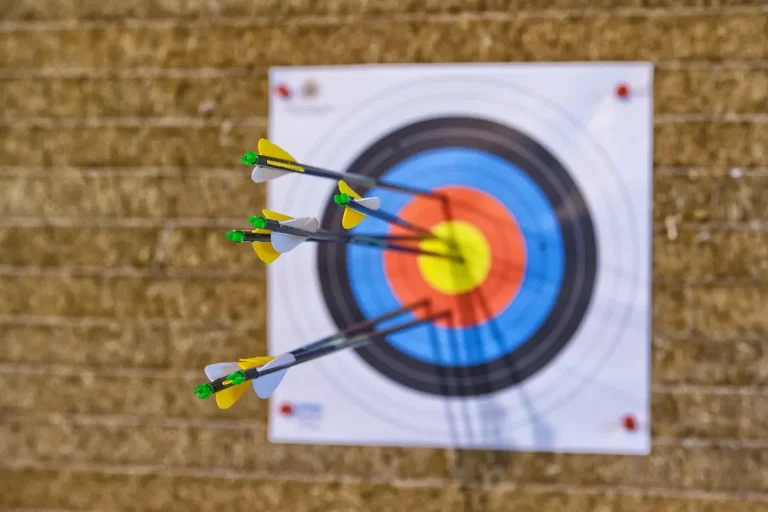
Paper tuning, bare shaft tuning, and broadhead tuning do different jobs. Paper is a close-range check at short distance from the paper, and the goal is a clean round bullet hole. Bare shaft tuning is an unfletched-arrow diagnostic, usually shot with fletched arrows at 20, 30, and 40 yards, to read dynamic spine and launch behavior. Broadheads are the final hunting-point check, and they are less forgiving than field points.
A clean paper tear and a clean bare shaft do not prove that the front of the arrow will fly the same way under blade drag. A field point is streamlined. A fixed blade is not. That extra drag can expose a small rest issue, a weak front end, a cam timing problem, or a build that is close on paper but still sensitive in real flight.
When the shaft and field point agree but the broadhead does not, the bow is often close enough for basic launch, yet not finished for hunting-point flight. That is why broadhead tuning belongs after paper and bare shaft work, not before it.
What each tune actually proves
Paper shows whether the arrow leaves the bow with a clean hole and without obvious tail-high, tail-low, or left-right tear. Bare shaft tuning shows whether dynamic spine and launch behavior are in the right zone. Walk-back tuning checks centerline drift. Broadhead tuning confirms the setup with the actual hunting point.
Where broadhead drag changes the read
A broadhead adds steering pressure to the front of the shaft. Fixed blades show that pressure most clearly, which is why they are the best final check for hunting setup. Mechanical broadheads usually act more like field points in flight, so they can hide a problem that fixed blades reveal. That difference matters in diagnosis.
Why field points can hide the issue
Field points rarely punish a small flaw the way broadheads do. A setup can paper tune clean, group bare shafts acceptably, and still show broadhead drift at distance because the point end is more sensitive to rest position, nocking point height, front-of-arrow mass, and tiny alignment errors.
What broadhead planing is telling you
Broadhead planing usually means the arrow is flying close, but the front end is still carrying a small correction problem. If a fixed blade drifts while a field point stays stable, the bow may have a last-step issue in rest position, nocking point height, cam timing, or arrow balance. Mechanical heads can be quieter diagnostically, so fixed blades are the sharper test.
Fixed-blade vs mechanical broadhead behavior
Fixed blades expose tune flaws faster because the blades act like steering surfaces. Mechanical heads open and often fly with less drag before deployment, so a bow can appear better with them than it really is for hunting. That is why a mechanical head is not the same diagnostic tool as a fixed blade.
Left-right drift and high-low drift
If broadheads strike left or right of field points, common first checks are centerline issues, spine reaction, or cam timing. The exact left-right read depends on handedness and the current tune, so use the pattern as a clue rather than a fixed rule. If they strike high or low, common first checks are nocking point, rest height, and arrow balance. A problem that shows only at distance is usually a setup issue, not aim.
When the issue is arrow flight, not aim
Aim error does not repeat the same way across distances. Broadhead planing often does. When the point of impact moves farther off line as distance grows, the arrow is telling you it is being steered in flight. That is the moment to stop guessing and move through a sequence.
Broadhead planing matrix
| Symptom | Likely cause | Confirming test | Safest next correction |
|---|---|---|---|
| Paper clean, bare shaft clean, fixed blade drifts left at 40 yards | Front-end steering from a stiff reaction, rest position, or minor cam timing issue | Yes on paper, yes on bare shaft match, then check walk-back drift at 20, 30, 40, 50 yards | Move rest in tiny increments; verify cam timing before changing shaft |
| Paper clean, bare shaft clean, fixed blade drifts right at distance | Weak front end, too much point mass, or a rest that is slightly off centerline | Compare broadhead and field-point groups, then confirm with walk-back tuning | Reduce point weight only if arrow weight stays above the hunting floor |
| Bare shaft hits high, broadhead also prints high | Low nocking point or rest height set too low | High bare shaft impact, then repeat at 20, 30, and 40 yards | Raise the nocking point in 1/16 inch steps |
| Bare shaft hits low, broadhead also prints low | High nocking point or rest height set too high | Low bare shaft impact, paper tear may stay acceptable | Lower the nocking point in 1/16 inch steps |
| Paper clean, bare shaft close, fixed blade wanders but mechanical stays tighter | Blade drag exposing a front-end or alignment flaw | Compare fixed blade to mechanical at the same distance and sight mark | Use fixed blade as the final check; correct rest, nocking point, or front-end mass |
| Changing point weight makes broadheads settle but arrow slows too much | Spine correction is being bought with too much front mass | Retest after the change and watch total arrow weight | Keep hunting build near 10 to 15 percent FOC and above 5 grains per pound of draw weight |
Do-no-harm checklist for hunting arrows
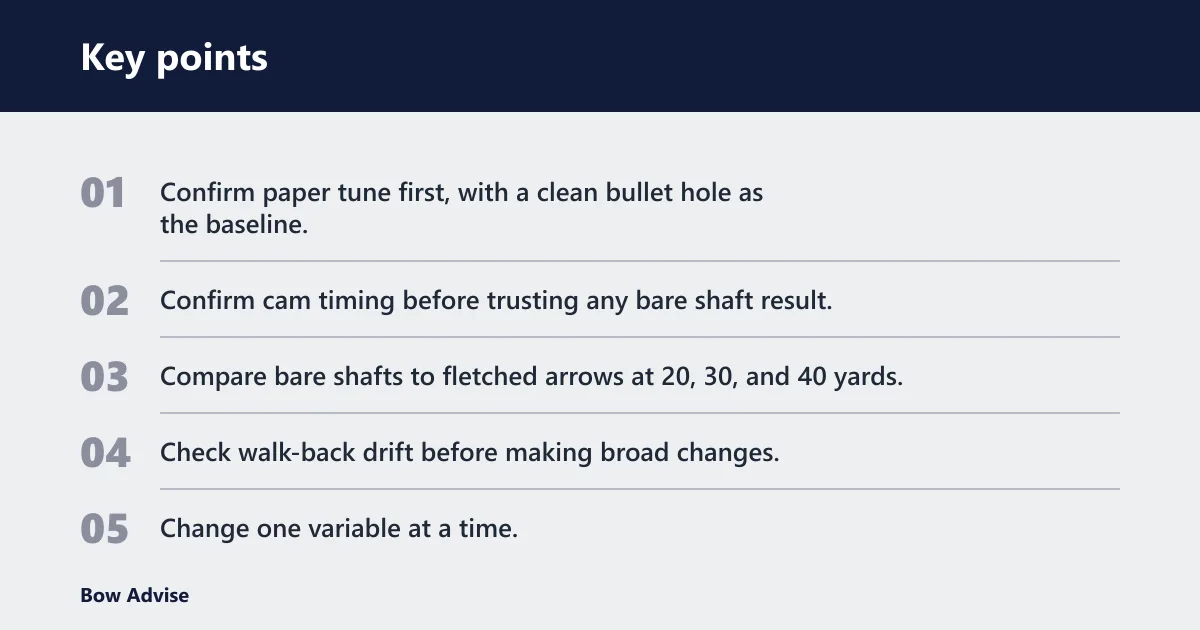
- Confirm paper tune first, with a clean bullet hole as the baseline.
- Confirm cam timing before trusting any bare shaft result.
- Compare bare shafts to fletched arrows at 20, 30, and 40 yards.
- Check walk-back drift before making broad changes.
- Change one variable at a time.
- Keep nocking point changes to 1/16 inch steps.
- Watch broadhead alignment and vane clearance after each change.
- Do not add point weight or cut shaft length without checking total arrow weight.
Paper tune, then confirm the next layer
Paper tune is useful, but it is not the end of the process. A clean bullet hole tells you the arrow is leaving the bow in a reasonably controlled way. It does not tell you whether the front of the arrow will stay stable after the broadhead starts steering.
If the tear is tail-high or tail-low, that points first to nocking point height or rest height. If it tears left or right, that can point to spine, center shot, or release interaction. The key is to fix the tear only enough to get to the next test. Do not stop at paper if the hunting point still drifts.
Reading bullet holes and tear shapes
A clean round bullet hole is the goal. Tail-high usually points to a low nocking point. Tail-low usually points to a high nocking point. Left-right tears can reflect dynamic spine or centerline issues. Those are clues, not a finish line.
Why a good paper tear is only the start
Paper is shot at close range, so it can miss issues that show up later. A bow can pass paper and still need bare shaft and broadhead confirmation. That is especially true with fixed blades, which read alignment problems that a field point may hide.
What to verify before chasing broadheads
Verify cam timing first. Then verify rest position and nocking point. After that, check whether bare shafts agree with fletched arrows at 20, 30, and 40 yards. Only then is broadhead tuning a meaningful final check.
What should I check first if broadheads drift left or right?
Check cam timing first, then rest position, then nocking point. A left or right broadhead drift often comes from centerline or spine issues, and untimed cams can make every other read unreliable. Walk-back tuning helps confirm whether the drift is a centerline problem or something deeper in the arrow build.
Cam timing before anything else
If cams are not in sync, the bow may launch the arrow in a way that mimics spine or rest error. That makes the rest of the diagnosis noisy. Some manufacturers consider cam timing acceptable before a final tune is complete, so timing still deserves a direct check.
Rest position and nocking point
Rest position affects centerline and vertical launch. Nocking point is the vertical reference, and it should be adjusted in 1/16 inch steps. High bare shaft impact points to a low nocking point. Low bare shaft impact points to a high nocking point.
Centerline drift from walk-back tuning
Walk-back tuning uses a vertical tape line on the target and shots at 20, 30, 40, and 50 yards. If the impact line walks sideways as distance grows, center shot or rest alignment needs attention. Make only tiny rest moves, then retest before moving farther. Large changes can erase useful information.
How do I know if the problem is arrow spine, rest position, or cam timing?
Start with the sequence. If cam timing is off, the rest of the read can be distorted. If timing is good, use bare shaft impact to separate spine from vertical issues, then use walk-back tuning to confirm centerline. Broadheads then verify whether the correction survives blade drag.
Dynamic spine is the actual flex
Dynamic spine is the arrow’s real flex under launch conditions. It is affected by point weight, draw weight, arrow length, cam aggressiveness, and brace height. The printed spine on the shaft only starts the conversation. The bow decides the final behavior.
Stiff or weak from bare shaft impact
For a right-handed archer, a bare shaft left of the fletched group can indicate a stiff arrow, while a bare shaft right of the fletched group can indicate a weak arrow. That read is most useful when the bow is timed and the comparison is made at 20, 30, and 40 yards.
Rest, nocking point, or shaft change
If the shaft is only slightly off, small rest or nocking point moves may be enough. If the bow wants a much different reaction, a spine change can be the better fix. That choice should come after the other checks, not before them.
How to use walk-back tuning in the sequence
Use walk-back tuning after paper and bare shaft checks, not before them. It confirms whether your center shot is tracking in line as distance increases. Shoot at 20, 30, 40, and 50 yards. If the line drifts, the bow still needs rest correction.
20 to 50 yard checks
The target uses a vertical tape line. Shots should stack on that line as distance increases. If the group angle changes, centerline is off. Walk-back is not a broadhead substitute. It is a centerline check that helps explain why broadheads may plane even when paper looks fine.
Tiny rest moves only
Move the rest in small steps. A tiny rest change can move both bare shaft and broadhead impact. Large jumps make it harder to tell whether the correction helped or simply moved the problem somewhere else.
What a moving impact line means
If impacts move farther from the line as distance grows, the bow is still steering the arrow off center. That can come from rest position, timing, or a spine choice that is close but not finished. A clean bare shaft does not cancel that possibility.
How spine and front-end mass change impact
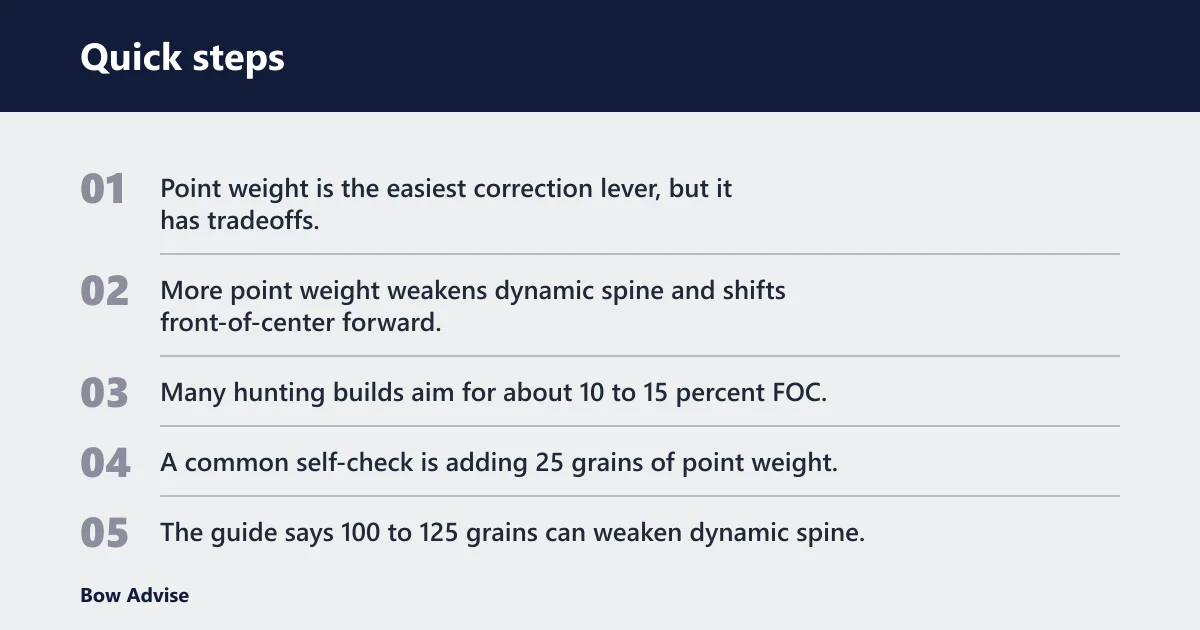
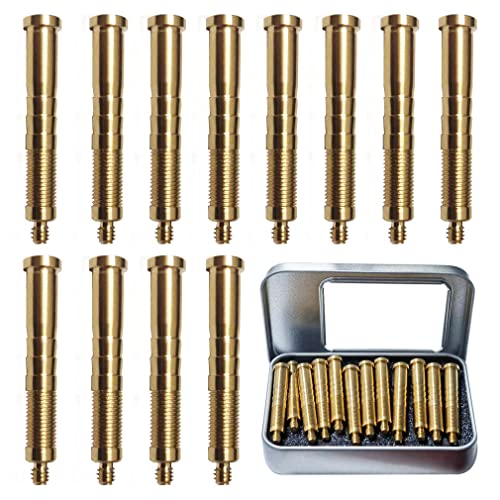
Point weight is the easiest correction lever, but it has tradeoffs. More point weight weakens dynamic spine and shifts front-of-center forward. Less point weight stiffens the reaction. Many hunting builds aim for about 10 to 15 percent FOC, but effective setups can fall outside that range, and the cited floor is 5 grains of total arrow weight per pound of draw weight.
Point weight as the easiest correction lever
A common self-check is adding 25 grains of point weight. The guide says 100 to 125 grains can weaken dynamic spine. That can help if the bare shaft is stiff or the broadhead is planing from a front-end mismatch.
Arrow length changes and spine reaction
Longer arrows act weaker. Shorter arrows act stiffer. Cutting shaft length can clean up broadhead flight, but it can also lower total arrow weight and push a hunting build too light. That tradeoff matters as much as the tune.
When a shaft change is the better fix
If point weight changes and rest adjustments do not settle the arrow, the shaft may simply be the wrong spine class. A shaft change is cleaner than forcing a bad build to behave with extreme point mass or a tiny rest workaround.
Say your bare shaft matches your fletched arrows at 30 yards, but a fixed blade prints six inches right at 40 yards. That points first to front-end drag, not a paper tear problem. A small rest correction or a modest point-weight change may settle it, but the fixed blade remains the final check.
Suppose the bow paper tunes clean and the bare shaft groups with the fletched arrows, yet the broadhead still opens a gap at 50 yards. That is a sign to recheck cam timing and walk-back drift before changing spine. A clean shaft read is helpful, but it does not cancel a timing or centerline issue.
Why does my bare shaft tune clean but my broadheads still plane?
A clean bare shaft means the arrow’s launch behavior and dynamic spine are close, but broadhead planing usually means one more issue survives the first two tests. Fixed-blade drag can expose minor rest position, nocking point, cam timing, or front-end mass errors that bare shafts and field points do not show as clearly.
FAQ short answer
If the bare shaft is clean and broadheads still plane, start with broadhead alignment and vane clearance, then verify timing, center shot, and front weight. That order is safer than changing spine immediately, because the problem may be a small setup error rather than the shaft itself.
Frequently asked questions
What causes broadheads to hit differently than field points after tuning?
Broadheads create more drag at the front of the arrow, so they expose small setup flaws that field points can hide. The most common causes are slight rest misalignment, cam timing issues, nocking point height, or front-end balance that is close for field points but not for blades.
Can a bow paper tune and still not broadhead tune?
Yes. Paper tuning only checks the launch at close range, and the target is a clean bullet hole. A bow can pass that test and still show broadhead drift because broadheads are more sensitive to steering, balance, and alignment.
Do bare shafts need to match fletched arrows at 20 yards and 30 yards?
They should be compared at 20, 30, and 40 yards. The point is not a single perfect impact hole. It is whether the bare shaft tracks with the fletched group across distance, which is a better read on dynamic spine and launch behavior.
Is a clean paper tear enough for hunting broadheads?
No. Clean paper is the starting point, not the hunting finish line. Broadheads are less forgiving than field points, so a bow can paper tune well and still need bare shaft, walk-back, and fixed-blade confirmation before it is ready for hunting points.
Should I change point weight, arrow length, or draw weight to fix planing?
Start with point weight, because it is the easiest correction lever. If that does not settle the tune, arrow length and draw weight can change dynamic spine too, but both have tradeoffs. Cutting shaft length can help tune and can also reduce total arrow weight.
What if my bare shafts and fletched arrows group together but broadheads still miss?
That usually means the remaining issue is at the front end or in alignment, not basic spine. Check fixed-blade alignment, vane clearance, rest position, cam timing, and walk-back drift. If changes are needed, make one at a time and retest with the same broadhead.