How Point Weight Affects Arrow Spine in Tuning and Accuracy
Heavier point weight weakens dynamic spine. A common tuning move is 10–20 grains heavier when you need the arrow to react less stiff; if bare shafts still hit right for a right-handed shooter, the point is one of the first variables to change. Get it wrong and groups open, broadheads plane, or the real tuning issue shifts elsewhere. This guide explains when heavier points fix spine and when they create a new problem.
What point weight changes in arrow spine


Point weight is measured in grains. In tuning, it changes dynamic spine, not the printed spine label on the shaft. Static spine is the shaft’s test rating; dynamic spine is how the full arrow behaves at launch after draw weight, arrow length, bow type, insert weight, and point weight are added together.
Lower spine numbers mean stiffer shafts. A 500 spine shaft sags half an inch in the standard test, and a 400 spine shaft deflects 0.400 inches under the standard test load. That stiff-versus-weak relationship matters because added front weight makes the arrow act weaker, not stiffer.
That is why point weight matters beyond broadhead choice. Add 25 grains of point weight and the arrow acts weaker. Move from a light field point to a heavier hunting head, and the arrow may tune differently even if nothing else changes.
Static spine vs dynamic spine
Static spine is the number printed on the shaft label. Dynamic spine is the result after the arrow is built and shot. A shaft can be stiff on paper but tune weak once a long arrow, heavy insert, and 125 grain head are installed.
That gap is why chart selection is only the starting point. The printed spine helps you get close. Point weight, insert weight, and arrow length decide whether the arrow leaves the bow acting stiffer or weaker than the chart suggests.
Point weight adjustment table
The table below shows a rough trend from front weight alone. Read it as a setup map, not a substitute for a manufacturer chart. Draw weight, arrow length, bow type, insert weight, and broadhead weight all stay in play.
| Front weight | 300 spine | 340 spine | 400 spine | 500 spine | 600 spine |
|---|---|---|---|---|---|
| 85 grains | stiff | slightly stiff | near neutral | slightly weak | weak |
| 100 grains | stiff | near neutral | slightly weak | weak | weaker |
| 125 grains | near neutral | slightly weak | weak | weaker | much weaker |
| 150 grains | slightly weak | weak | weaker | much weaker | extremely weak |
| 175 grains | weak | weaker | much weaker | extremely weak | far too weak |
Read the table as a trend line. In many setups, moderate front-weight changes can move the tune by about one spine group, but the exact shift depends on the full build.
Combined front weight is the real variable. Point weight, insert weight, and outsert weight add together. A 100 grain point on a brass insert does not behave like a 100 grain point on a light aluminum insert.
Suppose a setup starts with a 100 grain point, a standard insert, and a 400 spine shaft. Swapping to a 125 grain point may move the arrow enough to clean up a weak bare shaft. If the insert is already heavy, the same swap can push the shaft too weak instead.
How to read the table with insert and outsert weight included
Start with total front-end mass, not point weight by itself. Add the point, insert, and any outsert together. Then compare that total with your shaft’s spine group and your arrow length. A 175 grain point on a light insert can act differently from a 125 grain point on a brass insert.
That matters because heavy inserts can force a stiffer shaft selection. A brass insert plus a 125 grain broadhead can weaken a shaft noticeably. If the insert package is already heavy, adding more point weight may move the arrow past tune faster than expected.
Which setup inputs change the result most?
Draw weight and arrow length are the biggest starting inputs. Bow type and release style change how much forgiveness the arrow has at launch. Point weight, insert weight, and broadhead weight then push the dynamic spine weaker or stiffer around that starting point.
Draw weight and arrow length
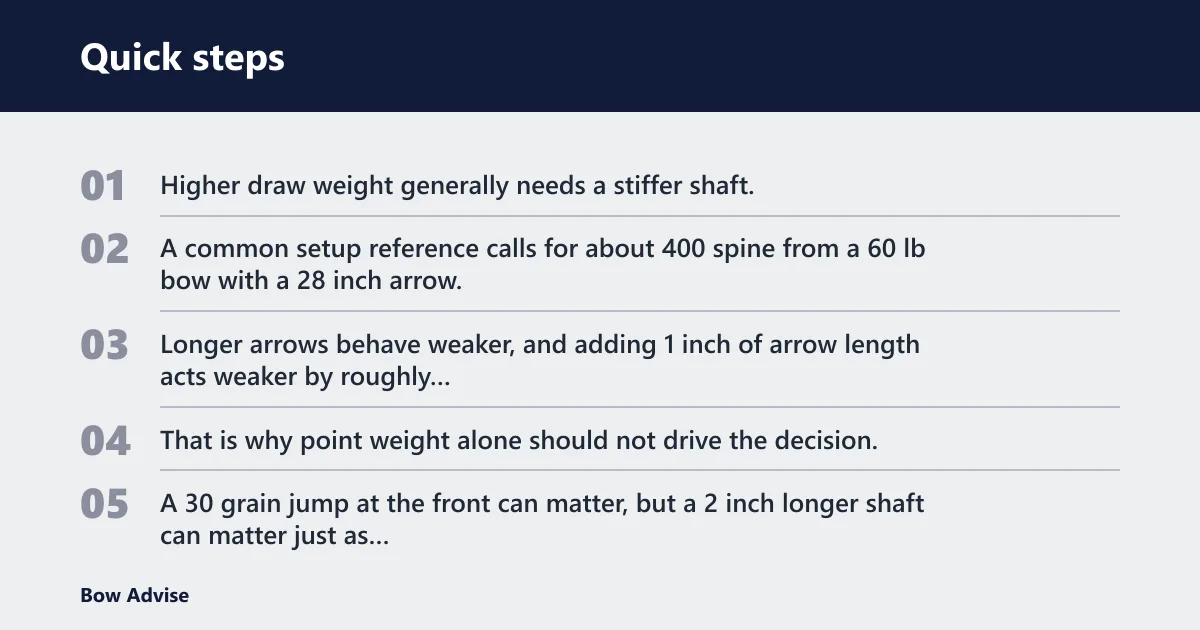
Higher draw weight generally needs a stiffer shaft. A common setup reference calls for about 400 spine from a 60 lb bow with a 28 inch arrow, and about 340 spine from a 70 lb bow with a 28 inch arrow. Longer arrows behave weaker, and adding 1 inch of arrow length acts weaker by roughly one chart step.
That is why point weight alone should not drive the decision. A 30 grain jump at the front can matter, but a 2 inch longer shaft can matter just as much or more.
Bow type and release style
Compound bows and recurve bows do not react the same way. A release aid usually needs a stiffer shaft than a finger-shot setup using the same draw weight and arrow length. Shoot fingers instead of a release and the setup generally needs a weaker shaft.
That difference is one reason recurve tuning feels less forgiving. Finger release adds more lateral flex at launch, so a point change that looks small on a compound can shift tune more on a recurve or traditional bow.
Insert weight and broadhead weight
Standard aluminum inserts are often light enough to stay near chart values. Brass inserts can add enough mass to change the spine decision before a point is ever installed. Broadhead weight matters the same way, because fixed-blade broadheads sit at the front and increase effective weak reaction.
A 125 grain broadhead on a brass insert is a very different setup from a 100 grain field point on a light insert. The first setup may need a stiffer shaft or a shorter arrow. The second may stay inside the intended spine group.
How many grains heavier can you go?
A 10–20 grain increase is a sensible first move when an arrow reads stiff and the chart says you are near the edge. If the arrow is already close to correct, that same change can solve the tune without changing shafts.
Past that, the risk rises fast. If the arrow is already borderline weak, a heavier point can push it into a new problem. Manufacturer spine charts should still come first, because the chart accounts for draw weight, arrow length, and often a starting point weight.
When a heavier point helps a stiff shaft
Heavier point weight helps most when the arrow is stiff on bare shaft, broadheads hit right for a right-handed shooter, or the shaft is behaving tighter than the chart predicts. In those cases, added front weight can bring dynamic spine closer to the bow’s launch impulse.
If the bare shaft stays right and the broadheads hit right, moving to 125 grains may move the reaction toward center without buying new shafts.
When the same change makes the shaft too weak
If the bare shaft already shows weak behavior, heavier front weight can make the issue worse. Broadheads may start to plane, paper tears can open in the weak direction, and the arrow may recover too slowly to group well at distance.
A common first-timer mistake is to add a heavy point to fix poor broadhead flight when the real issue is already weak dynamic spine. That swap can hide the problem for a few yards and then show it again when the arrow leaves the bow under hunting heads.
Does a heavier broadhead make the arrow weaker?
Yes. A heavier broadhead acts like added front-end mass, so the arrow behaves weaker. This is why broadhead weight cannot be treated as a separate purchase decision. It changes the tuning equation the same way a heavier point does.
The effect is strongest in fixed-blade hunting setups because the broadhead rides on the nose of the arrow and exposes the tune. If the shaft is stiff, broadheads may hit one direction and bare shafts another. If the shaft is weak, broadheads may plane or strike erratically as distance increases.
Broadhead weight, insert weight, and total front weight
Broadhead weight, insert weight, and outsert weight should be counted together. A 100 grain broadhead on a brass insert can behave more like a much heavier front package than the number on the head alone suggests. That is why two arrows with the same broadhead can tune differently.
The combined front weight also changes FOC, so the arrow may carry more front balance while becoming harder to tune. That tradeoff matters most on hunting arrows, where many archers aim for roughly 10 to 15 percent FOC or higher.
Front of center and tuning tradeoffs
Heavier front weight increases front of center. More FOC can help stabilize broadheads and improve some hunting setups, but it does not cancel a bad spine choice. If the shaft is too weak or too stiff, extra FOC will not fix the launch problem by itself.
That is the key tradeoff. Higher FOC can help the arrow carry forward balance, but it also adds pressure to the spine. The setup may look better on paper and still tune poorly if the arrow length, draw weight, and front weight are mismatched.
A heavier hunting front end can be useful when the spine is already close and the goal is more FOC plus acceptable flight. It is a poor fix when the shaft is far off. A 175 grain front on a 600 spine shaft is a very different problem from a 100 grain front on a 340 spine shaft.
Retune after a point swap
After any point change, retune in the same order each time. Paper tune first to check launch quality. Then shoot bare shafts, usually at about 20 yards, to see how the shaft actually reacts. Finish with broadhead confirmation.
- Install the new point weight and confirm the total front mass, including insert or outsert.
- Paper tune the bow to check for weak or stiff launch signs.
- Shoot bare shafts at about 20 yards and compare impact to fletched arrows.
- Move to broadhead checks and watch for planing or left-right separation.
- Only after the shaft tunes should you build the full set to the same spec.
Paper tuning catches launch issues early. Bare shaft tuning confirms whether the chart-based spine choice still fits the actual arrow. Broadhead tuning is the final check because fixed blades reveal weak or stiff behavior that field points can hide.
Say your compound is set up with a 340 spine arrow, a 100 grain point, and a standard insert. If the bare shaft is stiff, moving to a 125 grain point may bring it closer to tune. If broadheads then hit weak, the total front weight is probably too high for that shaft length and draw setup.
Frequently asked questions
How does point weight change arrow spine?
Point weight changes dynamic spine by adding mass to the front of the arrow, which makes the shaft behave weaker at launch. Static spine does not change, but the bow sees the whole system. Around 25 to 30 grains of added point weight is often enough to move one spine group.
How many grains heavier can my point be before I need a stiffer shaft?
There is no single cutoff, but a useful rule is that 25 to 30 grains heavier can shift about one spine group. If your arrow is already near the weak side, even a 10 to 20 grain increase can matter. Always compare the change against draw weight, arrow length, and insert weight.
Does a heavier broadhead make an arrow act weaker?
Yes. A heavier broadhead adds front-end mass and makes the arrow act weaker. Fixed-blade broadheads show this clearly because they expose the tune. A heavier head on top of a heavy insert can move the setup several spine groups weaker if the shaft was already close to the edge.
How does point weight affect paper tuning and bare shaft tuning?
Heavier point weight can change paper tears and bare shaft impact because it changes dynamic spine. A shaft that was clean with a 100 grain point may show weak behavior with a 125 or 150 grain point. That is why paper tune should be repeated after any front-weight change.
Can I fix a stiff arrow by changing point weight instead of buying new shafts?
Sometimes. If the arrow is only slightly stiff, adding 10 to 25 grains at the front can bring it into tune. If the shaft is far from the correct group, point weight alone will not solve it. In that case, a different spine or a shorter arrow is the better fix.
Does point weight matter more on a recurve than a compound?
Often, yes. Finger-shot recurve setups are usually less forgiving and generally need a weaker shaft than a release-shot compound with the same draw weight. That means point weight changes can move the tune more noticeably on a recurve, especially when arrow length and brace height are also part of the setup.