How to Choose Arrow Spine for Heavy Draw Weight Bows
Choose arrow spine from actual draw weight at full draw, then correct for arrow length and point weight. On heavy-draw bows, start 10–20 spine points stiffer than the chart’s baseline. Skip those corrections and arrows can plane, group poorly, or break on release. This guide explains how to measure real draw weight, adjust for shaft length and point weight, and use charts without buying the wrong spine.
Static versus dynamic spine on heavy draw weight bows
Arrow spine is the shaft’s stiffness rating. Lower spine numbers mean a stiffer shaft, and the number comes from a static deflection test. A 500 spine shaft deflects half an inch in the standard test, while a 340 spine shaft is stiffer than a 500 spine shaft. Heavy bows need stiffer arrows because launch load is higher.
Static spine versus dynamic spine
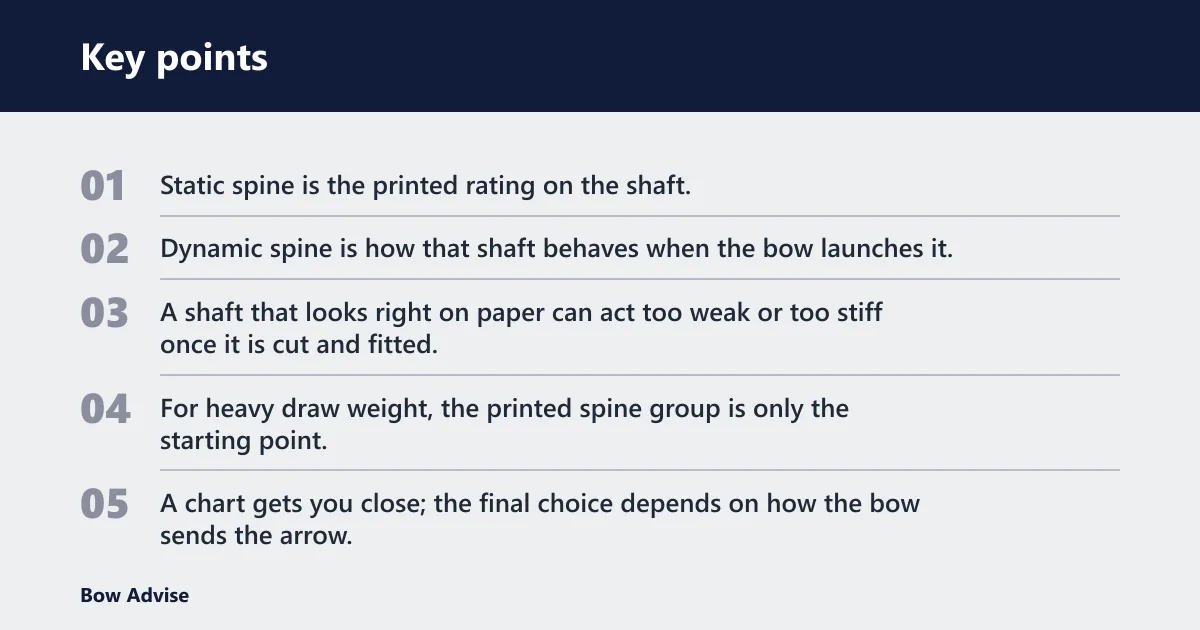
Static spine is the printed rating on the shaft. Dynamic spine is how that shaft behaves when the bow launches it, and that behavior changes with draw weight, arrow length, point weight, bow type, and release style. A shaft that looks right on paper can act too weak or too stiff once it is cut and fitted.
For heavy draw weight, the printed spine group is only the starting point. A chart gets you close; the final choice depends on how the bow sends the arrow, not just the label on the box.
How much draw weight should you use?
Use the actual draw weight at full draw, measured on a bow scale, not the number printed on the limbs. For compounds, peak draw weight happens before letoff, while holding weight at full draw is much lower. For heavy bows, actual draw length matters because spine requirements shift about one group per 10 pounds of draw weight.
Measure actual draw weight on a bow scale
That matters more than the bow label, especially on compounds with aggressive cams and letoff. If a bow is labeled 70 pounds but scales lower at the archer’s actual draw length, the arrow may not need the same spine as a true 70-pound setup.
Say a bow is labeled 70 pounds, but the archer’s draw length is shorter than the setup the chart assumes. The arrow may behave closer to a lighter bow, so starting spine can change one group in either direction once the real draw is measured.
Use real draw length, not the label on the bow
Draw length changes spine demand because it changes both stored energy and how much shaft remains in front of the rest. Rose City advises going up one spine group per inch over 30 inches of draw length. That is a useful heavy-bow warning sign, not a substitute for the chart.
For a long-draw archer, a 60-pound bow at 31 inches can call for a stiffer shaft than the same labeled bow at 28 inches. The label alone does not tell the whole story.
How arrow length and point weight change spine
Longer arrows act weaker dynamically, and cut length matters before you order a dozen shafts. Each additional inch of arrow length weakens dynamic spine by roughly one group. Heavier points also soften spine; about 25 to 30 grains more point weight can soften spine by one group, and heavier heads require going up in spine weight.
Why longer shafts behave weaker
The farther the shaft sticks past the front of the bow setup, the more it flexes on launch. That is why full-arrow length matters before ordering. If you plan to leave arrows long for safety or future draw-length growth, build that into the spine choice before you buy.
Suppose a setup looks perfect with a 28-inch shaft, then the archer leaves it at 29.5 inches for broadhead clearance. That extra length weakens dynamic spine and can turn a close chart match into a weak arrow problem.
How broadheads and brass inserts add demand for stiffer shafts
Broadheads and heavy inserts both move mass forward. A 100 to 125 grain point is a common baseline, but a heavier hunting head or brass insert can push the setup toward a stiffer shaft. A heavy point over about 150 grains should shift one column stiffer. A light point under 85 grains should shift one column weaker.
This matters most on heavy bows because the arrow is already under more launch stress. The same shaft that tunes with a 100 grain field point may act weak once a 125 grain broadhead and brass insert are added.
Does bow type change the spine choice?
Yes. Compounds, recurves, and longbows do not launch arrows the same way. Harder or faster cams weaken effective spine because launch force is higher. Traditional bows and finger-release setups usually need different treatment than compounds, and a chart meant for one bow type should not be copied to the other without adjustment.
Compound bows and cam aggressiveness
More aggressive cams create more launch force. That means a compound may need a stiffer shaft than a milder cam at the same labeled draw weight. Peak weight also matters more than holding weight on compounds, because the arrow feels the stored energy released off the wall, not the relaxed holding number.
For a compound, start with actual measured draw weight, then correct for cam speed, arrow length, and point weight. That sequence avoids the common mistake of choosing spine from peak label alone.
Recurve and longbow setups
Recurve and longbow setups usually need a different spine path because there is no cam system to absorb or reshape the launch the same way. Finger release versus mechanical release also changes the tune. A finger-released recurve commonly needs a different shaft than a mechanical-release compound with the same poundage.
That is why a compound arrow spine chart should not be used unchanged for a recurve. The same number can be wrong once the release method and bow geometry change.
Heavy draw spine table
This table is a practical starting point for heavy-draw bows after you have measured actual draw weight, set the intended arrow length, and chosen the point weight. It is not a substitute for a maker’s chart or bare shaft tuning. Start here, then verify before buying a full dozen.
| Actual draw weight | Arrow length | 100 grain point | 125 grain point | 150+ grain point |
|---|---|---|---|---|
| 50 lb | 27-28 in | 500-450 | 500-500 | 450-400 |
| 50 lb | 29-30 in | 500-500 | 450-400 | 400-340 |
| 60 lb | 27-28 in | 450-400 | 400-340 | 340-300 |
| 60 lb | 29-30 in | 400-340 | 340-300 | 300-250 |
| 70 lb | 27-28 in | 400-340 | 340-300 | 300-250 |
| 70 lb | 29-30 in | 340-300 | 300-250 | 250-200 |
| 80 lb | 27-28 in | 340-300 | 300-250 | 250-200 |
| 80 lb | 29-30 in | 300-250 | 250-200 | 200-150 |
The table assumes a typical hunting-style setup with moderate insert weight. Move one step stiffer for harder cams, heavy inserts, or broadheads over about 150 grains. Move one step weaker only if the bow maker’s chart and your bare shaft results both support it.
Our picks by need
Best starting spine for a 55 lb compound: V TOWER digital bow scale

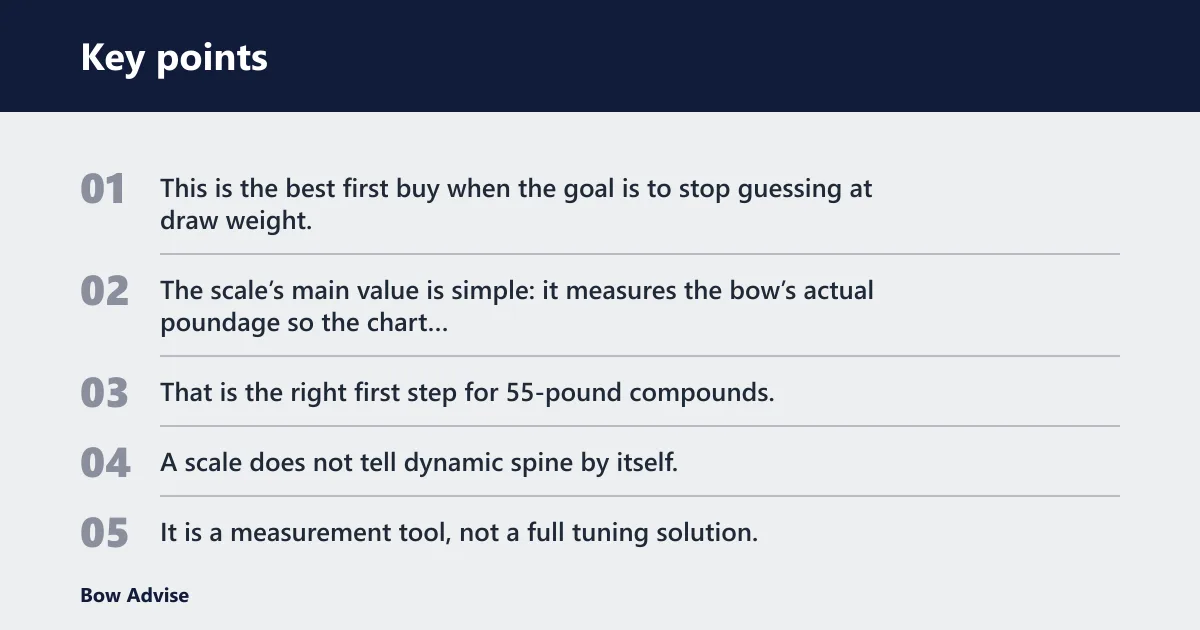
This is the best first buy when the goal is to stop guessing at draw weight. The scale’s main value is simple: it measures the bow’s actual poundage so the chart starts from a real number, not a label. That is the right first step for 55-pound compounds, especially with letoff and different draw lengths.
One drawback is clear. A scale does not tell dynamic spine by itself, so it cannot replace arrow-length and point-weight corrections. It is a measurement tool, not a full tuning solution.
Best starting spine for a 60 lb compound: V TOWER digital bow scale
For a 60-pound compound, this scale helps confirm whether the setup is truly a 60-pound bow at the archer’s draw length. That matters because the article’s 60 lb, 28 inch first-pass recommendation is 400 spine, and the real draw number should come before buying shafts.
The drawback is the same. It measures weight well, but it will not tell whether a 400 spine is right after a 29-inch shaft and a heavy head are added. Use it with a chart, not instead of one.
Best starting spine for a 45 lb recurve: HANDBAIGE arrow spine tester

This is the better fit when the focus is shaft selection and verification rather than draw-weight measurement. Based on the published product details, it is meant to compare shaft deflection across materials and can help sort stiff and soft arrows before final tuning. That is useful for recurve and longbow buyers who may compare several shaft options.
The drawback is cost and workflow. It is more specialized than a bow scale, and it still does not replace a bare shaft test at range. It helps with selection, but not with final tune confirmation.
Best starting spine for a 70 lb bow: V TOWER digital bow scale
A 70-pound bow is where measurement matters most. The article’s 70 lb, 28 inch first-pass recommendation is 400 spine, and the setup also needs at least 350 grains total arrow weight. A scale helps verify the actual poundage before the shaft choice is locked in.
The drawback is that it cannot predict weak-arrow symptoms by itself. Heavy-draw setups still need a chart check, then a bare shaft confirmation before a full dozen is ordered.
Mistakes to avoid
The biggest mistake is buying by draw weight alone. A 70-pound label does not tell the full story if the arrow is long, the point is heavy, or the bow is a hard-cam compound. The second mistake is ignoring point weight after the shaft choice. Heavy broadheads and brass inserts weaken dynamic spine.
Another common error is skipping bare shaft tuning before buying a full dozen. Confirm the chart choice at about 20 yards before committing to production arrows. And never start below the bow maker’s stated minimum arrow weight. Too-light arrows can damage bows, and compounds may face warranty risk if launched under the maker’s minimum.
A common first-timer mistake is cutting a shaft down later and expecting the tune to stay the same. Shortening the arrow stiffens it. If the setup was already close on the weak side, the change can hide the problem until broadheads start planing.
Arrow spine troubleshooting checklist
| Check | What to look for | Likely spine move |
|---|---|---|
| Arrow is long for the setup | Full-length shaft still protrudes farther than planned | Move stiffer |
| Point weight increased | Field point became broadhead, or brass insert was added | Move stiffer |
| Arrow was cut shorter | Same shaft now carries less front-end length | Move weaker if it became too stiff |
| Bare shaft impacts are inconsistent at 20 yards | Groups open up after setup changes | Recheck spine and tune |
| Bow maker’s minimum arrow weight is not met | Finished arrow is too light for the bow | Do not shoot until corrected |
| Cam is aggressive | Fast bow, hard wall, high stored energy | Start stiffer |
| Finger release on traditional bow | Arrow leaves the string differently than a release aid | Recheck with a recurve or longbow chart |
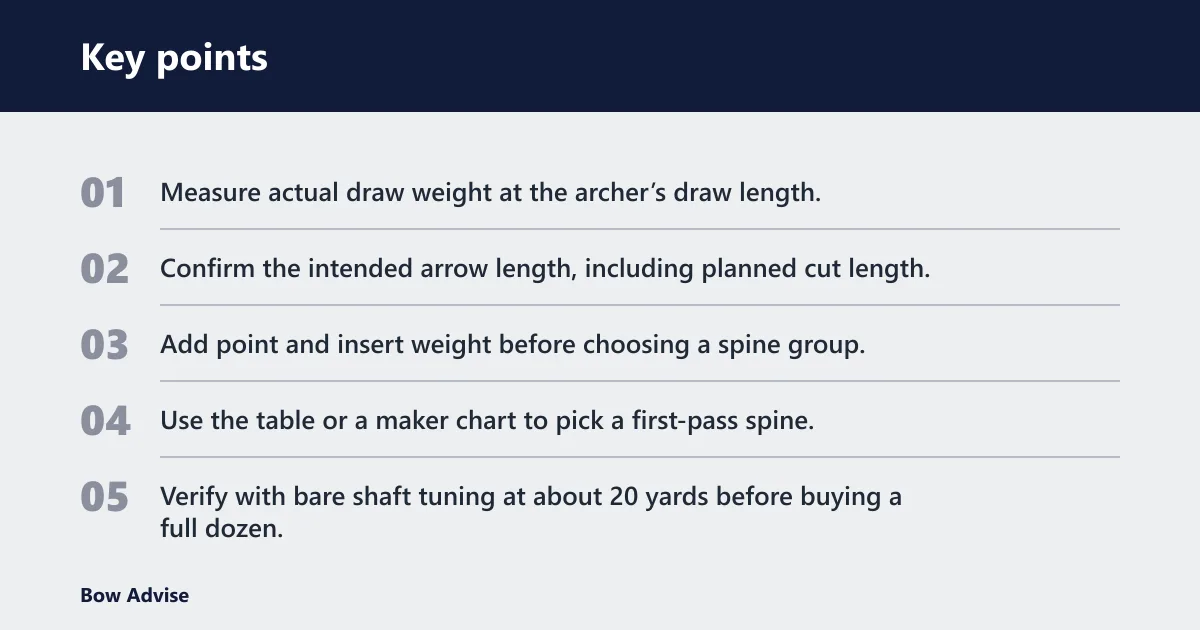
- Measure actual draw weight at the archer’s draw length.
- Confirm the intended arrow length, including planned cut length.
- Add point and insert weight before choosing a spine group.
- Use the table or a maker chart to pick a first-pass spine.
- Verify with bare shaft tuning at about 20 yards before buying a full dozen.
Frequently asked questions
What spine arrow for a 70 pound bow?
The article’s 70 lb guidance also notes at least 350 grains total arrow weight, with bow maker minimums still taking priority.
What spine arrow for a 45 lb recurve?
A 45 lb recurve usually starts weaker than a comparable compound because the bow type and finger release change the launch. A common starting range is 500 to 400 spine, then shift stiffer for long arrows or heavier points. Bare shaft tuning matters here more than a generic chart.
How does heavy draw weight change arrow spine?
Heavy draw weight increases spine requirement because the arrow leaves the string under more launch force. A useful starting rule is about one spine group for every 10 pounds of draw weight, then adjust again for arrow length, point weight, cam aggressiveness, and bow type.
Do I need stiffer arrows for a heavy point or broadhead?
Yes. Heavier points weaken dynamic spine, and broadheads often push the setup in the same direction. About 25 to 30 grains more point weight can soften spine by one group, and a heavy point over about 150 grains should shift one column stiffer before purchase is finalized.
Can I use a compound arrow spine chart for a recurve?
No, not as a direct substitute. Recurve and longbow setups use a different release behavior, and finger release changes the way the shaft flexes. A compound chart can be a rough reference, but recurve tuning should follow a recurve or traditional chart and then be confirmed with bare shafts.
How much arrow length affects spine selection?
Arrow length changes spine more than many buyers expect. Each additional inch of arrow length weakens dynamic spine by roughly one group, so leaving arrows long for safety or future growth should be planned before ordering. Cutting length later stiffens the shaft.
How do I know if my arrows are too weak for a heavy bow?
Too-weak arrows often show up after the chart choice, especially with long shafts or heavy points. The safest check is bare shaft tuning at about 20 yards. If the shafts stop behaving after a point-weight change or after shortening, the setup needs a spine reassessment before a full dozen is bought.
What spine should I buy for a 60 lb compound bow?
A 60 lb, 28 inch setup gets a first-pass recommendation of 400 spine in this guide. If the bow has aggressive cams, a longer shaft, or a heavy hunting head, the arrow may need to move stiffer. Measure actual draw weight first, then tune before ordering in bulk.