Which Arrow Spine Is Best for 20-Yard Target Practice?
For 20-yard recurve target practice, match arrow spine to your actual draw weight at your draw length; 20 yards itself does not change spine. A bad match can give poor grouping, a bare shaft that lands far off, and a setup that fights tuning instead of helping it. Start with the spine chart, then use point weight and shaft length only for fine tuning.
What arrow spine means for 20-yard shooting


Arrow spine is the shaft’s stiffness. Lower numbers are stiffer shafts. Easton says static spine is measured with a 29-inch arrow on 28-inch supports, and the number is the inches the arrow bends times 1,000. Dynamic spine is the way the arrow reacts when shot.
That split matters at 20 yards. A shaft can look right on paper and still leave the bow with a different reaction once point weight, shaft length, and actual bow weight are part of the setup. The target at 20 yards does not change the shaft. The shot reaction does.
Static spine vs dynamic spine
Static spine is the chart number on the shaft. Dynamic spine is the moving result after the string pushes the arrow. Easton identifies dynamic spine as how an arrow reacts when shot. That is why two arrows with the same label can behave differently once one is cut shorter or fitted with a heavier point.
For short-range target shooting, the common mistake is to think the distance causes bad flight. It usually does not. Distance only makes grouping errors easier to spot. The actual spine match is still set by the bow and arrow combination.
Why lower numbers mean stiffer shafts
Lower spine numbers are stiffer. A 400 shaft is stiffer than a 500, and a 500 is stiffer than a 600. That simple order is useful because most recurve selections start by deciding which band fits the bow weight, then refining from there with length and point weight.
Forum and selector references often use 400, 500, 600, 700, 800, 900, and 1150 bands. Those labels are only starting points. The real question is which band leaves enough room to tune without forcing the setup into a corner.
Why draw weight on the fingers matters most
Actual draw weight on the fingers matters more than the labeled limb weight. A recurve marked 32 lb does not tell the whole story, because draw length changes the real number. The spine chart should follow the measured bow weight at full draw, not the label printed on the limbs.
That point matters even more for recurve shooters because the arrow sees the draw at full draw, not the limb sticker. A shorter draw can lower the actual weight on the fingers. A longer draw can raise it. The shaft choice should follow that real number first.
How recurve shooters should think about setup first
Start with actual draw weight on the fingers, then add arrow length and point weight as corrections. Easton’s Target & Hunting Arrow Selector uses static spine chart logic for that reason. It is a better first pass than guessing from limb labels or from what someone else shoots at 20 yards.
- Measure the draw weight on the fingers at full draw.
- Note the arrow length, not just the shaft label.
- Pick the nearest spine band from a selector chart.
- Use point weight or shaft length only if the arrow sits between two bands.
Suppose a recurve is marked 34 lb, but the archer draws only to 27 inches and sees 31 lb on the fingers. That setup usually belongs closer to the 31 lb line than the 34 lb label. If the shaft choice starts from the label instead, the arrow can end up too stiff.
Which spine should you start with?
Start with the spine band that matches your actual draw weight on the fingers and your arrow length, then check the next softer and stiffer band only if the result sits near a boundary. Easton selector logic points to the same approach: pick the chart match first, then use point weight or cut length as the fine correction when the answer falls between bands.
For 20-yard target practice, the right start is not “softer because it is close range.” It is the shaft that fits the bow. A short-range group can hide a small mismatch, but it will not turn the wrong shaft into the right one.
Common spine bands and what they mean
These bands come up often in recurve discussions and selector charts:
- 400 and 500: stiffer choices for higher draw weight or longer arrows.
- 600 and 700: common recurve bands for lighter to mid-range setups.
- 800, 900, and 1150: softer shafts used for lighter bows or longer, weaker setups.
Another reply suggested 700 spine for a 35-pound recurve setup. Those replies line up with the same principle: match the bow weight on the fingers first, then refine.
Arrow spine sanity-check table
The table below gives a practical starting check for 20-yard recurve practice. Use it as a first pass, not as a final answer. If the result falls between two bands, the correction lever column shows the cleanest direction to move.
| Actual draw weight on fingers | Arrow length | Likely starting spine band | Best correction lever if borderline |
|---|---|---|---|
| 20-25 lb | 29 inches | 600 | Heavier point to weaken, shorter shaft to stiffen |
| 20-25 lb | 30-32 inches | 700-800 | Use a heavier point first if the arrow reads stiff |
| 26-30 lb | 29 inches | 500-600 | Cut a little shorter to stiffen, or add point weight to weaken |
| 31-35 lb | 28-29 inches | 500 | Move to 600 if the bare shaft lands weak, or shorten slightly if the shaft is too soft |
| 35+ lb | 28-29 inches | 400-500 | Use a lighter point if the shaft feels weak |
That matrix matches common chart logic, not a one-size answer. GOHUNT’s chart lists 30-35 lb at 28 inches as 500 spine. It also lists 20-25 lb at 29 inches as 600 spine. Those two lines show why draw weight and arrow length need to be read together, not separately.
Is 500 spine too stiff at 20 yards?
Not by distance alone. A 500 spine can be a normal choice at 20 yards if the actual draw weight and arrow length call for it. It becomes too stiff only when the bow weight is low enough, or the arrow is long enough, that the dynamic spine no longer matches the shot.
A 32 lb recurve with 29-inch arrows is a useful example. In one forum thread, that setup was charted around 600 spine, and 500 spine was described as too stiff. That does not mean 500 is always wrong at 20 yards. It means the bow weight on the fingers and the shaft length pointed softer than 500 for that setup.
When 500 spine is a normal choice
Choose 500 when the actual draw weight is in the range where the chart points there, or when the arrow is short enough that it acts weaker than the label suggests. A stiffer shaft can also make sense if the front end is heavy and the bow is pulling more weight than the limb label suggests.
Picture a shooter with a recurve that measures 34 lb on the fingers and 28-inch arrows. A 500 spine can be the ordinary starting point there. If the bare shaft still reads weak, the fix is usually to shorten the shaft a little or reduce point weight, not to guess a completely different spine band.
When 600 spine is the safer start
Use 600 as the safer first try when the actual draw weight is lower and the arrows are long. That is why long arrows often surprise shooters who focus only on bow label weight.
Another forum reply recommended Easton Vector 1400 for a 20-pound bow. That is a reminder that low draw weight usually needs a softer shaft, not a stiffer one. The exact band still depends on length and point weight, but the direction is clear.
How to fine-tune with point weight and shaft length
Heavier points make the arrow act weaker. Easton says reducing point weight can make an arrow act stiffer, and the reverse is also true: adding point weight weakens dynamic spine. Shortening the arrow also makes it act stiffer. Those two levers are the best small corrections when the shaft is close, but not clean.
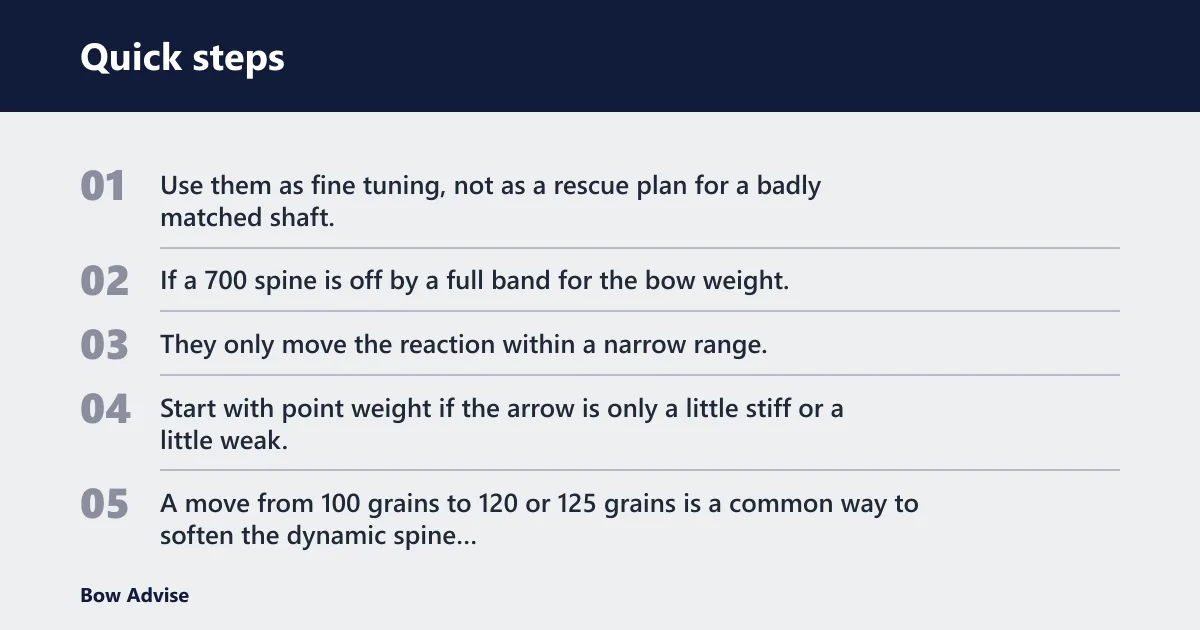
Use them as fine tuning, not as a rescue plan for a badly matched shaft. If a 700 spine is off by a full band for the bow weight, point changes will not make it a 500. They only move the reaction within a narrow range.
What to change first when groups sit close but not clean
Start with point weight if the arrow is only a little stiff or a little weak. A move from 100 grains to 120 or 125 grains is a common way to soften the dynamic spine without changing the shaft. If the arrow is already long, cutting a small amount from the rear is the cleaner stiffening move.
A common first-timer mistake is to blame 20-yard groups on spine when the shaft is only reacting to a small point-weight mismatch. If the group tightens at 10 yards but opens at 20, that can still be tuning noise. It becomes a real spine problem when the bare shaft stays clearly off and the paper tear or group shape points the same way shot after shot.
Indoor target setups are a separate case. Fat line-cutter arrows often use heavier front ends or different balance goals than casual 20-yard practice. That means the same spine band can be chosen for a different reason indoors than outdoors, even at the same distance.
Frequently asked questions
Is 500 spine too stiff for 20-yard target practice?
Not automatically. For 20-yard recurve shooting, 500 can be fine if the actual draw weight on the fingers and arrow length point there. It is too stiff only when the bow is lighter or the shaft is long enough that the dynamic spine does not recover cleanly.
What spine arrow should I use for a 20-yard target setup?
Start with the spine band that matches actual draw weight on the fingers and arrow length, not the target distance. Use the chart first, then tune with point weight.
Does short-distance target shooting need weaker spine?
No. Short distance does not require a weaker shaft by itself. The arrow still needs to match the bow weight at full draw. What changes at 20 yards is how easy it is to spot a group shape problem or a small tuning issue.
How does draw weight change arrow spine for recurve target archery?
Higher actual draw weight generally calls for a stiffer shaft, which means a lower spine number. Lower actual draw weight usually needs a softer shaft, which means a higher spine number. Because recurve draw length changes the weight on the fingers, the limb label is only a starting point.
What spine works for 29-inch arrows with a 32 lb recurve?
A common chart answer for 32 lb and 29-inch arrows is around 600 spine. One forum thread on that exact kind of setup also said 500 spine was too stiff. If the setup includes a heavier point, the arrow can act weaker, so 600 is often the safer start.
Should I use heavier points to tune stiff arrows for indoor target shooting?
Yes, but only as a fine-tuning move. Heavier points make the arrow act weaker, so they can help when the shaft is slightly stiff. If the spine is far off, point weight will not solve it. For indoor-style target arrows, the front end is part of the setup, not an afterthought.
Can I shoot 600 spine arrows at 20 yards without issues?
Yes, if the spine matches the bow weight on the fingers and the arrow length. A 600 shaft is not a 20-yard problem. It is a setup question. If the arrows group well and the bare shaft reaction looks sensible, the distance is not the issue.
Why do my arrows wobble at 20 yards but not 10 yards?
At 20 yards, small tuning errors show up more clearly. Wobble at that distance can be harmless tuning noise, especially if the group is still tight. It becomes a spine concern when the wobble comes with poor grouping, a clear bare-shaft mismatch, or a repeatable left-right impact pattern that stays the same.