Arrow spine for hunting broadheads: stiffness guide
For fixed-blade broadheads, I usually start one spine step stiffer than the chart if the setup is marginal, and I only stay on-chart when draw weight, arrow length, and point weight all sit in the middle of the range. A shaft that is too weak gives broadhead planing, lost penetration, and tuning problems that show up fast.
This guide is part of our Arrow Spine guide for archers series.
What you’ll need before you change spine
- Your bow’s draw weight, draw length, and cam type.
- Your arrow cut length, shaft model, and spine label.
- Insert or outsert weight, plus broadhead weight.
- Paper tuning setup.
- Bare shaft or field-point tuning setup.
- Fixed-blade broadheads for final confirmation.
- A target set at hunting distance, not only at very close range.
What arrow spine means for fixed-blade hunting
Static spine is the arrow maker’s stiffness number. Dynamic spine is how that shaft bends after your bow launches it. For hunting, dynamic spine matters most, because draw weight, arrow length, point weight, insert mass, and cam aggressiveness all change it.
Fixed-blade broadheads are less forgiving than field points because the blades steer the shaft. If the arrow is weak, the head can plane and drift off line. I’ve seen that show up as clean paper tears at close range and ugly broadhead groups at 40 yards.
Longer arrows bend more. Heavier points bend more. A heavier insert or outsert does the same because it adds front-end mass. I treat that front section as one system, not separate parts.
What I check before touching spine
- Measure cut carbon length from nock groove to end of shaft.
- Write down point weight, insert weight, and outsert weight.
- Note draw weight at your actual holding weight, not the label on the limb sticker.
- Confirm bow type and cam feel, because aggressive cams punish weak dynamic spine harder.
How stiff should my arrows be for fixed-blade broadheads?
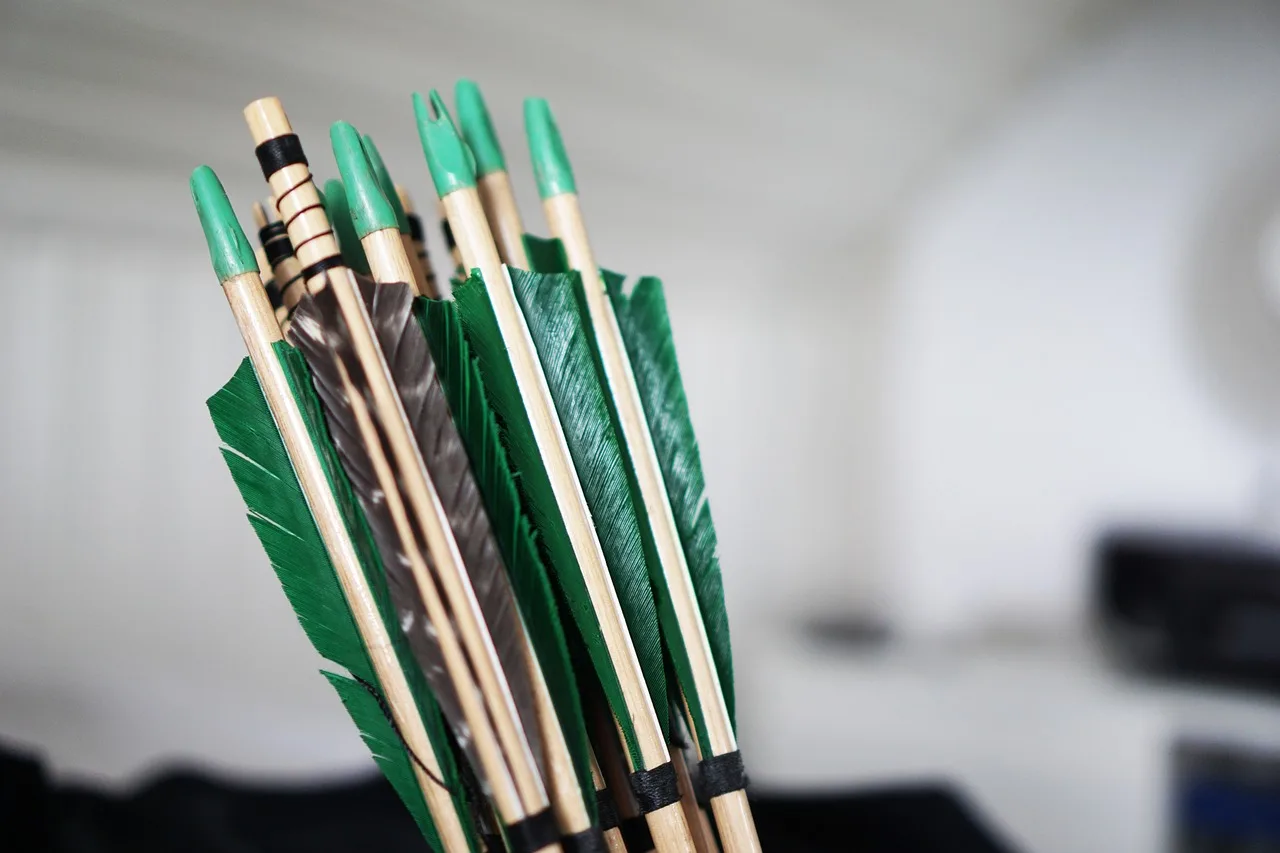
Start with the chart, then move one step stiffer if your setup is long, heavy in the nose, or shot from a hard cam system. I stay on-chart only when the bow is moderate, the arrow is not long, and the front end is not loaded with mass. That keeps tuning simple and keeps broadheads calmer at distance.
One spine jump is usually enough when you are near the edge of the chart, not far outside it. Two steps stiffer makes more sense when several weak-spine factors stack together: long shaft, heavy point, aggressive cam, or a hunter who wants field-point and broadhead groups to land together out past 40 yards.
Use this decision table to pick the right spine bump
| Setup pattern | Broadhead type | Recommended spine move | Tuning checkpoint |
|---|---|---|---|
| 55-60 lb draw, 27-28 in cut length, 100 gr total point system | Mechanical | Stay | Paper tune, then verify at 40 yd |
| 60-65 lb draw, 28-29 in cut length, 100-125 gr total point system | Fixed blade | One size stiffer | Bare shaft or broadhead at 20-30 yd |
| 65-70 lb draw, 29-30 in cut length, 125-150 gr total point system | Fixed blade | Two sizes stiffer | Walk-back plus broadhead at 40-60 yd |
| Moderate draw weight, short shaft, light front end | Mechanical | Stay | Paper tune can be enough |
| Any draw weight with long shaft and heavy insert/outsert stack | Fixed blade | One to two sizes stiffer | Test broadhead grouping at distance before hunting |
When to stay on your current spine
Stay when your bow is in the middle of its range, your cut length is not long, and your total front-end mass is ordinary for hunting. A mechanical broadhead also gives you more room here because it steers less. If field points and broadheads stack together at 40 yards, I would not force a stiffer shaft just because a chart says I might.
When one spine size stiffer is enough
Move one size stiffer when you have a fixed blade, a little extra point weight, or a shaft length that pushes the chart toward the weak side. This is the move I make most often. It gives me a little safety margin without turning the arrow into a brick that needs endless rest adjustments.
When two sizes stiffer makes more sense
Go two sizes stiffer when the bow is aggressive, the shaft is long, and the front end is heavy enough to bend the arrow hard at launch. That is common with high draw weight compounds, long hunting cuts, and broadheads over 100 grains plus heavy inserts. If you have already fought planing, this is the cleaner fix.
How does arrow length affect spine for broadheads?
Longer arrows act weaker because there is more shaft to flex during launch. Shorter arrows act stiffer because less shaft is bending. For broadhead hunting, even a small cut-length change can move you from forgiving to finicky, especially once you add a fixed blade and a heavy insert stack.
I like to measure real cut length, not the number printed on the box. That matters because two hunters can buy the same shaft and end up with different dynamic spine once each one cuts it for his draw length and sight setup.
Practical length rule
- If you add length, expect the arrow to behave weaker.
- If you shorten it, expect the arrow to behave stiffer.
- If you cannot shorten much, move to the next stiffer shaft before chasing rest changes forever.
How does point weight change spine for hunting arrows?
Heavier point weight weakens dynamic spine. That includes the broadhead, insert, and outsert as one front-end mass system. If you add roughly a few dozen grains up front, do not think only about total arrow weight; think about how much extra bend the shaft must absorb on release.
A 100-grain broadhead with a light insert behaves very differently from the same head on a heavy insert or outsert. Hunters miss that all the time. I do not split those parts when I judge spine. I add them together, then decide whether the shaft still has enough stiffness left.
Front-end mass changes I watch
- Broadhead weight change.
- Insert weight change.
- Outsert weight change.
- Any added collar, washer, or aftermarket nose hardware.
How to tune a hunting arrow for broadhead flight
Paper tune first, then confirm with bare shaft or broadhead tuning, then check at hunting distance. Paper gives you a starting point, not the final answer. A setup can paper tune well and still throw a fixed blade left or right at 40 yards once the head starts steering the shaft.
- Set center shot and rest height with paper at a close distance.
- Shoot a bare shaft or fixed blade at a short distance.
- Walk back to a longer distance and compare broadhead and field-point impact.
- Adjust rest or spine choice only after the distance test, not before.
If the broadhead group stays with the field points at hunting distance, I usually stop there. If it does not, I do not keep blaming my release hand. I move to the next stiffer shaft or change the front-end mass before I waste more time.
What are the signs my hunting arrows are too weak?
The common weak-spine signs are broadheads hitting left for right-handed shooters, right for left-handed shooters, planing in flight, and group separation that grows as distance increases. A weak arrow can look fine at 10 or 20 yards and then fall apart when the blades have more time to steer it.
I also watch for broadheads landing with a little tail wag or a sideways correction on impact. That is the kind of thing paper tears often miss.
Common mistakes
- Chasing a perfect paper tear while broadheads drift at distance.
- Ignoring insert and outsert weight when choosing spine.
- Using a long hunting arrow with a heavy point and a soft shaft.
- Assuming one good field-point group means the broadhead is tuned.
- Testing only at 10 yards and calling the setup ready.
When a slightly stiff arrow is the safer choice
A slightly stiff arrow is often the safer hunting choice when you shoot an aggressive compound cam, use a long shaft, or run a heavy fixed blade with extra front-end mass. I would rather be a little stiff than weak when the arrow must hold line through bone and angle changes.
That said, too stiff is not a free pass. You still need the shaft to tune cleanly.
If that didn’t work, try this next
- Reduce point weight by 25 grains and retest broadhead grouping.
- Shorten shaft length if you have extra cut length.
- Move one spine size stiffer if the arrow still planes left or right.
- Only then change rest position again and repeat the distance test.
Prevention: once the broadhead and field-point groups match at a longer distance, record the cut length, total point system weight, and spine label in your bow notes. That saves you from rebuilding the same problem next season.
Frequently asked questions
Do broadheads need a stiffer spine than field points?
Usually yes, at least a little. Fixed blades steer more than field points, so a shaft that looks fine with field points can drift once the blades catch air. I confirm at 20 to 60 yards, because that is where the difference becomes obvious.
Should I go one spine size stiffer for hunting broadheads?
If you are on the edge of a chart, one size stiffer is often the right move. I prefer that when the arrow is long, the insert stack is heavy, or the cam is sharp enough to punish weak dynamic spine. It is a common hunting fix.
Can a slightly stiff arrow still tune with broadheads?
Yes, and I often prefer it. A slightly stiff shaft can still group well if the rest setup is close and the front end is not excessive. I would rather settle on a shaft that gives broadhead confidence at hunting distance than force a weak arrow to behave.
What spine should I choose for a compound hunting bow?
For a compound, I choose the spine that matches draw weight, draw length, cam aggressiveness, and total front-end mass together. Moderate bows with mechanicals can stay on chart. Harder cams and fixed blades usually need one step stiffer, and sometimes two, once the arrow gets long or heavy up front.