Trophy Ridge Arrow Spine Chart Review for Hunters Today
Trophy Ridge arrow spine guidance gives me a workable starting map, but I only trust it after I check draw weight, draw length, point weight, arrow length, and bow type. If I am between two spine options, I start with the stiffer shaft. Get it wrong and arrows can fly erratically, group poorly, and break on release or impact. I’ll show where Trophy Ridge helps, where it misses, and how I verify spine on my own bows before buying or cutting arrows.
What the Trophy Ridge arrow spine chart is for
The Trophy Ridge Arrow Spine Chart is built to get you into the right neighborhood before you cut shafts or buy arrows. It pairs draw weight and bow style with a starting spine, which helps, but it is not a final fitment audit. I treat it as the first pass, then I check the current manufacturer selector before I commit.
That matters because a chart cannot see your finished shaft length, insert weight, broadhead weight, or bow speed. I have seen arrows that looked right on paper fly weak after a heavy front end was added. I have also watched a clean chart pick turn into a stiff mess once the shafts were cut short.
How I use a chart before I cut arrows
I use the chart to narrow the field, not to end the process. First I confirm my bow type, then I check draw weight at my actual draw length, then I estimate point weight and final shaft length. If I am close to two spine options, I start with the stiffer shaft and tune from there.
That habit saved me when I switched to a left-hand bow after finding out I am left-eye dominant. My groups tightened within two weeks because I stopped fighting the setup. Spine works the same way: match the bow first, then clean up the details.
According to pyramydair.com — The Trophy Ridge Wrath arrows are listed at 30 inches long.
How arrow spine numbers work
Arrow spine is a measure of shaft stiffness. The Trophy Ridge guide describes spine using a shaft of about 29 inches supported roughly 28 inches apart with a weight of about 880 grams, and the measured deflection in inches is multiplied by 1,000 to become the spine rating. Lower numbers mean stiffer shafts, so 300 is stiffer than 340, 400, 500, and 600.
That simple rule helps, but only up to a point. A 400 spine shaft can behave very differently once you change arrow length, insert weight, or broadhead weight. Static spine is the label on the shaft; dynamic spine is what the bow actually sees when the string launches the arrow.
Where common spine ranges fit in
In the Trophy Ridge guide, 400-500 spine sits in the medium-stiff range for compound bows around 40-55 lbs and heavy recurves around 50-60 lbs. The same guide places 600-800 spine in the flexible range for recurve bows around 25-40 lbs and youth bows. For recurve bows, 20-25 lbs with a 30-inch arrow maps to 500 spine, while 55-60 lbs with a 30-inch arrow maps to 350 spine. For compound bows, 60-70 lbs with a 30-inch arrow maps to 300 spine.
I would not treat those rows as a perfect fitment test. They are closer to a map with good landmarks than a GPS with turn-by-turn direction. The chart gets me close, then the bow itself tells me whether the shaft is too stiff or too weak.
Does Trophy Ridge spine guidance fit your bow?
It fits as a starting point, but the same spine can act differently in a compound bow and a recurve. Compound bows usually need more attention to speed and release method, while recurves care more about draw length and shaft length. If you hunt, you often need a different starting point than a target setup because broadheads and heavier front ends punish a weak arrow fast.
Compound bow setup and why speed changes spine needs
On a compound, actual draw weight, cam speed, and release consistency all matter. The Trophy Ridge guide warns that faster compound setups can increase dynamic spine demand, and I agree with that from my own tuning. My first compound bow was set 10 lb too heavy; I flinched for a month before I backed the limb bolts out. After that, the bow was easier to tune and my arrows behaved better.
With compounds, I start by asking one question: is this a hunting bow or a target bow? Hunting setups often carry heavier points and fixed broadheads, which can make a borderline shaft act weak. Target setups may use lighter points and calmer tuning, so the same draw weight can land on a different spine.
Recurve bow setup and why draw length matters more than many new archers think
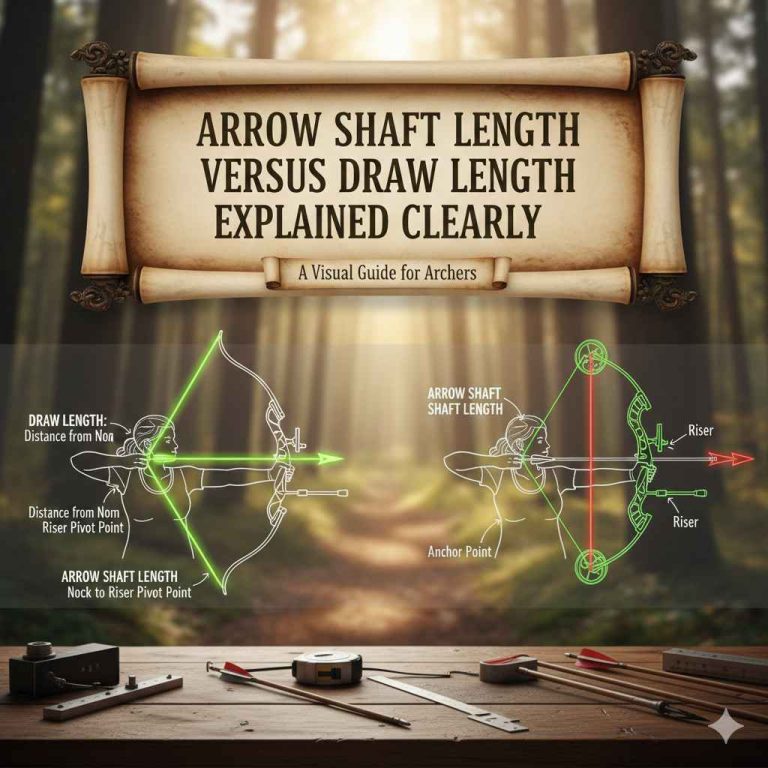
With recurves, draw length changes the real load on the shaft, and the shaft length itself changes how stiff the arrow behaves. A longer arrow acts dynamically weaker. That is why a recurve archer with a 30-inch shaft and a longer draw may need a different spine than another archer with the same bow weight but a shorter cut shaft.
Traditional and Olympic recurve setups also differ in how they are shot and tuned. A cleaner release and a steadier clicker routine can help, but neither one cancels poor spine choice. If the shaft is wrong, tuning gets harder, not easier.
How arrow length and point weight change the answer
Finished shaft length and point weight change dynamic spine every time. A longer shaft behaves weaker, while a shorter cut shaft behaves stiffer. Heavy front-end weight, including insert weight and collars, also weakens dynamic spine and can push a shaft that looked correct into poor flight.
Finished shaft length and dynamic spine
The chart examples you will see most often sit in the 27 to 31 inch range, and that range matters. If you shorten a shaft, you usually make it behave stiffer. If you leave it long, you usually make it behave weaker. That is why I confirm cut length before I buy shafts, not after.
Heavy points, inserts, and collars
Point weight changes the arrow’s front-end balance, and more front-end weight weakens dynamic spine. Inserts do it too. So do collars. If you add mass up front on a shaft that was already borderline weak, broadheads can start planing and paper tune can turn ugly fast.
For me, this is where people get fooled by the package spine number. Two arrows with the same static spine can behave differently once one carries a heavier insert and a hunting head. The bow does not care what the label says. It cares about how the shaft leaves the string.
Trophy Ridge Wrath arrows: are they a good fit?
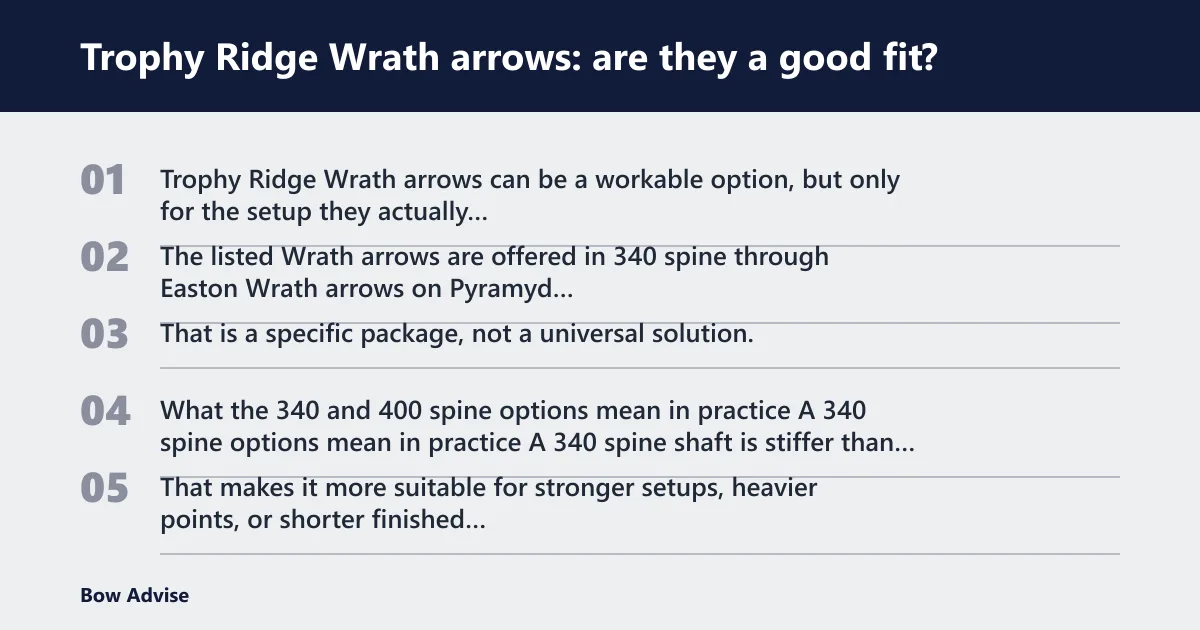
Trophy Ridge Wrath arrows can be a workable option, but only for the setup they actually match. The listed Wrath arrows are offered in 340 spine through Easton Wrath arrows on Pyramyd AIR, and the Trophy Ridge Wrath arrows are listed at 30 inches long with six arrows per pack, +/- 0.006 straightness, 2-inch fletching, a .246 inch ID, and 1-inch inserts included but not installed. That is a specific package, not a universal solution.
What the 340 and 400 spine options mean in practice
A 340 spine shaft is stiffer than 400, 500, and 600. That makes it more suitable for stronger setups, heavier points, or shorter finished lengths. A 400 spine option gives you more flex, which can help with lighter compounds, some recurve setups, or arrows that will carry less front-end weight.
On my own bows, I would treat those two spine choices as different tools. The 340 is the safer pick when I expect the arrow to behave weak because of speed or front-end mass. The 400 is the better starting point when the bow is calmer and the shaft is not being overloaded up front.
What the straightness and fletching specs mean in practice
+/- 0.006 straightness is fine for many hunting and casual target setups, but straightness alone does not make an arrow tune well. The 2-inch fletching is a practical choice for stabilization, especially on hunting-style builds. The included 1-inch inserts matter because insert weight changes dynamic spine, and the fact that they are not installed gives you some control over final build weight.
I would still check nock fit, vane adhesion, and pack-to-pack consistency before trusting them hard. A shaft can look good on the rack and still leave you with little annoyances that show up only after a few dozen shots. That is where durability matters as much as the spine number.
Setup-verification table for Trophy Ridge arrows
Use this table as a field check, not a verdict. I built it around common setup patterns I would actually test on my range before I cut shafts. If your bow sits between rows, I would lean stiffer first, then tune down if needed.
| Bow type | Draw weight | Arrow length | Point weight | Likely starting spine | Common misfit symptoms |
|---|---|---|---|---|---|
| Compound, hunting | 60 lb | 30 in | 100 gr plus insert weight | 300 to 340 | Weak flight, broadhead planing, impacts left for right-handed shooters |
| Compound, target | 50 lb | 29 in | 75 to 100 gr | 400 | Paper tear that will not clean up, tail kick, groups open as distance grows |
| Compound, beginner | 40 lb | 28 in | 75 gr | 500 | Hard tune, weak left/right flight, noisy impact, arrow feels sluggish |
| Recurve, traditional | 30 lb | 30 in | 100 gr | 500 to 600 | Porpoising, weak reaction, inconsistent bareshaft impact |
| Recurve, Olympic style | 45 lb | 28 to 29 in | 100 gr | 400 to 500 | Arrow kicks off the rest, poor bareshaft match, broadheads steer oddly |
| Recurve, heavy draw | 55 to 60 lb | 30 in | 100 to 125 gr | 350 to 400 | Weak flight, tail kick, broadhead planing, left/right scatter |
How to tell if your arrows are too stiff or too weak
Too stiff and too weak do not look the same. A stiff arrow often shows stubborn left/right impact issues, paper tears that move one way, and bareshafts that refuse to settle with fletched arrows. A weak arrow often planes broadheads, kicks oddly through paper, and feels like it is fighting the bow on release.
Paper tune and bare shaft clues
I start with paper tune, then I confirm with bareshafts at distance. If the bareshaft lands consistently away from the fletched group, I look at spine, point weight, and cut length before I blame the bow. If the tear refuses to clean up, I do not keep cranking on rest position forever. That is how people chase their tail for a week.
What to change before buying a new spine
Before I buy a different spine, I check the easy variables. I confirm actual draw weight, finished shaft length, point weight, insert weight, and broadhead weight. If I am using a fast compound, I also remember the chart’s warning that speed increases dynamic spine demand. Often the fix is a shorter shaft, lighter front end, or a cleaner tune.
- Measure actual draw weight at your draw length.
- Confirm finished shaft length, not just package length.
- List point weight, insert weight, and any collar.
- Check whether you shoot broadheads, field points, or both.
- Cross-check the current manufacturer selector before cutting shafts.
Should I trust a chart or verify spine with the manufacturer selector?
Trust the chart as a starting point, then verify with the manufacturer selector. I would never stop at a general spine row when the exact shaft, insert, draw weight, and use case are known. The selector is there to account for setup-specific variables that a printed chart cannot handle well.
That is the cleanest way to avoid buying the wrong shafts twice. The chart gets you moving, but the selector keeps you honest.
Frequently asked questions
Is Trophy Ridge arrow spine chart accurate for my bow?
It is accurate enough to start, but not accurate enough to finish the job by itself. I treat it like a first draft. Your actual draw weight, bow speed, finished shaft length, and point weight can move you into a different spine, so I always verify with the manufacturer selector.
What Trophy Ridge spine should I use for a 60 lb compound bow?
For a 60 lb compound bow with a 30-inch arrow, the guide maps to 300 spine. I would still check speed, release style, and point weight before I cut anything. If you are on the edge and plan to use heavier front-end weight, I would lean stiffer first.
How do arrow length and point weight change Trophy Ridge spine recommendations?
Longer arrows behave dynamically weaker, and heavier points weaken spine even more. A 30-inch shaft with a heavy insert or broadhead can need a stiffer shaft than the chart suggests. A shorter cut arrow can move you one spine class stiffer without changing the bow at all.
Can I use Trophy Ridge arrows for hunting and target shooting?
Yes, but not every Trophy Ridge shaft fits both jobs equally well. Hunting usually asks more of the front end, especially with broadheads, while target shooting may favor different point weight and tune tolerance. I pick the spine based on the use case, not just the bow weight.
What does 340 spine mean on Trophy Ridge arrows?
340 spine means the shaft is stiffer than 400, 500, and 600 spine. In practical terms, it is the better starting point for stronger bows, faster setups, or heavier front-end loads. If your bow is softer or your arrows are long and light up front, 340 may be too stiff.
How do I know if my arrows are too stiff or too weak after tuning?
Too stiff usually shows stubborn left/right flight, poor bareshaft match, and tuning that will not settle cleanly. Too weak often shows broadhead planing, odd tail kick, and erratic grouping as distance increases. I check those signs after paper tune and bareshaft testing, not before.