Gold Tip Arrow Spine Chart Review: Verify Spine Fast
I use the Gold Tip arrow spine chart as a starting point, then I confirm the choice with real draw weight, actual arrow length, point weight, and a bare-shaft or paper tune before I cut anything. Get that wrong, and you buy the wrong spine, fight broadhead planing, and waste shafts. I’ll show what the Gold Tip selector assumes, how Hunter, Hunter XT, Velocity, and Traditional Classic shafts differ, and how I verify spine for compound and trad setups.
Verdict: how good the Gold Tip spine chart is
I use it for a fast first pass, not a final answer. In my shop, it gets me close when the bow is ordinary, the point package is simple, and the arrow length is measured the way Gold Tip expects. It misses more often when front-end weight climbs, when a broadhead is longer than a field point, or when I leave the shaft too long and assume the chart can see that.
The Gold Tip selector works because it is built for Gold Tip shafts and asks for the inputs that move spine the most before shaft selection. Its limit is simple: it cannot account for the bow’s live tune, release style, or the way a real arrow flies before the first cut.
Where the chart gets you close fast, and where it can miss
It gets me close fast on a plain release-aid compound with a normal point weight and a clean draw length. It can miss when I add insert weight, a collar, a heavier hunting head, or a long shaft that I have not shortened yet. I have seen a chart pick that looked right on paper and then read weak once I bare-shafted it.
When I would trust the chart enough to buy shafts
I trust it enough to buy shafts when the setup is simple, the bow is already tuned, and I know I will still leave extra length for testing. I do not trust it enough to cut shafts immediately. That is where mistakes get expensive.
According to Arrow Spine Chart: Recurve, Compound & Traditional (2026) — The Gold Tip Traditional Classic is currently offered in 340-600 spine.
How the Gold Tip spine selector works
The Gold Tip spine selector is a manufacturer-specific selection chart used before shaft selection. It asks for draw weight, point weight, and arrow length, then gives a spine recommendation output. I treat that output as a starting box, not a promise.
What inputs it asks for
- Draw weight
- Point weight
- Arrow length
Those inputs matter because they shape dynamic spine, not just the printed spine number on the shaft.
What Gold Tip means by arrow length
Gold Tip measures arrow length from the throat of the nock to the end of the insert. That is not the same as a loose “arrow-to-tip” guess. I see mistakes here all the time, and they usually come from measuring the wrong end of the shaft.
What counts in point weight
Gold Tip defines point weight as the point, insert, Ballistic Collar, and FACT weight combined. That means the front of the arrow is heavier than many archers first assume. If I ignore those parts, I can end up with a shaft that behaves weaker than the chart suggested.
What arrow spine means and why the number matters
Arrow spine is shaft stiffness, or resistance to bending. Lower spine numbers generally indicate a stiffer shaft. That simple rule matters because the bow does not care what the label says; it reacts to how much the arrow flexes at the shot.
Why front-end mass changes dynamic spine
Heavier front-end mass makes the arrow act dynamically weaker. I have seen this most clearly with hunting setups where insert weight and head weight creep up together. The chart may still point to a usable shaft, but the tune can move weak once that front end is built.
How shaft length makes an arrow act weaker
A longer shaft can behave weaker even if the printed spine stays the same. That is why a chart choice can look fine and still tune poorly after a bow is shot with a long uncut shaft. Length matters before the first saw cut, not after.
Pros and cons of the Gold Tip selector
Pros
- Fast way to narrow shaft choice
- Brand-specific to Gold Tip arrows
- Helps before buying or cutting
- Useful when the setup is simple
Cons
- Does not see every front-end variable
- Cannot replace bare shaft tuning
- Can miss when arrows stay long
- Broadheads can change the answer
Best use case
Use it when you want a clean starting point before buying shafts. That is the right job for a chart. The final job still belongs to the bow on the range.
Who this chart is for
This chart fits compound archers with a release aid, compound archers shooting with fingers, recurve and longbow shooters, and bowhunters who want a broadhead-ready starting point. It does not fit anyone who wants to skip tuning and trust a printed box blindly.
I shot a compound that was 10 lb too heavy when I started out, and I spent a month flinching before I backed the limb bolts out. That lesson stuck. The right starting point matters, but the bow has the final vote.
Worked Gold Tip spine decision table for 6 common setups
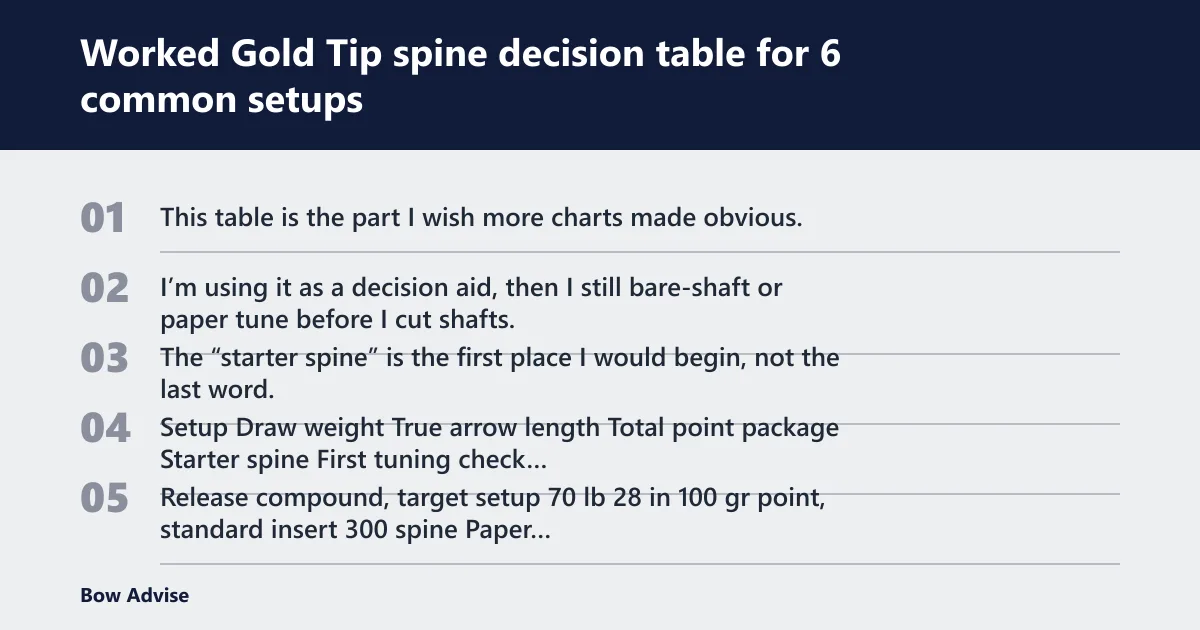
This table is the part I wish more charts made obvious. I’m using it as a decision aid, then I still bare-shaft or paper tune before I cut shafts. The “starter spine” is the first place I would begin, not the last word.
| Setup | Draw weight | True arrow length | Total point package | Starter spine | First tuning check before cutting |
|---|---|---|---|---|---|
| 1. Release compound, target setup | 70 lb | 28 in | 100 gr point, standard insert | 300 spine | Paper tune at 6-8 ft, then bare shaft at 10-15 yd |
| 2. Release compound, hunting setup | 60 lb | 29 in | 100 gr fixed broadhead package | 300 or 340 spine | Bare shaft first; confirm broadhead flight after field points are close |
| 3. Traditional recurve | 45 lb at actual draw length | 26 in | 125 gr point package | 500 spine | Bare shaft tune at short range before any cut |
| 4. Compound with finger release | 50 lb | 30 in | 100 gr point package | Start 2 boxes weaker than the release-aid pick | Begin with arrows 1 in long, then bare shaft tune |
| 5. Recurve, left uncut longer | 40 lb at actual draw length | 27 in | 100 gr hunting point | 600 spine or weaker starting point | Leave it long, then shoot bare shafts before trimming |
| 6. Hunting shaft with heavier front end | 65 lb | 29 in | Heavier insert plus collar package | 340 spine or stiffer | Check for weak reaction in paper, then confirm with bare shafts |
How to verify the chart before you cut arrows
Start long, then cut 1/4 inch at a time. That approach gives me room to correct a weak or stiff tune without turning a new shaft into scrap. Once the shaft is short, you can only guess your way backward.
Use bare shaft tuning to confirm the first pick
- Build one arrow first.
- Leave it long.
- Paper tune or bare shaft tune at close range.
- Watch for a weak or stiff impact reaction.
- Only then trim 1/4 inch and retest.
Use walk-back tuning when the tune is close
When the paper tune looks good, I like walk-back tuning to see whether the arrow stays in line as distance grows. That matters because a chart can land near the mark while the bow still shows a small left-right drift at distance.
Gold Tip model-by-model spine ranges
These are the current Gold Tip spine ranges I would use as model guards when I’m choosing a shaft family. They matter because the selector only helps if the shaft line you want actually comes in the spine you need.
- Gold Tip Hunter XT: 250, 300, 340, 400, 500 spine
- Gold Tip Traditional Classic: 340, 600 spine
- Gold Tip Velocity: 300-700 spine
- Gold Tip Hunter: 300-500 spine
How to choose spine for compound, recurve, or longbow?
For compounds, I start with draw weight, arrow length, and release style. For recurves and longbows, I set draw weight at the actual draw length first, then choose a shaft long enough to tune before cutting. Broadheads may push me slightly stiffer, but I still verify with bare shaft or paper tune.
Compound bow setup and release style
If I am using a release aid, I follow the chart closely, then tune the arrow before trimming. If I am using fingers on a compound, Gold Tip says to start two boxes weaker to the left, start one inch longer, and cut down 1/4 inch at a time. That is the safer path.
Traditional setup at actual draw length
For recurve or longbow, Gold Tip says to establish draw weight at the actual draw length, then start arrows at least 1 inch longer than finished length. I would then cut down 1/4 inch at a time and bare shaft tune as I go.
Broadhead use and when to start stiffer
A longer broadhead than a field point may justify a slightly stiffer shaft. I do not treat that as a command to overbuy spine. It is a reason to check the front end, then test the tune instead of guessing.
How do I use the Gold Tip spine selector?
I enter draw weight, point weight, and arrow length, then I read the spine recommendation as a starting point. I do not cut arrows yet. I build one test shaft, keep it long, and confirm with bare shaft or paper tune before I commit the rest of the batch.
What Gold Tip means by arrow length?
Gold Tip means the length from the throat of the nock to the end of the insert. That is the number that belongs in the selector. If I measure to the end of the broadhead or field point instead, I can end up with the wrong spine and a wrong cut.
Should I choose a stiffer shaft for a longer broadhead?
Sometimes, yes, but only slightly. Gold Tip says a longer broadhead than a field point may justify a slightly stiffer shaft. I still prefer to confirm with tuning, because a broadhead can expose weak spine without meaning the entire setup needs a big jump stiffer.
How do I select spine for a recurve or longbow?
I start by setting draw weight at the actual draw length, then I pick a shaft that is long enough to test before cutting. Gold Tip says to start at least 1 inch longer than finished length and cut 1/4 inch at a time. That method gives me room to correct the tune.
What arrow length is measured on Gold Tip charts?
Gold Tip measures arrow length from the throat of the nock to the end of the insert. That is the number I use on the chart. It is not a full arrow-to-tip estimate, and it is not the same as a casual ruler measurement from the outside of the shaft.
What point weight counts in Gold Tip spine selection?
Gold Tip counts the whole point package: point, insert, Ballistic Collar, and FACT weight combined. That matters because the front end drives dynamic spine. A setup that looks like 100 grains on paper can behave heavier once those extra parts are added.
How do I start spine selection for a compound with finger release?
Gold Tip says to start two boxes weaker to the left, start one inch longer, and cut down 1/4 inch at a time. I would bare shaft tune before trimming further. Finger release compounds usually need more forgiveness than release-aid setups, so I start with more room, not less.
What Gold Tip spine works for hunting or target setups?
For hunting, I usually bias toward the shaft that bareshafts clean with the full front-end package, especially if the broadhead is long. For target setups, I want the chart answer and the tune to agree. If they do not, I trust the bow and adjust before I cut the rest of the dozen.
Frequently asked questions
How do I use the Gold Tip spine selector?
I plug in draw weight, point weight, and arrow length, then I treat the output as a first draft. The key is to measure length the Gold Tip way and include the full front-end weight. After that, I verify with bare shaft or paper tune before I cut the shaft.
What Gold Tip mean by arrow length?
Gold Tip means the distance from the throat of the nock to the end of the insert. That is the number that belongs in the selector. If I measure to the tip or guess from shaft length alone, the spine choice can land off.
Should I choose a stiffer shaft for a longer broadhead?
A longer broadhead may justify a slightly stiffer shaft, and Gold Tip says so plainly. I would not jump several spine steps just because the head is longer. I would start close, then use bare shaft and broadhead flight to confirm the final call.
How do I select spine for a recurve or longbow?
I set draw weight at the actual draw length, then start with a shaft at least 1 inch longer than the finished arrow. From there I cut 1/4 inch at a time and bare shaft tune. That keeps me from overcutting before the bow tells me the truth.
What point weight counts in Gold Tip spine selection?
The whole front-end package counts: point, insert, Ballistic Collar, and FACT weight. That is the number that affects dynamic spine, not just the field point label on the box. Heavier front ends make the arrow act weaker, so I check the complete stack.
How do I start spine selection for a compound with finger release?
I start two boxes weaker to the left, begin one inch longer, and cut down 1/4 inch at a time. Then I confirm with bare shaft tuning. Finger release compounds are less forgiving, so I want margin before I make the first cut.