Easton Arrow Spine Chart Review: How to Use It Right
The Easton spine chart gives me a starting point, not the final answer: match draw weight, cut length, and point weight, then tune; if arrows group weak or stiff, change spine or point before I blame the chart. A bad shaft match costs accuracy, adds tuning time, and hurts clean kills on game. I cover how to read Easton spine charts, choose the right shaft for compound or recurve setups, and when real-world tuning should override the chart.
This guide is part of our Arrow Spine guide for archers series.
How I read the Easton spine chart


I treat the chart as a first pass. Spine is shaft stiffness, and Easton’s chart is built to put you near the right stiffness class before I start tuning. It gets more reliable when your draw length, finished arrow length, and point weight are ordinary. It gets less exact when you add heavy front weight, short-draw geometry, or unusual shaft cuts.
What Easton is measuring
Arrow spine is the shaft’s resistance to bend under load. Easton’s spine testing uses a fixed weight over a set span, which gives you a consistent way to compare shafts within a class. That test helps because it gives a common yardstick, even though your bow setup bends the arrow a different way.
Where the chart starts to lose accuracy
The chart starts to drift when one setup variable moves a lot. A 70-pound compound with a short arrow and a 100-grain point is one story. A 45-pound recurve with a long shaft and a heavy front end is another. Easton can point me at the right lane, but the final answer still depends on how the shaft reacts after I cut it, build it, and shoot it.
According to outdoorlife.com — Easton Axis shafts are available in spine sizes from 260 to 700.
What changes spine choice more than people think

Draw weight matters, but it is only part of the picture. Draw length changes how much energy the bow stores for you, and shaft length changes how much of the arrow is left to flex. Point weight and brass inserts can move the finished arrow into a much weaker dynamic reaction than the paper chart suggests.
Draw weight and draw length
Two archers can both pull the same advertised weight and need different spine. A shorter draw often sends less energy into the arrow than a longer draw at the same labeled weight.
Cut length and shaft stiffness
Cutting a shaft shorter makes it act stiffer in the shot cycle. That matters on compound and recurve bows alike. I have seen arrows that looked fine on paper but started to drift once I trimmed them down and changed how they left the string. The chart cannot know your final cut length unless you feed it the real number.
Point weight, brass inserts, and front-of-center
Heavier point weight weakens the dynamic reaction. Brass inserts do the same thing by adding mass up front, and they can push a finished arrow into a heavier grain range. If you are trying to run higher front-of-center, expect the arrow to react weaker than the bare shaft spine number suggests.
How do I choose Easton spine for my setup?
I start with draw weight, then I lock in draw length, shaft cut length, and point weight before I buy arrows. For compound bows, I usually bias a little stiffer if the setup is aggressive or the front end is heavy. For recurve, I expect more flex and more testing, especially if the archer is new or the release is inconsistent.
A simple decision path I use
- Measure actual draw weight at your draw length.
- Decide finished arrow length, not raw shaft length.
- Pick point weight and insert choice first.
- Use the Easton chart to land in a spine range.
- Verify with bare shaft or walk-back tuning.
- Change spine or point weight if the bow still shows a weak or stiff reaction.
Compound bow versus recurve differences
Compound bows usually show spine problems in a sharper way because the power stroke is cleaner and the bow is less forgiving of a bad arrow reaction. Recurve bows often ask for more spine testing because finger release, shaft length, and point weight all swing the tune more. I shot recurve and compound for years, and the recurve setup always punished sloppy arrow choice faster.
Easton Axis 5mm: the spine range most hunters compare first
Easton Axis 5mm is the model many hunters check first because it runs from 260 to 700 spine and gives a broad choice for different bow weights. Easton says archers shooting 35 to 80 pounds will find an Axis spine that fits. The standard Axis has a .003 straightness tolerance, while the Axis Pro has a .001 straightness tolerance.
What the 340 Axis tells you
A 340 spine Easton Axis has a .267-inch outside diameter and a .204-inch inside diameter. Easton also lists the 340 Axis at 9.5 grains per inch, and a bare 28-inch 340 Axis shaft weighs 266 grains. Those figures matter because spine, mass, and build length all interact before the arrow ever reaches the target.
HIT system and hidden insert impact
Easton uses the HIT system so standard field points can be used in a small-diameter arrow. The hidden insert helps keep the front end compact, which is useful for hunters who want a smaller shaft without giving up common point hardware. If you add brass HIT parts, remember that extra front mass can move the build into a weaker dynamic reaction.
What do X10, ACE, and weight codes change in the decision?
Easton’s X10 and ACE shafts are not read the same way as a simple parallel carbon. X10 uses three distinct custom spine zones, and Easton says the tail section is less stiff and lighter. Easton also says cutting X10 or ACE shafts from the rear makes them effectively stiffer, which means the cut location matters as much as the cut length.
Why rear cutting changes X10 and ACE behavior
On X10, the rear section is already the softer part of the shaft design, so removing material from that end changes the whole reaction. The same idea applies to ACE, which is a tapered shaft and tied to Easton’s weight-code discussion. Rear cutting makes both shafts stiffer in practice, and it can leave you with a tune that looks fine on paper but reacts wrong in flight.
What C1, C2, and other weight codes tell you
Easton weight codes such as C1 and C2 are weight categories used to sort carbon shafts within a spine class. They are there to improve uniformity, not to change the spine number itself. On high-end A/C shafts, the weight code helps you build a more consistent set when you care about point-of-impact spread and arrow-to-arrow match.
What happens when broadheads tell a different story?
Broadheads often reveal spine trouble before field points do. A shaft can group acceptably with field points and still plane with broadheads if the spine is off, the centershot is wrong, or the front end is too heavy. Weak and stiff reactions both show up here, and the difference matters for hunting arrows more than many shooters admit.
Stiff versus weak reactions
A weak setup often shows broadheads kicking one way and field points grouping somewhere else. A stiff setup can look cleaner on paper but still show a hard left or right reaction depending on bow hand, rest timing, and release style. That is why I use broadhead tuning as a truth check, not a replacement for good form.
When a decent group still hides a bad tune
I have seen arrows group inside a small cluster while the bow was still out of tune enough to punish broadheads. That is common on hunting rigs. Walk-back tuning tells you whether your centershot is honest, and bare shaft testing can show weak or stiff reaction before the broadheads expose it on a target face.
Real Easton spine decisions on common setups
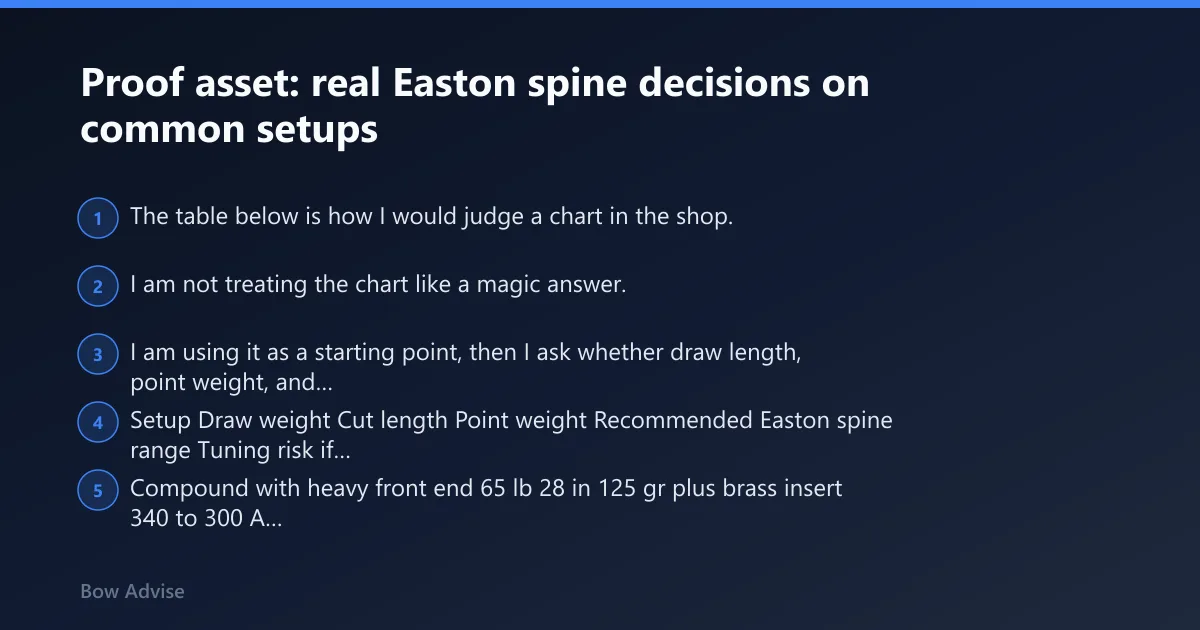
The table below is how I would judge a chart in the shop. I am not treating the chart like a magic answer. I am using it as a starting point, then I ask whether draw length, point weight, and shaft length push the build weaker or stiffer than the printed range suggests.
| Setup | Draw weight | Cut length | Point weight | Recommended Easton spine range | Tuning risk if followed blindly |
|---|---|---|---|---|---|
| Compound hunting rig, moderate speed | 60 lb | 29 in | 100 gr | 400 to 340 | Choosing 400 without testing can leave broadheads weak if the shaft is long or the rest is soft. |
| Compound with heavy front end | 65 lb | 28 in | 125 gr plus brass insert | 340 to 300 | A chart-only 340 can end up too weak once the brass insert changes dynamic spine. |
| Short-draw compound | 55 lb | 27 in | 100 gr | 400 to 340 | Short draw can trick the chart into a spine that is too weak if you also run a heavy vane setup. |
| Recurve beginner setup | 35 lb | 29 in | 100 gr | 700 to 600 | If the archer collapses on release, a chart-true shaft can still tune weak in practice. |
| Recurve with longer draw | 45 lb | 30 in | 100 gr | 500 to 400 | Cutting too short can make the shaft stiffer than the chart suggests and force a bad pluck compensation. |
| Heavy front-of-center hunt build | 70 lb | 29 in | 150 gr | 300 to 260 | Following a mid-spine suggestion can create broadhead planing once the brass or heavy point is added. |
| X10 target-style build | 50 lb | 30 in | 100 gr | 500 to 400 | Rear cutting changes the effective spine, so the same printed number may no longer tune after trimming. |
| ACE-style tapered build | 55 lb | 28.5 in | 100 gr | 450 to 400 | Ignoring the weight code and rear-cut effect can leave the set stiffer than the chart predicts. |
Frequently asked questions
How do I read the Easton arrow spine chart?
Read it as a guide to shaft stiffness, not a final verdict. Start with draw weight and draw length, then add real cut length and point weight. If the first shaft groups weak or stiff, adjust the arrow build or spine before I blame the chart.
What Easton spine do I need for my draw weight and draw length?
Use your actual draw weight at full draw, not the label on the limb. Then account for finished arrow length and point weight. A longer arrow or heavier front end usually asks for a stiffer spine, while shorter arrows often move you toward a weaker number.
How does point weight change Easton spine selection?
Heavier point weight makes the arrow act weaker in flight. That can be useful for tune, but it can also push a borderline build into broadhead planing. If you move from 100 grains to 125 grains or add brass, recheck spine rather than assuming the old setup still works.
Should I choose a weaker or stiffer arrow for broadheads?
I prefer to start a little stiff rather than too weak when broadheads are part of the plan. A weak arrow often shows up fast in broadhead flight. Still, the right answer depends on draw weight, shaft length, and the exact front-end mass you are using.
How do Easton Axis spines compare across 260 to 700?
Easton Axis runs from 260 to 700, with 260 the stiffest and 700 the lightest. The right choice depends on your bow weight, draw length, and build length. The 340 spine is a common middle point, and Easton gives it a .267-inch outside diameter and a .204-inch inside diameter.
Can I cut Easton X10 or ACE shafts from the rear?
You can, but Easton says rear cutting makes X10 and ACE shafts effectively stiffer. That matters because X10 has three custom spine zones and a lighter, less stiff tail section. Rear cutting can change the way the shaft reacts enough to force a fresh tune check.