Carbon vs aluminum arrow spine: which shaft is easier?
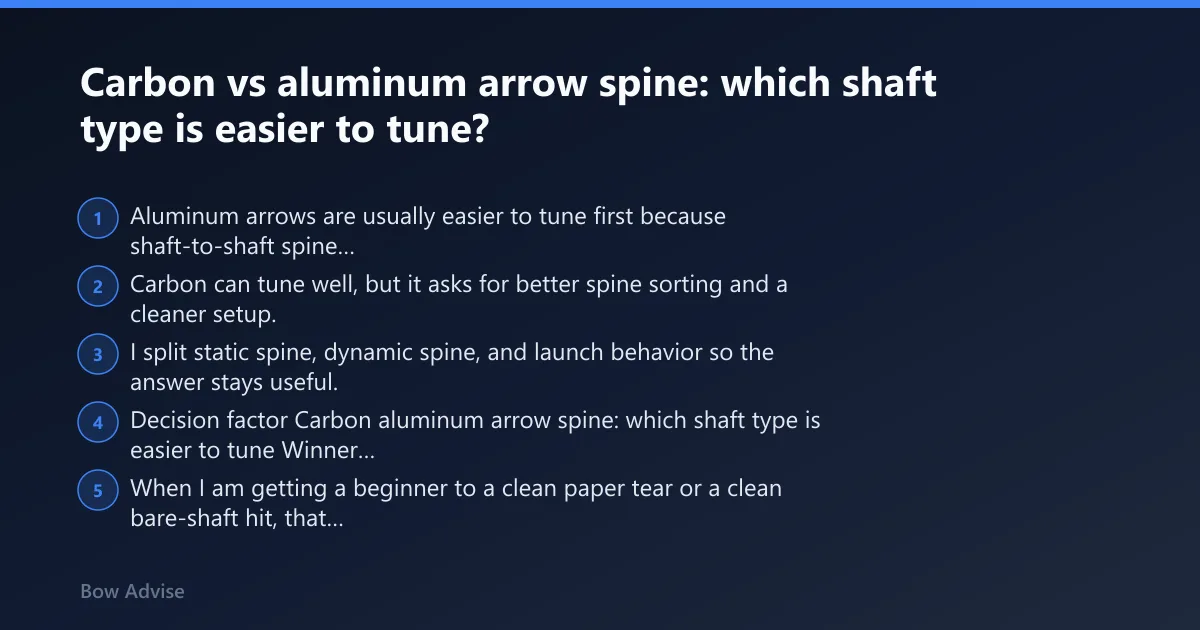
Aluminum arrows are usually easier to tune first because shaft-to-shaft spine consistency is tighter and bare-shaft or broadhead results are easier to read. Carbon can tune well, but it asks for better spine sorting and a cleaner setup. I split static spine, dynamic spine, and launch behavior so the answer stays useful.
Carbon vs aluminum arrow spine: which shaft type is easier to tune?


| Decision factor | Carbon | aluminum arrow spine: which shaft type is easier to tune | Winner |
|---|---|---|---|
| First-pass bare-shaft tune | Good when spine is matched, but sorting matters more | Usually easier to read and correct early | aluminum arrow spine: which shaft type is easier to tune |
| Broadhead tuning | Often better once dynamic spine is set | Can work well, but bent shafts and mass choices can complicate it | Carbon |
| Wide size range for odd setups | Narrower size range | Very wide range of sizes | aluminum arrow spine: which shaft type is easier to tune |
| Insert and point attachment | Epoxy preferred | Hot-melt works well | aluminum arrow spine: which shaft type is easier to tune |
| Damage reads during tuning | Hidden internal crack is hard to spot | Bends are easier to see | aluminum arrow spine: which shaft type is easier to tune |
First-pass bare-shaft tune
Aluminum usually wins here because the shaft-to-shaft behavior is easier to trust. When I am getting a beginner to a clean paper tear or a clean bare-shaft hit, that consistency saves time and confusion.
Carbon can still tune cleanly, but I spend more time checking for a bad shaft, a poor cut, or an insert issue.
Broadhead tuning
Carbon often wins once the bow is already close, especially on faster hunting setups. A shaft that starts with cleaner launch behavior can make broadhead flight settle sooner, but only if the dynamic spine is right for the bow.
I do not treat carbon as magic. I treat it as the easier finish when the setup is already in the right zone.
Wide size range for odd setups
Aluminum has a wider range of sizes, and that matters when the bow or archer sits in an awkward middle ground. I see that with odd draw lengths, heavier points, and indoor recurve setups where a small change in shaft choice can fix a weak or stiff reaction fast.
Carbon has a narrower size range, so sometimes I need more trial-and-error or a hybrid arrow to land in the right window.
Insert and point attachment
Aluminum is simpler to work on because hot-melt holds on metal, and I can swap parts without turning the whole shaft into a project. Carbon inserts and points need epoxy because hot-melt does not bond properly, so mistakes take longer to correct.
That difference does not decide tune by itself, but it changes how quickly I can test a change and move on.
Damage reads during tuning
A bent aluminum shaft usually tells on itself. An internally cracked carbon shaft may look fine and still shoot badly, which makes the tune harder to trust.
That is why I inspect carbon harder after a hard hit, and I retire any shaft that gives me a suspicious bare-shaft reaction I cannot explain.
According to archeryera.com — Carbon straightness tolerances are around ±0.001 inch.
Why I split this into static spine, dynamic spine, and real setup behavior
Static spine is the shaft’s stiffness rating on paper. Dynamic spine is how that shaft behaves after I cut it, add point weight, and shoot it from a real bow. Real setup behavior is the launch itself: release quality, bow speed, and how the arrow leaves the string and recovers.
Those three things are not the same. A shaft can look right in a chart and still tune badly if the actual bow, cut length, or point weight pushes it outside the useful range.
Carbon vs aluminum shafts: side-by-side tuning comparison
Carbon shafts are built from thousands of resin-bonded fibers, while aluminum is a single drawn metal tube. Carbon is often lighter at the same rough spine, while aluminum is commonly available in a wide range of sizes and can offer consistent shaft-to-shaft spine.
That is why aluminum often feels easier to start with, and carbon often feels easier to finish once the spine is already close.
Construction and size range
Aluminum’s size range helps when I need a weird combination of stiffness and mass. Carbon’s narrower range means I may have fewer exact choices, but the material itself is often very easy to build into a hunting shaft or a faster outdoor setup.
Straightness, consistency, and damage behavior
Carbon’s straightness tolerance is tighter on paper, but a hard hit can leave an internal crack with no visible sign. Aluminum can lose straightness quietly too, and it can wobble briefly on impact, but a bend is usually easier to catch during setup.
Insert and point attachment
Aluminum lets me use hot-melt on inserts and points, which makes tuning changes faster. Carbon needs epoxy, so I plan each change more carefully before I commit.
Arrow weight at matched spine
Carbon is usually lighter at matched spine, while aluminum is often heavier. That matters because weight changes launch behavior, not speed alone; a heavier arrow can calm a setup, but it can also move dynamic spine in the wrong direction if I ignore the bow.
Where each material usually tunes faster
On recurve and beginner rigs, aluminum often gets me to a usable tune faster. On hunting bows and many broadhead setups, carbon often gets me to the final tune faster because the shaft choice fits the job better once point weight and draw length are sorted.
What makes an arrow easy or hard to tune?
Easy tuning starts with a shaft that matches the bow before I touch fine adjustments. Static spine gets me in the right neighborhood; dynamic spine tells me whether the arrow will leave cleanly with the point and cut length I chose. If either one is off, tuning gets slow.
Static spine versus dynamic spine
Static spine is the label. Dynamic spine is the real outcome. I have seen arrows with the same rated spine react very differently once the actual bow, insert weight, and cut length were accounted for.
How cut length changes shaft stiffness
Shorter shafts tend to act a bit stiffer. Longer shafts tend to act a bit weaker. That is why a shaft that tunes fine at one length can fall apart after a trim, even when the spine label did not change.
How point weight shifts the tune
More point weight tends to weaken dynamic spine. Less point weight stiffens it. That change is often enough to flip the answer between carbon and aluminum, especially when I am close to the edge of the tune window.
How bow speed changes the result
Faster bows punish weak spine faster and reveal launch issues sooner. The page notes that cut length, point weight, and cam speed affect dynamic spine, and that is exactly why I check the real bow before I call a shaft choice “easy.”
Why aluminum often feels easier for beginner tuning?
Aluminum usually feels easier for beginners because the reaction is easier to read, the size range is broader, and hot-melt makes point changes simple. For indoor recurve especially, that means I can get a clean bare-shaft result sooner without fighting hidden shaft damage or an awkward spine gap.
Why indoor recurve shooters often get clean bare-shaft results sooner
Indoor recurve setups often run slower and heavier, so the tuning window can be friendlier to aluminum.
How the wider size range helps odd setups
If the archer has an odd draw length or wants an unusual point weight, aluminum gives me more places to land. That wider spread is useful when I need to tune around the setup instead of forcing the setup to fit one shaft option.
Why hot-melt and visible bends matter during tuning
Hot-melt lets me test faster. Visible bends let me reject a bad shaft faster. Both save time, and both reduce the chance that I blame my form for a shaft problem.
Why carbon often wins for hunting and broadhead tuning?
Carbon often wins once the setup is moving faster and the goal is clean broadhead flight. It is usually lighter at matched spine, it recovers quickly after the shot, and it often gives me a better final hunting shaft when the bow and point weight are already close.
Why lighter shaft weight can help some setups settle down
A lighter shaft can reduce total arrow mass enough to keep the bow happy while still staying in the right spine window. That does not mean lighter is always better. It means carbon can be the easier finish when I am balancing speed, penetration, and clean flight.
Why outdoor bows often end up with better broadhead flight on carbon
Outdoor setups often push more speed and use broadheads that punish poor dynamic spine. Carbon’s quick recovery helps here, but only if I select the right shaft and keep the insert and point system matched to the bow.
Why spine matching is still the real driver
If the spine is wrong, carbon will still miss. Broadhead flight is a setup test, not a material award ceremony. I think of carbon as the easier finishing tool when the broadhead window is narrow and the build is already close.
Real setups where carbon or aluminum tuned faster
I am not guessing here. Tune can be difficult to chase on the range with bows that behave very differently once point weight, draw length, and shaft length change. These are the kinds of setups where one material moved faster than the other.
| Bow type | Draw length | Point weight | Shaft length | Faster material | Why it tuned faster |
|---|---|---|---|---|---|
| Indoor recurve | 28 inches | Heavy point | Full-length shaft | Aluminum | Cleaner bare-shaft read and easier hot-melt point swaps |
| Beginner recurve | Short-to-mid draw | Moderate point | Longer shaft kept uncut at first | Aluminum | Wider size range gave me a better starting spine without overcutting |
| Hunting compound | 30 inches | Heavier broadhead-style point | Cut to hunting length | Carbon | Once spine was matched, broadhead flight settled faster and the shaft recovered cleanly |
| Compound with odd point preference | Long draw | Very heavy point | Moderate cut length | Aluminum | The wider size range let me move to a shaft that handled the weak reaction sooner |
| Outdoor recurve | Medium draw | Moderate point | Shorter shaft | Carbon | Once the spine was right, the lighter shaft gave a cleaner tune finish |
Cases where aluminum was faster to tune
Aluminum moved faster any time I needed a quick correction and a clear read. That happened most with indoor recurve, beginner tuning, and odd setups where the size range mattered more than arrow weight.
Cases where carbon was faster to tune
Carbon moved faster when I already knew the bow wanted that spine and I was finishing for hunting or broadheads. In those cases, the shaft itself was not the problem; the setup was, and carbon got me to the final answer sooner.
Cases where the result flipped after changing point weight or cut length
I have watched a shaft flip from good to bad after a simple cut or a point swap. That is why I never call a material “easy” without checking the actual bow, because dynamic spine can change the winner in one small step.
Does arrow material affect spine tuning for recurve, compound, and broadheads?
Yes, but not in the same way for every bow. Recurve tuning rewards clear shaft feedback, compound tuning rewards exact spine matching to cam speed, and broadhead tuning rewards the cleanest launch and the best dynamic spine match. The material changes how quickly I reach that match.
Recurve setups
For recurve, aluminum is usually easier for beginner tuning and indoor work. Carbon can still be very good outdoors, but aluminum often gets me to bare-shaft agreement faster when I am teaching someone who needs a simple read.
Compound setups
For compound, carbon often wins once the bow is set and the archer wants a hunting or outdoor shaft. If I am correcting an odd setup, aluminum can still be the faster first step because of the wider size range.
Broadhead tuning
Broadhead tuning is where dynamic spine matters most. Carbon often ends up ahead because the final setup is cleaner once the spine is matched, but aluminum can be easier when I need to diagnose the problem before I choose the final shaft.
Choose aluminum if… / Choose carbon if…
Choose aluminum if you want the easiest path for indoor recurve, beginner tuning, or a setup with an odd draw length or unusual point weight. Choose carbon if you want a better fit for hunting, broadheads, or a bow that already needs a lighter shaft and a cleaner final finish.
Choose aluminum if…
- You are learning bare-shaft tuning and want the clearest read.
- You shoot indoor recurve and want simple point swaps with hot-melt.
- You need a wider size range to match an unusual setup.
- You want visible damage checks during tuning.
Choose carbon if…
- You are tuning for hunting or broadhead flight.
- You want a lighter shaft at matched spine.
- You already know your spine window and want a cleaner final build.
- You are comfortable using epoxy for inserts and points.
Choose a hybrid carbon-aluminum arrow if…
A hybrid carbon-aluminum arrow sits in the middle. I use that idea when I want some of the stiffness and launch feel of carbon with a build that behaves more like a middle-ground shaft for tuning and recovery.
It is not my first pick for every bow, but it can solve a fit problem when pure carbon or pure aluminum leaves too much tuning work on the table.
Frequently asked questions
Is carbon or aluminum easier to tune for arrows?
Aluminum is usually easier to tune first because it gives a cleaner bare-shaft read, has excellent shaft-to-shaft spine consistency, and is easier to adjust with hot-melt. Carbon can tune just as well, but it usually needs better spine sorting and more care with inserts and points.
Why do aluminum arrows seem easier to tune than carbon?
They often seem easier because the size range is wide, the shaft behavior is predictable, and bends are easier to spot after a bad hit. That makes aluminum friendlier when I am trying to isolate a tune issue without wondering if the shaft itself is hiding damage.
Are carbon arrows harder to tune than aluminum?
Not always. Carbon is harder only when the spine choice is poor or the shaft list is too narrow for the bow. When the spine is matched and the build is right, carbon can finish very well, especially for hunting and broadhead work.
Which arrow shaft is better for beginner tuning, carbon or aluminum?
Aluminum is usually better for beginners because the feedback is easier to read and the tuning steps are simpler to change. I have seen new archers get discouraged by a shaft issue that carbon made harder to spot, while aluminum pointed to the fix faster.
How do point weight and cut length change tuning on carbon vs aluminum?
Both materials react the same way in principle: more point weight weakens dynamic spine, and shorter cut length stiffens it. The difference is that aluminum often gives me more size options to recover from a bad choice, while carbon often finishes better once the right combo is found.
Which arrow shaft is better for broadhead tuning, carbon or aluminum?
Carbon usually wins for broadhead tuning once the bow is already close, because the lighter shaft and quick recovery can help the arrow leave cleaner. Aluminum can still tune broadheads well, but I reach for carbon more often when the goal is the best final hunting flight.