Best Arrow Spine Picks for Longbows (2026): Research Shows
For many longbows with modern carbon arrows, a common starting point is 1–2 spine groups weaker than a recurve of the same draw weight, then confirm with bare-shaft tuning and point weight changes. Too stiff and the arrow clears poorly, tunes erratically, and can kick groups left for a right-handed shooter. Too weak and it bends too much, loses consistency, and can be unsafe with heavy points. This guide explains how longbow geometry, finger release, shaft length, point weight, and draw weight change dynamic spine choice.
Quick comparison
| Product | Badge | Best for | Price | ||
|---|---|---|---|---|---|
 | TOPARCHERY Arrow Shaft Pure Carbon Shafts 33 Inch ArrowTOPARCHERY | Our pick | 33 Inch · Pure Carbon · Spine 350 | $40.98 Price as of 18 Oct 2026 | View |
 | ZSHJGJR 30” Archery Carbon Arrows Hunting Arrows with 4”ZSHJGJR | Also great | 30 Inch · Turkey Feather · 500 Spine | $49.99 Price as of 18 Oct 2026 | View |
 | RUOERSISI Electronic Arrow Spine Tester Adjustable ArrowRUOERSISI | Upgrade pick | Dual Function · Adjustable · Aluminum Alloy | $156.09 Price as of 18 Oct 2026 | View |
The easiest first pick is the shaft that matches your actual draw weight, not the number printed on the bow, then adjust it for arrow length and point weight. Copying a compound chart without accounting for finger release is the common error, because a longbow sends the shaft through a different launch cycle.
How we chose
This guide follows manufacturer chart logic, static spine specs, and longbow setup behavior that can be checked against published data. The focus stays on finger release, simple rests, arrow length, point weight, and string material, because those change dynamic spine differently than compound assumptions.
The comparison also puts safe first setup, repeatable flight, and better broadhead tolerance ahead of guesswork. Brand-specific chart families matter here, so Easton, Gold Tip, Victory, and Black Eagle should be read within their own product lines, not mixed into one universal rule.
What spine should I start with?
Start with your actual draw weight, then adjust for arrow length, point weight, and string material. For a longbow with modern carbon arrows, a first cut is often 1–2 spine groups weaker than the same draw weight would suggest on a recurve chart, because finger release and longbow clearance change the dynamic load on the shaft.
Static spine is the printed rating, and lower numbers mean stiffer arrows. It is measured under a standard load using a 29-inch shaft with support points 28 inches apart and an 880-gram weight, so a 500 spine shaft deflects 0.500 inches in that test. That number helps compare shafts, but it does not decide the tune by itself.
Use arrow length from nock throat to shaft end, not a rough estimate. Longer arrows act dynamically weaker, and heavier point weights also make the shaft behave weaker. If a longbow is near the edge of two spine groups, those two factors usually decide the first choice.
A common first-timer mistake is ordering a full dozen before checking the first shaft. A safer path is a small shaft sample, then broadhead or bare-shaft tuning after the first cut length is set.
Do longbows need stiffer arrows than recurves?
Not automatically. Longbows often need a different starting point, but the direction is not always stiffer. Finger release, shorter shelf support, and simpler clearance can make the arrow behave weaker in flight than the same labeled draw weight would suggest on a recurve setup.
That matters because release style changes how the shaft recovers through the shot. The shaft flexes incorrectly through the shot cycle when spine is wrong, and that effect is easier to see on traditional bows than on a release-aid compound. A longbow with a clean finger release can still need a weaker shaft than a recurve of similar weight if the arrow is long or the point is heavy.
Suppose a 45 lb longbow is cut to 30 inches and tuned with 150 grain points. That setup can move weaker than a shorter 29-inch shaft with 100 grain points, even though the bow weight did not change. The shaft length and point weight changed the answer.
A stiffer shaft becomes the better first test when the bow has a fast string, the arrow is short, or the point weight stays light. Those conditions reduce the amount of dynamic bend the arrow needs to recover cleanly.
Can I use a compound arrow spine chart for a longbow?
Use a compound chart only as a rough reference, not as a final answer. Compound setups release the string differently, and the arrow leaves the bow under a different cycle than a finger-shot longbow. That is why a chart that works for a 70–80 lb compound with a 29-inch arrow can mislead a traditional setup.
Brand-specific selectors matter more than a generic chart. Easton, Gold Tip, Victory, and Black Eagle do not all use the same product-family assumptions, and those selector rules are not interchangeable. A chart may still help you narrow a starting group, but the longbow result should still be checked against the exact shaft family.
For a quick comparison, the published examples point in different directions by bow type: a 20–25 lb recurve with a 27-inch arrow starts around 700 spine, a 45–50 lb recurve with a 29-inch arrow starts around 400 spine, and a 70–80 lb compound with a 29-inch arrow starts around 300 spine. Those are starting points, not universal longbow answers.
One practical rule: if a chart does not ask about draw length, point weight, bow type, and release style, it is not detailed enough for a longbow carbon setup.
Toparchery carbon shafts: best for budget practice
These 33-inch pure carbon shafts fit a longbow archer who wants a simple, straightness-rated starting shaft for practice and tuning. The published spine of 350 makes them useful when actual draw weight and arrow length point toward a stiffer carbon shaft, especially for longer draws or heavier points.
What stands out is the plain carbon construction and the stated +/-0.003 straightness, which gives a clear baseline for setup work. The longer 33-inch length also leaves room for cutting to final draw length, and that matters because longer shafts behave dynamically weaker.
The drawback is that 350 spine may be too stiff for lighter longbows or for setups using shorter arrows and heavy feather drag reduction is not enough to fix a bad match. It is also a shaft-only package, so the archer still has to choose points, nocks, and fletching with care.
ZSHJGJR 500 spine arrows: best for lighter setups
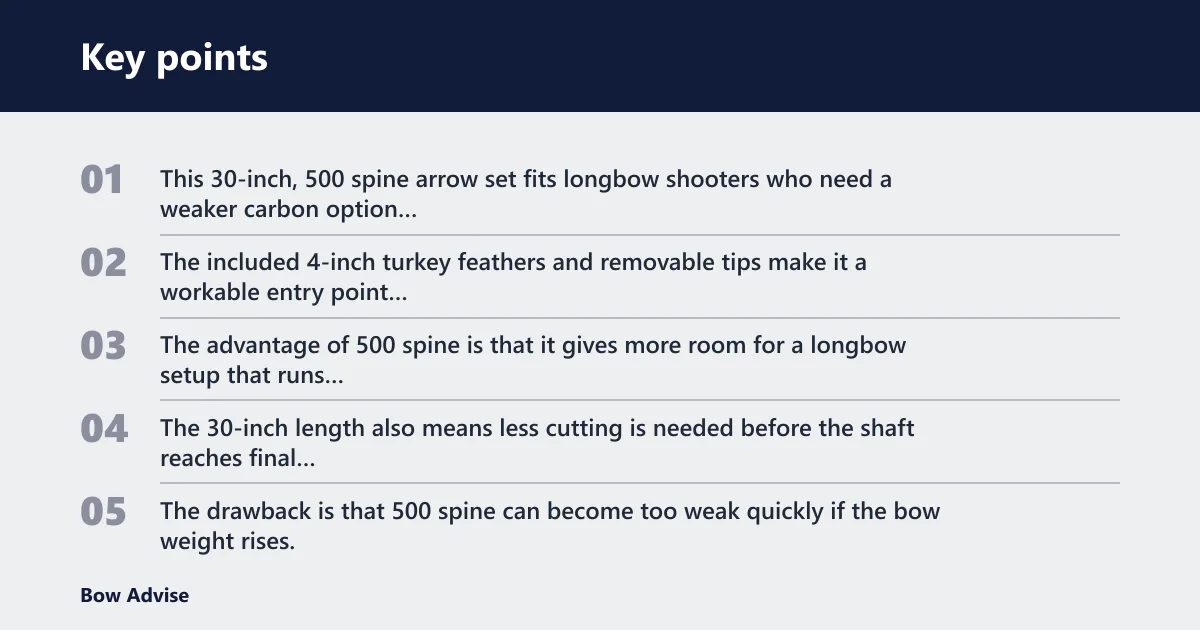
This 30-inch, 500 spine arrow set fits longbow shooters who need a weaker carbon option for moderate draw weight, shorter hunting-length arrows, or heavier point weights. The included 4-inch turkey feathers and removable tips make it a workable entry point for traditional setups that still want modern carbon consistency.
The advantage of 500 spine is that it gives more room for a longbow setup that runs weaker dynamically because of finger release, a heavier point, or a Fast Flight string. The 30-inch length also means less cutting is needed before the shaft reaches final length, which can help keep the dynamic tune closer to the starting chart.
The drawback is that 500 spine can become too weak quickly if the bow weight rises, the point weight climbs, or the shaft is left long. That makes it a better fit for lighter and midrange setups than for harder-hitting longbows with broadheads.
RUOERSISI spine tester: best for setup checks
This adjustable spine tester is for archers who want to sort shafts before final building, rather than guessing from printed labels alone. It is useful when matching a batch of carbon shafts to one longbow setup, especially if the plan includes different point weights or a Fast Flight string.
The main advantage is simple: it helps compare shaft behavior in a repeatable way before arrows are fletched and cut. That matters because static spine is only one part of the decision, and small differences between shafts can matter in a longbow setup where dynamic spine is already sensitive to length and release style.
The drawback is that a tester does not replace a real chart for the exact shaft family, and it does not tell the whole tuning story by itself. It is a setup tool, not a final answer for hunting flight.
Easton chart family: best for standard carbon shafts
Use the exact Easton product-family chart for the shaft you plan to buy. That matters because Easton-style charts are built around specific shaft families, and a selector for one line should not be treated as interchangeable with another maker’s carbon arrows.
For longbows, the useful part of an Easton chart is the starting band, then the adjustment for real draw weight, arrow length, and point weight. A 45 lb recurve example with a 125 grain point moves to a 48 lb chart weight, and at 29-inch cut shaft length that example lands in a 400-350 spine range. A longbow of similar actual draw weight may still start one step weaker because of finger release.
The limit is that a chart alone cannot see your shelf height, string speed, or broadhead choice. It gets you close. It does not finish the tune.
Gold Tip chart family: best for heavier point builds
Gold Tip-style selectors are useful when the build leans toward heavier points and a traditional hunting head. Heavier points make the shaft act weaker, so a 125, 150, 175, or 200 grain setup can move the answer noticeably compared with a 100 grain field point.
That makes these charts useful for broadhead plans, where a longbow archer often wants a shaft that bareshafts cleanly with hunting points as well as target tips. A heavier point can bring a stiff shaft into tune, but it can also push a borderline shaft too weak if the arrow is already long.
The drawback is the same one found in other brand charts: the family matters. Use the exact Gold Tip product line, not a generic carbon chart copied from somewhere else.
Longbow spine decision table
This table gives a longbow-specific first call for modern carbon arrows. It uses actual draw weight, arrow length from nock throat to shaft end, point weight, and whether the bow uses a Fast Flight-type string. “Stiffer” means move one spine group lower; “weaker” means move one spine group higher.
| Actual draw weight | Arrow length | Point weight | String type | First spine move |
|---|---|---|---|---|
| 20–25 lb | 27 inches | 100–125 grain | Dacron or similar | Start around 700; move weaker if arrows are long |
| 30–35 lb | 28–29 inches | 100–125 grain | Dacron or similar | Start around 600; stay put unless flight is stiff |
| 35–40 lb | 29–30 inches | 125 grain | Dacron or similar | Start around 500; move weaker with longer shafts |
| 40–45 lb | 29–30 inches | 125–150 grain | Dacron or similar | Start around 500 or 400; choose weaker if broadheads are planned |
| 45–50 lb | 29 inches | 100–125 grain | Dacron or similar | Start around 400; move weaker if the shaft stays long |
| 45–50 lb | 29–30 inches | 150–175 grain | Fast Flight or similar | Start around 400; the string may pull you one step weaker |
| 50–55 lb | 29–30 inches | 125–150 grain | Fast Flight or similar | Start around 400; move weaker only if the setup is very long |
| 55–60 lb | 29 inches | 100–125 grain | Dacron or similar | Start around 350; stay stiffer if broadheads plan to be light |
| 55–60 lb | 29–30 inches | 150–175 grain | Fast Flight or similar | Start around 400 to 350; lean weaker if the shaft is long |
| 60–65 lb | 29 inches | 100 grain | Fast Flight or similar | Start around 350; move stiffer only if arrows are short |
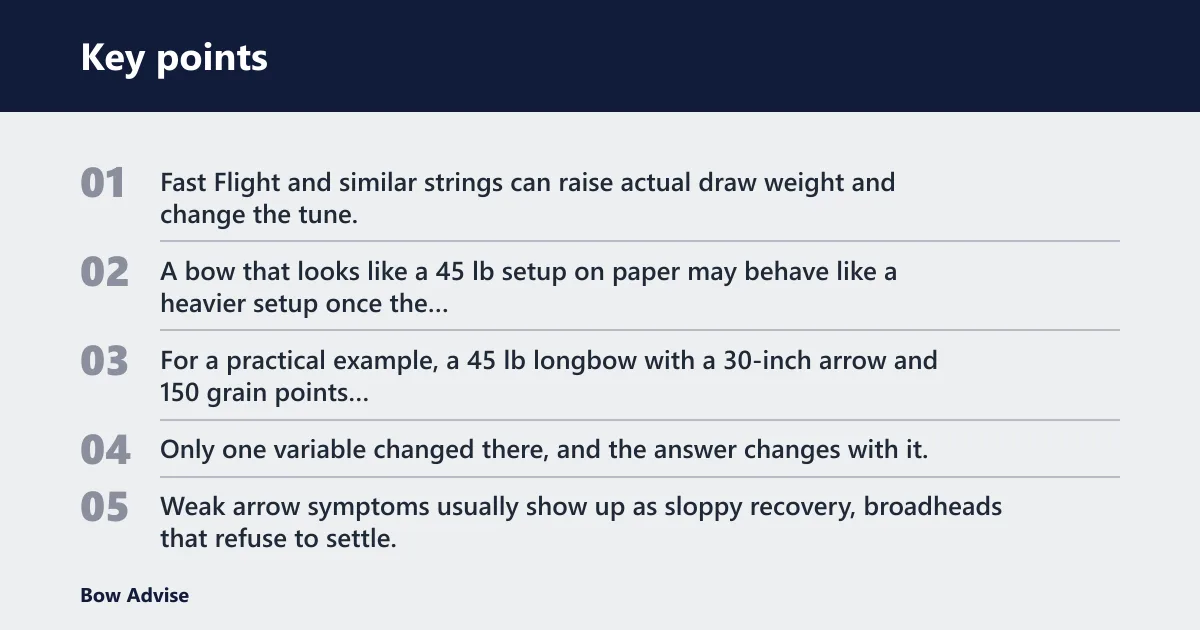
Fast Flight and similar strings can raise actual draw weight and change the tune, so they deserve a place in the first decision. A bow that looks like a 45 lb setup on paper may behave like a heavier setup once the string is installed and the holding weight changes.
Only one variable changed there, and the answer changes with it.
Weak arrow symptoms usually show up as sloppy recovery, broadheads that refuse to settle, and a shaft that seems to whip too much through the shot. Stiff arrow symptoms are different: flight can look harsh, groups can shift in the opposite direction of a weak tune, and bare shafts can behave as if they are not recovering enough.
Impact direction depends on handedness and the rest setup, so it should never be treated as universal. Use it as a clue, not a final verdict.
Which one should you buy?
Pick the Toparchery carbon shafts if you want a budget-friendly starting shaft and plan to cut and tune around a longbow setup. The 350 spine gives a stiffer option that fits many midweight traditional setups once arrow length and point weight are set.
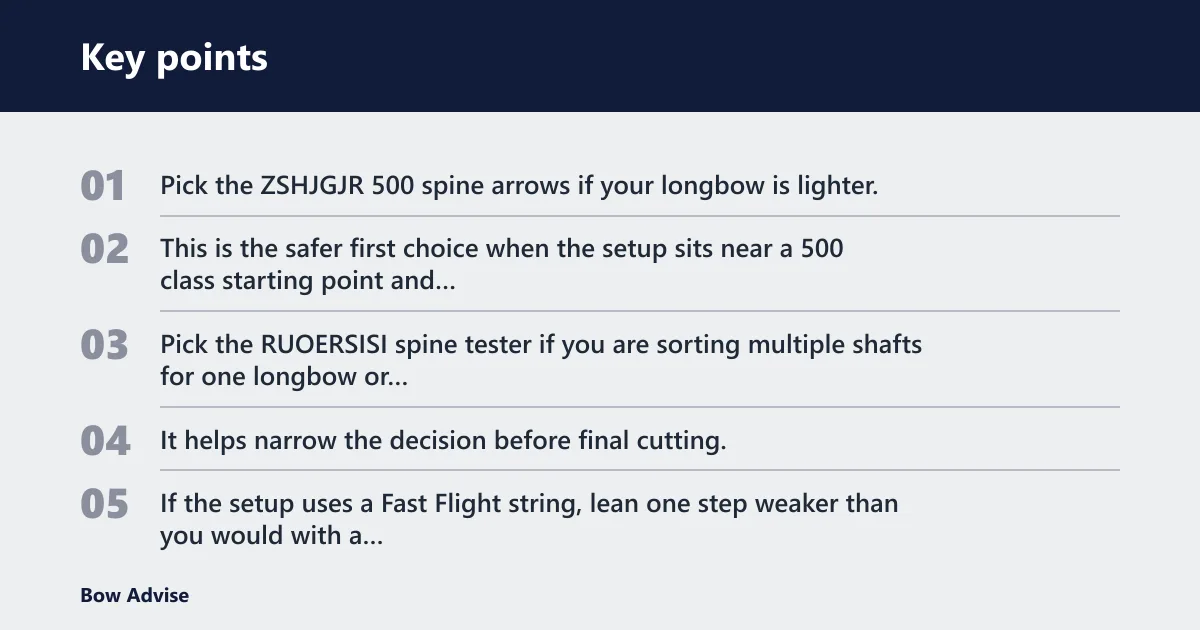
Pick the ZSHJGJR 500 spine arrows if your longbow is lighter, your arrow length is longer, or your point weight is moving the tune weaker. This is the safer first choice when the setup sits near a 500 class starting point and you want feathers and removable points included.
Pick the RUOERSISI spine tester if you are sorting multiple shafts for one longbow or building arrows in batches. It helps narrow the decision before final cutting, which is useful because traditional bow setups change with small length and point changes.
If the setup uses a Fast Flight string, lean one step weaker than you would with a softer traditional string. If the shaft is short or the point is light, lean one step stiffer. If the archer wants broadhead use, favor the shaft that bareshafts cleanly rather than the one that looks perfect only with field points.
Say your bow is 45 lb at your draw length, your arrow cut ends at 30 inches, and you plan to shoot 150 grain points. That setup is a better candidate for a weaker shaft than a short 29-inch arrow with 100 grain points, even though the bow label did not change. The longer shaft and heavier point did the work.
Frequently asked questions
What spine should I use for a longbow with carbon arrows?
Start with actual draw weight, then move one to two spine groups weaker than a recurve of the same weight if the arrow is long or the point is heavy. That is a safer first guess for a finger-shot longbow, because dynamic spine changes with release style, arrow length, point weight, and string material.
How does arrow length change spine for a longbow?
That means a 30-inch shaft will usually need more stiffness than a 29-inch shaft of the same model if every other detail stays the same. Measure from nock throat to shaft end before making the call.
What point weight works best with a longbow and carbon arrows?
For a longbow, 125 grain is a common middle starting point, while 150 grain and above are useful when the shaft needs help tuning weaker for broadheads or longer arrows.
How do I know if my longbow arrows are too stiff or too weak?
Too weak arrows usually show excessive flex, poor recovery, and broadheads that never settle well. Too stiff arrows often look harsh in flight and may not recover cleanly through the shot. Impact direction can vary with handedness and setup, so treat that as one clue, not the whole diagnosis.
What spine range should I start with for a 45 lb longbow?
For a 45 lb longbow with modern carbon arrows, a common starting band is around 400 spine, then adjust for arrow length and point weight.
How do Fast Flight strings affect arrow spine on a longbow?
Fast Flight and similar strings can change actual draw weight and alter the dynamic tune, so they should be treated as part of the spine decision. In practice, that often means a longbow may need one step weaker than the same bow with a softer traditional string, especially with long arrows or heavy points.