Signs Your Arrows Are Too Stiff or Too Weak for Your Bow
If arrows group left for a right-handed archer, weak arrows are usually too weak; right impact usually means arrows are too stiff, but confirm with bare-shaft, walk-back, and contact checks. Guessing wrong can hide tune problems, waste arrows, and keep poor flight patterns in the setup. This guide shows the clearest signs of each, plus the tests that separate spine mismatch from rest, timing, and form.
What arrow spine means
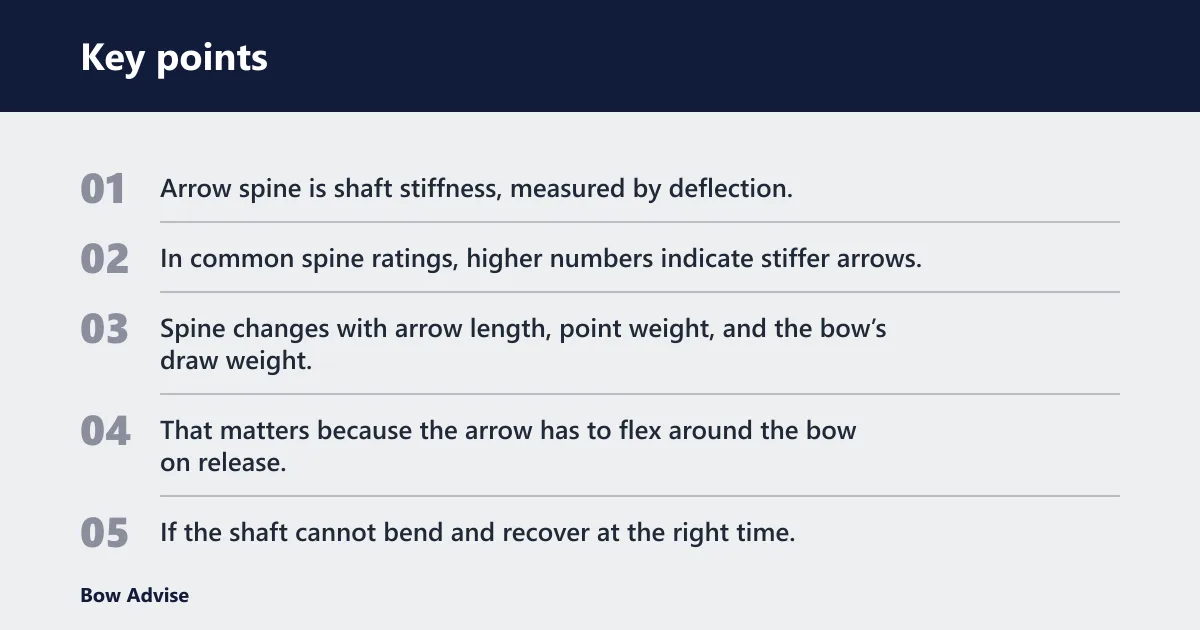

Arrow spine is shaft stiffness, measured by deflection. In common spine ratings, higher numbers indicate stiffer arrows, while lower numbers indicate weaker shafts. Spine changes with arrow length, point weight, and the bow’s draw weight, so a label alone does not tell the whole story.
That matters because the arrow has to flex around the bow on release. If the shaft cannot bend and recover at the right time, the arrow may not clear the bow cleanly, and that hurts flight and grouping.
ATA and ASTM spine standards
Spine numbers are not guessed; they are measured under standard conditions. The ATA spine test uses supports 26 inches apart and a 2-pound center load. ASTM is used for carbon and aluminum according to source context. Those systems help compare shafts, but they do not replace real setup tuning.
That is why two arrows with the same spine label can still behave differently once length, point weight, insert weight, and bow setup enter the picture. A spine chart can point you in the right direction. It cannot solve contact or form problems by itself.
Signs your arrows are too stiff
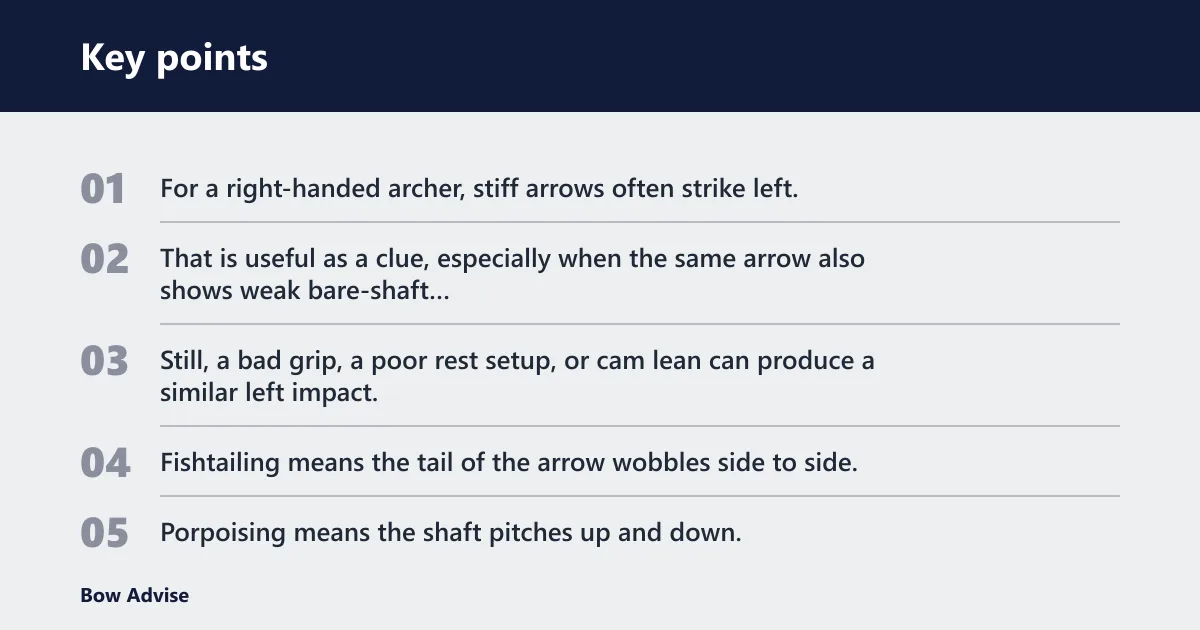
A too-stiff arrow often shows a left impact for a right-handed archer, but that clue is not proof on its own. Stiff shafts can also show fishtailing or porpoising, and in some setups the bow’s contact or release error can make the arrow look weaker than it really is.
Common impact pattern for right-handed archers
For a right-handed archer, stiff arrows often strike left. That is useful as a clue, especially when the same arrow also shows weak bare-shaft recovery or broadhead instability. Still, a bad grip, a poor rest setup, or cam lean can produce a similar left impact.
Fishtailing, porpoising, and broadhead clues
Fishtailing means the tail of the arrow wobbles side to side. Porpoising means the shaft pitches up and down. Those patterns can point to a spine mismatch, but they can also come from contact or timing issues. Broadheads often make the problem easier to see because they react to small steering errors faster than field points do.
A too-stiff arrow can also lose energy and speed. That does not always show up as a dramatic impact shift. It may simply group poorly, recover late, or fail to settle cleanly after release.
Why a stiff arrow can still seem confusing
Here is the trap: a stiff arrow can appear to act weak in some setups. If the shaft is contacting the rest, if the bow is out of tune, or if the release adds torque, the flight picture can mimic weak spine. That is why impact alone should never be the only test.
Suppose a right-handed compound archer moves from a 125-grain field point to a lighter point and still sees left impact. The lighter point should stiffen dynamic spine, so a persistent left tear points toward another issue such as contact, cam timing, or grip torque rather than simple spine choice.
Signs your arrows are too weak
A too-weak arrow usually flexes too much, and for a right-handed archer it may veer right. Weak arrows can wobble, stray off course, and group poorly. Broadheads may expose the issue even when field points look acceptable at close range.
Common impact pattern for right-handed archers: for a right-handed archer, weak
For a right-handed archer, weak arrows often hit right. That pattern is helpful when it matches the rest of the evidence. It is not proof by itself, because center-shot error, release error, and bow torque can also push impact right.
Excess flex, wobble, and poor grouping
Weak arrows bend too much during launch. The shaft may recover late, and the result is a wandering tail, rough grouping, or inconsistent downrange stability. If the setup is marginal, the arrow may never settle into clean flight, even if the point impact looks close at short distance.
A broadhead can make a weak setup obvious. The fixed blades catch air and amplify the arrow’s steering errors. Field points may hide some of that, especially at shorter distances, which is why a clean field-point group does not always mean the spine is right.
How do I tell spine from tuning problems?
Start by separating shaft behavior from bow behavior. A left or right impact pattern is a clue, not a verdict. Grip torque, release error, rest contact, and cam lean can all mimic spine issues or flip what the shaft is doing in flight.
Grip torque and release errors
Torque changes where the string leaves the fingers or how the bow rotates in the hand. A poor release can make a good shaft look wrong. If one shot is left, the next right, and the setup changes little else, the problem may be the shot rather than the arrow.
A common first-timer mistake is to treat every left tear as stiff spine. Then the archer buys weaker shafts, the bow still tears, and the real issue remains. That wastes time because the shaft change was aimed at the wrong cause.
Rest contact and cam lean
Rest contact can push the nock-end and give a false read. So can cam lean on a compound bow. If the arrow is touching anything during launch, the shaft may display symptoms that look like a spine mismatch even when the arrow choice is close.
When field points hide the problem
Field points often hide marginal spine issues because they are forgiving. Broadheads are less forgiving and usually reveal poor tune sooner. If field points group well but broadheads plane or open up, do not assume the spine is fine. Check the bow setup, then the shaft, then the shooter.
How to use a bareshaft test
Bareshaft testing is one of the clearest ways to diagnose spine and tune because it shows what the nock end is doing without the point and fletching smoothing the flight. It works best when form is consistent and the bow is already close to basic tune.
What bare shaft behavior tells you
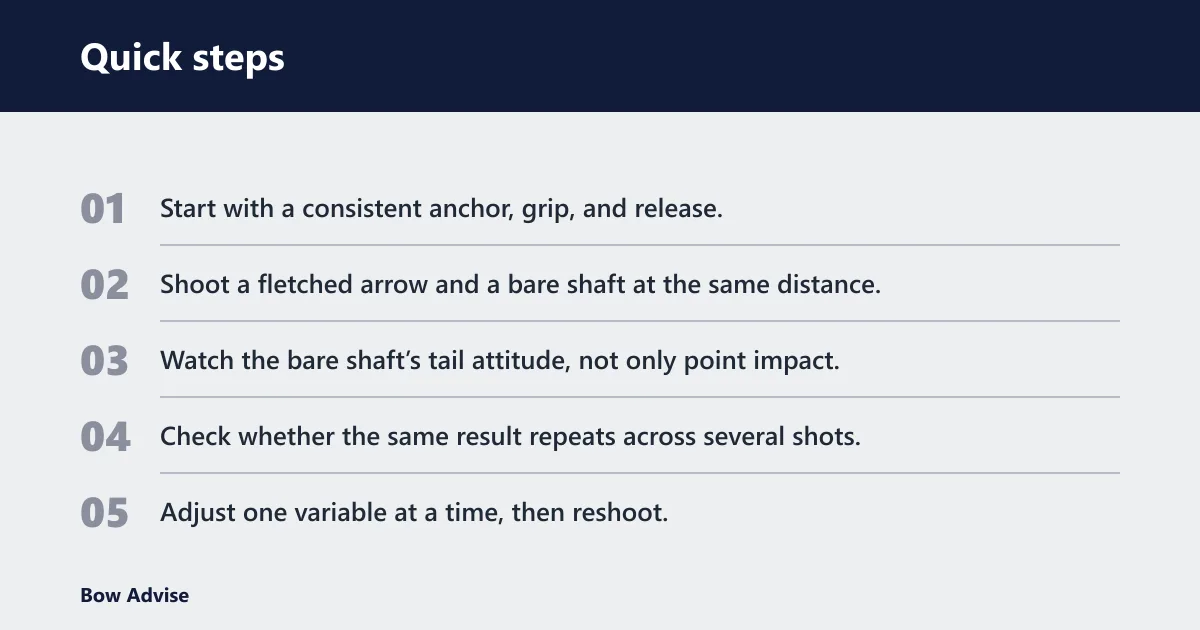
A bare shaft that lands with a clean, repeatable reaction is a useful sign. A bare shaft that kicks, yaws, or lands far from the fletched group points toward a setup issue, a spine mismatch, or both. The key is pattern, not one stray shot.
- Start with a consistent anchor, grip, and release.
- Shoot a fletched arrow and a bare shaft at the same distance.
- Watch the bare shaft’s tail attitude, not only point impact.
- Check whether the same result repeats across several shots.
- Adjust one variable at a time, then reshoot.
Why consistent form matters
If form changes shot to shot, the test loses meaning. A bare shaft is unforgiving. Small errors show up fast. That is useful only when the archer can repeat the same shot. Without that consistency, the test may blame the arrow for a release problem.
When paper tuning can mislead
Paper tuning can help, but it can also mislead if the bow is not already set up well. A clean paper tear does not guarantee the arrow is tuned for broadheads or field use. A messy tear does not always mean the shaft is wrong. It can mean the bow still needs contact or timing work.
For compound bows, paper and bare-shaft checks are most useful after the rest, nock point, and timing are close. For recurve and traditional bows, bare shaft and walk-back style checks often give a better read when the archer can keep form repeatable.
Arrow spine troubleshooting matrix
This matrix separates what you see from what it likely means. Use it to decide what to test first, not to declare a final diagnosis from one shot. The best answer comes from matching impact, bare-shaft behavior, and broadhead behavior together.
| Symptom | Left/right impact pattern | Bare shaft behavior | Broadhead behavior | Likely cause | One adjustment to try first |
|---|---|---|---|---|---|
| Arrow lands left for a right-handed archer | Left | Tail kicks right or shows weak recovery | Broadheads plane left or group apart from field points | Arrow too stiff or bow contact pushing the read false | Check rest contact and then test a heavier point |
| Arrow lands right for a right-handed archer | Right | Tail kicks left or shows excess bend | Broadheads steer right or open groups | Arrow too weak or bow setup too aggressive for the shaft | Check point weight and then test a shorter shaft if allowed |
| Field points group well, broadheads do not | May be centered | Small but repeatable tail error | Broadheads group off line | Marginal spine, rest contact, or tune state hiding under field points | Verify center shot and recheck bare shaft at the same distance |
| Groups change after a poundage change | May shift either way | New tail reaction after draw weight change | Broadheads no longer match field points | Bow draw weight no longer matches the spine choice | Retune the bow before changing arrows |
| Good close-range paper but poor downrange stability | May be unclear | Wobble grows with distance | Broadheads drift more than field points | Release or spine mismatch that only shows at distance | Move to a bare-shaft check with the same setup |
What changes arrow spine?
Three setup choices matter most here: arrow length, point weight, and bow draw weight. These change dynamic spine, which is the shaft’s real behavior in the bow, not just the label printed on the arrow.
Arrow length
Longer arrows are weaker. Shorter arrows are stiffer. That is why a shaft cut to a different length can move from acceptable to marginal without any other change. Length is one of the first things to confirm before blaming the spine label.
Say a 30-inch shaft groups well, but a longer cut of the same shaft starts to kick and drift. The longer version acts weaker because it bends more easily. The spine rating did not change, but the working stiffness did.
Point weight
Heavier points tend to weaken dynamic spine. Lighter points stiffen dynamic spine. That change can be enough to turn a clean setup into a marginal one, especially if the bow was already near the edge of the acceptable range.
BOWSOUL shafts are listed at 30 inches with a 31.5-inch overall arrow length, and they use 100-grain nickel-plated steel tips. Those details matter because shaft length and point weight both affect how the arrow behaves after release.
Bow draw weight
Bow draw weight must match spine selection. If poundage rises, the same shaft may become too weak. If poundage drops, the same shaft may act too stiff. That is why a bow change can create a mismatch even when the arrows themselves did not change.
The spine chart itself uses draw weight, draw length, and arrow length. That is only a starting point, though. The chart gets you close; the bow’s actual tune decides whether the arrow is truly matched.
Does bow type change the diagnosis?
Yes. The same symptom can mean different things on a compound, recurve, or traditional bow. The impact clue is still useful, but the tuning path and the kinds of errors that imitate spine problems are not the same.
Compound bow signs
On a compound, rest contact, cam lean, and timing can distort the read. A right-handed archer may see left impact from stiff shafts, but a bad rest setup can create the same picture. Broadhead testing and bare shaft checks are especially useful here once the bow is close to tune.
Recurve and traditional bow signs
On recurve and traditional bows, the archer’s release has a bigger effect on the arrow’s launch. A bare shaft often tells more than a field-point group does. If the arrow is too stiff or too weak, the flex pattern can show up fast because there is less mechanical forgiveness in the system.
SHENG-RUI arrows are also listed with a 500 spine rating, and the 26-inch carbon hunting arrows are listed as 500 spine too. That does not mean they behave the same in every bow. Length, point weight, and bow draw weight still decide the final result.
Frequently asked questions
How do I know if my arrow spine is too stiff?
A too-stiff arrow often hits left for a right-handed archer, but that clue alone is not enough. Look for stiff bare-shaft behavior, poor broadhead grouping, or a tail that recovers badly. Then rule out rest contact, cam lean, and release error before changing shafts.
How do I know if my arrow spine is too weak?
A too-weak arrow often hits right for a right-handed archer and may wobble, group poorly, or show broadhead instability. If the arrow flexes too much and the pattern repeats with a consistent shot, the shaft may be too weak for the bow setup.
What does a stiff arrow hit like for a right-handed archer?
It often impacts left, but that is a clue rather than proof. If the same setup also shows poor bare-shaft recovery or broadhead planing, the arrow may be too stiff. If contact or torque is present, the impact pattern can mislead.
What does a weak arrow hit like for a right-handed archer?
It often impacts right, and it may also show excessive flex or wandering flight. That said, right impact can also come from release error or setup problems. Confirm with bare-shaft behavior and a contact check before changing to a weaker shaft.
Can a too-stiff arrow still tune okay with field points?
Yes. Field points can hide a marginal spine problem, especially at shorter distance or on a forgiving setup. Broadheads usually expose the weakness sooner. If field points group but broadheads drift or plane, do not assume the spine is fine yet.
How do draw weight, arrow length, and point weight change spine?
Higher draw weight can make a shaft act weaker, longer arrows are weaker, and heavier points weaken dynamic spine. Shorter arrows and lighter points do the opposite. Those three changes often matter more than the printed spine number once the bow is set.