Arrow Spine Chart for Beginners: How to Pick Your First Arrows
Start by measuring the bow’s actual draw weight and draw length, then match the arrow family. If the chart lands between two spines, choose the stiffer shaft for the first setup. Choosing the wrong spine can lead to poor groups, tuning problems, and bent or broken arrows. This guide lays out the order beginners should follow to read an arrow spine chart and buy the first arrows with less guesswork.
What arrow spine means and why it matters
Arrow spine is a shaft’s stiffness rating. Lower numbers mean stiffer arrows. That rating matters because the shaft must flex around the bow, then straighten cleanly in flight. If the spine is off, the arrow leaves the bow in a poor state and groups suffer.
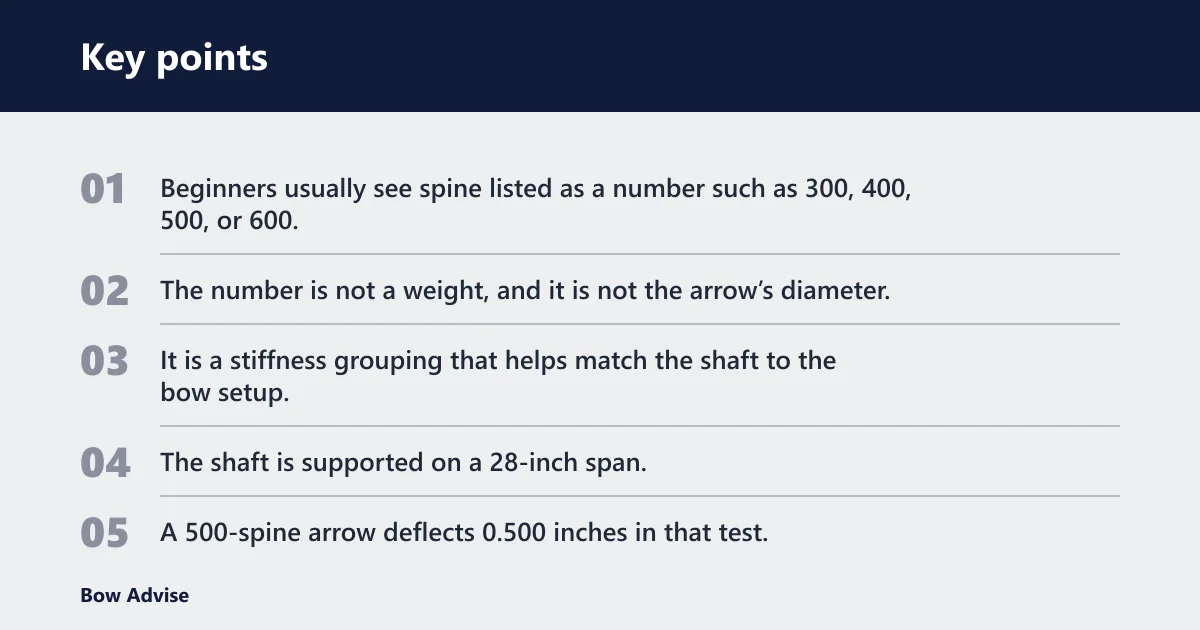
Beginners usually see spine listed as a number such as 300, 400, 500, or 600. The number is not a weight, and it is not the arrow’s diameter. It is a stiffness grouping that helps match the shaft to the bow setup.
Static spine versus dynamic spine
Static spine is the standardized bench test. The shaft is supported on a 28-inch span, then a 1.94-pound weight is applied and the deflection is measured. A 500-spine arrow deflects 0.500 inches in that test. Dynamic spine is how the arrow actually behaves during the shot, and that changes with bow setup and release style.
That difference is why two arrows with the same static spine can behave differently. Point weight, arrow length, bow type, and release style all affect dynamic spine. Static spine gets you in the right neighborhood. Dynamic spine is what the shot really cares about.
A manufacturer spine chart is the first filter, not the final answer. It usually uses draw weight, arrow length, and point weight, and many charts assume a standard point weight. The chart must match the exact arrow family, because different shafts in the same broad brand line can tune differently.
Many manufacturers provide an arrow selector or spine selector. Use it. Then check the fine print for the exact shaft family, the point weight used for the chart, and whether the chart is built around carbon, aluminum, or a hybrid shaft.
Why brand charts are not interchangeable
Do not borrow a chart from one arrow line and apply it to another. Wall thickness, shaft construction, and material all change how a shaft reacts. A carbon shaft, an aluminum shaft, and a hybrid carbon-aluminum shaft can all land differently even when the printed spine number looks similar.
That matters most for first-time buyers. A chart for one family may be close, but close is not the same as correct when you are trying to avoid the wrong first purchase.
What draw weight should you use?
Use the bow’s actual measured draw weight, not the label value. For recurves and traditional bows, measure at the fingers. For compounds, use peak draw weight, not holding weight. That single distinction keeps beginners from choosing arrows that are too weak.
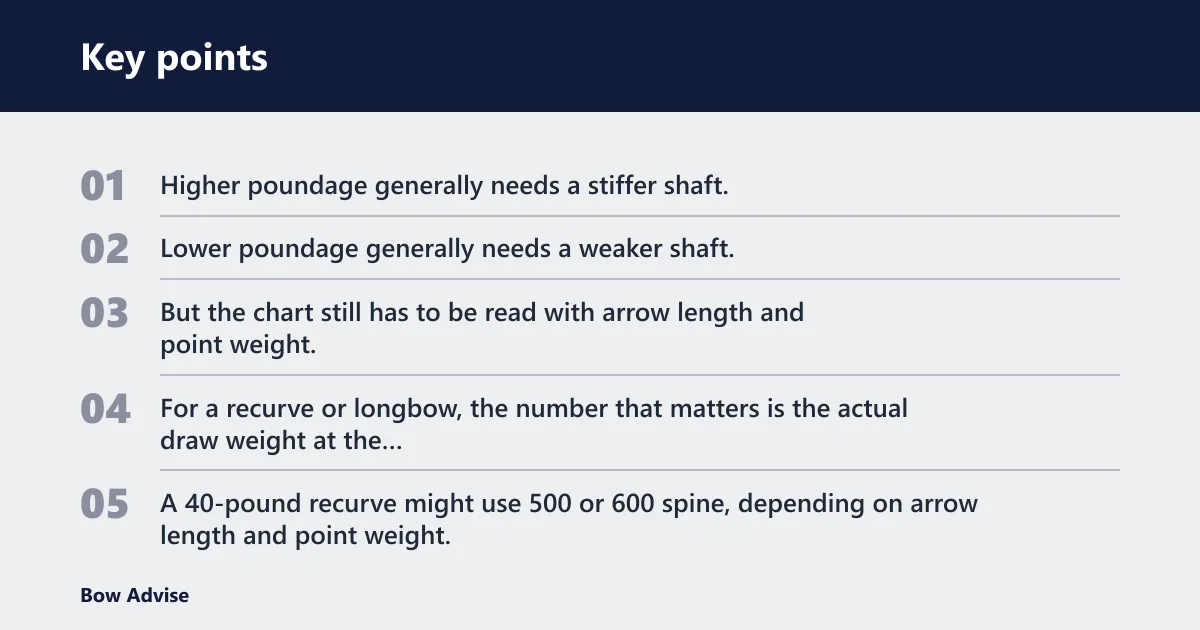
Higher poundage generally needs a stiffer shaft. Lower poundage generally needs a weaker shaft. But the chart still has to be read with arrow length and point weight, because those two inputs can move the answer enough to matter.
Recurve and traditional bows
For a recurve or longbow, the number that matters is the actual draw weight at the fingers at the archer’s draw length. A 40-pound recurve might use 500 or 600 spine, depending on arrow length and point weight. Compounds typically need stiffer spines than recurves.
Release style also matters. Finger release usually changes spine needs compared with a release aid, because the string leaves the fingers differently than it leaves a mechanical release.
Compound bows
For compounds, use peak draw weight. Not holding weight. That is the right input for the spine chart. A 70-pound compound with a 100-grain tip generally lands on 340 spine, and a 65-pound draw, 29-inch arrow, 100-grain point example likely uses 340 spine as well.
That does not mean every compound archer at those numbers should buy the same shaft without checking the exact chart. It means the starting point is in that neighborhood when the rest of the setup matches.
How draw length and arrow length change the choice
Draw length affects arrow length, and arrow length changes dynamic spine. Longer shafts flex more, so they act weaker. Many beginner arrows are often cut about 1 inch longer than draw length, which gives some safety room before trimming.
That extra length can move the chart choice. A shaft that looks fine at a shorter length may become too weak once it is cut long for safety or broadhead clearance. Keep the real cut length in view, not just the bow label.
Finished arrow length
For this guide, finished arrow length means carbon-to-carbon shaft length after cutting, not overall length with the point installed. That is the number many charts are trying to use. If a chart asks for arrow length, use the shaft length it expects and keep the point weight separate.
Picture a beginner with a 28-inch draw who orders arrows cut to 29 inches. If the chart was built for 28-inch shafts, the extra inch can weaken the dynamic spine enough to push the setup toward the next stiffer shaft.
How point weight changes spine
Point weight changes dynamic spine. A 100-grain point is a common baseline on many beginner charts. Heavier tips weaken dynamic spine, so they often push the setup toward a stiffer shaft. Adding 25 grains of point weight can weaken spine by about one step in some setups.
That shift is one reason broadhead planning should wait until the first setup is close. Beginners often buy hunting-style arrows before confirming tune, then discover the tip weight changed the answer. Start with the charted setup first.
When heavier points push you stiffer
If a chart says you are between two sizes, the heavier point usually nudges the arrow toward weaker behavior. If you already sit near the weak side of a spine group, that extra point weight can make the shaft act too soft. The safer move is usually the stiffer spine.
Say your chart lands between 500 and 600 spine with a 29-inch shaft and a 125-grain point. Choosing 500 is often the safer first step, because the heavier point already weakens the dynamic spine.
Beginner spine decision table
This table gives a beginner-safe starting point. Use the exact arrow family’s chart first, then compare your setup to the closest row. If your setup falls between two spine groups, choose the stiffer option unless the manufacturer chart clearly points weaker.
| Bow type | Measured draw weight | Finished arrow length | Point weight | Recommended starting spine | Between-sizes note |
|---|---|---|---|---|---|
| Compound | 50-55 lb peak | 28-29 in | 100 gr | 400 spine | Choose stiffer if between 400 and 500 |
| Compound | 60-65 lb peak | 28-29 in | 100 gr | 340 spine | Choose stiffer if between 340 and 400 |
| Compound | 60-65 lb peak | 29-30 in | 125 gr | 300 spine | Choose stiffer if between 300 and 340 |
| Recurve | 30-35 lb at the fingers | 28-29 in | 100 gr | 600 spine | Choose stiffer if between 600 and 700 |
| Recurve | 35-40 lb at the fingers | 28-29 in | 100 gr | 500 spine | Choose stiffer if between 500 and 600 |
| Traditional/longbow | 30-35 lb at the fingers | 29-30 in | 100 gr | 600 spine | Choose stiffer if between 600 and 700 |
These rows are starting points, not universal rules. A longer shaft, heavier point, or finger release can move the dynamic spine weaker. A short compound setup with a release aid can move the other way and need a stiffer shaft than the table suggests.
Should beginners choose a stiffer or weaker spine?
Beginners should usually choose the stiffer shaft when the chart lands between two sizes. That is the safer default because a weak arrow can fishtail and impact right for right-handed archers, while too stiff arrows can impact left. The wrong spine also makes grouping harder.
If the manufacturer chart clearly points weaker, follow the chart. But when the setup sits between two spine groups and the chart is not decisive, stiffer is the safer first buy.
When a softer shaft may still fit
A softer shaft can still fit when the bow is light, the arrow is short, and the point weight stays near 100 grains. That combination reduces stiffness demand. But once the arrow gets longer or the point gets heavier, the setup often moves back toward a stiffer shaft.
Common first-timer mistake: buying the weak side of the chart because the number looks easier. That choice can work against the arrow the moment the shaft is cut long or the tip weight goes up.
Our picks by need
Traditional beginner carbon: Pinals Archery traditional carbon Arrows

Based on the manufacturer’s specs and published details, this carbon option gives beginners a clear spine range to work from: 300, 400, 500, and 600. The included 100-grain points fit the common chart baseline, and the 30-32 inch length range gives room for safe beginner trimming.
The drawback is that it is not a one-size-fits-all answer. A beginner still has to match the exact spine to the bow setup, and the 4 inch turkey feathers may not suit every compound rest or clearance setup. It is also a traditional-style arrow, so buyers should confirm it matches the bow type and release style.
Mistakes to avoid
Do not guess draw weight from the bow label. Measure the actual setup. Do not use holding weight on a compound. Do not treat brand charts as interchangeable. And do not buy hunting-point arrows before the first chart check is finished.
Another common mistake is ignoring arrow length. A shaft cut 1 inch longer than draw length may need a stiffer spine than the same shaft cut shorter. The beginner-safe order is always the same: measure the bow, choose the exact arrow family, then choose the stiffer side when the chart lands between sizes.
Suppose a new archer has a 35-pound recurve, a 29-inch finished shaft, and a 125-grain point. If the chart sits between 500 and 600, the heavier point and longer shaft both weaken dynamic spine. That is the kind of setup where the stiffer shaft usually keeps the first purchase safer.
If that still feels uncertain, stop before buying and compare the exact arrow family chart one more time. A pro shop can confirm the match in minutes, especially when point weight or cut length is still undecided.
Frequently asked questions
What is arrow spine and why does it matter?
Arrow spine is the shaft’s stiffness rating. Lower numbers mean stiffer arrows. It matters because the arrow must flex correctly during the shot. If the spine is off, the shaft can fly poorly, group inconsistently, and tune badly for the bow setup.
How do I read an arrow spine chart
Start with the exact arrow family, then match measured draw weight, arrow length, and point weight. Use the row that matches your setup closest. If the chart lands between two spine groups, choose the stiffer one unless the manufacturer chart clearly points weaker.
What spine arrows do I need for my draw weight?
Use the actual measured draw weight for your bow type. Recurves and traditional bows use draw weight at the fingers. Compounds use peak draw weight.
How does arrow length change spine selection?
Longer arrows act weaker because they flex more. That is why many beginner arrows are cut about 1 inch longer than draw length for safety. If your shaft is longer than the chart’s assumption, move toward the stiffer spine when the choice is close.
Can I use the same spine chart for any arrow brand?
No. The chart must match the exact arrow family. Different brands and even different lines within a brand can respond differently because of shaft construction and material. Use the manufacturer’s selector for the specific arrow you plan to buy.
Do compounds and recurves use the same spine chart
Not the same way. Compounds typically need stiffer spines than recurves, and compounds use peak draw weight while recurves use draw weight at the fingers. The chart inputs overlap, but the starting point and the tuning behavior are not identical.