Bowhunters Super Spine Chart Review: What to Use for Bows
A super spine chart is a first-pass filter. Start there, then move one spine stiffer when fixed-blade broadheads, bows over 60 pounds, or heavy points enter the setup. Wrong spine costs tune time, broadhead groups, and hunting confidence. This review breaks down how to read the chart for compound and recurve setups, then turns it into a practical buy-or-pass decision for fixed-blade arrows.
Verdict



For bowhunters, the chart matters most when you are building around real hunting variables: actual draw weight at draw length, finished arrow length, and front-end weight. A lower spine number means a stiffer shaft, so a 300 spine is stiffer than a 500 spine, and a 600 spine is more flexible. That rule sets the baseline, and the rest of the build shifts the final answer.
📊 Spine rating equals measured deflection in inches multiplied by 1,000. Source: Arrow Spine Chart: Recurve, Compound & Traditional (2026).
Specs at a glance
| What the super spine chart measures | Why it matters for hunting arrows |
|---|---|
| Static spine | Shows shaft stiffness before the bow’s speed, point weight, and length are added into the mix |
| Standard spine test | A 29-inch shaft is supported at two points 28 inches apart, then loaded with an 880-gram weight in the center |
| Spine rating system | Measured deflection in inches multiplied by 1,000 |
| 500 spine example | Deflects 0.500 inches under the standard test |
| Common hunting range | 300 spine is stiff, 600 spine is flexible |
| Best use | Choosing a safe starting point before verifying with actual flight and manufacturer selectors |
For a hunting build, three inputs do most of the work: actual draw weight, finished arrow length measured from nock throat to shaft end, and broadhead or point weight. Heavier front ends weaken dynamic spine. Longer shafts do the same. Faster compound setups can also increase dynamic spine demand.
Who it is for
This chart is for compound bowhunters setting up fixed-blade hunting arrows, recurve and traditional bowhunters cutting shafts to length, and buyers comparing spine charts from Easton, Gold Tip, Victory, Carbon Express, and Black Eagle. It is most useful before an order goes in.
It is less useful as a final answer by itself. A chart cannot see bow speed, release style, insert mass, or whether a broadhead has a wide blade profile that makes tuning less forgiving.
What does the super spine chart actually tell you?
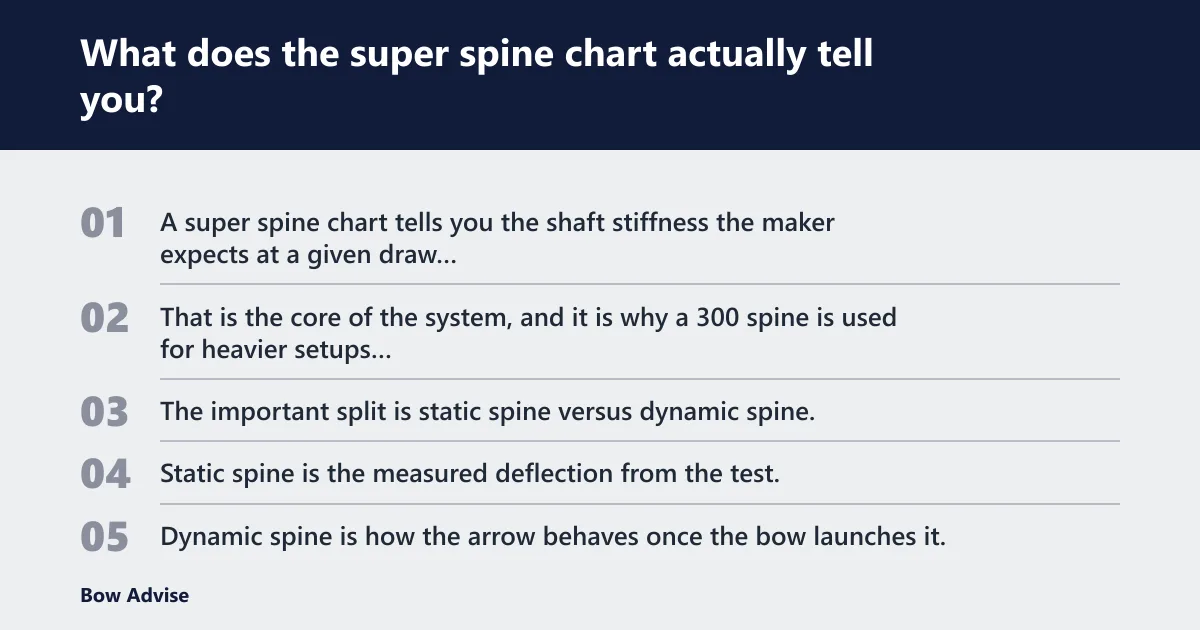
A super spine chart tells you the shaft stiffness the maker expects at a given draw weight and arrow length. Lower numbers mean stiffer shafts. That is the core of the system, and it is why a 300 spine is used for heavier setups while a 600 spine fits lighter or longer setups.
The important split is static spine versus dynamic spine. Static spine is the measured deflection from the test. Dynamic spine is how the arrow behaves once the bow launches it. Long shafts, heavy inserts, collar weight, and broadheads all make the arrow act weaker dynamically, even if the static label stays the same.
Why hunting setups change the chart result
Field points are more forgiving than fixed-blade broadheads. A shaft that looks acceptable on paper can still plane broadheads left, right, up, or down if it is dynamically wrong. That is why hunting charts should be treated as a starting point, not a final verdict.
Say your compound is set at 68 pounds, your finished arrow length is 30 inches, and you move from a 100-grain point to a heavier hunting head. The same shaft can move from acceptable to weak on impact. The chart did not change. The setup did.
How do you choose the right spine for a hunting setup?
Start with actual draw weight at draw length, not the bow’s label weight. Then measure finished arrow length from nock throat to shaft end. After that, add point weight, insert weight, and collar weight into the decision. Those front-end parts all push dynamic spine weaker.
The cleanest way to read the chart is to treat it like a filter. Use the bow type, draw weight, and shaft length to get in the right band. Then bias stiffer if the setup uses fixed-blade broadheads, heavier inserts, or a long cut length.
How to read the hunting inputs
- Measure actual draw weight at full draw.
- Measure finished arrow length from nock throat to shaft end.
- Choose the broadhead or point weight you plan to hunt with.
- Add insert and collar mass to the front-end total.
- Start with the chart band, then move one spine stiffer if the build is heavy up front.
Picture a common first-timer mistake: a bowhunter cuts arrows long for safety, then adds a fixed-blade broadhead and a heavy insert. The shaft looked fine on the chart at 29 inches, but at 30.5 inches with more front mass it can behave weak and refuse clean broadhead flight.
Bowhunting decision table
| Bow type | Draw weight band | Finished arrow length | Broadhead weight | Starting spine band |
|---|---|---|---|---|
| Recurve / traditional | 20-25 lbs | 27-28 inches | 100 grain | 700 to 600 |
| Recurve / traditional | 20-25 lbs | 29-31 inches | 100 grain | 600 to 500 |
| Recurve / traditional | 30-40 lbs | 27-29 inches | 100 to 125 grain | 500 to 400 |
| Compound | 30-45 lbs | 27-29 inches | 100 grain | 500 to 400 |
| Compound | 46-60 lbs | 28-30 inches | 100 to 125 grain | 400 to 350 |
| Compound | 70-80 lbs | 29-31 inches | 125 grain or heavier | 350 to 250 |
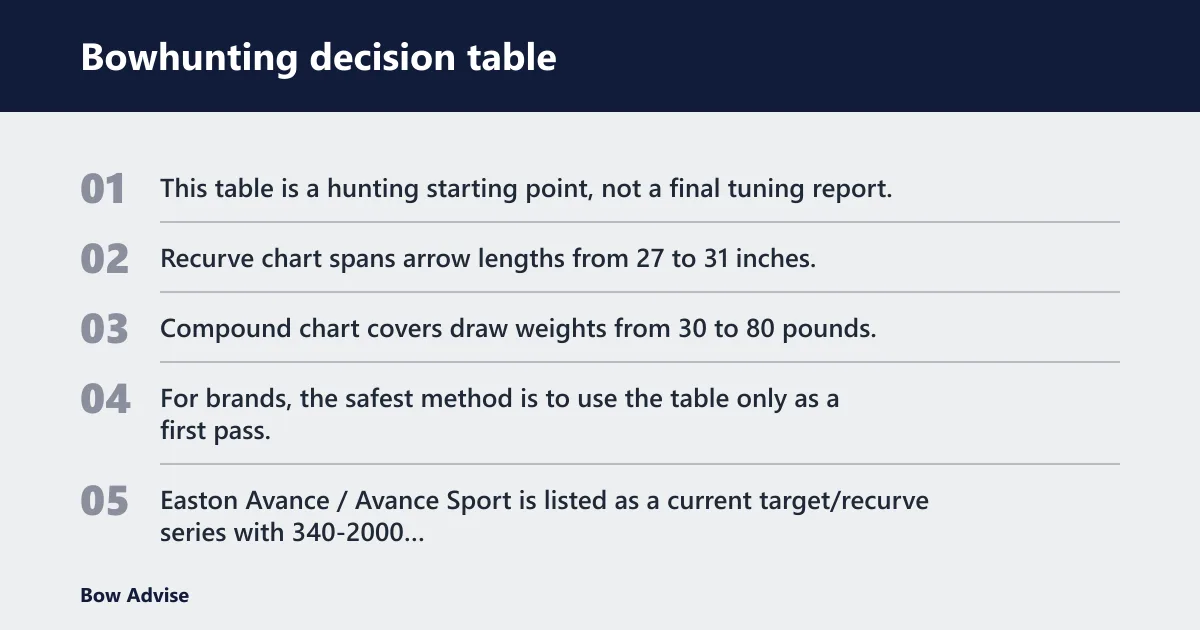
This table is a hunting starting point, not a final tuning report. Recurve chart spans arrow lengths from 27 to 31 inches, and the published recurve starts include 20-25 pounds using 700 to 500 spine depending on length. Compound chart covers draw weights from 30 to 80 pounds, and 70-80 pound setups are shown with 350 to 250 spine depending on length.
For brands, the safest method is to use the table only as a first pass, then confirm the exact shaft in the maker selector. Easton Avance / Avance Sport is listed as a current target/recurve series with 340-2000 spine. Gold Tip Traditional Classic is listed in the 340-600 spine range. Current models change, so verify before buying.
What works and what does not
What works
Where the chart helps most is narrowing the field before you spend money on arrows. It does a solid job of pointing a bowhunter toward the right stiffness family. It is especially useful when the setup is ordinary: moderate draw weight, standard cut length, and a 100-grain hunting point.
It also works well for comparing brands. Easton, Victory, Black Eagle, Carbon Express, and Gold Tip all label shafts by spine, but the exact product line and available cut lengths differ. A chart helps you compare the correct stiffness class before you sort out the series.
What does not
The chart does not account for every hunting variable. Fast compounds, long arrows, and heavy front ends can make an apparently correct shaft behave weak. Fixed-blade broadheads are less forgiving than field points, so a shaft that groups field points may still plane broadheads badly.
Too weak usually shows as broadhead impact drifting left for right-handed shooters, unstable flight, or a tail that kicks wide during bare shaft or paper checks. Too stiff usually shows as right impact for right-handed shooters, a stubborn tail-right reaction, or an arrow that refuses to settle without major rest changes.
Suppose a 70-pound compound is shooting a 30-inch arrow with a 125-grain broadhead and a heavy insert. The chart may point to a band that looks close, but broadhead flight may still punish a shaft that is even a little too weak dynamically. That is where stiffer starts to make life easier.
- Too weak symptoms: broadhead planing, unstable flight, tail left for right-handed shooters, shafts that react soft to tuning changes.
- Too stiff symptoms: broadhead impact right for right-handed shooters, tail right, difficult clearance and poor center-shot forgiveness.
- Neutral sign: clean flight with broadheads and field points grouped close with minimal rest correction.
What spine should I use for my draw weight and arrow length?
Use actual draw weight and finished arrow length together, then bias the choice based on the hunting head. Short, light-front-end arrows can sit in a stiffer band. Long shafts with heavier inserts and broadheads move weaker dynamically and usually need more spine.
As a practical rule, start where the chart says you should be, then choose the stiffer side of the range if your setup includes a fixed-blade broadhead or extra front-end weight. The chart is a filter. The build decides the final call.
How much does broadhead weight change arrow spine?
Broadhead weight changes dynamic spine because it increases front-end mass. That extra mass makes the arrow flex more on release, so the shaft behaves weaker. A 100-grain head is easier to tune than a heavier head, all else equal.
The effect grows when point weight, insert weight, and collar weight stack together. A fixed-blade head with more mass can push a setup out of the chart band even if the static spine number looks correct. That is why broadhead tuning can expose a borderline shaft faster than field points.
Are heavier front-end weights making my arrow weaker dynamically?
Yes. Heavier front-end weights make the arrow act weaker dynamically. That includes point weight, insert weight, and collar weight. The shaft still has the same static spine, but the launch behavior changes because the bow must accelerate more mass from the front.
For hunting, this matters because a more front-heavy arrow may fly fine with field points and still show broadhead planing. If the build already sits near the weak side of the chart, extra front mass can be enough to push it over the edge.
How do I confirm the right spine with Easton, Victory, or Black Eagle charts?
Confirm the current model selector first, then compare your actual draw weight, cut length, and point weight against that brand’s chart. Different makers label shafts differently, and current series can change spine options. Easton Avance / Avance Sport, for example, is listed in a very wide spine range.
The safest method is side-by-side: use the manufacturer’s selector, then compare the result against the bowhunting decision table here. If the setup includes a fixed-blade broadhead, heavy insert, or long cut length, move stiffer before ordering. That is the quickest way to avoid a weak-hunting shaft.
What spine should I use for compound hunting bows?
Compound bows usually want a stiffer starting point than many recurve setups at the same labeled draw weight, because speed raises dynamic spine demand. The published compound chart covers draw weights from 30 to 80 pounds, and 70-80 pound setups are shown with 350 to 250 spine depending on length.
For hunting, compound bows with fast cams, long arrows, or heavy front ends often need more stiffness than a casual chart reading suggests. Fixed-blade heads make that even more important. If the build is near the edge, choose stiffer first and verify by flight.
What spine should I use for recurve or traditional bowhunters?
Recurve and traditional bows often start with longer shafts and slower arrow speeds, so the chart reading is different from compound setups. The published recurve chart spans arrow lengths from 27 to 31 inches, and 20-25 pounds is shown using 700 to 500 spine depending on length.
For hunting, many recurve setups need careful attention to arrow length because a longer shaft behaves weaker. Fixed-blade heads and heavier points also push the shaft softer dynamically. If the bow is borderline, a shorter finished arrow or a stiffer shaft is usually the cleaner route.
Should you buy it
Buy around the chart if you are building a fixed-blade setup and want a sane starting point before tuning. It is best for bowhunters who already know their draw weight, can measure finished arrow length, and plan to verify with broadhead flight. It is also useful when comparing shafts across Easton, Gold Tip, Victory, Carbon Express, and Black Eagle.
Do not treat it as a substitute for tuning. If you change poundage, cut arrows shorter, or add front-end weight, re-check the spine band before ordering more shafts. For fixed-blade hunting, the safer move is usually to start slightly stiffer than the minimum and work back only if the arrow proves too stiff.
For the LEANPRO broadheads, the main plus is the 100-grain, 1-1/8-inch cut format with a vented design and standard 8-32 thread, which suits many compound hunting builds. The drawback is simple: a broadhead this style still demands a properly matched shaft, and a weak arrow will not tune itself. The Swhacker practice heads are useful for matching hunting weight and profile in tuning sessions, but they are practice points, not hunting heads, so they do not answer the spine question by themselves.
Frequently asked questions
What does a super spine chart mean for bowhunters?
A super spine chart is a starting map for shaft stiffness. It tells bowhunters which spine range fits a given draw weight and arrow length before dynamic factors are added. Because fixed-blade heads, insert mass, and shaft length all change behavior, the chart should guide the first buy, not the final tune.
How do I choose the right arrow spine for my bowhunting setup?
Use actual draw weight at draw length, then measure finished arrow length from nock throat to shaft end. Add point weight, insert weight, and collar weight. After that, choose the chart band and move stiffer if the setup uses a fixed-blade broadhead or extra front-end mass.
What spine should I use for my draw weight and arrow length?
Match the bow’s actual draw weight with the finished arrow length, not just the label on the bow. Shorter arrows can use a stiffer shaft, while longer arrows usually need more spine. If the setup is for hunting, a fixed-blade head often justifies choosing the stiffer side of the chart band.
How much does broadhead weight change arrow spine?
Broadhead weight matters because it changes dynamic spine. Heavier heads make the arrow act weaker. That effect grows when the insert and collar are also heavy, so a setup that looks fine with field points can show planing or unstable flight once a fixed-blade broadhead is installed.
Are heavier front-end weights making my arrow weaker dynamically?
Yes. Heavier point weight, insert weight, and collar weight all weaken dynamic spine. The arrow flexes more on release, so the same static spine label can behave softer. That is why front-end mass must be part of the buying decision, not an afterthought.
How do I confirm the right spine with Easton, Victory, or Black Eagle charts?
Use the brand’s current selector for the exact shaft family, then compare that result with your actual draw weight, arrow length, and point weight. Brand charts differ by series and can change over time. After that, verify the choice against hunting flight, especially if fixed-blade broadheads are part of the setup.