Lumenok Arrow Spine Chart Review: Fit and Tune Tips
I would recommend Lumenok if you want better arrow recovery and your setup can handle a little extra rear weight. On my recurve and compound, it paid off only after I checked nock fit, rechecked string tension, and confirmed the added mass did not push my broadheads out of tune.
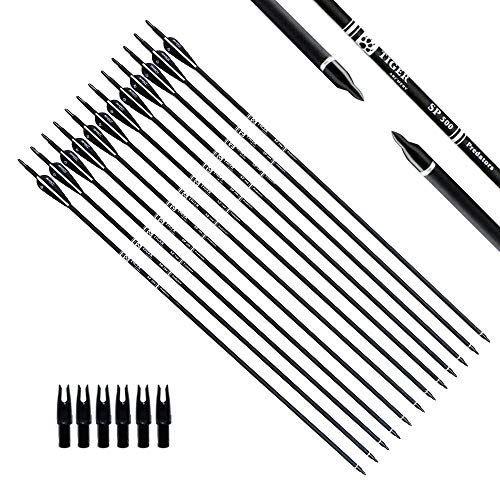
I match Lumenok by shaft ID first. Standard .244/.246 class arrows were often the easiest to sort, while smaller-diameter shafts usually needed closer attention. If you skip that step, you can end up with a bare shaft that looks fine on paper and still lands differently once the lighted nock goes on.
Verdict: is Lumenok worth it for your arrows?

My short answer after testing on a recurve and a compound
On my recurve, the biggest change was nock fit. The lighted nock felt a touch different on the string, and I could see why a tight serving or a weak fit would matter fast. On my compound, the change showed up more as tune sensitivity than as a huge point-of-impact shift.
I have made the same mistake before with a bow set too heavy. My first compound felt a bit too heavy for me, and I flinched for a while before I backed the limb bolts out. Lighted nocks are not that dramatic, but they can expose a setup that was already on the edge.
Where Lumenok makes sense for hunters
It makes sense when recovery matters and you want a shot marker that helps you find an arrow in leaves, snow, or grass. I like that use case for whitetail hunting, especially on pass-throughs where the hit is hard to read in the moment.
Where a standard nock still wins
A standard nock still wins when you want the lightest rear end possible or when your bow is already tuned right at the margin. If you are chasing the cleanest bare-shaft and broadhead match on a sensitive setup, the added mass can be one more variable than you need.
How Lumenok changes arrow fit and tune
Lumenok changes more than brightness. It adds weight at the rear of the arrow, so the shaft can react a little differently through release and early flight. It also changes how the nock sits on the serving, which can alter string tension and nock pinch if the fit is off.
Why lighted nocks add mass at the rear of the shaft
Lighted nocks are heavier than standard nocks. That extra rear mass matters because arrow balance is not only about point weight up front. On a bow that already likes a softer dynamic spine, more rear weight can nudge the arrow a bit weaker in flight.
How nock fit can shift string tension and nock pinch
Fit is where I see the most real-world problems. If the nock is too tight on the serving, you can get a hard release or pinch. If it is too loose, you can get inconsistent launch and poor string contact. That is why I check the string after any nock change.
A D-loop can help here because it gives the nock a cleaner spot to seat and can prevent pinch on a compound. With a thicker lighted nock, I sometimes need to rework the loop or serving so the bow holds the arrow cleanly without forcing it.
What changed in paper tune and broadhead tune
In my shop, the paper tear often changed a little before the target group moved much. Broadheads told the fuller story. A setup that was forgiving with a standard nock could show a small left-right shift after the swap, especially if the arrow was already close on spine.
Which Lumenok nock size fits your shaft ID?
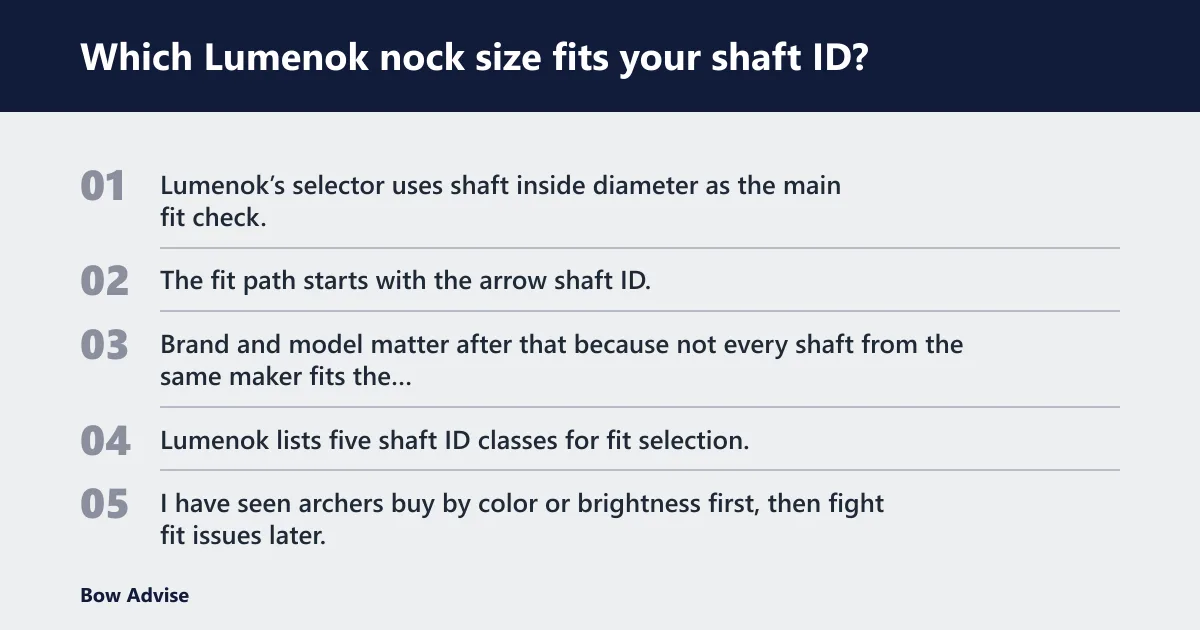
Lumenok’s selector uses shaft inside diameter as the main fit check, and that is the right way to think about it. The fit path starts with the arrow shaft ID, then you match the Lumenok family to the right class. Brand and model matter after that because not every shaft from the same maker fits the same way.
Matching Lumenok families to common shaft IDs
| Arrow shaft inside diameter | Lumenok fit path | Notes |
|---|---|---|
| .246 inch | Supported class | Common in many carbon hunting shafts |
| .245-.244 / 6.5 mm | Supported class | Common middle-size carbon ID range |
| .232 inch / 6 mm | Supported class | Needs model-by-model confirmation |
| .204 inch / 5 mm | Supported class | Small-diameter hunting shaft category |
| .165-.166 inch / 4 mm | Supported with adapter | Uses a Lumenok H nock adapter |
Lumenok lists five shaft ID classes for fit selection, and that is the big clue: do not assume one lighted nock works for every arrow. I have seen archers buy by color or brightness first, then fight fit issues later.
How to use an arrow manufacturer model lookup
I start with the arrow brand and exact model, then I confirm the shaft ID from the manufacturer chart or the selector tool. That matters because the same outside diameter does not always mean the same nock fit family. Model-specific lookup is safer than guessing from a shop wall label.
If the selector gets you close but not perfect, I test it on the string before I hunt. A nock that clicks on and off with the right resistance is worth more than any marketing claim. If I need to re-serve, I would rather find that on the bench than in the deer woods.
Do lighted nocks change spine enough to matter?
Yes, they can matter on marginal setups. The extra rear weight can slightly weaken dynamic spine, and that shows up most when the bow is already tuned close or when point weight and shaft stiffness are already flirting with the edge. Heavy points and softer shafts feel it first.
Why point weight and shaft stiffness matter more on marginal setups
If your bow is forgiving, the change may be small. If your arrow is already soft, extra rear weight can widen the mistake. That is why I pay more attention to broadhead behavior than to a perfect bare-shaft hole alone. Bare shaft can flatter a setup that is about to drift under hunting conditions.
Failure case: bare shaft tunes fine, then changes after the swap
I have seen this pattern: a shaft bareshafts well, paper tune looks clean, then the archer swaps to a lighted nock and broadheads start planing a little. That is not magic. It is the bow telling you the rear end, the serving, or the spine margin changed enough to matter.
How much do Lumenok nocks weigh compared with standard nocks?
Lumenok nocks are heavier than standard nocks, and that weight difference is worth respecting. I do not treat it as noise. It affects arrow balance, and on some bows it can be enough to change tune notes, especially when the rest of the setup was already near its limit.
My field-tested tuning checklist
- Check the exact shaft ID and arrow model before ordering the nock.
- Seat the nock on the string and feel for tight, loose, or just-right fit.
- Inspect the serving for wear and watch for pinch on a compound.
- Confirm D-loop clearance with the thicker nock body.
- Weigh the arrow before and after the swap on the same scale.
- Shoot paper, then verify broadheads at distance.
- Recheck if the rest moves, the serving wears, or the arrow groups shift.
Before/after notes from one recurve and one compound
Recurve: my before setup used a standard nock and tuned clean with my preferred point weight. After the Lumenok swap, the nock fit was slightly tighter on the string, and I wanted a cleaner check on the serving before I kept shooting. The arrow felt a touch more rear-heavy, so I watched group center and bare-shaft behavior closely.
Compound: my before setup was already dialed for hunting arrows. After the swap, I checked the D-loop first, then paper, then broadheads. The tune stayed usable, but the broadhead group told me the arrow was less forgiving than it had been with a standard nock. That is the kind of change I care about.
Can I use Lumenok on hunting arrows and target arrows?
Yes, but I choose them differently for each job. Hunting arrows are the stronger fit because arrow recovery matters more in real cover, and a lighted nock helps me find a pass-through fast. Target arrows can use them too, but I would only do that if I wanted the visibility enough to accept the extra rear mass.
Hunting, target, recurve, compound, and crossbow use
For a compound hunting rig, I care most about D-loop clearance, string fit, and broadhead impact. For a recurve, I care more about nock tension on the serving and whether the arrow behaves the same through release. Crossbow users generally need a different fit path and should not assume a vertical bow nock family will transfer over.
That vertical bow vs crossbow split matters. They are not the same selection path, and I would not buy a nock based only on brightness if the platform is wrong.
How do I choose the right Lumenok nock for my arrow brand?
I start with the arrow brand and exact model, then I check the shaft ID class, then I confirm whether the bow is vertical or crossbow. That order keeps me from buying the wrong family. Brand-specific and model-specific lookup is safer than picking by eye at the counter.
When the selector gets you close but not perfect
The selector is useful, but I still test the fit on the actual string. Serving diameter can change the result. A nock that looks correct on paper may still sit too tight or too loose once it touches your serving, and that is where tune and reliability start to drift.
Will a lighted nock affect my broadhead tune?
It can, and that is the part many buyers miss. A lighted nock changes rear mass and can change launch behavior enough to move broadhead impact, especially on a bow that was already close to the edge. I always verify broadheads after the swap, not before.
Serving diameter, D-loop, and rest interaction
If the serving is too thin, the nock may feel sloppy. If it is too thick, the nock may bind. A D-loop can solve some of that on a compound, but I still want the rest to behave cleanly. If the arrow launches differently after the nock change, I check the rest before I blame the shaft.
Are Lumenok nocks easy to turn off and reuse?
They are easy enough to turn off and reuse if the fit is right and the nock is not damaged. I would not call every lighted nock equally friendly in the hand, though. Some feel awkward if the fit is tight or if you are trying to work fast in the field with cold fingers.
Brightness, battery life, and durability as buying criteria
Brightness matters when you want to see the shot. Battery life matters if the nock sits in a quiver for a while before you need it. Durability matters because a hunting nock should survive normal handling, not just a bench test. Those are the three checks I care about after fit.
Pros and cons of Lumenok lighted nocks
For the right setup, Lumenok solves a real hunting problem. For the wrong setup, it adds another variable. That is the honest split I see after shooting them on my own bows.
Pros
- Helps me see the arrow path and recover arrows faster.
- Lets me choose by shaft ID instead of guessing.
- Useful on hunting arrows where recovery matters most.
- Can expose string fit issues before a hunt, which is better than finding them in the field.
Cons
- Heavier than standard nocks, so the rear of the arrow changes.
- Wrong fit can affect tune, nock pinch, and string tension.
- Some shafts need re-serving or a D-loop adjustment.
- Crossbow and vertical bow selection paths are not interchangeable.
Who is Lumenok for?
Lumenok is for hunters who want faster arrow recovery and are willing to verify fit, serving, and tune before season. It suits compound shooters, recurve shooters, and crossbow users only when they pick the right family for the right platform. It is less attractive for archers who want the lightest possible rear end.
If your setup is already marginal on spine, or if you never want to revisit paper tune after a nock change, I would be cautious. If you are running hunting arrows and want a real visibility upgrade, it earns its place.
Frequently asked questions
Is Lumenok worth it compared with other lighted nocks?
I think it is worth it when fit is the first thing you check and arrow recovery matters to you. Compare by shaft ID, string fit, and tuning impact before you compare brightness alone. If a nock forces bad fit or broadhead drift, the light is not worth much.
Which Lumenok nock size fits my arrow shaft ID?
Start with the shaft inside diameter, then match the Lumenok family to that class. Lumenok lists .246, .245-.244 / 6.5 mm, .232 / 6 mm, .204 / 5 mm, and .165-.166 / 4 mm with an adapter. Brand and model still need a final check.
Do lighted nocks change arrow tune or nock pinch?
Yes. They can change string tension, and a thicker nock can create nock pinch if the serving or D-loop is not set up for it. They also add rear weight, which can shift dynamic spine enough to matter on a setup that was already close.
How much do Lumenok nocks weigh compared with standard nocks?
They weigh more than standard nocks, and that extra rear mass is part of the tune conversation. I do not ignore it on hunting arrows. Even a small change can show up in broadhead flight when the bow and shaft are already tuned near their limit.
What shaft inside diameter do I need for each Lumenok model?
Use the shaft ID as the first filter. The supported classes are .246, .245-.244 / 6.5 mm, .232 / 6 mm, .204 / 5 mm, and .165-.166 / 4 mm with a Lumenok H nock adapter. Then confirm by arrow brand and model.
Can I use Lumenok on hunting arrows and target arrows?
Yes. I prefer them for hunting arrows because recovery matters more there, and the shot marker is useful in grass, brush, or snow. Target arrows can use them too, but I would only accept the extra rear weight if I wanted the visibility enough to justify the trade.