Best Arrow Spine Chart for Hunting Setup: Research Shows
Start with arrow length, broadhead weight, and bow style. Longer arrows, heavier points, and higher draw weight can move you toward a weaker spine. Shorter arrows and lighter points can move you stiffer. Wrong spine hurts accuracy, broadhead flight, and penetration. This guide gives a hunting-specific spine workflow and a simple weak-or-stiff diagnosis for real setups.
Hunting spine decision table
The table below is a starting point, not a final verdict. Use the exact shaft model’s current chart before you cut arrows, then confirm with bare shaft or paper tune after assembly. Lower spine numbers mean stiffer arrows, and hunting setups often need closer attention when fixed-blade broadheads are involved.
| Bow type | Actual draw weight | Finished arrow length | Broadhead weight | Starting spine | Too weak | Too stiff | Final check |
|---|---|---|---|---|---|---|---|
| Compound with release aid | 40-50 lb | 27-28 in | 100 gr | 500 | Left tear on paper, broadhead impacts left of field-point group for a right-handed shooter, tail wag in flight | Right tear on paper, broadhead hits right of field-point group, broadhead flight looks stable but group opens | Paper tune first, then broadhead impact at 20-30 yd |
| Compound with release aid | 50-60 lb | 28-29 in | 125 gr | 400 | Broadhead planing left, poor clearance, weak paper tear | Right tear and broadheads strike right of the field-point group | Recheck nock height and centershot after paper tune |
| Compound with release aid | 60-70 lb | 28-31 in | 100-125 gr | 340 | Paper tear opens, fletching contact, broadheads drift left | Right paper tear, broadheads land right of field points | Confirm tune with bare shaft before broadheads |
| Compound with release aid | 30-40 lb | 29-31 in | 125-150 gr | 600 | Broadheads kick left, shaft reacts weak in bare-shaft test | Right tear and broadheads stay right of group | Check after full-point and broadhead assembly |
| Recurve with fingers | 20-25 lb | 27 in | 100 gr | 600 | Weak bare-shaft reaction, left impact for right-handed shooter | Right tear, broadheads group right of field points | Paper tune, then broadhead impact confirmation |
| Recurve with fingers | 30-35 lb | 28-29 in | 125 gr | 500 | Broadhead flight wanders left, shaft flexes too much | Right tear and broadhead group sits right of the main group | Confirm with bare shaft at short range |
| Recurve with fingers | 35-45 lb | 28-30 in | 150 gr | 400 | Left broadhead impact, weak reaction in paper, nock kick | Right tear and broadhead group shifts right | Check arrow clearance and brace height after tune |
| Traditional longbow or off-the-shelf setup | 25-30 lb | 29-31 in | 100-125 gr | 600 | Broadhead strike left, shaft acts weak at launch | Right tear or hard right broadhead impact | Paper tune if possible, then compare broadhead impact |
| Traditional longbow or off-the-shelf setup | 30-40 lb | 28-30 in | 125-150 gr | 500 | Weak reaction, broadhead drifts left, poor forgiveness | Right tear and broadheads group right of the main group | Use bare-shaft check if paper tune is not practical |
| Traditional longbow or off-the-shelf setup | 40-50 lb | 27-29 in | 100-125 gr | 400 | Left impact and visible weak flex | Right tear, broadheads group right | Confirm with broadhead flight at hunting distance |
A few patterns repeat across the table. Shorter arrows and lighter heads move the choice stiffer. Longer shafts and heavier broadheads move it weaker. For a right-handed shooter, weak usually shows left impact and stiff usually shows right impact; reverse that for a left-handed shooter.
Say your compound is 58 lb at actual draw length, your finished shaft is 28.5 inches, and you want 125 gr up front. That setup starts in the 400 band, not 500, because draw weight and front-end mass need more stiffness than a light field-point setup.
Quick comparison
| Product | Badge | Best for | Price | ||
|---|---|---|---|---|---|
 | Arrow Spine Tester Electronic Arrow Deflection TesterHANDBAIGE | Our pick | 2000 deflection · electronic · arrow tester | $148.00 Price as of 11 Nov 2026 | View |
 | Gold Tip Ted Nugent Hunting Arrow Shafts (12 Pack)Gold Tip | Also great | $109.99 Price as of 11 Nov 2026 | View | |
 | Carbon Express CX Draw Length Arrow GuideCarbon Express | Also great | 22-32 in · 1/8 in · guide | $16.79 Price as of 11 Nov 2026 | View |
Use the table above to narrow the band, then compare it to the manufacturer’s current selector for the exact shaft model. Easton, Gold Tip, Victory, and Black Eagle all publish model-specific charts, and those charts beat a generic guess.
How we chose
The workflow here uses four filters: bow style, actual draw weight, finished arrow length, and point or broadhead weight. Those inputs matter because spine is a static deflection rating measured on a 28-inch span with a 1.94 lb weight, and a 400 spine arrow deflects 0.400 inches under standard test conditions.
The chart separation also follows shooting style. Compound bows with release aids usually tune differently from recurve bows shot with fingers, and finger shooters often need a weaker spine than compound shooters.
Length and point mass get their own weight in the process. The measurement should be taken from the throat of the nock to the end of the shaft, and heavier points make the arrow behave dynamically weaker.
The last check is not optional. After the first spine choice, confirm with paper tune or bare shaft, then verify broadhead impact. Hunting arrows need clean broadhead flight, not just a chart match.
Easton spine charts: best overall starting point
This is for hunters who want a way to inspect shaft deflection and straightness before committing to cuts. Based on the listed function, it is useful when you want a second look at shaft consistency before a chart decision becomes permanent.
What stands out is simple: it measures arrow shaft deflection, also checks straightness, and works with wood and carbon shafts. That makes it a practical cross-check tool when a setup sits between two spine bands or when a batch of arrows needs sorting.
The drawback is that it is a tester, not a spine recommendation chart. It does not replace the manufacturer’s selector for the exact shaft model, and it does not tell you whether a finished hunting arrow will tune with fixed-blade broadheads.
Gold Tip spine charts: best for broadhead setups
This is the cleanest fit for hunters who want a 300-spine baseline in a proven hunting shaft line. A 300 spine shaft is the stiffest of the common hunting ranges listed here, so it gives margin when a setup includes heavier broadheads or a longer finished length.
What stands out is the direct hunting orientation. When broadhead flight matters more than a bare field-point group, a stiffer front end often gives more room to tune.
The drawback is obvious: one spine number is not a full chart. A 300 spine shaft can still be wrong if the finished arrow is too long, the point weight climbs, or the bow’s actual draw weight is lower than expected.
Carbon Express spine guide: best for lighter front ends
This is for archers who want a draw-length reference while building a lighter front end setup. The product details say it covers 22-32 inch draw lengths in 1/8-inch increments, which helps keep draw-length assumptions honest before spine choice starts.
What stands out is the draw-length guide format. That matters because limb labels are usually at 28 inches, and true load changes with actual draw length. For a lighter point setup, that check helps keep the spine selection from drifting too weak.
The drawback is that it is a draw-length guide, not a spine chart. It helps measure one input, but the final shaft choice still depends on finished arrow length, actual draw weight, and broadhead weight.
What spine arrow do I need for hunting?
Start with the bow type, then use actual draw weight, finished arrow length, and point weight. For compound bows, use peak draw weight at your actual draw length. For recurve and longbow setups, use the weight at draw length, not the label on the limb. Then verify the exact shaft model’s current chart before buying or cutting.
Compound bow with release aid
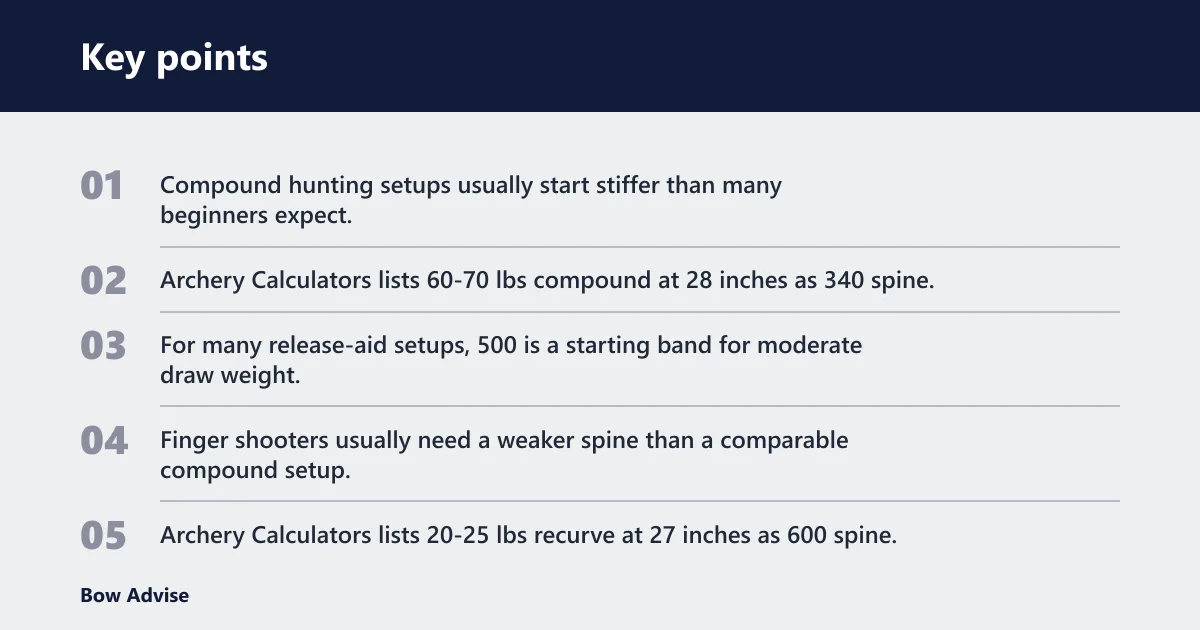
Compound hunting setups usually start stiffer than many beginners expect, especially when the arrow is long or the broadhead is heavy. Archery Calculators lists 60-70 lbs compound at 28 inches as 340 spine, which shows how quickly a compound can move into a stiffer band at hunting weight.
For many release-aid setups, 500 is a starting band for moderate draw weight, 400 is common once draw weight climbs or point weight moves to 125 gr, and 340 becomes more likely when the setup is long and heavy up front.
Recurve bow with fingers
Finger shooters usually need a weaker spine than a comparable compound setup. The same source lists 20-25 lbs recurve at 27 inches as 600 spine, and Explained Archery says finger shooters usually need one to two sizes weaker spine than compound shooters.
That means a recurve hunter often starts in 600 or 500, then steps stiffer as draw weight rises, arrow length shortens, or point weight climbs. Bare shaft tells the truth fast here, because finger release and broadhead drag can reveal a weak shaft quickly.
Traditional longbow and off-the-shelf setups
Traditional hunting bows often need the most careful tuning because the arrow leaves the string without the same launch help as a release-aid compound. Longer shafts and heavier broadheads can make weak spine problems show up early in flight and impact.
Do not use draw-length labels from a compound chart as a substitute for the actual bow setup.
Which one should you buy?
If your setup is borderline weak, start with the stiffer option. A hunting arrow that is a little stiff is usually easier to tune than one that is too weak, especially with fixed-blade broadheads. That is the safer route when your finished arrow is long or your point weight is above 100 gr.
If you shoot a fixed-blade broadhead, prioritize the shaft line and spine band that the current manufacturer chart supports for your exact draw weight and cut length. Hunting arrows need broadhead flight confirmation, so a chart match plus paper tune is the right sequence.
If you want the safest starting point, pick the spine band that the chart supports after you measure finished arrow length correctly. Then confirm with bare shaft or paper tune before you buy a full dozen. A common first-timer mistake is ordering by draw length alone and ignoring a 29-inch finished shaft with 150 gr up front.
Suppose a hunter uses a 31-inch finished shaft, 40 lb at actual draw, and 150 gr broadheads. That setup usually behaves weaker than the bow label suggests, so the first look should be at the stiffer side of the nearby chart band, not the softer side.
Another common mistake is assuming all 100 gr hunting heads behave the same. Broadhead shape and front-end mass can affect tune, and a longer broadhead can make the setup more demanding to tune.
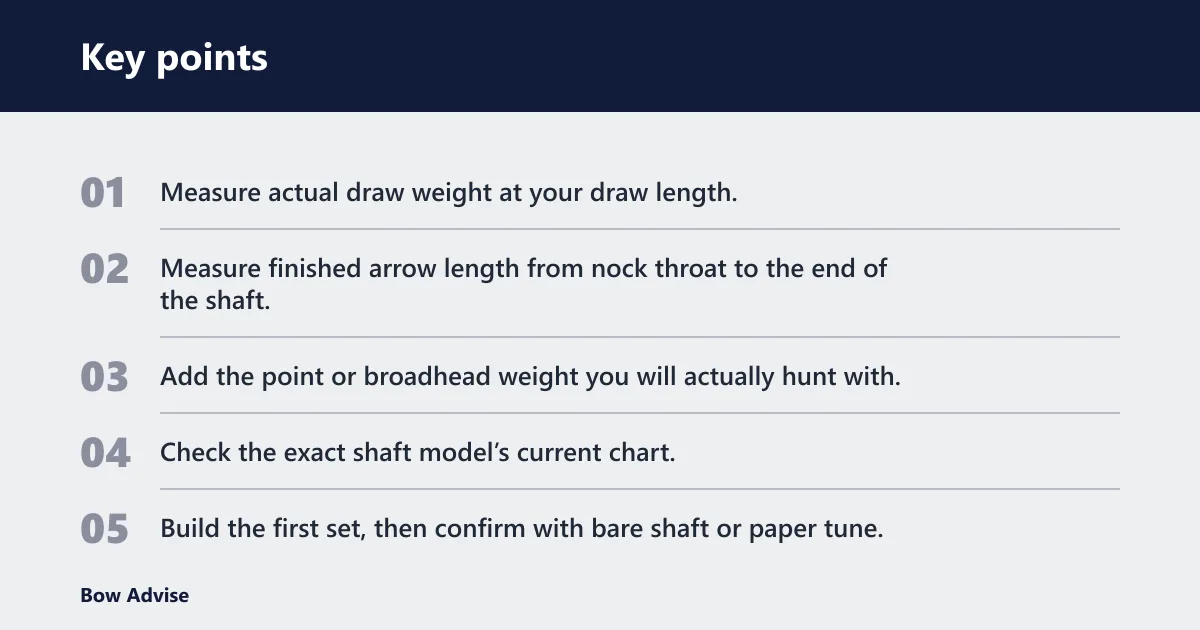
- Measure actual draw weight at your draw length.
- Measure finished arrow length from nock throat to the end of the shaft.
- Add the point or broadhead weight you will actually hunt with.
- Check the exact shaft model’s current chart.
- Build the first set, then confirm with bare shaft or paper tune.
- Verify broadhead impact before hunting.
Frequently asked questions
How does arrow length change spine selection?
Longer arrows behave dynamically weaker, so they usually need a stiffer spine than a shorter arrow from the same bow. The measurement should be the finished shaft length from nock throat to the end of the shaft. A one-inch change can matter when the setup is already near a border.
How does point weight affect arrow spine?
Heavier points make the arrow behave dynamically weaker. Front-end weight should be included in the decision.
What spine arrow should I use for a compound bow?
For a compound with a release aid, start with peak draw weight at actual draw length, then use finished arrow length and point weight to narrow the band. Verify the exact shaft chart before buying.
What spine arrow should I use for a recurve bow?
For a recurve with fingers, start weaker than you would for a comparable compound. The same source lists 20-25 lbs recurve at 27 inches as 600 spine, and finger shooters usually need one to two sizes weaker than compound shooters. Then confirm with bare shaft and broadhead flight.
How do I check if my arrows are too weak or too stiff?
Too weak often shows left impact for a right-handed shooter, weak paper tears, and broadheads that plane left. Too stiff often shows right impact, right paper tears, and broadheads that land right of the main group. Paper tune first, then confirm with broadhead impact at hunting distance.