Victory Arrow Spine Chart Review: How to Use It Right
Victory’s spine chart is a solid buying starting point, but if my setup lands between two recommendations, I buy the stiffer shaft and verify with paper tune, bare-shaft flight, and point weight changes. Pick wrong and you can fight weak-flight tears, broadhead wander, and money spent on shafts that never tune cleanly. I’ll break down how I read the Victory Arrow Spine Chart and the tune-check steps I use on my own bows before I commit to a shaft.
This guide is part of our Arrow Spine guide for archers series.
Verdict: the Victory spine chart is useful, but only as a first pass



I would use Victory’s chart when I’m narrowing a buy, not when I’m trying to finish a tune in one step. It gives me a fast, sensible first answer, and the calculator is better than guessing. The weak spot is borderlines: when speed, shaft length, or front-end weight push a setup between two spines, the chart alone can send you to the wrong shaft.
What the chart gets right for buyers
Victory’s guide is built for real buying decisions. It includes a spine calculator for personalized selection, and it tells you to use chart values directly to find the recommended spine. That matters because the guide asks for the same variables I care about on the bench: bow IBO speed in fps, draw weight in pounds, arrow shaft length in inches, point weight in grains, and insert weight in grains.
I also like that Victory separates compound and recurve guidance. My first compound bow was set 10 lb too heavy, and I flinched for a month before I backed the limb bolts out. That kind of mismatch is exactly why a chart should be paired with a real tune check.
Where the chart can mislead you
The chart can mislead you when you treat it like a final answer. It does not know how your cam timing looks, how your rest is set, or how much front weight you added after you bought the arrows. It also cannot tell you whether your cut length leaves room for future poundage increases.
That is where the borderline shaft choice matters. If the chart puts you between two spines, I lean stiff, then I test. In my experience, a shaft that is a bit stiff is usually easier to manage than one that starts too weak and gives poor results under broadhead load.
According to Arrow Guide – Victory Archery — Victory also has a separate chart for Rival (X) without 20gr weight.
How do I read the Victory spine chart?
I read Victory’s chart by matching my bow speed, draw weight, shaft length, point weight, and insert weight, then I check the recommended spine against the bow type. The calculator does the same job faster. If the chart and the calculator agree, I am already close enough to buy with confidence, then fine-tune at the range.
The inputs Victory uses
Victory’s selection workflow asks for bow IBO speed in fps, draw weight in pounds, arrow shaft length in inches, point weight in grains, and insert weight in grains. That is the right order of thought too. Speed and draw weight give the base load, while shaft length and front-end weight decide how much the arrow flexes in flight.
How to separate compound and recurve chart reading
Do not cross the streams here. Victory has a compound bow spine chart and a recurve bow spine chart, and I treat them as separate tools because the release, energy transfer, and arrow reaction are different. A compound setup with a clean release can often tolerate a different spine than a recurve setup at a similar draw weight.
On recurve, I pay more attention to point weight and shaft length because I often see bigger changes from small component shifts. On compound, I care a lot about front-end weight too, but I also expect cam timing and rest position to move the answer.
Where the calculator fits into the workflow
I use the Victory spine calculator when I want the fastest first pass. I enter the inputs, read the recommended spine output, then compare it with the chart values before I order anything. That cross-check matters because the calculator is still a guide, not a substitute for a tune check on my bow.
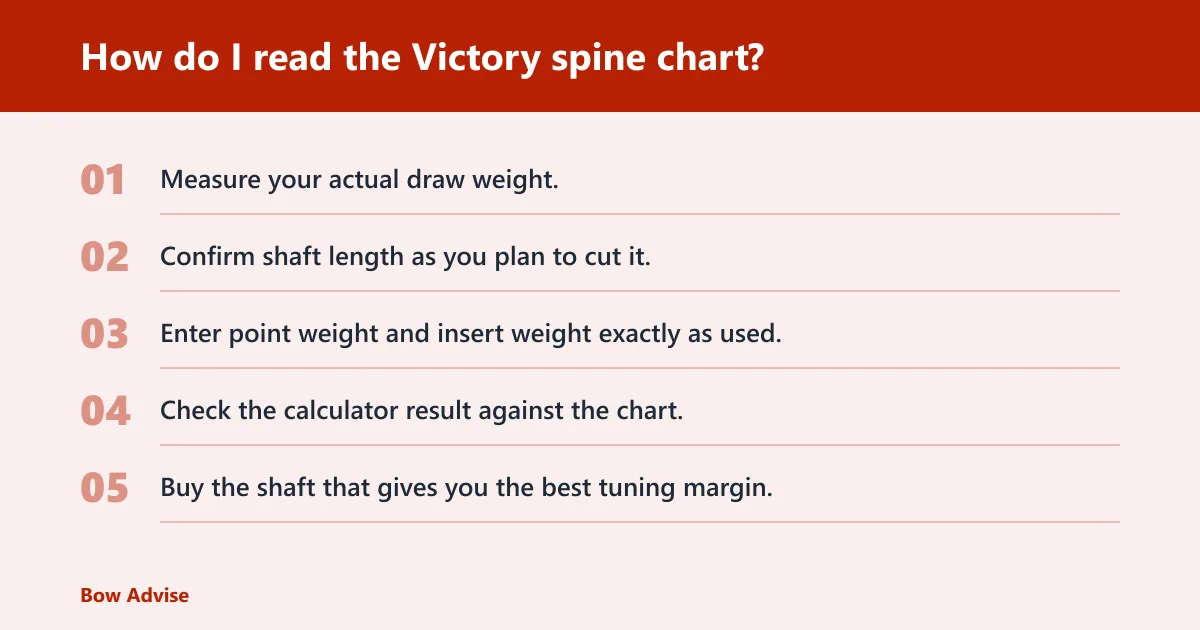
- Measure your actual draw weight.
- Confirm shaft length as you plan to cut it.
- Enter point weight and insert weight exactly as used.
- Check the calculator result against the chart.
- Buy the shaft that gives you the best tuning margin.
What spine do I need for my draw weight and arrow length?
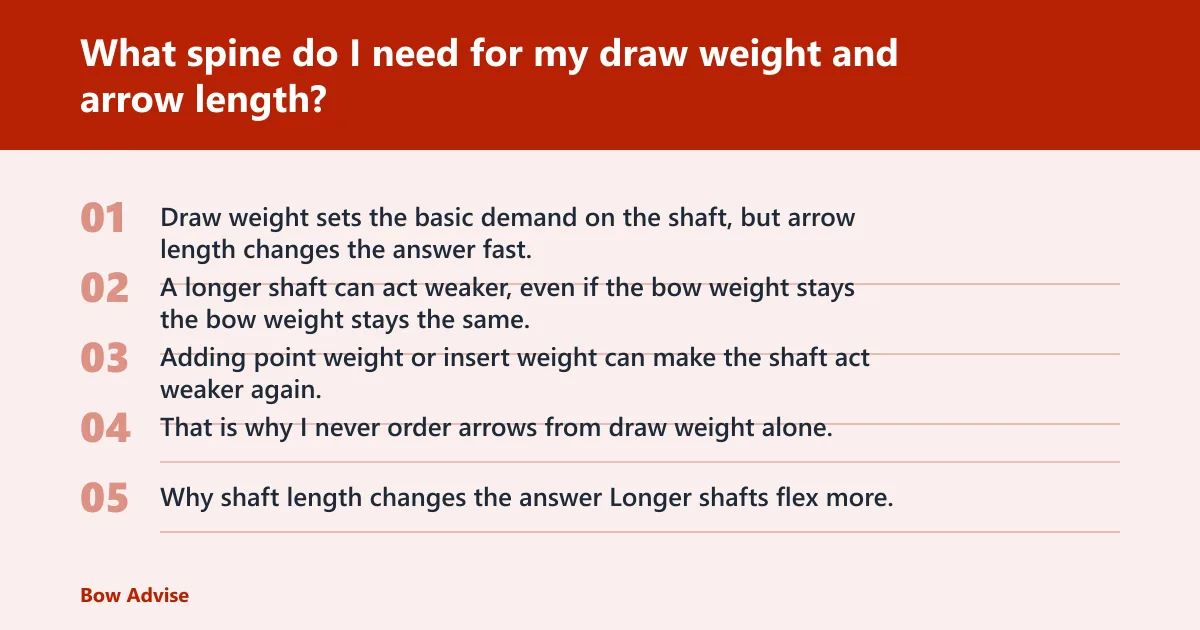
Draw weight sets the basic demand on the shaft, but arrow length changes the answer fast. A longer shaft can act weaker, even if the bow weight stays the same. Adding point weight or insert weight can make the shaft act weaker again. That is why I never order arrows from draw weight alone.
Why shaft length changes the answer
Longer shafts flex more. A short hunter setup can often step down to a stiffer shaft than a long arrow at the same draw weight, because the extra inches on the rear of the arrow change how much it bends through the shot. I have seen that in my own range work more than once.
How point and insert weight move the recommendation
More weight up front weakens dynamic spine. That is the part many buyers miss. A chart recommendation that looks perfect with a light point can move one spine weaker once you add a heavier point and insert combination, especially on a recurve or a slower compound setup.
| Common setup | First-choice spine | Backup spine | Tuning sign that confirms the right pick |
|---|---|---|---|
| Light compound hunting rig | 500 | 400 | Paper tear is near clean and bare shafts land close to fletched impacts |
| Heavier front-end compound setup | 400 | 340 | Broadheads group with field points after small rest moves |
| Recurve with standard point weight | 600 | 500 | Bare shaft enters clean and group shape stays round at short range |
| Recurve with added front weight | 500 | 400 | The arrow stops planing and walks into the same group as fletched shafts |
| Short shaft, fast bow, borderline stiff choice | 400 | 340 | Weak tear disappears after small point-weight change and rest check |
| Long shaft, slower bow, borderline weak choice | 500 | 600 | Bare shaft stops fishtailing and impact shape tightens instead of stringing horizontally |
What to do when you land between two spines
If I’m between two shafts, I usually buy the stiffer one first. Then I tune with point weight, minor rest adjustment, and paper tune before I commit to trimming too much. If the shaft is weak, you often run out of room fast. If it is stiff, you usually have more adjustment left.
Pros and cons of Victory’s chart system
Victory’s chart system is good buying help, but it is still a starting point. I like the speed and the model grouping. I do not like when buyers treat the first recommendation as permanent and cut arrows before they test flight.
Pros
- Fast starting point for buying.
- Clear model grouping across Victory families.
- Calculator support reduces guesswork.
- Compound and recurve guidance are separated.
Cons
- Borderline setups still need a tune check.
- Front-end weight can change the answer after the first reading.
- Cut length mistakes are expensive.
- Future poundage changes can make the first buy short-lived.
Who is the Victory spine chart for?
This chart is best for buyers who want a fast first pass before ordering Victory shafts. It fits compound archers who know their draw weight and speed, and it fits recurve archers who want a cleaner spine starting point. It is not ideal for anyone who plans to guess on cut length or ignore front-end weight.
Best fit for compound buyers
Compound buyers get the most out of the calculator and chart pair because the inputs line up well with real setup data. If you are shopping VF, RIP, XV, RVL, or the VAP and RIP family, I would use the chart, then confirm with paper tune once the arrows arrive.
Best fit for recurve buyers
Recurve buyers should use the recurve chart and pay close attention to point and insert weight.That taught me again how quickly setup details show up in arrow flight.
Who should be extra careful before ordering
Be careful if your bow is near a poundage change, if you are planning a future limb upgrade, or if your arrow will be cut long for safety. Also be careful if you want to run heavy points. Those setups move spine enough to make the first chart answer wrong more often than people expect.
Victory model groups: VF, RIP, XV, RVL, VAP, and VAP TKO
Victory groups its shafts into chart families so buyers are not reading every model from scratch. VF, RIP XV, and RVL share one chart family. HLR, VLR, VAP, VAP TKO, VAP SS, RIP, RIP TKO, and RIP SS live in another family. Rival (X) has its own separate chart with and without the 20gr weight variant.
What the VF/RIP XV/RVL chart group tells you
This family tells me Victory is trying to keep related shafts on a similar buying path. In practice, I use that grouping to narrow durability and forgiveness questions before purchase. If I want a shaft that feels easier to tune on a hunting compound, I pay close attention to where the chart puts the VF, RIP XV, and RVL options.
What the HLR/VLR/VAP/VAP TKO/VAP SS/RIP/RIP TKO/RIP SS chart group tells you
This second family is broader and includes several shaft versions that can change how forgiving the setup feels. I read it as a model-by-model buying guide, not a one-size answer. If I want to compare tuning ease against durability, I look at the chart family first, then check what each shaft version is meant to do.
Why the 20 gr weight variant uses separate chart logic
The 20 gr weight variant matters because extra front weight changes the dynamic spine enough to justify separate chart handling. Victory splits Rival (X) into a separate chart without 20gr weight and another with 20gr weight. That is exactly the kind of detail that saves a buyer from ordering the wrong shaft the first time.
What happens if you choose too stiff or too weak a Victory arrow?
Too stiff usually gives a shaft that resists bending enough to leave tuning clues on the weak side of the tune. Too weak usually makes the arrow act sloppy, with more visible flight correction and a wider group shape. I read those clues before I trim anything again or order a second set.
Too stiff: flight behavior and group shape
A stiff shaft often shows a paper tear that leans one direction and bare shafts that land off the main group until I tune around them. In the field, broadheads can sit slightly off compared with field points until the setup is corrected. The group can still be tight, but it often feels less forgiving.
Too weak: flight behavior and group shape
A weak shaft usually looks more obvious. It can kick hard, plane more, and open the group in a way that is easier to see at short distance. If the shaft is far enough weak, broadheads and bare shafts can start wandering before the fletched arrows tell you there is a problem.
What paper tune and field impact tell you
Paper tells me the direction of the problem. Bare shaft tells me whether the chart guess was close. Field impact tells me whether the setup is actually ready for hunting or target work. I want all three before I call a Victory shaft “right” for my bow.
Buying advice before you cut arrows
Keep enough extra length to protect your future tuning room. If you cut too short, you lose options fast. If you plan to raise poundage later, buy with that in mind now, because a shaft that tunes at today’s weight may act differently after you add pounds.
How much extra length to keep for future tuning
I leave enough length to let the bow and arrow tell me the truth before I make the final cut. Once a shaft is too short, you cannot undo that mistake. That matters most on borderline spines, where a small cut can change the result enough to force a new shaft order.
Overdraw risk and why it matters
Overdraw risk is simple: if your setup gets longer or changes in draw mechanics, a too-short shaft can stop being safe or sensible. I keep that in mind on new builds and on bows that may get handed down or retuned later. Safety comes before perfect spine math.
When to plan for future poundage increases
If you know the bow will get heavier later, buy the shaft that gives you room to grow. I would rather start slightly stiff and tune forward than buy to the exact edge and run out of options. That approach has saved me money on more than one hunting setup.
Frequently asked questions
How do I read the Victory spine chart?
Start with the inputs Victory uses: bow IBO speed in fps, draw weight in pounds, arrow shaft length in inches, point weight in grains, and insert weight in grains. Then match those values to the chart and compare the answer with the calculator. I still verify with a tune check before I buy.
What spine do I need for my draw weight and arrow length?
Draw weight sets the base load, but arrow shaft length can change the answer quickly. A longer arrow usually needs a stiffer starting point than a shorter one at the same poundage. Add point weight or insert weight, and the shaft acts weaker again, so the final choice often shifts.
How much does point weight change spine choice?
Enough that I never ignore it. Heavier point weight weakens the dynamic spine and can move a chart answer to the next weaker shaft, especially on recurve bows and slower compounds. If your setup is near two recommendations, point weight is one of the first things I check.
Do I need a different spine for compound and recurve?
Yes, I treat them separately. Victory does too, with a compound bow spine chart and a recurve bow spine chart. Compound and recurve release the arrow differently, so the same draw weight does not always call for the same shaft. Separate the two before you order.
What is the difference between VF, RIP, XV, RVL, VAP, and VAP TKO?
For buying, I look at the chart families first. Victory groups VF, RIP XV, and RVL together in one chart family, while HLR, VLR, VAP, VAP TKO, VAP SS, RIP, RIP TKO, and RIP SS sit in another. That grouping helps me compare durability, forgiveness, and tuning ease.
Should I use Victory’s calculator or the chart?
I use both. The calculator is faster for a first answer, and the chart is the cross-check that keeps me honest. Victory’s guide includes the calculator, and it says to use chart values directly to find the recommended spine. That is the safest path before you spend money.
What happens if I choose too stiff or too weak a Victory arrow?
Too stiff usually shows weak-side tune issues and less forgiving bare-shaft behavior. Too weak often shows more obvious flight drama, broader groups, and tougher broadhead behavior. If I’m between two spines, I choose the stiffer shaft, then tune with point weight, rest position, and paper before I cut too far.