Arrow Spine for 20 to 30 Lb Bows: Recommended Setups
A shaft that is too weak can plane badly and make tuning harder, which wastes arrows and time. This guide gives a simple setup table by draw weight, arrow length, and point weight, then shows the easiest bare-shaft check to confirm the choice.
Light-bow spine basics
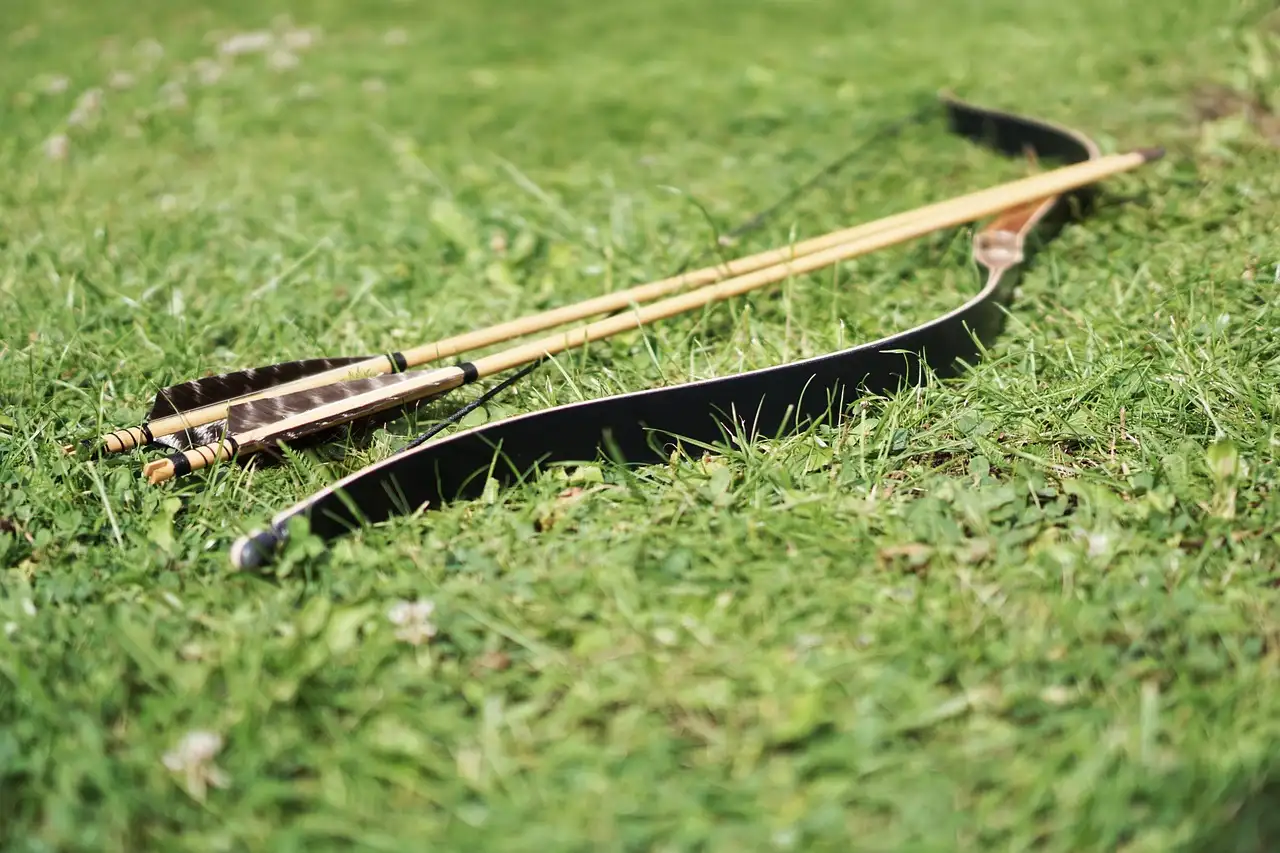


Arrow spine is the shaft stiffness rating, and a lower number means a stiffer shaft. For beginner bows in the 20–30 lb range, the real buying question is not “What is the perfect spine?” It is “Which shaft gives a safe, tuneable starting point?”
That matters because light bows often sit near the edge of several spine bins. In that zone, 700, 600, 500, 400, and even 340 can all appear in different charts, but the final pick depends on actual draw weight at the archer’s draw length, arrow length, point weight, and bow type.
Why 700, 600, and 500 matter most here
Those sizes are the main decision points for light-bow setups that sit near a normal beginner draw length. If the bow is short-drawn, the arrow is short, or the point is light, the setup moves toward a stiffer shaft number.
Brand charts differ, so any Easton-style selector or similar table should be treated as a starting point only. Bowbuilds notes that a chart cell can show two sizes, weaker and stiffer, which helps when your setup sits between bins. Bowbuilds also adds 3 lb for every 25 grains of tip weight over 100, which is why point weight can shift the choice fast.
How to read a light-bow chart
Use actual draw weight at the archer’s draw length, not the bow label. Compound charts usually reference peak draw weight, while recurve and longbow setups use holding weight at full draw. That difference is why a “25 lb bow” does not always land in the same shaft range across bow types.
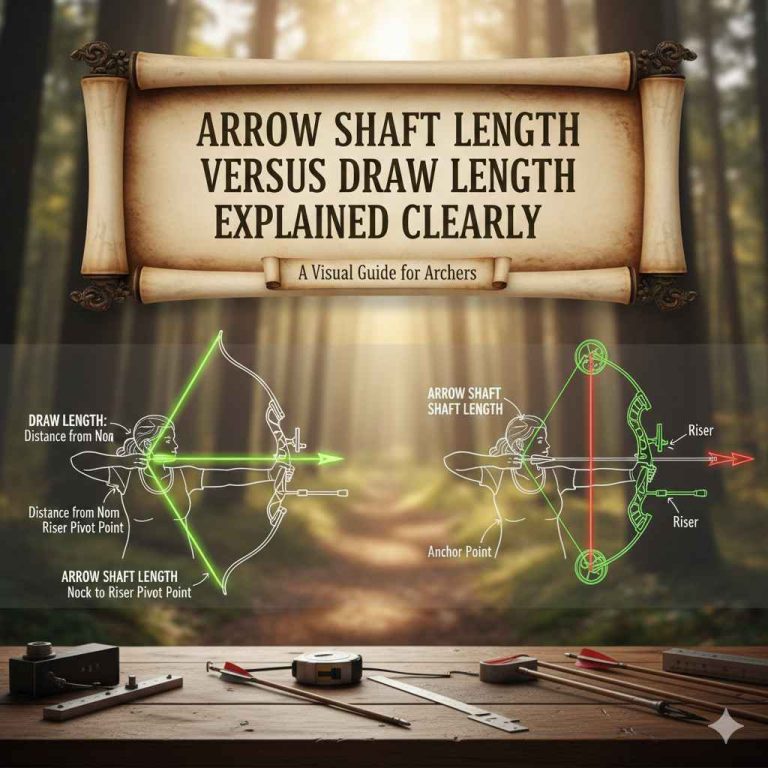
Arrow length is measured from nock throat to shaft end. Point weight works the same way in the other direction: 100 grains is the common baseline, while 125 and 150 grains weaken dynamic spine and can push the setup toward a softer shaft choice.
Bow type changes the starting point
Finger-release recurves and longbows usually need a softer starting shaft than a compound of the same listed weight, while light compounds often need a slightly stiffer spine because the release is cleaner and the arrow leaves faster. ArcheryCalculators accepts recurve, compound, and longbow inputs, and it includes point-weight options from 100 to 200 grains plus a 341-350 fps compound speed bracket.
ArcheryCalculators also defines spine by the standard 28-inch, 1.94-pound deflection test. That is the static rating. The real buying decision is dynamic spine after you account for draw length, point weight, and the release style.
What spine do you need for a 20 lb bow?
If the setup sits near the edge, start weaker rather than stiffer, because a light bow with a weak reaction is usually easier to tune than an arrow that is too stiff.
For a 20 lb compound, check the maker’s chart first. ArcherySetup lists 20 lb compound setups at 28 inches in the 1400-1600 spine range, which shows how much peak weight and release style can shift the recommendation compared with a finger-release recurve.
What spine do I need for a 25 lb recurve?
For a 25 lb recurve, begin around 700 spine for 28–30 inch arrows with 100 grain points. If the choice is borderline, start weaker rather than stiffer.
The same source lists 25 lb recurve setups at 28 inches as 1300-1600 spine, which is much weaker than the common carbon sizes many beginners see on shelf. That is why checking the exact shaft type matters: aluminum, carbon, and brand-specific sizing systems do not always line up cleanly across charts.
What spine do I need for a 30 lb bow?
If the setup is near the edge, choose weaker first.
For a 30 lb compound, the starting spine is often stiffer than the same weight recurve. The same source lists 30 lb compound setups at 28 inches as 900-1000 spine, while 30 lb recurve setups at 30 inches are 900-1000 spine in that system. The practical takeaway is simple: do not assume the same arrow works across bow types.
How length and point weight change the pick
Arrow length and point weight change dynamic spine before the arrow ever leaves the string. A longer shaft flexes more, so it behaves weaker. A heavier point adds front-end load, which also makes the setup act weaker. That is why a 150 grain point can move a setup one full step softer than a 100 grain point on the same bow.
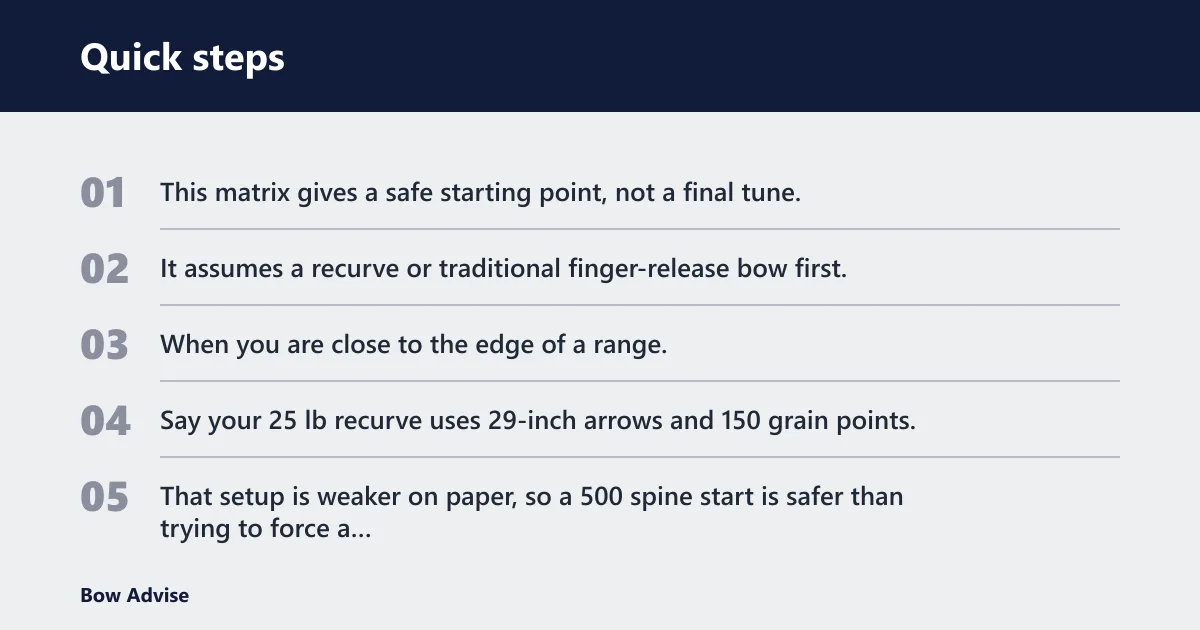
Light-bow arrow setup matrix
This matrix gives a safe starting point, not a final tune. It assumes a recurve or traditional finger-release bow first, then a light compound if the chart or tune shows the need. When you are close to the edge of a range, the final column tells you whether to begin with a stiffer or weaker shaft.
| Bow weight | Arrow length | 100 gr point | 125 gr point | 150 gr point | Edge call |
|---|---|---|---|---|---|
| 20 lb | 26 in | 700 | 700 | 600 | Stiffer |
| 20 lb | 27 in | 700 | 600 | 600 | Weaker |
| 20 lb | 28 in | 700 | 600 | 600 | Weaker |
| 20 lb | 29 in | 600 | 600 | 500 | Weaker |
| 20 lb | 30 in | 600 | 500 | 500 | Weaker |
| 25 lb | 26 in | 700 | 600 | 600 | Stiffer |
| 25 lb | 27 in | 700 | 600 | 500 | Weaker |
| 25 lb | 28 in | 700 | 600 | 500 | Weaker |
| 25 lb | 29 in | 600 | 600 | 500 | Weaker |
| 25 lb | 30 in | 600 | 500 | 500 | Weaker |
| 30 lb | 26 in | 600 | 500 | 500 | Stiffer |
| 30 lb | 27 in | 600 | 500 | 500 | Weaker |
| 30 lb | 28 in | 600 | 500 | 500 | Weaker |
| 30 lb | 29 in | 500 | 500 | 400 | Weaker |
| 30 lb | 30 in | 500 | 400 | 400 | Weaker |
Two simple examples help. That setup is weaker on paper, so a 500 spine start is safer than trying to force a stiffer shaft to work. Suppose the same bow drops to 26-inch arrows with 100 grain points. The setup moves stiffer, so 700 spine becomes the cleaner starting choice.
Compound vs recurve setup differences
Finger-release recurves and longbows usually follow a softer dynamic setup than light compounds of the same weight. Release-aid compounds leave the string cleaner and often need a slightly stiffer shaft. Compound charts also key off peak draw weight, so a labeled bow weight is not enough on its own.
What the chart can and cannot tell you
The same source says faster bows need stiffer spine adjustments, which is another reason a chart is only a first pass. A 25 lb bow that shoots quicker or uses a heavier point may move out of the first suggested bin even if the headline weight looks light.
For beginner buys, that means the chart should tell you where to start, not where to stop. If the first shaft comes out weak on bare shafts, move stiffer only after the rest of the setup is confirmed. If the first shaft comes out stiff, move weaker rather than trying to fix stiffness with a heavier point that pushes the arrow the wrong way.
Paper tuning and bare-shaft tuning are part of the buying decision, not optional extras. Paper tune first to see the initial reaction, then bare-shaft tune to confirm the final setup before buying a full dozen. On light bows, that check matters because small changes in point weight or shaft length can shift the result quickly.
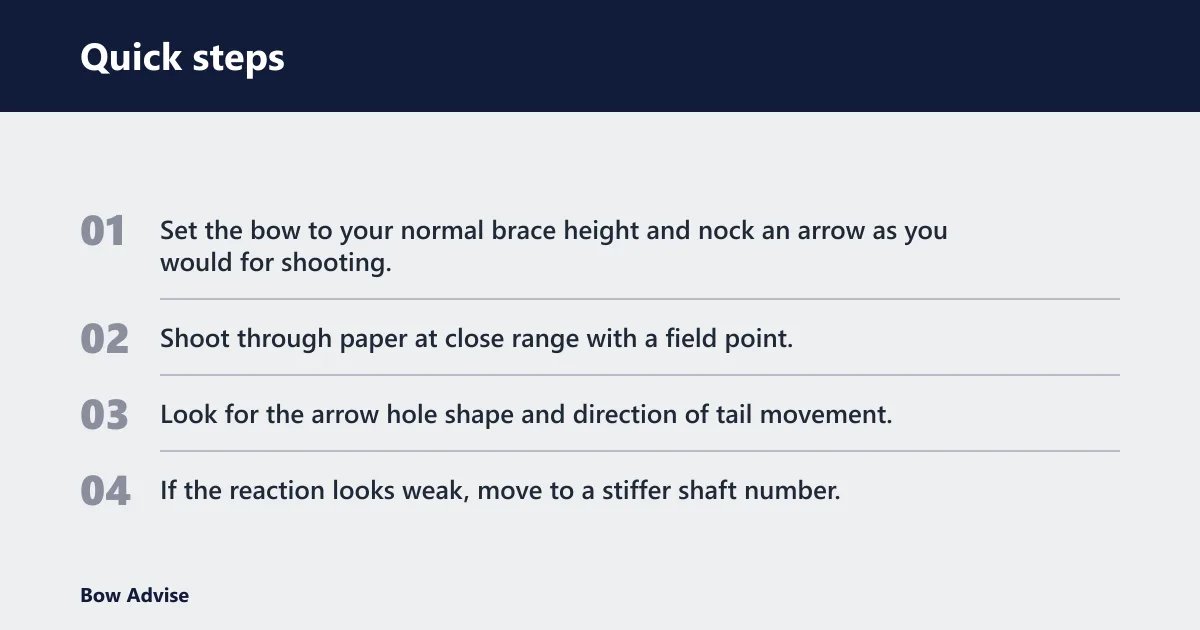
Paper tune first
- Set the bow to your normal brace height and nock an arrow as you would for shooting.
- Shoot through paper at close range with a field point.
- Look for the arrow hole shape and direction of tail movement.
- If the reaction looks weak, move to a stiffer shaft number. If it looks stiff, move weaker.
A weak arrow usually shows more flex, a tail-left or tail-right reaction depending on handedness, and messy flight that never settles. A stiff arrow often shows the opposite pattern. Keep the correction direction straight: weak reaction means go stiffer; stiff reaction means go weaker.
Use bare shafts to confirm
Bare-shaft tuning gives a clearer read once paper tuning has narrowed the choice. Shoot one fletched arrow and one bare shaft at the same distance. If the bare shaft lands consistently off line in the direction that matches a weak or stiff reaction, adjust the shaft choice before ordering a full dozen.
Safety matters here. FireArcher warns that a weak arrow can break and injure you. Do not keep shooting cracked shafts, and do not try to save a dangerous setup with guesswork. Check the shaft maker’s listing for your model, then confirm with tuning before buying in volume.
Should you choose carbon or aluminum?
For a 20–30 lb beginner bow, carbon is the easier starter choice for most buyers because it is common, available in many spine sizes, and often less expensive per shaft. Aluminum can still work well, but the best pick depends on the exact model and straightness grade in the manufacturer’s listing.
When consistency matters most
If the goal is the quietest and most uniform shaft possible, check the manufacturer’s chart and straightness spec for the exact aluminum or carbon model you are considering. Do not assume every brand sorts the same way.
A common setup mistake is choosing a 20 lb spine without checking whether a 29-inch draw length and broadheads will make the arrows behave stiffer than expected. That locks in the wrong dynamic spine if the shafts were chosen too stiff or too weak. Two test shafts cost less than replacing twelve.
Frequently asked questions
What arrow spine do I need for a 20 lb bow?
If the setup is on the edge, begin weaker rather than stiffer so tuning stays easier.
What arrow spine do I need for a 25 lb recurve?
Check the actual draw weight at your draw length before ordering, because that number drives the chart choice.
What arrow spine do I need for a 30 lb bow?
Compounds often need a stiffer choice than recurves.
Are 600 spine arrows too stiff for a 20-30 lb bow?
Not always. A 600 spine shaft can be right for a 30 lb bow, a long arrow, or a heavier point. It is often too stiff for a short 20 lb setup with a 100 grain point, though. The only reliable answer is the combination of bow weight, arrow length, point weight, and tuning.
How does arrow length change spine for light bows?
Longer arrows act weaker because the shaft flexes more. Shorter arrows act stiffer because less shaft is exposed to bend. That means a 30-inch arrow may need a weaker spine number than a 26-inch arrow on the same bow, even if the draw weight and point weight stay the same.
How does point weight affect spine on low-poundage bows?
The same source says each 25 grains over 100 adds 3 lb in its guidance, which shows how quickly point weight can change the starting point.