Arrow Spine for 60 Lb Compound Bows: What to Buy and Why
For a 60 lb compound, start with a 300 spine carbon arrow if your cut length is about 27–29 inches and your point weight is 100–125 grains; go to 250 spine for longer shafts or heavier points, and 340 spine only for short, light-front setups. A shaft that is too weak or too stiff hurts tune, broadhead flight, and penetration. This guide shows how cut length and front-end weight decide the safest starting spine before you buy arrows.
What arrow spine means


Static spine is the shaft’s stiffness number from a standardized deflection test. In that test, the arrow is supported at 28 inches and loaded with a 1.94 lb weight in the center; the amount it bends is measured in thousandths of an inch. Lower numbers mean stiffer shafts.
That is why a 300 shaft is stiffer than a 400 shaft, and a 400 is stiffer than a 500. Carbon hunting and target shafts commonly use labels such as 300, 340, 400, 500, and 600, but those labels are not identical across every brand or model.
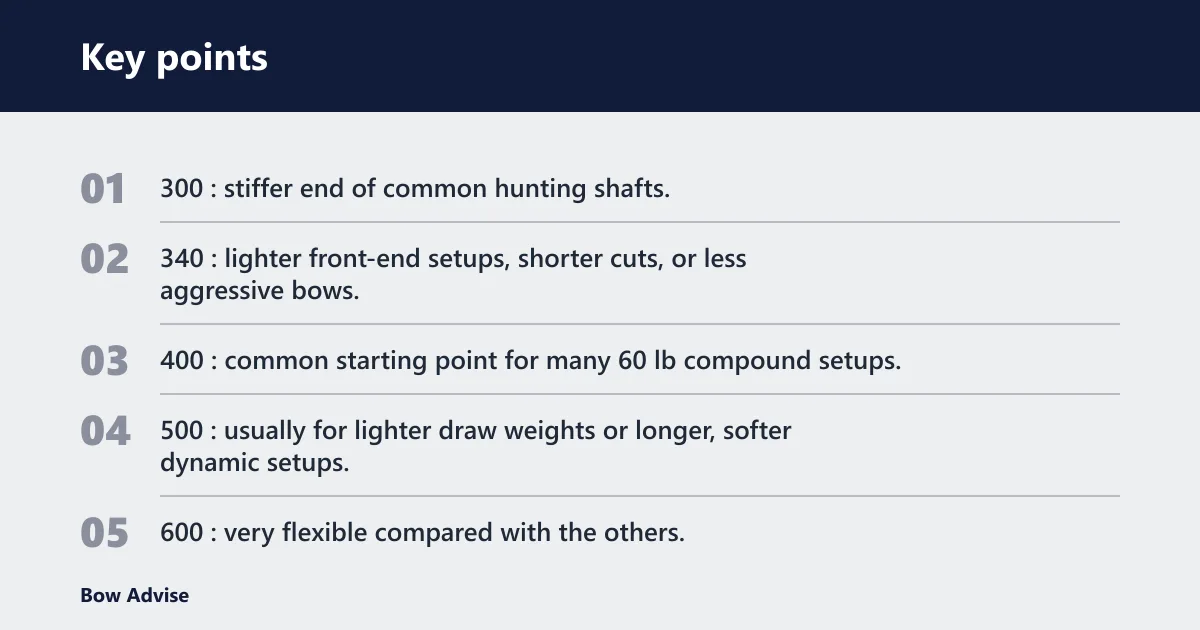
Common carbon spine labels to know
- 300: stiffer end of common hunting shafts.
- 340: lighter front-end setups, shorter cuts, or less aggressive bows.
- 400: common starting point for many 60 lb compound setups.
- 500: usually for lighter draw weights or longer, softer dynamic setups.
- 600: very flexible compared with the others.
What spine fits a 60 lb compound?
For a 60 lb compound bow, treat draw weight as peak weight at full draw, not a casual label on the riser. With a release aid and a typical hunting setup, many shooters begin near 400 spine with a 100 grain point, then move stiffer as cut length rises, cams get faster, or front-end weight increases.
A faster cam system usually needs a stiffer shaft because it drives the arrow harder on release. A slower or more forgiving cam can handle a weaker dynamic setup more easily. Release aids also matter because they remove finger-flex variables, so the setup is usually judged by bow, arrow length, point weight, and cam aggressiveness rather than finger-shot behavior.
Typical starting range
A 60 lb compound with a 28-inch arrow needs about 400 spine. That is a useful starting reference for common 100 grain hunting points, but it is not a finish line. Cut length, insert mass, outsert mass, and broadheads can move the real purchase decision stiffer than that starting point.
Arrow spine decision matrix
Use this table as a shopping filter, not a final tune. The point is to buy the safest starting shaft before committing to a full dozen.
| 60 lb build type | Cut length | Front end | Start here | Why this works | When to step stiffer |
|---|---|---|---|---|---|
| Standard hunting setup | 27-28 in | 100 gr field point | 400 spine | Matches the common 60 lb, 28-inch starting point and keeps dynamic bend in range. | Move to 340 if the cam is aggressive or the insert adds noticeable nose weight. |
| Longer cut, standard head | 29 in | 100 gr point | 340 spine | Longer shafts act weaker, so the stiffer shaft offsets the extra dynamic flex. | Move to 300 if the bow is fast, the cam is harsh, or the arrow carries a heavy insert. |
| Standard length, heavier hunting head | 27-28 in | 125 gr head | 340 spine | Heavier points make the arrow act weaker, so the shaft needs more stiffness. | Move to 300 if broadheads, outserts, or a faster cam add even more front-end load. |
| Broadhead hunting build | 28-29 in | 125 gr head plus insert weight | 300 spine | Broadheads and added front-end mass increase dynamic weak effect and usually need a stiffer start. | Move to 250 if the shaft is longer, the insert/outsert is heavy, or the cam is very aggressive. |
| Short, light-front setup | 26-27 in | 100 gr point | 340 spine | Shorter shafts recover stiffness, so a 340 can work when the front end stays light. | Move to 300 if paper tear opens up or the bow launches broadheads weak. |
Rule for stepping stiffer: if you lengthen the shaft, add front-end weight, or shoot broadheads from an aggressive cam, move one spine stiffer before you move weaker. A weak shaft is harder to fix later than a stiff one, especially once a full dozen arrows has been bought.
Say your 60 lb bow uses a 29-inch cut and a 125 grain fixed blade with a heavy insert. A 400 spine may paper tune acceptably with field points, then show left impact with broadheads. That is a classic sign that the purchase should have started one step stiffer.
Does arrow length change the answer?
Yes. Arrow length is measured from the nock throat to the shaft end, not from the tip or from the insert shoulder. Longer shafts act weaker dynamically because more shaft bends under load, and even about 1 inch can shift spine demand enough to change the buying choice.
That is why a 27-inch cut and a 29-inch cut do not buy the same shaft, even with the same bow weight and point weight. The longer shaft usually needs a stiffer static spine to land in the same tune window.
How to measure correctly
- Measure from the nock throat, where the string sits.
- Measure to the end of the carbon shaft, not the broadhead.
- Use the cut length you will actually shoot, not the unfinished shaft length.
How point weight changes spine
A 100 grain point is the most common baseline for buying arrow spine. A 125 grain hunting head makes the arrow act weaker, which is why the same bow and length often need a stiffer shaft once the point gets heavier.
Insert and outsert mass matter too. A heavy insert or outsert adds front-end weight just like a heavier point, so it changes the purchase decision even if the broadhead label still says 100 grains.
Picture a 60 lb compound set up with a 28-inch carbon shaft. With a 100 grain point, 400 spine may be a normal starting choice. Add a heavy outsert and a 125 grain fixed blade, and the same shaft can move into weak dynamic behavior; the buyer should look stiffer, not weaker.
Why hunting heads push you stiffer
Broadheads increase dynamic weak effect more than field points because the blade surface adds steering load as the arrow leaves the bow. That is why hunting arrows often need a stiffer setup than target arrows with simple field points, especially when the cam is fast or the front end is heavy.
Manufacturer chart differences
Easton, Gold Tip, Victory, and Black Eagle each publish model-specific selector charts, and those charts are not interchangeable. A 400 spine label on one shaft model can behave differently from a 400 in another brand because shaft diameter, wall construction, and tolerances vary by manufacturer and by model.
Check the exact shaft chart before buying a full dozen. A chart for one hunting shaft does not guarantee the same result for another carbon line with the same spine label.
What to verify on the chart
- Exact shaft model, not just brand name.
- Draw weight at peak.
- Arrow length used by the chart.
- Point weight and any insert or outsert assumptions.
How do you confirm the choice?
Start with a manufacturer chart, then confirm the shaft with bare-shaft tuning or paper tuning. Bare-shaft tuning is the better first check after the initial spine choice because it shows whether the shaft is behaving weak or stiff without the broadhead’s steering effect hiding the result.
Paper tuning is useful as a crossover check, but it should not be the only decision tool for a hunting setup. Broadhead flight matters, and broadheads can expose a spine mismatch that a field point paper tear does not fully reveal.
Why buy a few shafts first
Do not buy a full dozen until the starting spine is confirmed. Buying the wrong spine first can force a second purchase, and hunting shafts with inserts, outserts, and fixed blades are expensive enough that the mistake hurts twice: once at purchase and again during retuning.
That setup may tune with field points yet drift with broadheads, which means the first dozen solves nothing.
What happens if my arrows are too stiff or too weak?
Too stiff and too weak both cause tune problems, but they show up differently. A shaft that is too weak often struggles more with broadheads and can look messy in tuning; a shaft that is too stiff can be harder to settle into clean dynamic flight and may leave the bow less forgiving at the shot.
For a hunting setup, the bigger risk is often buying too weak first, because heavier points, longer cuts, and broadheads all push the arrow in that direction. A slightly stiff starting shaft is usually easier to work with than one that is already under-spined.
Frequently asked questions
What spine arrows do I need for a 60 lb compound bow?
Start with the shaft length and front-end mass, then choose the stiffest reasonable starting option. Longer arrows, heavier points, or broadheads usually push the choice stiffer.
Is a 400 spine or 340 spine better for a 60 lb compound?
Neither is universally better. The chart on the exact shaft model still matters.
How does arrow length affect spine on a 60 lb bow?
Longer arrows act weaker dynamically, so length can change the buying decision as much as point weight. A 29-inch cut will usually need a stiffer shaft than a 27-inch cut at the same draw weight and point weight. Even 1 inch can move the tune enough to matter.
What point weight should I use with 60 lb compound arrows?
Use 100 grains as the baseline unless the hunting setup calls for more front-end mass. A 125 grain point makes the arrow act weaker, so it often pushes the shaft choice stiffer. Add insert or outsert weight to that total, because those parts count too.
Do broadheads require a stiffer spine than field points?
Usually, yes. Broadheads add steering load and increase dynamic weak effect, so a setup that looks fine with field points can need a stiffer shaft for fixed blades. That matters most on 60 lb compounds with long cuts, heavy points, or aggressive cams.
How do I confirm spine before buying a dozen arrows?
Check the exact manufacturer chart first, then buy a few shafts and bare-shaft tune before committing to a full dozen. Paper tuning can help cross-check the result, but bare-shaft feedback is usually the cleaner way to confirm whether the starting spine is right for the bow and head choice.