Arrow Spine for Heavy Point Weights: When to Go Stiffer
If your point weight, insert weight, and arrow length leave a shaft 5 to 10 pounds weaker than the chart’s center value, pick the stiffer spine. If you are already on the edge, move up a spine class. Missing that margin can leave you with weak flight, poor broadhead tune, and arrows that group badly in real hunting use. This guide shows the practical thresholds for heavy points, long arrows, brass inserts, and broadheads across compound, recurve, and finger-release setups.
Static spine versus dynamic spine

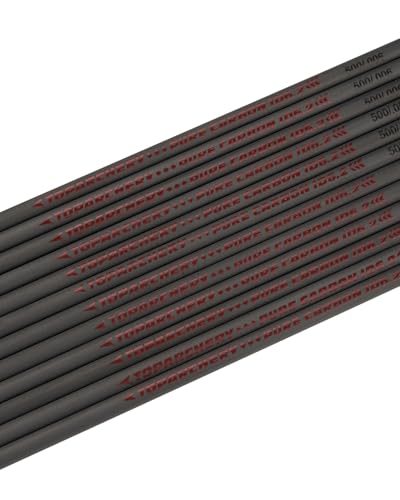

Static spine is the shaft’s measured stiffness before it ever leaves the rack. It is an ASTM-style deflection test on a supported shaft with a 1.94 lb weight, and a 400 spine shaft deflects 0.400 inches under that standard load. Lower spine numbers mean stiffer shafts, so a 340 spine shaft is stiffer than a 500 spine shaft.
Dynamic spine is the arrow’s real behavior after release. It changes with point weight, arrow length, bow speed, cam aggressiveness, and release type. That is why two arrows with the same static rating can behave very differently once broadheads, inserts, and cut length enter the setup.
Why heavier points make an arrow act weaker
Adding 25 grains of point weight makes the arrow act weaker, and a common rule of thumb is that 25 grains is roughly equal to +3 to 5 lb draw weight in dynamic effect. Heavy broadheads, brass inserts, and outserts all push the same way. They load the front of the shaft and make it flex more on release.
That means a chart can be correct and still leave gaps. A shaft that looks fine on paper with a standard field point may act weak once a 125 or 150 grain head is installed. The point weight did not change the printed spine. It changed how the arrow behaves.
How long arrows amplify the effect
Longer shafts act weaker. Adding 1 inch of arrow length acts weaker, and that extra inch is roughly equal to +4 to 6 lb draw weight. Cut length should be known before buying shafts, because an arrow cut long today can become borderline weak the moment a heavier front end is added later.
Picture a 28 inch compound setup that is already near the weak side of the chart. If the shaft is left 1 inch longer for safety, the dynamic effect can be enough to move the same arrow out of the comfortable window. That is why cut length belongs in the decision, not after it.
When should you go stiffer?
Choose the stiffer spine when the setup is no longer just “a little soft” on the chart. If heavy points, longer shaft length, or a faster bow move the arrow about one spine group weaker, stiffer is the safer starting point. If the setup is already borderline, go one class stiffer rather than hoping tune will save it.
That is especially true for broadheads and future changes. A shaft that only barely tunes with a light field point can become a weak broadhead setup the moment front weight increases. Safe minimum spine is the least stiff shaft that can be made to fly acceptably. Optimal spine leaves room for accuracy, broadheads, and later weight changes.
When one spine group stiffer is enough
Move one spine group stiffer when the arrow is close to the chart’s center but the front end is heavier than normal. A 125 to 150 grain head, a brass insert, or a slightly long cut often lands here. The arrow may still tune, but it is usually better to start stiffer than to rely on a weak shaft and add fixes later.
That is a classic one-group-stiffer case. The chart is not wrong; the final arrow package is just heavier in front than the baseline chart assumed.
When two spine groups stiffer makes sense
Move two spine groups stiffer when heavy front-end weight stacks with a long arrow or a faster bow. A 175+ grain head, brass insert, and a long cut can push the arrow well past what is often considered borderline. In that case, trying to tune a weak shaft often wastes time and can leave broadheads unstable.
This is also the point where future upgrades matter. If the hunter may later add more front weight, a marginal shaft can become a poor buy. It is usually smarter to step down in spine now than to build a setup that has no room left for tuning.
Why broadheads and brass inserts shift the decision
Broadheads matter because they add front weight and demand cleaner flight than field points. Brass inserts and outserts do the same thing, only earlier in the shaft. Both increase dynamic weakness, so they often move a chart-safe setup into the “buy stiffer shafts” range.
A common mistake is to tune a shaft for a light field point, then switch to a long-cut broadhead and a heavier front-end setup without stepping up in spine. The arrow may still leave the bow, but weak tears and broadhead plane drift are common. If the front end is already planned, include it in the spine decision from the start.
Arrow length and bow speed
Cut length matters before purchase because arrow length is part of the spine equation, not a post-purchase detail. A shaft that looks correct on paper can become weak once it is left long. Faster compounds make the issue more pronounced, because speed and cam aggressiveness are cited dynamic spine factors.
Compound bows generally want stiffer arrows than recurves at the same weight. Release style also changes the picture. A mechanical release usually supports a stiffer setup than fingers, while finger shooters generally need a dynamically weaker arrow than release-aid shooters.
Why faster compounds can need a stiffer shaft than the chart suggests
A faster compound can need a stiffer shaft than the chart suggests because the bow transfers energy more abruptly. Aggressive cams can punish borderline spine even when static rating and draw weight look reasonable. That is why a chart result should be treated as a starting point, not a final answer.
For example, a setup that looks acceptable on a slower bow may show weak paper tears on a high-speed compound with the same arrow package. The bow did not change the shaft rating. It changed how hard and how quickly the arrow was loaded on release.
Release type changes the answer
Release type changes dynamic spine because the arrow leaves the string differently. Mechanical release shooters can usually run stiffer shafts than finger shooters at the same draw weight. Finger shooters generally need a dynamically weaker arrow, because finger release adds more paradox and changes the shaft’s recovery path.
That means the same static spine can be correct for one archer and wrong for another. A chart that ignores release style is incomplete. If the setup uses fingers, expect the arrow to behave weaker than the same shaft behind a release aid.
Mechanical release versus fingers
With a mechanical release, the string leaves more consistently and the arrow can tolerate a stiffer choice. With fingers, the string is released around the nock and the shaft typically needs a weaker dynamic match. The difference shows up most clearly in weak or stiff tears that appear after the first tune pass.
That is why traditional and finger-shooter setups should not be matched to compound recommendations without adjustment. A shaft that is correct for a release aid may be too stiff for fingers, even when draw weight and arrow length match.
Heavy point spine escalation check
This table gives a practical escalation rule for when heavy front-end weight moves an arrow from borderline to clearly underspined. Use it as a decision aid after you know cut length, bow type, and release style. Then confirm the choice with paper tuning or bare shaft tuning.
| Point weight | Arrow length | Bow type | Common symptom | Recommended action |
|---|---|---|---|---|
| Standard field point | 28 inches or shorter | Compound with release | Clean paper tear, bare shaft close to fletched impact | Stay with chart spine; verify with paper tune |
| 125 grain | 28 to 29 inches | Compound or recurve | Weak tear starts to appear, broadheads drift left for right-handed shooters | Move one spine stiffer if already near the chart edge |
| 150 grain | 29 inches or longer | Compound, especially faster setups | Weak tear, poor bare shaft recovery, broadhead planing | Move one spine stiffer; consider two groups if the bow is fast |
| 175+ grain | Any length beyond a conservative cut | Compound or finger release | Clear weak tear, broadhead instability, inconsistent bare shaft impact | Move two spine groups stiffer before chasing tune |
| Standard field point plus brass insert or outsert | 29 inches or longer | Recurve or compound | Arrow behaves weaker than expected from the printed spine | Move one spine stiffer; verify with paper or bare shaft tuning |
| 125 to 150 grain broadhead plus brass insert | 28 to 30 inches | Compound with aggressive cams | Weak tear that does not clean up with minor rest changes | Move one to two spine groups stiffer, depending on draw weight and speed |
Use this as a threshold guide, not a rigid rule. If the front end is heavy and the shaft is long, the setup deserves a stiffer starting point. If the arrow is already short and the bow is slower, one spine group may be enough.
How to verify the choice
Paper tuning and bare shaft tuning are the two checks that confirm whether the arrow is actually too weak after front weight is added. Paper tuning uses a sheet of paper in front of the bow. Bare shaft tuning compares fletched and unfletched impacts. Together they show whether the arrow needs to stiffen, soften, or be cut differently.
What weak tears suggest
A weak tear usually points toward an arrow that is acting too soft dynamically. After heavy point weight, brass inserts, or a longer cut, a weak tear is a common sign that the shaft needs to stiffen or the front end needs to lighten. Do not assume rest position alone will fix it.
If the tear stays weak after basic center-shot adjustment, the arrow package itself is the likely issue. That is the failure case many archers miss. The bow can be tuned around a weak shaft only so far, and broadheads will often expose the problem even sooner than field points.
What bare shafts should tell you
Bare shafts should group close to fletched arrows once the setup is correct. If bare shafts hit consistently weak or plane badly, the arrow is usually acting too weak for the bow, especially with heavy front-end weight. That is the second-stage confirmation after the first chart pick.
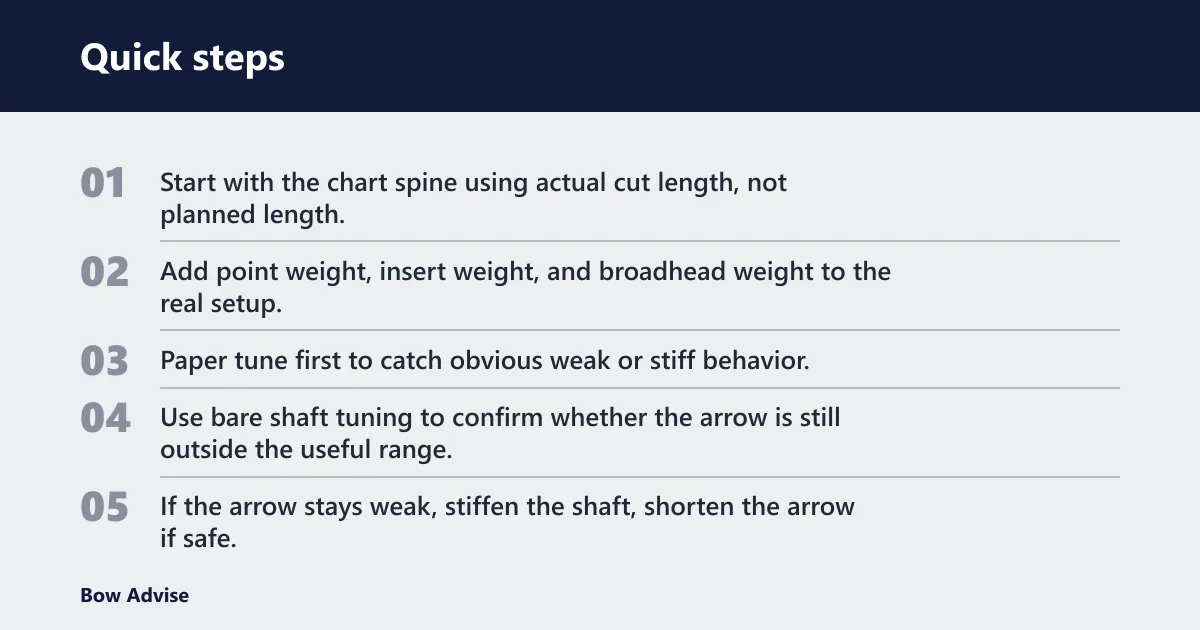
- Start with the chart spine using actual cut length, not planned length.
- Add point weight, insert weight, and broadhead weight to the real setup.
- Paper tune first to catch obvious weak or stiff behavior.
- Use bare shaft tuning to confirm whether the arrow is still outside the useful range.
- If the arrow stays weak, stiffen the shaft, shorten the arrow if safe, or reduce front weight.
Suppose a 60 lb compound with about a 28 inch arrow is set up with a 400 spine baseline, then a brass insert and 150 grain head are added. If paper tune shows a weak tear and bare shafts land left of the group, the practical fix is not another rest adjustment. The shaft likely needs to move stiffer.
Frequently asked questions
When do I need a stiffer arrow spine for heavy point weights?
Go stiffer when added point weight pushes the setup past the chart’s comfortable center and into the weak side. Verify with paper tuning and bare shaft tuning.
How many grains of point weight make an arrow act weaker?
Adding 25 grains of point weight makes the arrow act weaker. A practical rule of thumb is that this is roughly like adding +3 to 5 lb draw weight in dynamic effect. That small change can be enough to move a borderline shaft from acceptable to weak, especially on a long arrow or a fast compound.
Does a longer arrow need a stiffer spine even if the shaft rating stays the same?
Yes. Adding 1 inch of arrow length acts weaker, and that is roughly equal to +4 to 6 lb draw weight. Cut length should be known before buying shafts, because a shaft that is fine at one length can become weak once it is left longer for safety or future tuning.
Should I choose the stiffer spine if I am between two groups?
If the setup is between two spine groups, choose the stiffer one when the front end is heavy, the bow is fast, or the arrow is long. That gives more room for broadheads, brass inserts, and future changes. Then confirm with paper tune or bare shaft tune rather than relying on the chart alone.
How do heavy inserts or outserts change dynamic spine?
Heavy inserts and outserts add front weight, so they make the arrow act weaker. They can move a setup that looked fine with a standard field point into a weak-tuning range. If the insert weight is part of the final build, include it before selecting spine, not after the shaft is already cut.
Can a faster compound bow need a stiffer shaft than the chart suggests?
Yes. Bow speed and cam aggressiveness are dynamic spine factors, and faster bows can require stiffer shafts than a basic chart assumes. Aggressive cams transfer energy more abruptly, which can expose a borderline shaft. If paper tears stay weak after setup changes, the arrow is often the real issue.