Arrow Spine for Recurves with String Walking: Selection Tips
Choose a starting shaft that is one step stiffer than the manufacturer chart suggests if your setup, riser cut, center shot, limb behavior, tab face, and crawl range point that way, then tune with point weight and crawl range, not anchor alone. A shaft that is too weak may kick, plane badly, and drift as your crawl changes. This article gives a practical starting point, crawl checks, and the adjustments that keep a barebow recurve tuneable across multiple crawls.
What string walking changes


String walking changes crawl distance, which changes launch angle and the amount of dynamic spine the shaft needs at release. A longer crawl usually makes the arrow act weaker with the same shaft, while a shorter crawl usually makes it act stiffer.
That is why one crawl can look clean on paper and still miss tune at another crawl. Barebow recurves need a compromise that stays close across the crawl range you actually shoot, not a setup tuned only for one anchor distance.
Why the same arrow can act stiffer or weaker
The arrow does not change its static spine when the crawl changes. The shot changes. Finger pressure, launch angle, and the path the shaft takes around the riser all shift the dynamic spine demand.
Picture a barebow archer who tunes at a short crawl and then moves to a long crawl for a lower target. The same shaft may now show a weak reaction, even though the bow, arrows, and brace height have not changed.
Arrow spine basics for recurves
Arrow spine is the shaft’s stiffness, and lower spine numbers mean stiffer shafts. Recurve bows react more to spine changes than compounds, so the same mismatch shows up faster in group shape and bare shaft behavior. That sensitivity is one reason string walking needs a wider tune plan.
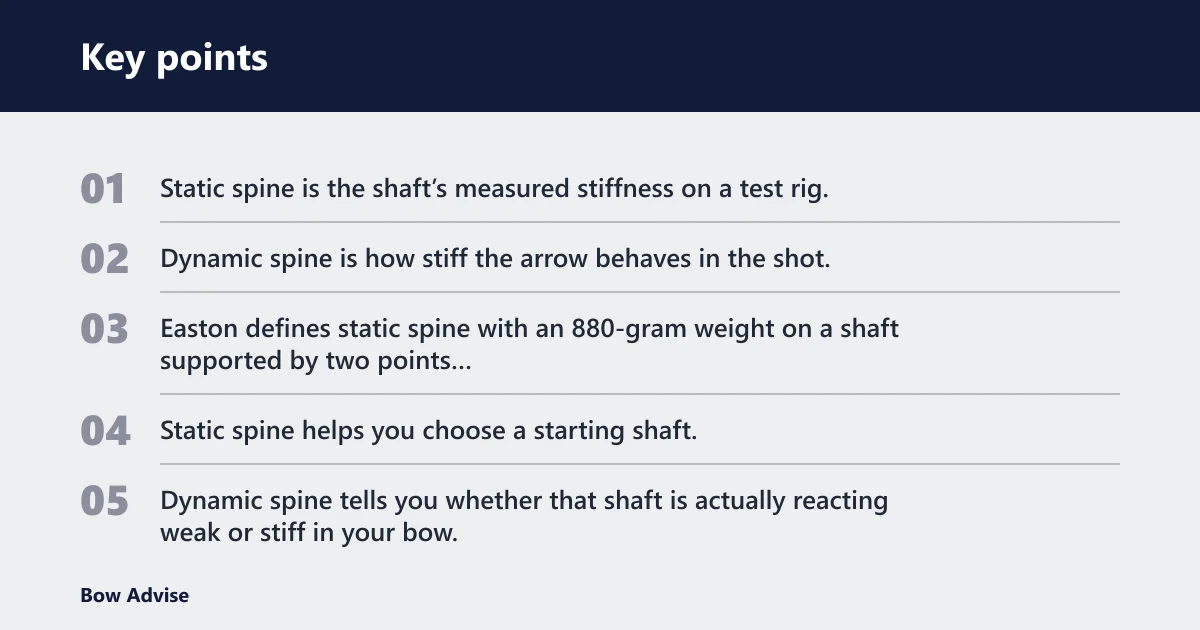
Static spine is the shaft’s measured stiffness on a test rig. Dynamic spine is how stiff the arrow behaves in the shot. Easton defines static spine with an 880-gram weight on a shaft supported by two points 28 inches apart, and Easton notes that a 500 arrow bends .5 inches under that test weight.
Static spine vs dynamic spine
Static spine helps you choose a starting shaft. Dynamic spine tells you whether that shaft is actually reacting weak or stiff in your bow. Point weight, arrow length, draw length, and bow weight all move dynamic spine.
For recurves, that matters more than for many other bows because finger release increases the amount of arrow flex the shaft must absorb. Bare shaft tuning remains the practical final check.
Why recurves are more spine sensitive than compounds
Recurve bows are more spine sensitive than compounds because the release is through the fingers and the arrow must clear the riser while flexing around the bow. Archer’s paradox matters a whole bunch for a recurve shooter.
That means the chart number alone is not enough. The right shaft for a recurve with string walking is the shaft that still tunes when the crawl moves, not just the shaft that looks right at one anchor.
How do draw length and poundage set the starting point?
Use your actual draw length and actual poundage on the fingers, not a guessed setup number. A longer draw generally weakens dynamic spine, and higher draw weight usually calls for stiffer arrows. If either number is off, the spine choice can miss the target before tuning even starts.
Measure draw length, do not guess it
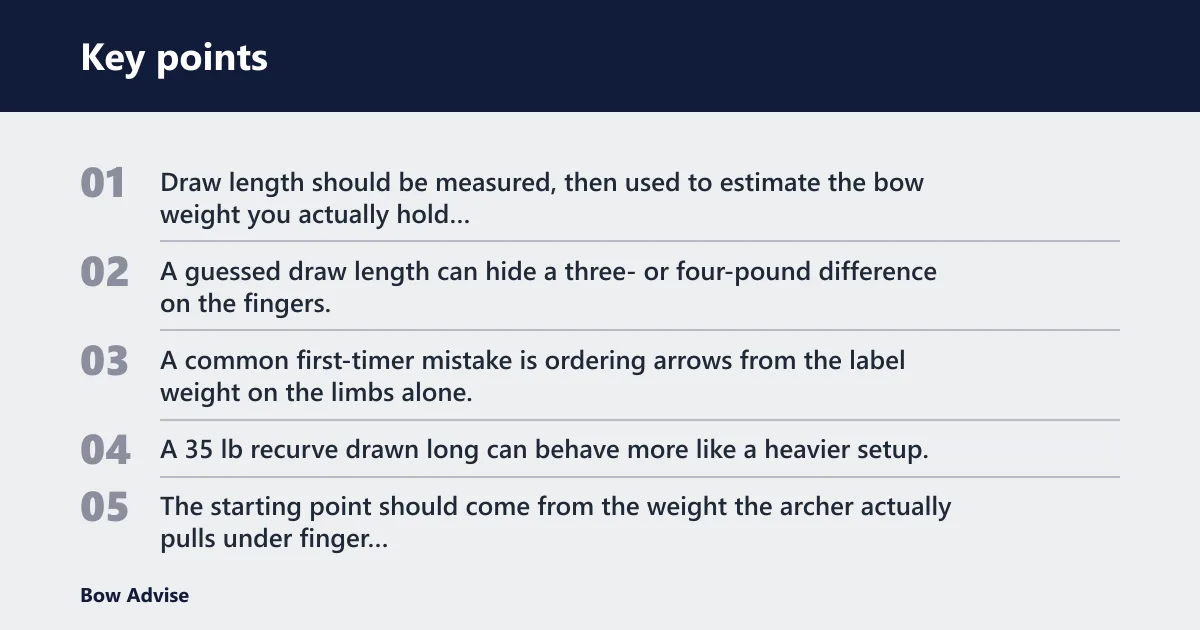
Draw length should be measured, then used to estimate the bow weight you actually hold at anchor. A guessed draw length can hide a three- or four-pound difference on the fingers, and that changes shaft choice enough to matter.
A common first-timer mistake is ordering arrows from the label weight on the limbs alone. A 35 lb recurve drawn long can behave more like a heavier setup, so the shaft often needs more stiffness than the bare limb number suggests.
Use actual fingers-on-the-string weight
The starting point should come from the weight the archer actually pulls under finger release. That is the number that drives the arrow, not the marked limb weight by itself. If the measured draw weight rises, the shaft generally needs to be stiffer.
Suppose a barebow shooter orders for 30 lb limbs but draws long enough to hold more than that on the fingers. The chart can land too soft if the actual poundage is ignored, even before crawl choice enters the picture.
Why a longer draw weakens dynamic spine
A longer draw increases the energy stored in the bow and the force applied through the fingers. That drives the arrow harder, which makes the shaft behave weaker dynamically. A shaft that was fine at a shorter draw can become weak as draw length increases.
That is why arrow selection for recurves should begin with measured draw length, then be adjusted for crawl range and point weight. The bow does not forgive much here.
How does point weight change tune?
Point weight is one of the strongest tuning levers for recurve shooters. Heavier points make dynamic spine act weaker. Lighter points make dynamic spine act stiffer. If the spine is close, point weight can move the tune enough to fix or create a bare shaft issue.
Where point weight fits in the selection order
Use point weight after you have the right general spine window and shaft length. Then use it to fine-tune the bow for your crawl range. It is not a substitute for choosing a shaft that is already in the right neighborhood.
Start with a reasonable point band, tune the bow, then adjust in small steps if the bare shaft reaction says the setup is weak or stiff. That approach works better than trying to solve a bad spine choice with point weight alone.
Point weight and crawl range
A bow that feels weak at long crawls may tolerate a lighter point or a stiffer shaft. A bow that feels stiff at short crawls may need a heavier point or a weaker shaft. The crawl range matters because the same point weight is being asked to work across several launch conditions.
Arrow length and shaft choice
Arrow length affects spine and should be tied to draw length. Longer shafts are weaker in spine. A common rule of thumb is to set arrow length about 1 to 2 inches past draw length, which leaves a safe margin and keeps the shaft from being cut too short.
Adding a little extra length matters because a longer shaft flexes more.
Material choice changes the final spine window
Carbon, aluminum, wood, and fiberglass do not all behave the same, so the exact spine window can shift by material. The practical point is simple: the spine number still has to match the actual shot, and the shaft length and point weight still move the tune.
Bare shaft tuning for string walking recurves
Bare shaft tuning is the final check because it shows stiff or weak behavior directly. For right-handed shooters, a bareshaft hitting left can indicate a stiff setup, while a bareshaft with the nock right indicates a weak setup. Left-handed results are the mirror image.
That check matters more for string walking than one-distance tuning advice. A setup that bareshafts well at one crawl may not hold across the rest of the crawl range, so the tune should be judged after the bow is set up for the crawl range you actually shoot.
What to change first after the bare shaft tells the truth
If the bareshaft says weak, the first adjustments are usually a stiffer shaft, a shorter shaft, or a lighter point. If it says stiff, the first adjustments are usually a weaker shaft, a longer shaft, or a heavier point. Brace height can also move the result.
Brace height and tiller affect tune, so check them after major setup changes. If the bow shifts from clean to erratic after a brace height change, recheck bare shaft before changing the spine choice again.
- Measure draw length at full draw.
- Estimate actual draw weight on the fingers.
- Choose shaft length about 1 to 2 inches past draw length.
- Pick a starting spine one step stiffer than the chart suggests if your setup calls for it.
- Set a point weight band that fits the crawl range you shoot.
- Check brace height and tiller before final bare shaft tuning.
- Read the bare shaft and adjust spine, length, or point weight.
Arrow spine checklist
This table is a tuning aid, not a universal rule. Match the shaft to the crawl range you actually use, then confirm with bare shaft tuning instead of trusting one anchor distance.
| Crawl range | Expected dynamic-spine change | Starting point weight band | First adjustment if bareshaft is weak | First adjustment if bareshaft is stiff |
|---|---|---|---|---|
| Short crawl | Acts stiffer than the same shaft at longer crawls | Lower to mid point weight | Try heavier points or a slightly longer shaft | Try lighter points or a slightly shorter shaft |
| Medium crawl | Usually the best compromise zone | Mid point weight | Try a modest point-weight increase | Try a modest point-weight decrease |
| Long crawl | Acts weaker than the same shaft at shorter crawls | Mid to higher point weight, or one spine stiffer | Try a stiffer shaft or lighter point if the arrow is clearly weak | Try a heavier point if the shaft is only slightly stiff |
Use the table as a crawl-specific starting map. If your longest crawl is the crawl you care about in competition, tune for that crawl first, then check whether the short crawl still stays close enough. If not, the shaft choice is probably too soft for the whole range.
Should you follow the Easton chart exactly?
No. The chart is only a starting point for recurve archers. That is especially true for string walking, where crawl changes move dynamic spine around during the same round. Use the chart as a first pass, not as the final answer.
The chart is treated more strictly for compound setup than for finger-release recurves. For a string-walking recurve, pair the chart with measured draw length, actual draw weight, shaft length, and point weight before final tuning.
How to use the chart with a calculator
Feed the chart or calculator your measured draw length and actual poundage, then treat the result as a starting spine. If the result sits on a boundary, start one step stiffer rather than softer. That gives more room to tune across crawl distances.
Say your measured draw length is longer than expected and the chart lands between two spines. Starting on the stiffer side gives more room to recover with point weight and shaft length if the bare shaft shows weak at the long crawl.
Frequently asked questions
What arrow spine should I use for a recurve with string walking?
Start one spine stiffer than the chart suggests if your setup calls for it, then tune from there with point weight, shaft length, and brace height. For string walking, the best spine is the one that stays tuneable across the crawl range you actually shoot, not just at one anchor distance.
Does string walking make my arrows need to be stiffer or weaker?
It depends on crawl distance. Longer crawls usually make the arrow behave weaker, while shorter crawls usually make it behave stiffer. That is why a barebow recurve often needs a compromise spine that can survive the full crawl range instead of a single-distance tune.
How does longer anchor distance change arrow spine for barebow recurve?
A longer crawl changes the launch angle and the dynamic spine demand. In practice, the same shaft usually acts weaker as the crawl gets longer. If the crawl range is large, the setup may need a stiffer shaft or a lighter point to stay in tune.
What point weight works best with string walking on a recurve?
The best point weight is the one that keeps bare shafts close across your crawl range. Heavier points make dynamic spine act weaker and can help a stiff setup. Lighter points make dynamic spine act stiffer and can help a weak setup. Start in a middle band, then adjust from the bare shaft result.
Should I follow the Easton chart exactly for a string walking recurve?
No. Use it as a starting point only. The chart is only a starting point for recurve archers, and string walking changes the tune across crawls. Measured draw length, actual finger weight, and bare shaft results should have the final say.
How do I tune recurve arrows after changing brace height or point weight?
After a brace height or point weight change, recheck bare shaft impact before changing the spine choice. Brace height can shift tune, and point weight changes dynamic spine. If the bareshaft moves left for a right-handed shooter, the setup is stiff; if the nock moves right, it is weak.
What spine is best for a 25 lb, 30 lb, or 35 lb recurve with fingers?
There is no single spine number that fits all three weights once draw length and crawl range are included. The practical starting method is the same: measure draw length, use actual poundage on the fingers, start one step stiffer than the chart if needed, and then confirm with bare shaft tuning.