Arrow Direction Problems After Broadhead Changes Guide
If your arrows move left or right after a broadhead, insert, outsert, or point-weight change, treat it as a component-mass shift first. Go back to the previous setup and change one part at a time. Ignore it and you can chase tuning for hours, weaken broadhead accuracy, and hide a bad arrow build. This guide shows how to identify whether the head, insert or outsert, or point weight caused the shift, then how to confirm it with a simple step-by-step check.
What you’ll need before you diagnose the problem


- A spin-test surface or arrow spinner
- The original field points and the new broadheads
- A scale or the labeled mass for each point, insert, and outsert
- Paper target and frame for a 6- to 8-foot test
- A target lane with marks at 20 and 40 yards
- Bow square or draw board notes for centershot reference
- Arrow straightness checker, if available
- Notebook or component swap log
Why did my arrows start hitting left or right after changing broadheads?
The most common reason is not the broadhead alone. Fixed-blade broadheads act like steering surfaces, so they expose problems that field points can hide because field points track with less drag and less steering effect. Start with the broadhead and the arrow build together, then check tune only after the components are proven square.
What fixed blades reveal
Fixed blades can magnify small errors in centershot, spine, or component alignment. Longer ferrules can wobble more than shorter ones, which makes a tiny runout look like a large left-right miss at distance. Mechanical heads usually hide some of that steering effect, so a clean change from mechanical to fixed blade often exposes setup limits.
Suppose a bow was on target with field points at a shorter distance, but a heavier fixed blade starts landing noticeably left at a longer distance. That pattern points first to a component or tune mismatch, not a random bad shot.
What should I check first after swapping to fixed blades?
Check the arrow and head before touching the bow. A paper-tuned bow should produce a bullet hole before broadhead tuning, and broadhead tuning is a final confirmation step, not the starting point. Spin-test every arrow, then compare field point impacts and broadhead impacts at 20 yards.
First pass order
- Spin each assembled arrow with the broadhead installed before doing further checks.
- Inspect the insert or outsert seating and the shaft end.
- Shoot field points at 20 yards and mark impact height and direction.
- Switch to broadheads and compare the difference at the same distance.
A clean bullet-hole tear through paper at a short distance can suggest relatively minimal nock travel. If that baseline is clean and broadheads still wander, the arrow build is more likely than the bare bow.
Can a heavier point weight change arrow direction?
Yes. Point weight changes arrow spine behavior and front-of-center balance. A recent increase can make a shaft act too weak, while a lighter swap can make it act too stiff. Draw weight, arrow length, and point weight all affect spine choice, so a small head change can push a matched arrow out of its range.
Why weight changes move impacts
Heavier points shift balance forward and can raise FOC. The common hunting range is 10–15%. Low FOC can make a fixed blade steer the shaft more because the front of the arrow has less resistance to that steering input. That is why a point swap can change direction even when the bow itself did not move.
Check these values first
| Item | Original | New | Why it matters |
|---|---|---|---|
| Point weight | 100 grains | 125 grains | Changes spine and FOC |
| Insert/outsert mass | 25 grains | 50 grains | Alters balance and front loading |
| Broadhead model | Mechanical | Fixed blade | More sensitive to tune errors |
| Spin-test result | Clean | Wobble at tip | Signals runout or seating issue |
Do different inserts or outserts affect broadhead tune?
Yes. Insert and outsert alignment affect seating, and weight variation changes front-of-center. A crooked insert can create a single-arrow outlier, while mixed insert weights in the same dozen can make impacts split into two groups. Quarter-turn the head before gluing; if the wobble moves with the head, the problem is in the components.
How to separate seating from tuning
- Thread the broadhead onto the shaft and mark the high spot.
- Rotate the head a quarter-turn and spin it again.
- Keep the orientation that minimizes wobble.
- Do not glue a crooked insert into service.
Field points can hide a slight outsert error. Fixed blades usually do not. A shaft that spins true with a field point but wobbles with a broadhead often has a seating issue, not a bow issue.
How do I tell if the problem is the broadhead or my bow setup?
Use a comparison, not a guess. Field points are the baseline, broadheads are the test, and paper and walk-back tuning tell you whether the bow is already close. If the same arrow hits together with field points but spreads with broadheads, suspect the head, the insert, or the spine match before blaming the rest.
Compare at 20 yards first
Broadhead impact diagnosis starts by comparing field points and broadheads at 20 yards. If both land together there but separate at 40 yards, the system may be close yet still sensitive to spine or centershot drift. If the groups are split at a short range, revisit the arrow build and the bow tune.
How do I know if my arrow spine is now wrong after the change?
Look for a pattern that repeats across distances. Too weak often shows broadheads drifting one way and getting worse as distance grows. Too stiff can show the opposite pattern. The key is that the miss stays consistent, not random. That is why paper tuning and walk-back tuning belong in the same diagnosis.
Use paper and walk-back together
Paper tuning at a short distance gives an early read on launch quality. Walk-back tuning is the fastest centershot check and verifies impact at multiple distances on one vertical line. A multi-distance ladder uses 10, 20, 30, and 40 yards. If the impacts walk left or right as distance increases, centershot or rest position deserves attention.
Match the drift to the likely cause
- Left-right drift that grows with distance often points to centershot or rest misalignment.
- A clean paper tear but broadhead drift can point to dynamic spine limits.
- One arrow that fails spin-testing usually points to shaft damage or a crooked component.
Could bow torque or form be the real cause?
Yes, but only after the equipment checks are clean. Grip pressure, anchor change, and release inconsistency can mimic a tuning problem. The mistake is making form the first explanation. If the same arrow, with the same point weight and verified spin, still shifts only when shot by different people or different grip pressure, then form is worth a hard look.
Common form checks
- Use the same grip pressure on every shot.
- Hold the same anchor and head position.
- Keep the release clean and straight to the rear.
- Confirm the sight picture is not changing at full draw.
Common first-timer mistake is chasing a left miss with rest adjustments when the real issue is a torque-heavy grip. Another is blaming form when one arrow has a bent ferrule and the rest are clean.
The component swap log and retune decision tree
A log turns guesswork into a yes-or-no call. Record every arrow separately, because mixed batches can hide one crooked insert or one shaft with a different point mass. Pass or fail the setup based on whether the change altered FOC, created wobble, or moved impacts consistently in one direction at 20 and 40 yards.
Use this log for each arrow
| Arrow | Original point | New point | Insert/outsert | Spine | Broadhead model | Spin-test | 20 yd miss | 40 yd miss |
|---|---|---|---|---|---|---|---|---|
| A1 | 100 gr | 125 gr | Insert, 25 gr | 300 | Fixed blade, 3-blade | Clean | 1 in left | 4 in left |
| A2 | 100 gr | 100 gr | Outsert, 50 gr | 300 | Mechanical | Wobble | 2 in right | 6 in right |
Decision tree
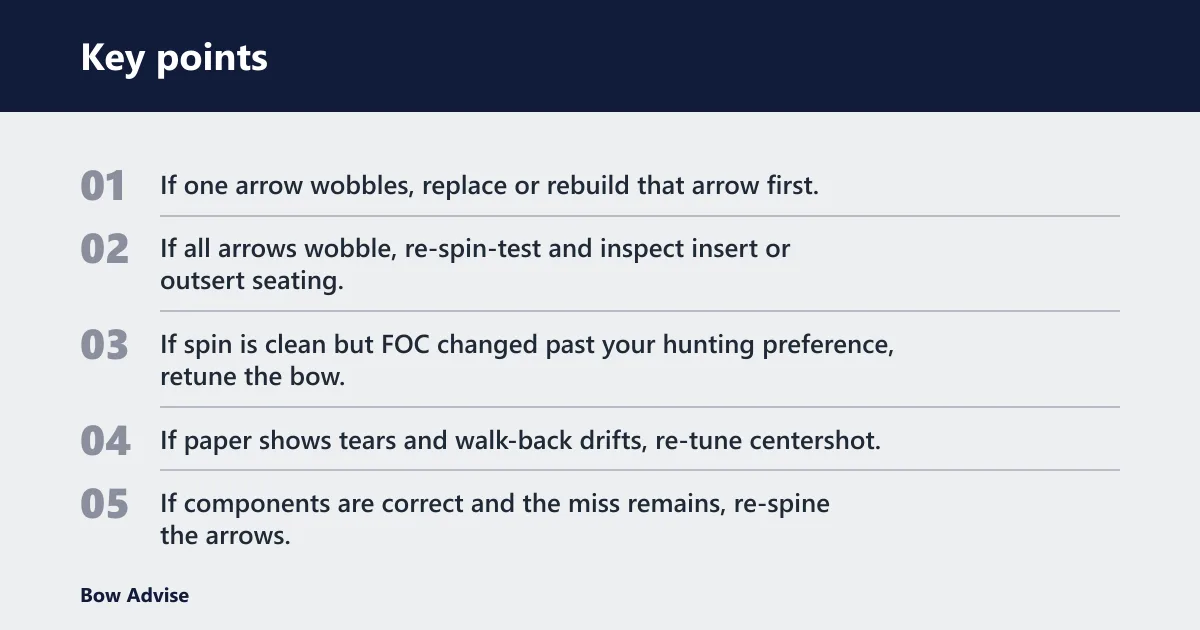
- If one arrow wobbles, replace or rebuild that arrow first.
- If all arrows wobble, re-spin-test and inspect insert or outsert seating.
- If spin is clean but FOC changed past your hunting preference, retune the bow.
- If paper shows tears and walk-back drifts, re-tune centershot.
- If components are correct and the miss remains, re-spine the arrows.
If that did not work, go in this order: re-spin-test, then paper tune at six to eight feet, then walk-back tune, then change spine. That ladder keeps the diagnosis on the component mismatch first and avoids chasing a broadhead problem that started in the insert or point weight.
Prevention: keep one exact parts list for a hunting dozen and replace components in matched sets. Mixed insert weights and mixed point weights make future diagnosis much harder.