How Were Native American Bowstrings Made and Replaced?
Native American bowstrings were commonly made from sinew, rawhide, plant fibers like dogbane or nettle, and sometimes animal hair, then replaced when fraying, stretching, or breaking made the bow unsafe. A weak string can fail at full draw, waste game, and leave a hunter with a dead bow. This guide covers historic string materials, when to swap them out, field-ready substitutes, and how humidity, cold, and dryness changed the best choice.
This guide is part of our Native American bows and arrows guide series.
What materials made Native American bowstrings?
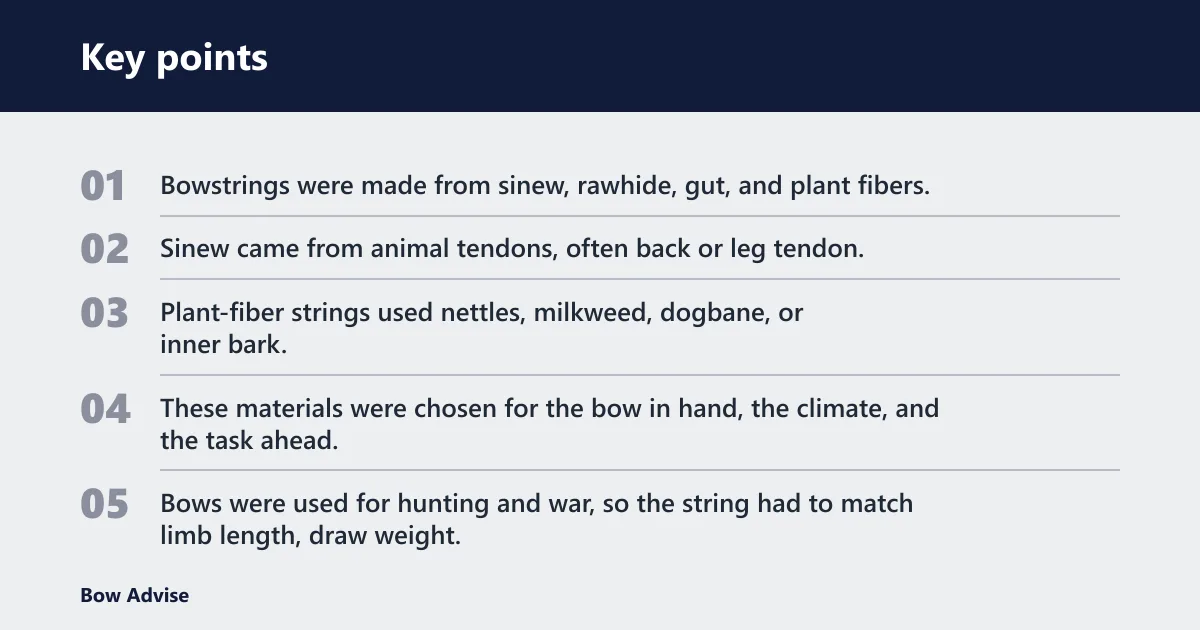


Bowstrings were made from sinew, rawhide, gut, and plant fibers, with local availability shaping the choice. Sinew came from animal tendons, often back or leg tendon, including buffalo tendon in some traditions. Plant-fiber strings used nettles, milkweed, dogbane, or inner bark, and they took much more work to prepare.
These materials were chosen for the bow in hand, the climate, and the task ahead. Bows were used for hunting and war, so the string had to match limb length, draw weight, and expected weather. That is why one region might favor tendon-based stringing while another leaned on tough plant fiber.
Sinew from tendon
Sinew was a common high-value choice because tendon fibers could be split and twisted into a strong cord. The material came from animal tendons, often from the back or leg, and buffalo tendon appears often in traditional accounts because buffalo provided large, workable lengths.
Sinew strings were valued for strength and compact storage, but they needed care. Moisture could change their behavior, so hunters kept them dry when possible and watched for slack after wet weather. That sensitivity matters in the field, where a string that lengthens even a little can throw off brace and point of impact.
Rawhide and gut
Rawhide was one of several traditional bowstring materials, and animal gut was another. Both could be used when a community had the right processing knowledge and access to hide or gut from game. They were practical options when sinew was limited or when local practice favored a different texture and handling profile.
Neither material should be treated as identical to sinew. Rawhide tends to behave more like a skin strip than a fiber cord, and gut can respond sharply to damp or drying cycles. In survival terms, that means both can work, but both reward careful drying, inspection, and backup planning.
Plant fibers
Plant-fiber strings could be made from nettles, milkweed, dogbane, or inner bark. They were less common because they involved much more work, but they had an important advantage: plant-fiber strings were more stretch resistant and more durable in damp conditions. That made them useful where moisture was the bigger threat than labor.
Plant fibers also mattered because they were renewable and widely available in some regions. The tradeoff is time. Preparing fibers, cleaning them, spinning them, and finishing them into a usable string takes more labor than cutting and twisting tendon. For a traveling archer, that labor was the real cost.
How were Native American bowstrings attached and tensioned?
Bowstrings were usually attached with end loops, notches, or similar holding points at the limb tips, then tensioned so the string sat correctly against the bow’s length and draw. The fit had to be snug enough to stay put, but not so tight that it overstressed the limbs before the bow was ready to shoot.
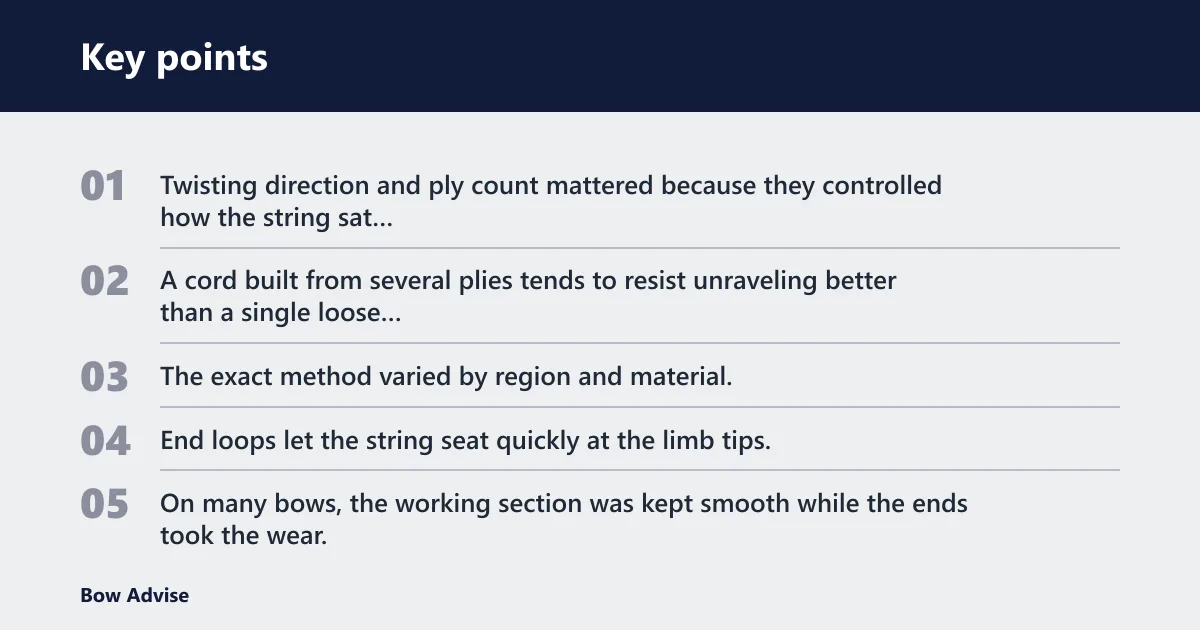
Twisting direction and ply count mattered because they controlled how the string sat under load. A cord built from several plies tends to resist unraveling better than a single loose bundle. The exact method varied by region and material, but the logic stayed the same: even tension, clean seating, and enough twist to stabilize the cord without making it kink.
End loops and serving points
End loops let the string seat quickly at the limb tips. On many bows, the working section was kept smooth while the ends took the wear. Serving points, or reinforced contact sections, protected the places most likely to rub against the bow or arrow pass, especially on heavier setups.
A short string that fits badly can be worse than no spare at all. If the loops are mismatched, the bow may brace unevenly or twist under draw. That is why a replacement string had to match the bow, not just the material.
Twist and tension logic
Strings were generally built with controlled twist so the fibers loaded evenly. Too little twist leaves the cord soft and sloppy. Too much twist can stiffen it, shorten serviceable length, and make fine adjustment harder in the field.
Picture a hunter carrying a spare sinew cord in a dry pouch. If that cord is untwisted and the main string breaks, the spare can be matched to the bow and twisted to final tension far faster than a raw bundle could be processed from scratch. The spare still needs checking, but it is usable immediately.
How were native american matrix
This table compares several common materials by source, moisture behavior, preparation, field replacement speed, and likely use. It is a practical decision guide, not a claim that one material fit every bow or every region.
| Material | Source material | Moisture behavior | Prep difficulty | Likely field-replacement speed | Best use case |
|---|---|---|---|---|---|
| Sinew | Animal tendon from back or leg; buffalo tendon in some traditions | Sensitive to damp; can slacken when wet | Moderate to high | Fast if a spare pre-twisted cord is carried | Strong general-purpose string for dry conditions and prepared kits |
| Rawhide | Strip of prepared hide | Can stiffen, swell, or change shape with moisture | Moderate | Moderate if a ready strip is on hand | Traditional option when hide material is available |
| Gut | Animal gut | Moisture-sensitive and needs careful drying | Moderate | Moderate to slow without a prepared spare | Historic string option where gut was easier to obtain than fiber cord |
| Plant fiber | Nettles, milkweed, dogbane, inner bark | More stretch resistant and more durable in damp conditions | High | Slow unless pre-made cord is carried | Wet climates and places where plant fiber is the local backup |
How did Native Americans replace a broken bowstring in the field?
Field replacement meant removing the damaged string, checking that the new one matched the bow’s length and bracing needs, then seating and tensioning it carefully. The goal was a safe, shootable bow, not a perfect workshop finish. A replacement had to be fast, but it also had to be correct.
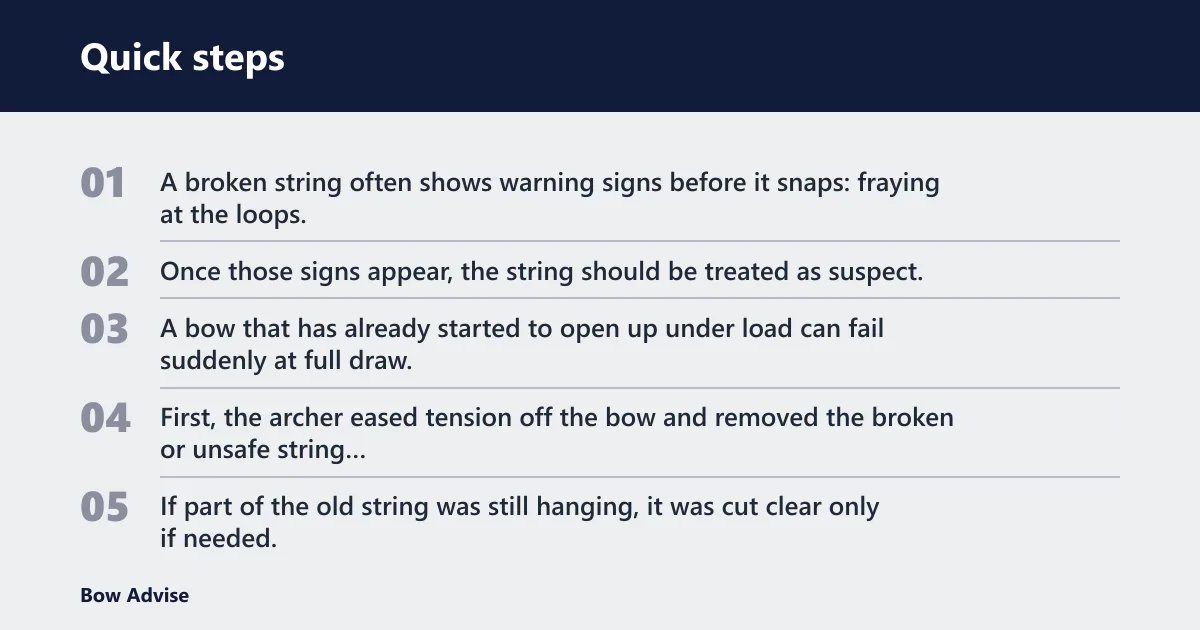
A broken string often shows warning signs before it snaps: fraying at the loops, fuzzed fibers along the belly side, creep that leaves the bow under-braced, or swelling after rain. Once those signs appear, the string should be treated as suspect. A bow that has already started to open up under load can fail suddenly at full draw.
Removing a damaged string
First, the archer eased tension off the bow and removed the broken or unsafe string without letting the limbs twist violently. If part of the old string was still hanging, it was cut clear only if needed. On a self-bow, the replacement job focused on the one-piece wooden limb and its tip notches.
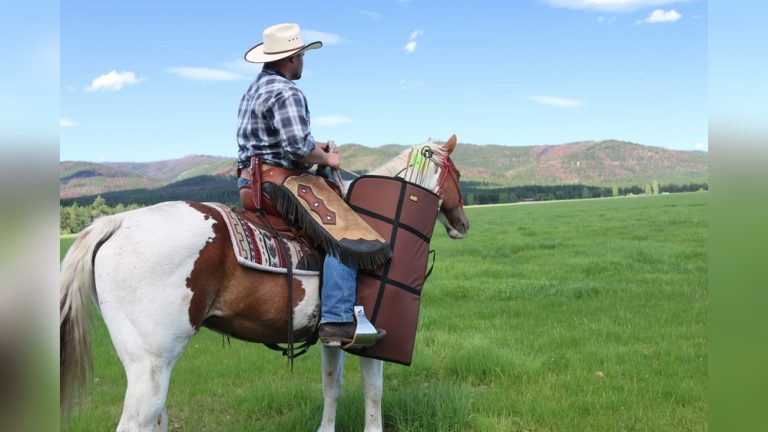
On a composite bow, the repair could be more delicate because the bow used multiple materials and often carried more stored energy. That made careful bracing and a clean string seat more important. Composite bows were also more associated with horseback use, so a damaged string could mean losing mobility as well as firepower.
Matching length and bracing
The replacement string had to fit the bow at a workable brace height. If it was too long, the bow would feel dead and unstable. If it was too short, it could over-brace the limbs and increase stress. The right fit let the string sit with enough clearance for shooting while keeping the bow ready.
Suppose a roughly 5-foot self-bow loses its cord in damp brush after a short hunt. A spare plant-fiber string in the pack may take longer to seat than sinew, but if it is already braided and long enough to match the limb tips, the bow can be made serviceable again without rebuilding the entire weapon.
Tying, bracing, and checking twists
After attachment, the bow was brought to brace carefully and checked for twists or uneven load. If one limb looked more stressed than the other, the string could be reseated or retwisted. The final check was simple: the bow should draw cleanly, without side pull, slipping loops, or obvious uneven tension.
That inspection mattered because a field fix is only useful if the bow can be shot safely. A string that creaks, slips, or grows loose after the first draw should be reset before use. The same caution applies in wet weather, when moisture can change string length quickly.
Which strings worked best in damp weather?
Plant-fiber strings often performed better in damp conditions because they were more stretch resistant and more durable in moisture. Sinew and gut could work well, but they were more sensitive to wetting and drying cycles. Rawhide sat somewhere in between, depending on how it was prepared and kept.
That does not mean plant fiber was always the best answer. It often took more work to make, and a prepared sinew spare could still be the faster emergency fix if a hunter already carried one. Climate mattered, but so did storage, maintenance, and how much labor could be spent before the hunt.
Wet conditions versus dry conditions
In wet country, plant fiber could be the better long-term choice because it held its shape more reliably. In dry country, sinew might be favored for strength and compactness. In freezing or highly changeable weather, any organic string needed regular inspection because moisture cycling can create creep, slack, or brittle spots.
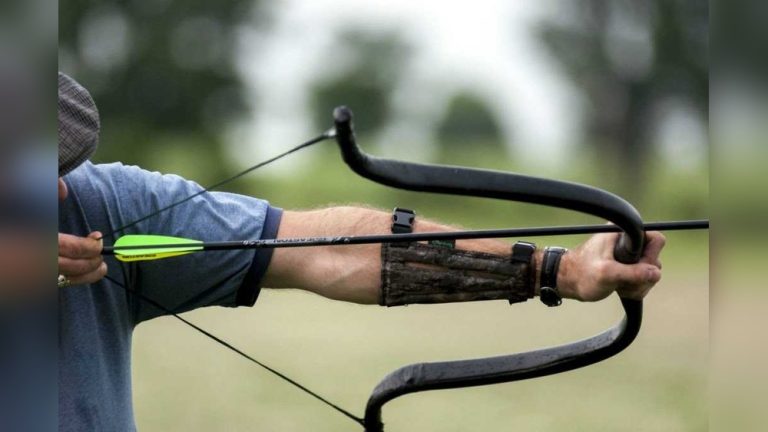
Leather wrist guards were worn to protect against bowstring impact, and some could be made of carved bone, ivory, antler, or silver bracers. That protection mattered more with powerful strings and tighter bracing. A hard string does not forgive a loose sleeve or a poor wrist angle.
Self-bows and composite bows
A self-bow was a weapon made from a single piece of wood. A composite bow incorporated several materials such as wood and horn. The stringing needs of the two are related, but not identical, because the limb structure, draw force, and repair priorities differ.
Self-bows were simpler to make and repair in the field. Composite bows were more specialized, often associated with horseback use, and they could demand more careful maintenance. Hide glue was used to secure sinew backing in composite construction, helping create the layered bow structure used in those bows.
Maintenance differences
Self-bow stringing usually meant checking the tip notches, attaching the loops, and bracing the bow to the correct height. Composite bows often required extra caution because the limbs themselves were built from different materials and could be damaged if the stringing process forced them out of shape.
The common thread is simple. Both bows depended on the string, but the composite bow depended on more than the string. Its backing, glue, and layered build could be affected by heat, moisture, and rough handling, so a broken string was only one of several problems a hunter had to manage.
Frequently asked questions
How were Native American bowstrings made?
They were made by hand from sinew, rawhide, gut, or plant fibers, then twisted or plied into a cord that fit the bow. The exact process varied by region and available materials. A finished string needed enough twist and tension to hold brace height without slipping or overloading the limbs.
What materials were used for Native American bowstrings?
The main materials were sinew, rawhide, gut, and plant fibers such as nettles, milkweed, dogbane, or inner bark. Sinew came from animal tendons, often from the back or leg. Plant fibers took much more work, but they were more durable in damp conditions.
Were sinew, rawhide, or plant fibers better for bowstrings?
Better depended on the climate and the job. Sinew was strong but moisture-sensitive. Rawhide was a traditional option when available. Plant fibers took more work, but they were more stretch resistant and handled damp conditions better. In wet country, plant fiber often had the edge.
How were Native American bowstrings tied to the bow?
They were often fixed with loops or notches at the ends of the bow, then twisted and tensioned until the bow sat at a suitable brace height. Some strings used reinforced sections where contact wear was greatest. The key was a secure fit that did not distort the bow.
How long did Native American bowstrings last before replacement?
There was no single service life because use, weather, and material quality all changed the answer. A string that frays, creeps, or swells after moisture exposure should be replaced sooner rather than later. Hunters judged by condition, not by a fixed calendar or universal number.
What tools were used to make Native American bowstrings?
Typical tools were simple: cutting blades, scraping tools, and hands for twisting, splitting, and finishing. Some string making depended more on patience than equipment. For composite bows, hide glue and careful drying mattered as much as the cord itself, and wrist guards protected the archer from impact.