Native American Bow Types Across Tribes: Main Forms
Across tribes, the main Native American bow types include reflexed yew-backed recurves and sinew-backed recurves in Woodlands and Plains contexts, self yew/maple longbows among some Eastern groups, and short composite war bows in many Plains groups. Regional materials and mounted versus on-foot hunting shape bow length, reflex amount, and grip. When I guess the wrong bow type, the draw expectation goes off, tiller matching fails, and gear choices turn into accuracy and safety problems. I sort these bow types by region first, then tie each design to the local wood, sinew use, horse use, and typical field hunting.


Native Archery: a simple way to sort bow types
I sort Native American bow types by two things, the build style and the hunting context. Build means single-wood self, sinew reinforcement, or multi-material composite. Hunting context means foot shooting versus mounted maneuvering. Those decisions control bow length, whether the profile goes reflexed or stays in a longer profile, and how the backing system gets used in the field. Once you do that, “tribal bow styles” stop sounding random.
Sort by form and build: self, backed, horn/composite, and mounted-short reflex patterns
A self bow is a single-wood construction. A sinew-backed bow uses dried animal sinew as reinforcement. Composite bows stack multiple materials, often including wood plus horn and sinew. Once horse movement and mounted archery become part of the hunt, bow length usually drops and the profile gets reflexed or gull-wing shaped for clearance and control.[2][3]
Tie shape to use: foot hunting vs mounted maneuvering drives length and profile
On foot, you can afford a longer bow that sits naturally against the set of your shot stance. On horseback, clearance becomes the limiting factor, and you need a shape that lets you draw and aim without the bow colliding with your body or mount. That’s why you see shorter recurves and reflexed forms in mounted contexts.
They tested that idea on their own practice shots, then wondered why their draw habits changed and groups opened up. The fix came when we matched the bow profile to the way they actually shot from their stance and draw cycle. After that, their groups tightened.
According to Plains Indian Weapons, part I: the Bow and Arrows — Plains bows are described as short, about 42-48 inches. (source)
What’s the difference between a self bow, sinew-backed bow, and composite bow?
A self bow uses one wood species for the working body. A sinew-backed bow reinforces the back with dried animal sinew, and that choice typically pushes the design toward a shorter, faster mounted setup. Composite bows combine materials, often pairing wood with horn and sinew, so builders can keep power compact when space and maneuverability matter.
Self bow: single-wood construction and why it shows up where backing materials are limited
Self bows are typically single-wood constructions, and they appear in Eastern Woodlands and Arctic contexts. Dense, consistent access to horn or heavy backing resources is tougher in those areas, so builders rely on the working wood. Woodland traditions often lean longer in feel because the build depends on wood behavior and shot stability rather than stacked reinforcement layers.
The Arctic variant adapts to scarce wood. Some builds use multiple pieces, but the goal stays the same: keep the working face and back behavior predictable enough for survival-focused hunting. When you see a “self-bow” label in northern descriptions, it usually means the core system stays fundamentally wood-based rather than a fully layered composite.
Sinew-backed bow: how dried sinew reinforcement changes durability and practical power
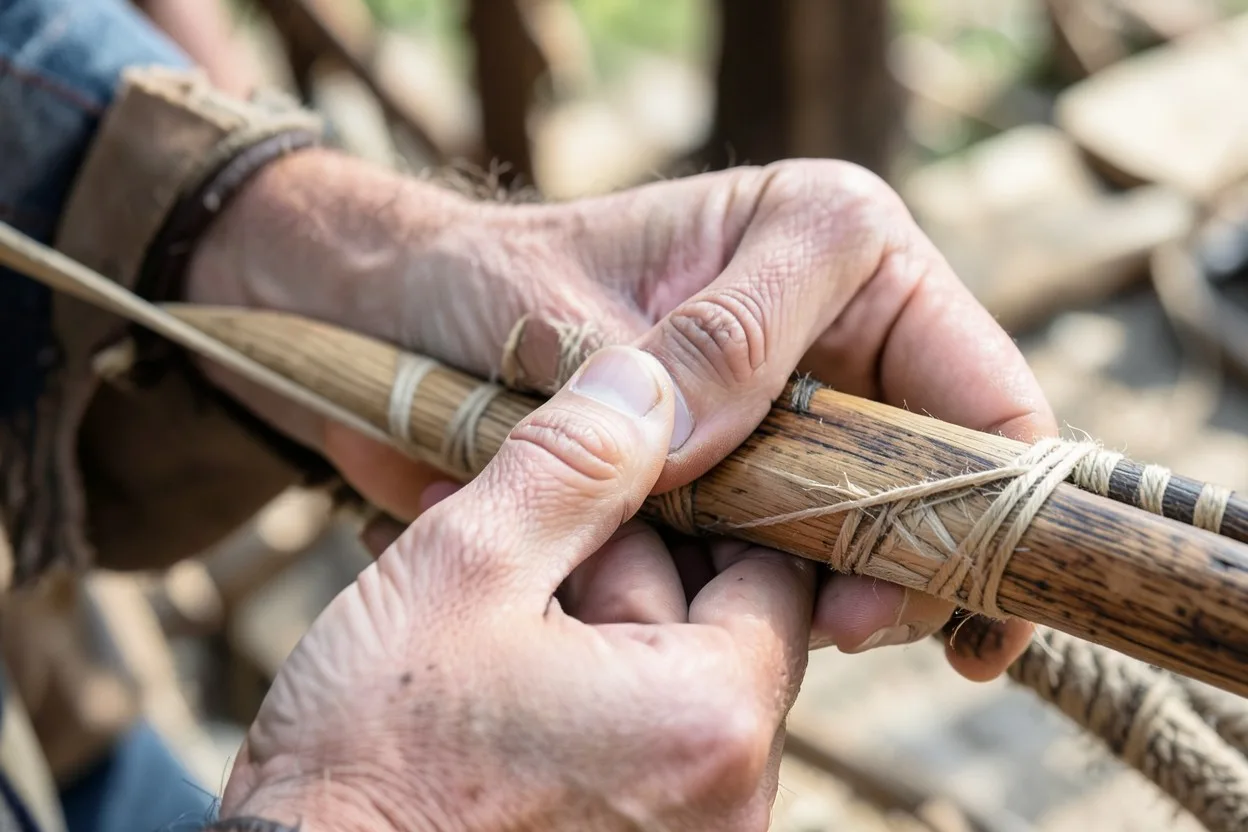
Sinew-backed bows use dried animal sinew on the back as reinforcement. This is one of the most common shifts that moves a bow toward shorter, faster behavior for mounted archery needs. One Plains source places sinew-backed draw weight around 50–70 lbs, and Plains construction descriptions often glue sinew in layers using hide-based glue.[1]
The bow tends to behave more consistently after repeated shots because the back takes load with more confidence. That consistency matters when you’re hunting and you cannot baby the equipment after every shot.
Composite bow and horn elements: multi-material builds that keep power compact
Composite bows are multi-material constructions. In the way these traditions are commonly described, they can include wood plus horn and sinew, and they’re tied to more complex bowmaking. The reason is practical: when you need maneuverability and compact power, stacked materials let builders reach that target without relying on an extremely long form.
Horn bows show up in discussions of Sioux-related examples. They’re often treated as part of composite design thinking, where horn strips or horn components work in the back system. In practice, horn gets named less often than wood self bows, because wood availability and backing access decide what a group can build repeatedly.
How did mounted archery change bow length and shape?
Mounted archery pushes bow length shorter because you need clearance, control, and repeatable draws while managing the horse’s movement. After horses were reintroduced, shorter, more maneuverable forms seem to have become more important in Plains warfare and hunting. Bow profiles often get reflexed or gull-wing shaped to improve arrow clearance and stance.
Shorter bows for horseback work: clearance, control, and repeatable draws
On horseback, a long bow creates problems you do not deal with on the ground. It interferes with body position during the draw and follow-through, and it’s harder to keep the bow stable when the horse changes speed. Shorter bows fix that by keeping the working limb area in a tighter arc.
One Plains source ties mounted contexts closely to buffalo hunting. In that description, a Plains bow is often around 42–48 inches, and it’s frequently reflexed with a gull-wing profile. When I tune similar modern builds for field shooting, that profile changes how the bow tracks through the draw, especially when footing is uneven.
Reflexed or gull-wing profiles: why these forms help with arrow clearance and stance
Reflexed and gull-wing profiles improve the arrow angle as you draw and anchor. That matters when your torso position shifts with the mount. A gull-wing style profile also changes how the limb loads through the shot cycle, which can support faster, flatter arrow flight behavior in a shorter package.
Eastern Woodlands bow tradition: what it looks like and why
Eastern Woodlands bow traditions are typically longer self bows made from regional woods and optimized for foot hunting and pre-horse contexts. Since they aren’t relying on added layers like sinew backing as the default, wood choice and shape matter more. The result is usually a steadier, longer form aimed at consistent shooting on the ground.
Typical emphasis on longer self bows built from local woods
In Eastern Woodlands discussions, self bows are commonly described as long in woodland traditions. The working principle is straightforward: if you build from trustworthy native wood, you can tune profile and tiller for good performance without needing horn or sinew systems.
If you hand someone a long, wood-only style bow and tell them it’s the same as a Plains reflexed short bow, their expectations break right away. Their stance and anchor end up wrong for the bow’s design intent.
Foot hunting context: how longer forms fit steadier ground shooting
Foot hunting lets you use body position to manage bow movement without the constant clearance issues of mounted shooting. Longer forms can stay consistent over the full draw cycle, especially when you’re braced for a shot rather than passing through the middle of a mount’s gait.
Plains bow tradition: what people mean by “Plains Indian bow”
A Plains Indian bow usually means a short, maneuverable bow tied to mounted use and often buffalo hunting. Plains bows are commonly described as short at about 42–48 inches, frequently reflexed with a gull-wing profile, and strengthened by sinew backing. One Plains source places sinew-backed draw weight around 50–70 lbs in that context.
Short, maneuverable forms linked to buffalo hunting and mounted use
The “Plains bow” label focuses on the shape problem it solves. Mounted archers need something the archer can manage while riding. Bowmakers and hunters favored compact designs, and the back system often relied on sinew reinforcement so builders could get practical strength from shorter working length.
Plains bows are described as reflexed with gull-wing profiles. One source also describes a technique detail: men often let fly eight arrows before the first hit the ground. Whether you treat that as tactical description or cadence description, the point matches the need for repeated, workable shot cycles from horseback.
Sinew-backed and regional wood choices, including why Osage orange appears in southern Plains discussions
Sinew backing is repeatedly described as strengthening the bow. Sinew gets glued on in layers using hide-based glue. That reinforcement pairs well with the shorter bow length Plains archers favored.
Wood choices shift by region. In the north, Plains bow woods are described as ash, chokecherry, or juniper. In the southern Plains, Osage orange is named as an important bow wood, valued for strength and performance. Those details matter because a bow’s “type” is also local material reality, what builders could produce again and again.
Arctic and northern variants: how bowmaking adapts to scarce wood
Arctic bow traditions are often described as self-bow traditions adapted to scarce wood, with sometimes multi-piece construction to make the best use of available material. Horn and sinew can appear in descriptions as bindings or reinforcement options, but the center theme stays constrained construction. When resources are limited, builders simplify while protecting performance.
Self-bow tradition under material constraints and occasional multi-piece construction
Self bows in Arctic contexts are frequently tied to what can be gathered and kept sound through storage. One source describes the Arctic tradition as using self-bows made from scarce materials. That scarcity limits how long a bow can be made without wasting valuable stock.
Some accounts describe multiple-piece builds. In my own shop work, multi-piece choices help you build around irregular stock, and survival-focused contexts follow the same logic. The aim stays consistent, keep the bow functional and repeatable enough for hunting.
Where horn or sinew bindings may show up inside survival-focused build choices
Even when a bow is fundamentally a self-bow, descriptions can include reinforcement that borrows from sinew or horn logic. In most cases, that appears as binding behavior rather than an elaborate composite stacking. In field terms, it aims to extend bow life when the back system sees stress.
Tribe-by-tribe comparison table
This table maps major bow forms to ecology and hunting context. It does not claim every tribe used every design, but it does show recurring links between bow shape, length, backing materials, and how horses or resource limits shaped field needs.
| Bow form (type) | Typical length | Wood or backing materials (as described) | Likely use case | Field note on why this design emerged |
|---|---|---|---|---|
| Self bow (single-wood construction) | Varies; often longer in woodland traditions | Regional woods; self construction; Arctic self-bow tradition uses scarce materials | Foot hunting; pre-horse contexts; survival-focused hunting | Builders optimized around available wood, since horn or heavy backing resources could be limited in Eastern Woodlands and Arctic contexts. |
| Sinew-backed bow (dried animal sinew) | Shorter Plains-style bows | Dried animal sinew glued in layers using hide-based glue; hide-based glue system | Mounted archery after horse adoption; repeated shots from horseback | Sinew backing strengthens a shorter bow and helps it survive high back loads during mounted use. |
| Composite bow (multi-material; wood + horn + sinew) | Often compact for control | Multi-material construction; wood plus horn and sinew | War and hunting where compact power matters | Stacked materials let builders achieve power in a smaller package, matching maneuverability needs. |
| Horn bow (horn components) | Varies; discussed within composite frameworks | Horn strips or horn components; described among Sioux-related examples | Back-system alternatives within complex builds | Horn solutions show up where builders incorporate horn behavior into composite thinking, even if wood self bows were more common overall. |
| Plains bow (short reflexed/gull-wing) | About 42–48 inches | North: ash, chokecherry, or juniper; South: osage orange; sinew backing commonly used | Buffalo hunting; mounted warfare and hunting | Short reflexed forms help clearance and control on horseback, while sinew backing adds strength to the shorter design. Plains arrows were often made from red osier dogwood. |
A quick checklist for reading bow types correctly
- Decide if the hunting context is foot or mounted first.
- Match length expectations: Plains descriptions put short bows around 42–48 inches.
- Check the back system: single-wood self versus sinew reinforcement versus horn/composite layers.
- Use wood availability clues: osage orange in southern Plains, ash/chokecherry/juniper in northern Plains descriptions.
- Expect different strength behavior: one Plains source places sinew-backed draw weight around 50–70 lbs.
What woods were commonly used, and how did regions choose them?
Native bow woods varied by geography and local supply, with ash, chokecherry, juniper, mulberry, cedar, hickory, and osage orange named across sources. Plains discussions explicitly track north-to-south shifts: ash/chokecherry/juniper in the north and osage orange in the southern Plains. Builders selected based on strength, workability, and what was available close enough to use.
Regional wood options named across sources
Across sources, you’ll see ash, chokecherry, juniper, mulberry, cedar, and hickory named as bow woods, with selection changing by tribe and geography. Plains-specific discussions also tie woods to region, including ash/chokecherry/juniper in the north and osage orange in the south.
One southern Plains account explicitly names osage orange as a common bow material, valued for strength and performance. Details like that change how you interpret “Plains bow” beyond silhouette alone.
Why material selection varies by tribe and geography, including performance tradeoffs in field conditions
Even when two bows share a profile, they can behave differently because wood density, grain, and elasticity shift tiller targets and stress tolerance. A longer self bow depends on the working properties of a single wood, while a sinew-backed bow relies on reinforcement to manage back strain.
On my own builds, when I swap wood species, I revise tiller targets and expect different brace feel and recovery. The historical logic matches that reality. Builders learned from repeated field outcomes and adjusted based on what their environment delivered.
Frequently asked questions
What are the main types of Native American bows?
The main types are usually grouped by build and use context: self bows (single-wood construction), sinew-backed bows (dried animal sinew reinforcement), and composite bows (multi-material builds often involving wood plus horn and sinew). Across ecology and hunting contexts, bow length and reflex patterns shift, especially once mounted archery becomes important.
Which tribes used self bows versus sinew-backed bows?
Straight “tribe-to-type” matching varies. Self-bow traditions are described in Eastern Woodlands and Arctic contexts, where builders often relied on scarce or local wood and stayed with single-wood construction. Sinew-backed bows are strongly associated with Plains traditions after horse adoption, where reinforcement supports shorter mounted bows.
What is a plains Indian bow?
A Plains Indian bow is typically described as a short bow used in mounted archery contexts, often linked to buffalo hunting. Plains bows are commonly described as about 42–48 inches, often reflexed with a gull-wing profile, and strengthened by sinew backing. One Plains source places sinew-backed draw weight around 50–70 lbs in that context.
Were Native American bows always short?
No. Mounted archery tends to drive shorter bows, which is why Plains “short reflexed” designs show up in those descriptions. Eastern Woodlands bow traditions are typically described as longer self bows optimized for foot hunting. Arctic bows can be constrained by scarce wood, but they are still described as self-bow traditions rather than always short by default.
What woods were commonly used for Native American bows?
Commonly named woods include ash, chokecherry, juniper, mulberry, cedar, and hickory, with regional choices changing by geography. Plains descriptions add explicit material examples: ash/chokecherry/juniper in the north and osage orange in southern Plains traditions, valued for strength and performance.
How did mounted archery change Native American bow design?
Mounted archery changes bow design by pushing for shorter, maneuverable forms with profiles that support clearance during the draw. After horse reintroduction in the 1500s, shorter reflexed or gull-wing profiles became important for Plains warfare and hunting. Plains bow descriptions often pair that length shift (42–48 inches) with sinew backing for strength and durability.
Did different tribes use composite or horn bows?
Some traditions are described as using composite bows, where wood can pair with horn and sinew for compact power, and horn is discussed within composite design frameworks. Horn bows are reported among Sioux-related examples in composite discussions, while many other contexts emphasize self bows or sinew backing depending on available materials and hunting needs.
Why did some tribes prefer bows even after guns were available?
Bows stayed practical for many communities because they were already integrated into hunting and mobility routines and relied on local craft and materials. Field reliability matters when weather and access change. Some groups continued bow use after guns arrived, even while adapting gear and strategies.
How strong were Native American bows?
Strength varies by bow form, wood, and backing. Plains descriptions include one sinew-backed draw weight source saying 50–70 lbs. Other sources describe some Native American bows approaching 80 pounds. Those ranges reflect differences in design and use case, not a single strength level for every bow type.