How Arrow Direction Changes at 20 Yards vs 60 Yards
Arrow direction does not truly change from 20 to 60 yards; small launch errors, wind, drag, and arrow drop build as the arrow stays in the air, so a 1/8-inch tune issue or a slight grip torque can look minor at 20 and ugly at 60. Ignore that, and you chase the wrong fix, waste arrows, and miss clean shots on game or target line. I’ll break down drift, trajectory, speed, fletching, and tuning so you can tell what is causing the change.
How Arrow Direction Changes at 20 Yards vs 60 Yards


| Factor | How Arrow Direction Changes at 20 Yards | How Arrow Direction Changes at 60 Yards | Winner |
|---|---|---|---|
| Visible impact point shift | Small launch errors are easier to hide, so the arrow often looks close to the aim point. | The same error spreads out more, so the miss is much easier to see. | 20 yards |
| Wind drift | Crosswind movement is present, but it is usually modest enough to read as a small hold adjustment. | Wind has much more time to move the arrow laterally, so the drift becomes a real aiming problem. | 60 yards |
| Drop and hold adjustment | Less drop, less pin gap, less visual confusion. | More drop, more holdover, and more room for sight picture errors. | 20 yards |
| Reading tuning problems | Bad tune can stay subtle and look like a normal miss. | Tuning issues show their hand faster because the arrow spends longer in the air. | 60 yards |
Visible impact point shift
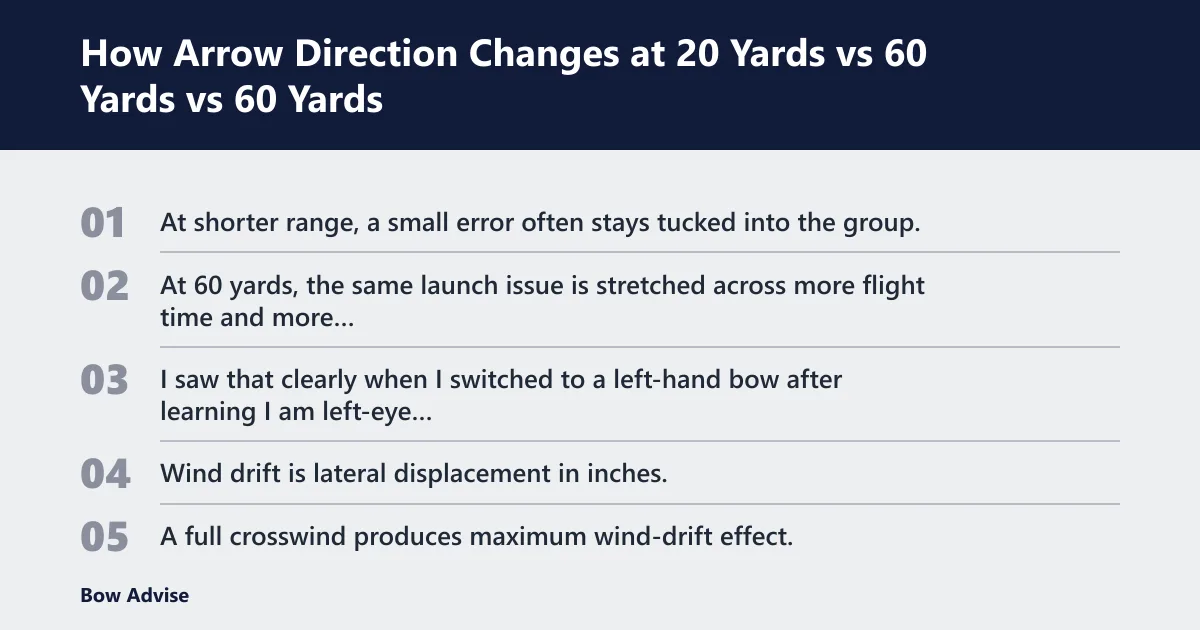
At shorter range, a small error often stays tucked into the group. At 60 yards, the same launch issue is stretched across more flight time and more distance, so it looks like the arrow changed direction mid-flight even when it did not.
I saw that clearly when I switched to a left-hand bow after learning I am left-eye dominant; my groups tightened within two weeks because the sight picture stopped fighting my aim. The arrow did not become a different arrow. My launch got cleaner.
Wind drift
Wind drift is lateral displacement in inches, and it grows because the arrow stays in the air longer at 60 yards. A full crosswind produces maximum wind-drift effect, quartering wind is about 71% of full crosswind drift, and direct headwind or tailwind produces zero lateral drift.
Drop and hold adjustment
Drop is gravity-driven vertical fall. Trajectory is the whole path, while drop is only the downward part of that path, and the article separates them for a reason: the arrow crosses the line of sight at the zero distance, rises before zero, then falls beyond zero.
Why does my arrow seem to move more at 60 yards than 20 yards?
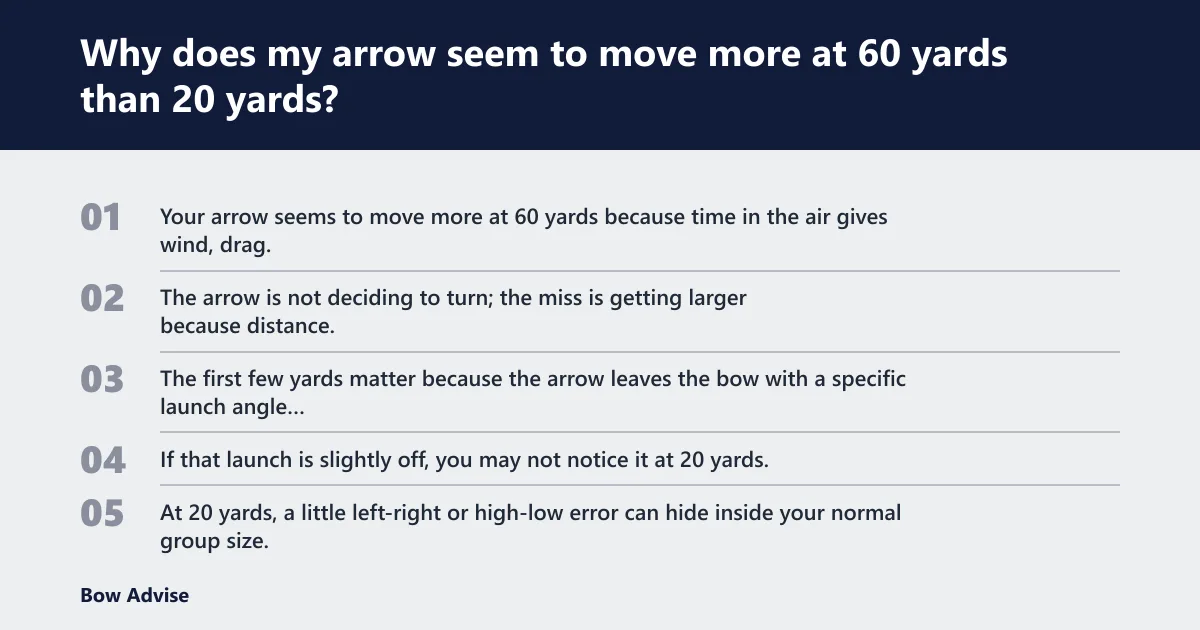
Your arrow seems to move more at 60 yards because time in the air gives wind, drag, and small launch errors more room to act. The arrow is not deciding to turn; the miss is getting larger because distance, flight time, and a sight picture make the gap look bigger.
Launch angle and the first few yards of flight
The first few yards matter because the arrow leaves the bow with a specific launch angle relative to your line of sight. If that launch is slightly off, you may not notice it at 20 yards, but at 60 yards the same small error has more distance to spread out.
Why a small miss is harder to notice at 20 yards
At 20 yards, a little left-right or high-low error can hide inside your normal group size. The arrow is still following the same trajectory, but the visual difference between a good shot and a slightly poor one is much smaller.
Why the same miss looks bigger at 60 yards
At 60 yards, the same miss has more time to grow into a visible impact point shift. That is why a bow that feels “close enough” at 20 can look suddenly wrong at 60, especially if your pin gap, float, or release is a little inconsistent.
Is arrow trajectory the same thing as arrow drop?
No. Trajectory is the full path the arrow takes from bow to target, while drop is the vertical part of that path caused by gravity. An arrow can have the same trajectory family from one shot to the next and still show very different drop at longer range because flight time changes.
What trajectory means in real shooting
Trajectory is the curved path you see when you think about line of sight versus where the arrow actually travels. The arrow rises above the line of sight before the zero distance, crosses that line at zero, then falls away after that.
Why drop increases as flight time increases
Gravity works the entire time the arrow is in the air. The longer the flight time, the more vertical fall builds up, so drop is always more obvious at 60 yards than at 20 yards for the same setup and sight-in distance.
How zero distance changes the point of impact
Your zero distance is the point where the line of sight and arrow path cross. If that zero is set for one range and you move to another without adjusting your hold or pin, the point of impact will shift even if the bow itself did not change.
What changes between 20 yards and 60 yards?
Three things change fast: time in air, drag buildup, and how visible your hold correction becomes. The arrow at 60 yards has spent much longer being pushed by gravity and wind, so any small setup issue or sight choice shows up with more force.
Time in air
The lag-time method used by the calculator treats wind drift as a function of how long the arrow is exposed to the wind. More flight time means more chance for the wind to move the arrow sideways, which is why speed matters so much.
Drag buildup over distance
Drag slows the arrow, and slower arrows spend even more time in the air. That creates a feedback loop: more time aloft means more time for wind to work, and more deceleration means the later part of the shot can drift more than the early part.
How much sight correction becomes visible
At 20 yards, a sight mistake may look like a normal hold wobble. At 60 yards, the same mistake often forces a clearer holdover change, so the sight picture itself can make the arrow seem to move direction even when the arrow flight is consistent.
How wind drift at 20 yards and 60 yards differs
Wind drift grows with distance because the arrow stays exposed longer. A full crosswind causes the most lateral displacement, quartering wind causes less, and direct headwind or tailwind does not create lateral drift, though both can still affect speed and drop through drag.
Crosswind vs quartering wind
A full crosswind pushes the shaft sideways the hardest. Quartering wind is about 71% of full crosswind drift, so it still matters a lot at 60 yards, but its effect is easier to manage at 20 yards because the arrow has less time to move off line.
Headwind and tailwind effects
Direct headwind and direct tailwind both produce zero lateral drift. They still change how the arrow slows down, which can alter drop and timing, but they do not create the side push that makes the arrow appear to move left or right.
Why longer distance gives wind more time to act
This is where many archers misread the shot. The wind did not suddenly get stronger at 60 yards; the arrow simply had more milliseconds for the wind to push it off the line.
Fast compound, hunting compound, and recurve side by side
Fast compound bows resist drift better because the arrow reaches the target sooner. A typical hunting compound sits in the middle, and a recurve usually shows the most long-range drift because lower arrow speed means more time in flight and more exposure to wind.
Typical 20-yard behavior
At 20 yards, all three setups can look manageable if the tune is decent. The faster compound shows the least visible drift, the hunting compound lands in the middle, and the recurve can still group well but may show more sensitivity to release and wind.
Typical 60-yard behavior
At 60 yards, setup differences are harder to ignore. The recurve’s longer flight time and the compound’s speed gap become much more obvious, and a slight hold error or grip issue starts to show up as a clear impact point shift.
What setup factors dominate each distance
At 20 yards, sight picture and release execution usually dominate what you see. At 60 yards, speed, wind exposure, and drag start to matter more, and small tuning differences become easier to separate from simple aiming error.
Proof asset: 20-yard vs 60-yard comparison table
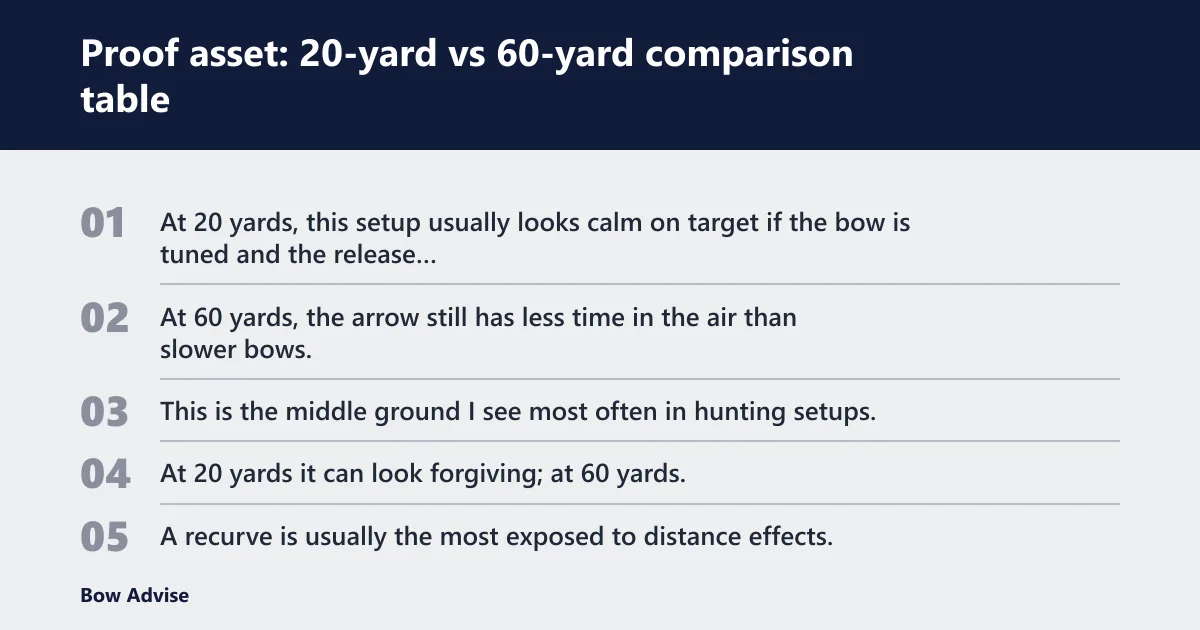
| Setup | 20 yards | 60 yards | Dominant factor at 20 | Dominant factor at 60 |
|---|---|---|---|---|
| Fast compound example: 320 fps and 380 grains | Small lateral movement; impact point shift is easier to hide in normal group size. | Wind drift becomes much more visible, but the fast shot time helps keep it tighter than slower setups. | Hold and sight picture | Wind and hold adjustment |
| Typical hunting compound example: 280 fps and 420 grains | Usually clean and forgiving if tune and release are steady. | More drift and more drop than the fast compound, with tuning errors easier to spot. | Release consistency | Wind, drop, and tuning |
| Recurve example: 220 fps and 450 grains | Groups can still be solid, but the arrow is already less forgiving of wind and release variation. | Largest apparent direction change of the three because longer flight time gives wind more time to act. | Form and tune | Wind and flight time |
Fast compound example: 320 fps and 380 grains
At 20 yards, this setup usually looks calm on target if the bow is tuned and the release is clean. At 60 yards, the arrow still has less time in the air than slower bows, so it resists drift better, but wind and sight correction still show up clearly.
Typical hunting compound example: 280 fps and 420 grains
This is the middle ground I see most often in hunting setups. At 20 yards it can look forgiving; at 60 yards, you start to notice that speed and weight together create more time for wind and drag to matter.
Recurve example: 220 fps and 450 grains
A recurve is usually the most exposed to distance effects. Feather use helps with stability, but lower arrow speed means more milliseconds for wind to move the shaft, so the same breeze looks harsher at 60 than it does at 20.
How arrow speed, weight, and fletching change drift
Faster arrows spend less time in the air, so they drift less. Heavier arrows can decelerate more, which means they may lose speed faster over distance, and fletching type controls how quickly the shaft settles and how much drag it carries.
Why slower arrows spend more time in the air
Time in flight is the enemy of clean long-range direction. A slower arrow gives wind more chances to move it, and that effect compounds from 20 to 60 yards in a way you can usually see on paper and on 3D targets.
How heavier arrows behave over distance
Heavier arrows often carry more momentum off the bow, but they also slow down in a way that can increase time exposure over longer shots. That means weight can help one problem and worsen another, so I look at weight together with speed, not by itself.
How micro vanes, standard vanes, helical vanes, and feathers affect stability
Two-inch micro vanes usually create less drag than larger standard vanes. Longer helical vanes and feathers can give more steering and quicker correction, which helps stabilize the shaft, but the extra drag can also make the arrow more sensitive to wind at longer range.
How do I tell whether the issue is wind, drag, or tuning?
Start with the pattern. Wind usually changes with direction and lane position, drag shows up more as distance grows, and tuning problems repeat the same miss pattern shot after shot. If the arrow group shifts the same way in calm air, I suspect tune or torque before I blame wind.
Pattern clues in left-right misses
A left-right miss that changes with breeze or shooting angle points me toward wind. A left-right miss that stays stubborn in still air makes me check bareshaft, paper tear, rest timing, and my own grip first.
When sight-in distance is the real issue
If the sight is zeroed for one distance and I move farther away, the point of impact can change because the trajectory has crossed the line of sight and is now falling away. That is not a tuning problem; it is a distance and hold issue.
When to check bow setup before blaming wind
I check setup first when the same arrow keeps landing in the same place regardless of wind direction. I also check my own form. My first compound was set noticeably too heavy, and I flinched for a while before I backed the limb bolts out; the “wind problem” disappeared as soon as I could hold the bow properly.
Choose 20 yards if… / choose 60 yards if…
Choose 20 yards when you want to verify tune, confirm release quality, or build a clean sight picture with less wind exposure. Choose 60 yards when you want to test how your setup handles time in flight, drift, drop, and sight correction under real long-range pressure.
If you are diagnosing a bow, start at 20 yards. If you are judging hunting or field performance, finish at 60 yards. The arrow is not changing its mind; the distance is exposing what was already there.
Frequently asked questions
Why does my arrow seem to move more at 60 yards than 20 yards?
Because the arrow spends more time in the air. That extra flight time gives wind, drag, and small launch errors more room to work, so a miss that looks tiny at 20 yards can look much larger at 60.
How much does wind drift increase between 20 and 60 yards?
It increases enough to change your hold choice, but the exact amount depends on speed, arrow weight, fletching, and wind direction. Full crosswind gives maximum drift, quartering wind is about 71% of that, and headwind or tailwind create zero lateral drift.
Do heavier arrows veer more at longer distances?
They can, depending on speed loss and setup. Heavier arrows may carry well off the bow, but over longer distances they can still spend enough time in the air for drift and drop to build, especially if the arrow is moving slower.
How does fletching type change arrow direction at longer range?
Fletching changes how fast the arrow stabilizes and how much drag it carries. Two-inch micro vanes usually add less drag, 3-4 inch standard vanes steer more, 4-inch+ helical vanes and feathers stabilize quickly, and that steering can matter more as distance grows.
Is arrow trajectory the same thing as arrow drop?
No. Trajectory is the whole flight path, and drop is the downward part of that path. The arrow crosses the line of sight at the zero distance, rises before zero, then falls beyond zero as gravity keeps working.
What changes first: sight picture, wind drift, or arrow drop as distance increases?
Usually sight picture changes first because the hold and pin gap become more noticeable. Then wind drift and arrow drop become harder to ignore as flight time increases. At 60 yards, all three can matter at once, which is why distance exposes setup flaws so well.