Arrow Direction After Bow Maintenance: Why It Shifts
After new strings, cables, or a tune, check the nock point and rest position first, because altered string geometry often moves them. Then verify cam timing and centershot if the impact moved left or right. Skip that order, and you can fix the wrong part, lose tune, and keep spreading broadheads and field points apart. This guide explains why maintenance shifts arrow direction and gives the first adjustment to inspect.
This guide is part of our Arrow direction guide for archers series.
Causes of arrow direction changes after maintenance


String and cable work can change arrow direction because the bow’s geometry changes before the bow looks obviously out of tune. Strings and cables can stretch enough to slightly rotate cams, and they can shift the nocking point and peep sight. That means impact can move even when the bow still feels normal at the shot.
Twist count matters here. Twisting strings and cables is the first step to bring a bow back into factory spec, but any change in length can also alter cam position and nock travel. On a two-cam bow, that can show up as a left or right impact change before the bow gets noisy or harsh.
Suppose a right-handed shooter installs a new string set and the arrows now hit left at 20 yards with field points. That does not automatically mean the rest moved wrong. The new string length, peep location, or cam sync may have shifted the launch path first.
Why peep rotation, D-loop creep, and cam drift matter
The D-loop changes effective draw length by about half an inch, and it can shift nocking point position. For release aid setups, the D-loop should be tied before setting nock height. If the loop settles or the serving compresses, the arrow can leave the string at a different angle than before maintenance.
Cam drift can change point of impact without a dramatic visual cue. On a two-cam bow, both cams should hit the stop simultaneously. If one cam arrives early and the other late, the string path changes and the arrow can leave left or right.
Why impact shifts often show up before obvious noise or vibration
A bow can still sound acceptable while its geometry has moved enough to change arrow direction. Small changes in string length, D-loop height, and cam sync alter where the arrow sits at release. That is why the first clue is often paper tear or field-point drift, not a loud shot.
That makes maintenance different from a simple wear issue. Worn strings and cables usually drift gradually. A fresh set can change the setup quickly enough that the first few shots reveal a new left/right pattern before anything else feels wrong.
What should you check first?
Start with nock height and D-loop length, then confirm centershot before moving the rest much. If the bow uses a release aid, the D-loop can change effective draw length and nocking point position, so check that first. After that, verify cam timing. Only then should paper tuning begin.
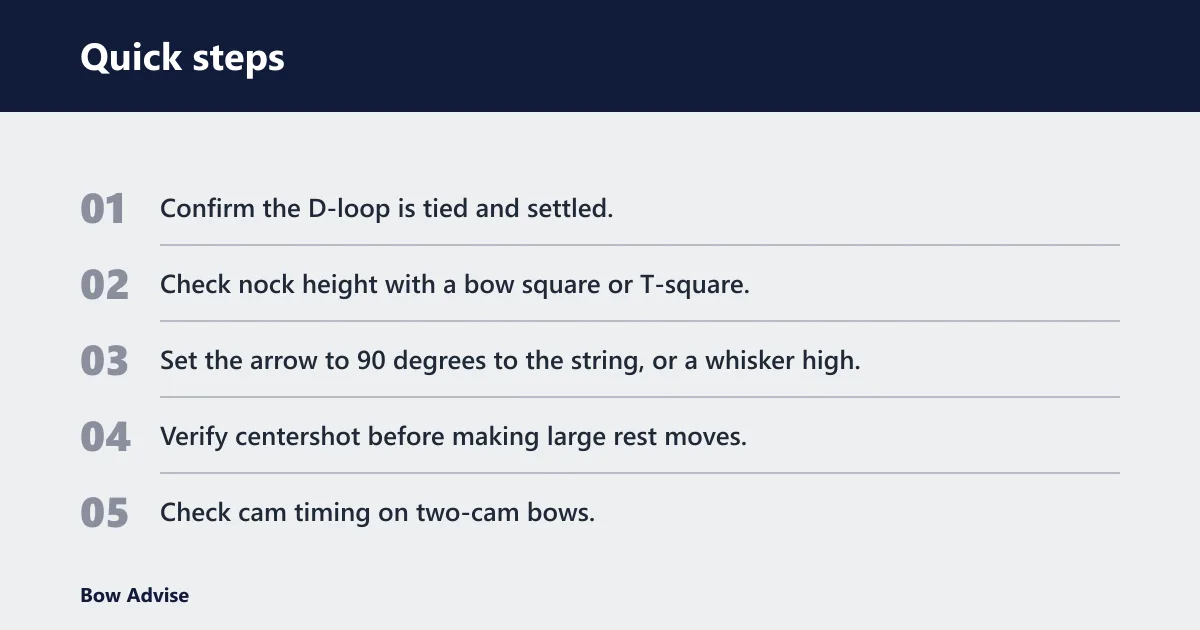
- Confirm the D-loop is tied and settled.
- Check nock height with a bow square or T-square.
- Set the arrow to 90 degrees to the string, or a whisker high.
- Verify centershot before making large rest moves.
- Check cam timing on two-cam bows.
- Use paper tune at 6 to 8 feet only after the basics are confirmed.
Set nock height before chasing rest movement
A nocked arrow should sit exactly 90 degrees to the string, or a whisker high. That gives the arrow a clean launch window. If nock height is wrong, the rest may look like the problem even when it is only reacting to a string or loop change.
Use a bow square or T-square. Do not guess from sight alone. A small nock-height error can show up as a paper tear that looks like a rest issue, especially after a new string set settles.
Confirm centershot before moving the rest much
Centershot is the rest position relative to the string. For right-handed shooters, the starting point is 1/16 inch to 1/8 inch left of the string. That is a foundation setting before paper tuning, not a final verdict on arrow flight.
If the bow suddenly hits left or right after maintenance, check the geometry first. The rest may need a small correction, but random rest moves can hide a timing or D-loop problem. For left-handed shooters, mirror the setup direction rather than copying the right-handed starting point.
Arrow direction reset checklist
This checklist separates the most common post-maintenance changes from the first correction to inspect. Use it in order. Do not jump straight to broad rest movement when string, cam, or loop changes can explain the shift first.
| Change made | Likely symptom | Quick check | Acceptable range | Fix first |
|---|---|---|---|---|
| New string set | Left/right impact shift | Check cam timing and arrow impact before moving the rest | Cams should hit the stops simultaneously on two-cam bows | String / cam |
| Twist count changed | Peep rotates, draw feel changes, impact moves | Confirm string and cable lengths are back in spec | Back to factory spec | String / cam |
| New D-loop | Nock point seems higher or lower, draw length feels different | Measure nock height after the loop is tied | Arrow at 90 degrees to string, or a whisker high | D-loop |
| Peep re-tied | Arrow direction seems unchanged, but anchor feel shifted | Confirm peep alignment at full draw | Peep centered at anchor | String / cam |
| Cam timing adjusted | Paper tear or left/right drift remains after basic setup | Check both cams hit the stop together | Stops together | Cam |
| Rest moved | Good paper at one distance, broadheads still miss | Verify centershot still sits in the starting window | 1/16 inch to 1/8 inch left for right-handed shooters | Rest |
A common first-timer mistake is moving the rest three times before checking cam timing. That can create a false tune pattern. Fix the earliest geometry change first, then retest. The bow only needs one real correction, not a string of compensations.
How do you know the bow is in time?
Two-cam bows need synchronized cams, and both cams should hit the stops simultaneously. If timing drifts after string or cable work, the bow can throw arrows left or right even when centershot and nock height look acceptable. That is why timing comes before paper tuning.
Timing errors often appear after maintenance because the new string and cables settle under load. Even a small change in twist count can move one cam ahead of the other. On some bows, that changes draw stops, valley feel, and arrow departure at the same time.
What to verify before touching paper tune
Check that both cams roll over together and stop together. If one cam reaches the stop early, correct timing first. A paper tear can be a symptom of that timing error, not the root cause. On single-cam or hybrid bows, the check still matters, but the exact synchronization target differs by design.
After timing is set, recheck D-loop height, nock height, and centershot. Then paper tune at 6 to 8 feet. Paper tuning works best after the basic geometry is correct because it shows tear direction, not a stack of unrelated setup errors.
When should you paper tune and bare shaft tune?
Paper tune at 6 to 8 feet for tear direction once nock height, D-loop, centershot, and cam timing are confirmed. Then use bare shaft tuning at 20 yards to confirm final flight. If the bare shaft lands within 1 to 2 inches of the fletched group, the spine and tune are usually in the right window.
Paper tells you what the bow is doing close to the bow. Bare shafts tell you whether the arrow is still recovering correctly downrange. Those are not interchangeable checks.
What to do when paper looks good but arrows still drift
If paper shows a clean tear but arrows still drift, move to bare shaft tuning before changing the rest again. A clean paper hole does not guarantee the arrow spine and launch path agree at 20 yards. That is where a setup can look fine at the bow and still separate downrange.
Say your paper shows a bullet hole at 7 feet after a string change, but a bare shaft lands 4 inches right of the fletched group at 20 yards. That points beyond paper. The fix may be arrow spine, cam balance, or a small rest correction that paper alone did not expose.
Broadhead flight after string changes
Fixed blades expose tune errors that field points hide. If broadheads hit differently from field points after a string or cable replacement, the bow is still telling you something about launch angle, cam timing, or centershot. Do not treat that difference as normal maintenance noise.
Broadhead flight should be checked after the basic tune is stable. If a field point groups well but a fixed blade prints left or right, the setup still has a mechanical mismatch. That mismatch is often more visible after new strings because the geometry has shifted enough to reveal it.
When a broadhead difference means more than a rest tweak
If a broadhead misses the field-point group by a small amount, a rest correction may solve it. If the broadhead difference grows after every adjustment, stop and recheck cam timing, nock height, and D-loop length. The problem is likely earlier in the chain than the rest blade.
Broadheads are useful because they punish imperfect tune. That makes them a final verification tool, not the first place to hunt for a fix after maintenance.
Normal break-in movement versus red-flag movement
Some movement after a new string or cable set is normal. A little peep rotation, a slight change in draw feel, or a small paper-tear correction after the first few shots can happen as the system settles. Large or repeated impact shifts are a different matter.
| Movement type | Normal break-in | Red flag |
|---|---|---|
| Peep rotation | Minor settling after initial shots | Peep will not stay aligned after repeated resets |
| Impact shift | Small correction that stabilizes after recheck | Left or right drift keeps changing after each adjustment |
| Cam position | Slight settling as string and cables seat | Cam stops no longer match |
| Paper tear | Minor tear that disappears after basic corrections | Persistent tear after timing, nock height, and centershot are confirmed |
How many shots should you take before rechecking? Enough for the new string or cable set to settle, then recheck peep, cam timing, and paper. Do not wait so long that a real timing issue keeps moving the tune. The bow should stabilize, not drift endlessly.
Frequently asked questions
Why does my arrow direction change after replacing strings and cables?
String and cable replacement can change bow geometry immediately. Stretch, twist count, peep rotation, D-loop height, and cam position can all move arrow launch angle. That is why impact can shift left or right before the bow shows obvious noise or other symptoms.
Do I need to retune my bow after a new string and cable set?
Yes. A new string and cable set should be treated as a reset, not a cosmetic change. Recheck nock height, D-loop, centershot, and cam timing first, then paper tune. Broadhead and bare shaft checks come after the bow is mechanically back in line.
What should I check first if arrows start hitting left or right after maintenance?
Check nock height and D-loop length first, then centershot, then cam timing. Do not start with random rest movement. If those basics are correct, paper tune at 6 to 8 feet to see the tear direction and decide the next move.
Can string stretch or cam timing change arrow flight direction?
Yes. Strings and cables can stretch enough to slightly rotate cams, and timing changes can move the string path enough to push arrows left or right. On two-cam bows, both cams should hit the stops simultaneously. If they do not, the launch path changes.
How many shots should I take before rechecking peep and paper tune after a string change?
Take enough shots for the new string or cable set to settle, then recheck. There is no useful fixed count for every bow, so the safer rule is to inspect after the first settling period and again if the peep keeps rotating or the tear keeps moving.
Should I move my rest or fix cam timing first after bow maintenance?
Fix cam timing first on a two-cam bow, then confirm nock height, D-loop, and centershot before moving the rest. Rest changes can mask timing problems and send the tune in circles. Use the rest for final alignment, not as the first repair.
Can a new D-loop or nock point shift arrow direction?
Yes. A D-loop changes effective draw length by about half an inch, and it can shift nocking point position. For release aid setups, the loop should be tied before setting nock height. A small loop change can alter left/right impact enough to matter.
Why does broadhead flight change after a string or cable replacement?
Fixed blades expose the remaining tune errors that field points can hide. After a new string or cable set, small changes in cam timing, centershot, or nock height can show up more clearly in broadhead flight. That difference usually means the tune still needs mechanical correction.