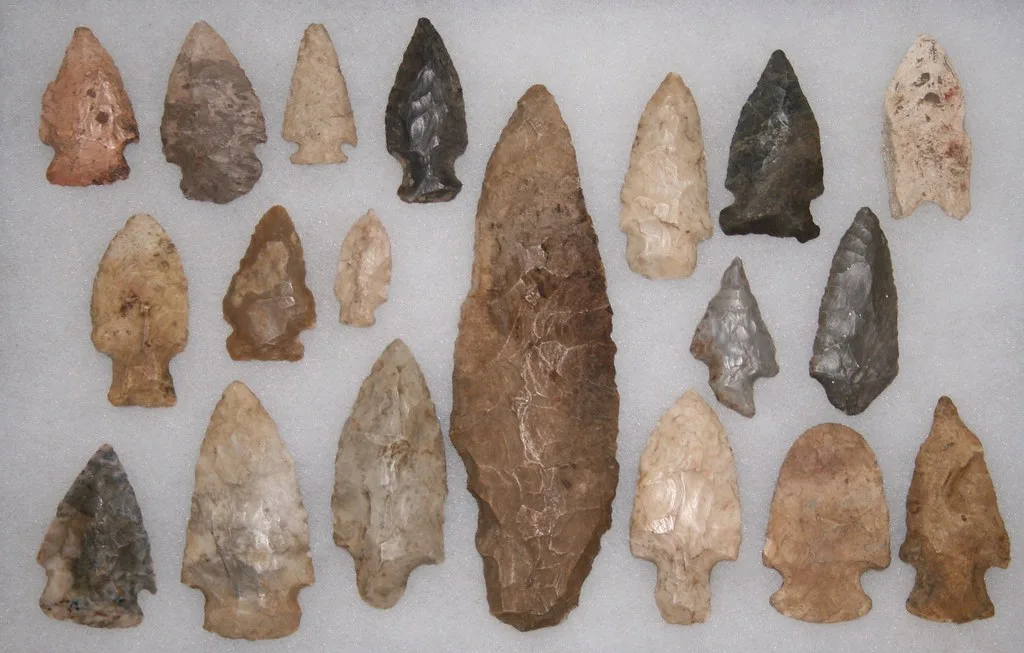
What Stone Arrowheads Were Best for Native American Hunting?
Broad, thin stone points with sharp edges, especially chert, obsidian, or high-quality flint, and a matched shaft are best for deer-sized game; smaller game favors lighter, narrower points, while heavy game needs sturdy points and strong arrows. Poor point choice can cut penetration, break shafts, and turn a clean hit into a lost animal. This guide compares point shapes, materials, and game size, then separates what was common historically from what actually performed best in hunting tests.
This guide is part of our Native American bows and arrows guide series.
What stone arrowheads were best for Native American hunting?


The best stone point depended on the game, the shaft, and the launch method. For deer, a moderate-width point with a sharp edge and good balance usually works better than a very large head. For bison and other large game, sturdier points with enough mass to survive impact were favored. For birds, smaller and lighter points were usually the smarter choice.
Why shape matters as much as material
Point shape changes how a shaft flies and how the edge enters tissue. A narrow point reduces drag and helps preserve arrow speed. A very wide head can lose penetration, even if the stone is hard and sharp. Balance matters too, because a point that is too heavy for the shaft can cause fishtailing and poor accuracy.
What historical use does and does not tell us
Archaeology shows what people made and used in real settings, but it does not mean every common form was the best possible hunting choice in every case. More than 700 tribes had their own styles of arrowheads, and those styles varied by region, prey, and hunting technology. Some forms were practical. Some were local tradition. Many were both.
Which point shapes were used for big game?
Large game often called for strong, carefully flaked points with enough mass to hold together on impact. For very large animals, point shape had to work with the shaft rather than against it. If the head was too broad, too brittle, or too heavy, the arrow could lose speed or break before driving deep enough.
Clovis points and very large animals
Clovis points date from roughly 10,000-13,000 years ago and have a short, wide groove called a flute. They are often found with mammoth and mastodon bones, which is why they are linked to big-game hunting. The flute likely helped with hafting and may have shaped how the point seated on the shaft.
Folsom points and bison hunting
Folsom points date from roughly 10,000-8,000 years ago and extend the flute almost the full length of the point. They are generally smaller than Clovis points and were used for buffalo hunting and other game. Folsom points are often found with bison bones, which fits a hunting strategy built around a different prey profile.
Why fluting mattered
Fluting removed material from the base and helped create a cleaner hafting area. It also changed the point’s geometry, which affects weight and balance. A well-made fluted point could seat securely on a shaft and fly more predictably. That mattered as much as edge sharpness when the target was moving.
📊 Each of more than 700 tribes had their own styles of arrowheads. Source: Hunting Arrowheads.
Were smaller arrowheads better for deer?
Often, yes. Smaller points can fly better on a properly tuned shaft, and deer do not require a huge cutting head to be lethal. A point under about half an inch long can still be effective on deer-size or larger animals if it is sharp, well placed, and matched to the shaft. Size helps less than many people assume.
How smaller points can fly better
A lighter point keeps the front of the shaft from getting too nose-heavy. That helps reduce fishtailing, where the shaft wobbles side to side in flight. A balanced arrow is easier to tune and usually loses less speed. For deer, that can matter more than raw point length.
When a wider head hurts penetration
A broad head creates more resistance when it enters tissue. That can be useful if the point is balanced and the shaft has enough energy, but a point that is too wide can slow the arrow too much. On lighter shafts, that loss of speed can reduce penetration and make blood trails poorer.
Why shaft balance changes the result
Point weight affects stability, and width can affect penetration. The right head on the wrong shaft can still fly poorly. A short, narrow point on a light shaft may hold a straighter line than a larger point on the same shaft. The shaft and point must work as one system.
How smaller points can still kill larger animals
Size alone does not decide lethality. A sharp, well-placed point can penetrate deeply enough to reach vital tissue even when it is small. That is why a tiny point can still kill a large animal. The main limits are stability, bone impact, and whether the shaft delivers enough energy.
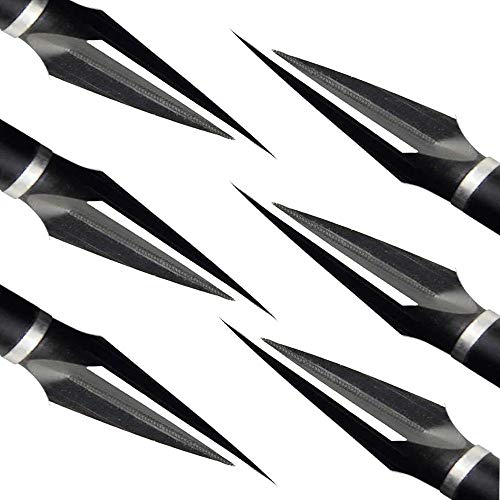
What stones did Native Americans make arrowheads from?
Arrowheads could be made from obsidian, flint, chert, jasper, quartzite, felsite, rhyolite, chalcedony, and more. Each stone type behaves differently under flaking. Some materials take an extremely sharp edge. Others are tougher but less glassy. The best choice depended on what was available and what the hunter needed the point to do.
Obsidian, flint, and chert
Obsidian is known for taking a very sharp edge, but it can be brittle. Flint and chert are common choices because they can be knapped into reliable points with a fine edge. These stones often offered a strong mix of sharpness, predictability, and workable fracture behavior.
Jasper, quartzite, felsite, rhyolite, and chalcedony
Jasper and chalcedony can make effective points when the stone quality is high. Quartzite is tougher but can be harder to shape cleanly. Felsite and rhyolite also appear in point-making traditions. In practice, stone quality mattered at least as much as the label attached to the rock.
How stone choice affects edge sharpness and breakage risk
Very glassy stone can produce a keen edge, but it may chip more easily on bone. Tougher stone may hold up better, though it may not come away as thin or as razor-sharp. That tradeoff matters in hunting. A point that survives impact is often better than one that starts sharper but fails early.
How were stone arrowheads made and attached?
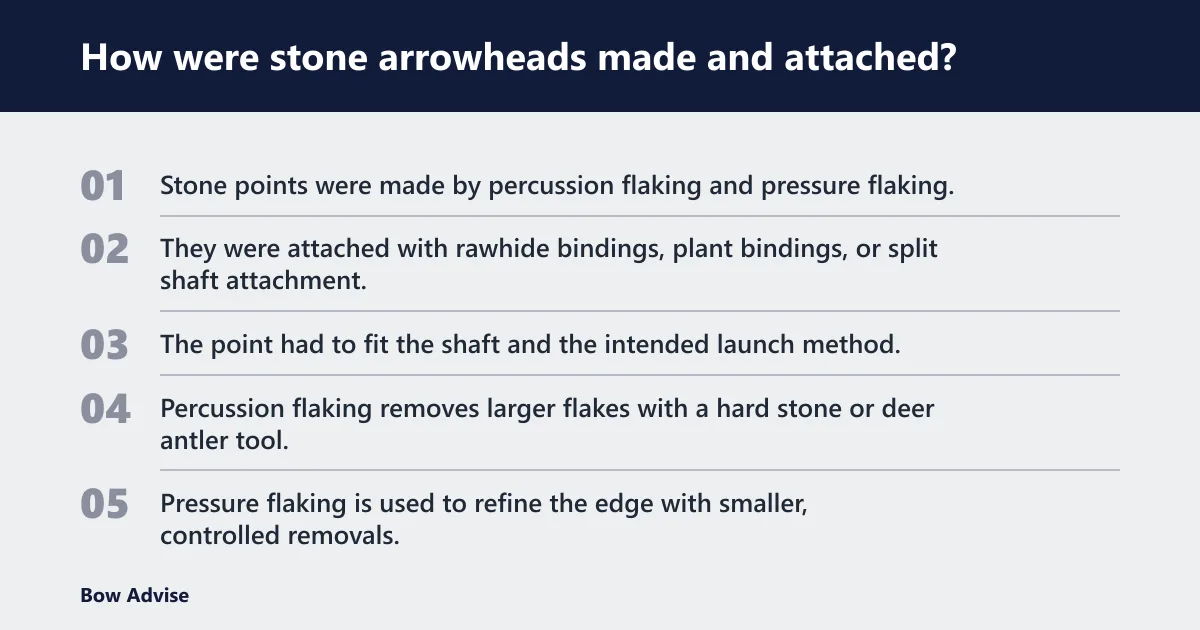
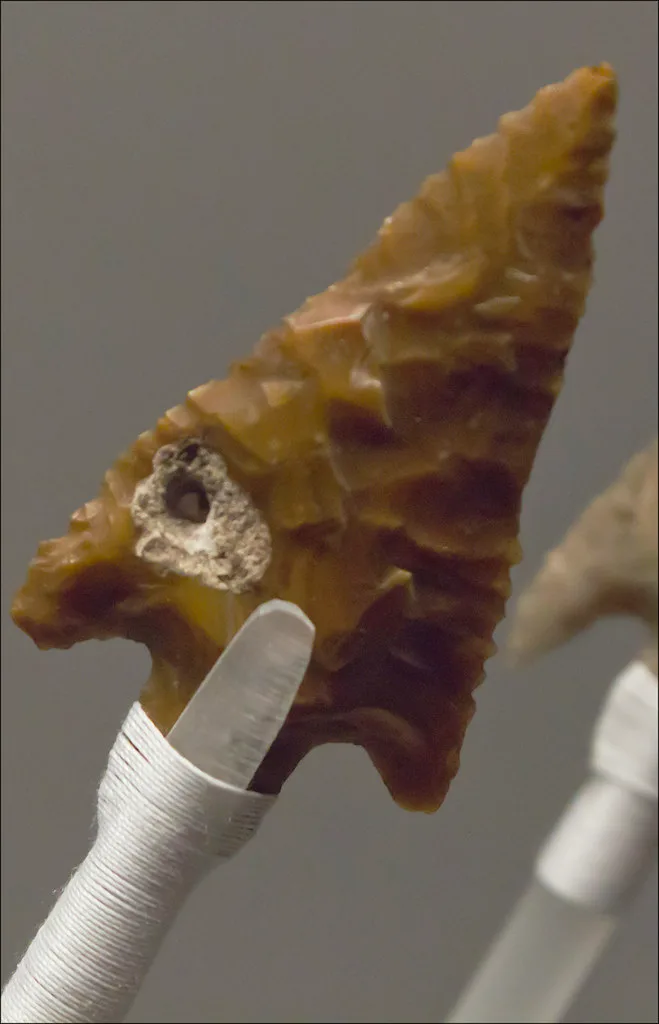
Stone points were made by percussion flaking and pressure flaking, then shaped with careful contour work. They were attached with rawhide bindings, plant bindings, or split shaft attachment. The point had to fit the shaft and the intended launch method, whether on a bow-launched shaft or an atlatl shaft.
Percussion flaking and pressure flaking
Percussion flaking removes larger flakes with a hard stone or deer antler tool. Pressure flaking is used to refine the edge with smaller, controlled removals. Together they let a knapper create thin, usable points with careful contour shaping. A skilled flintknapper can make a point very quickly; one 19th-century anthropologist timed an Apache flintknapper making four points in 6-1/2 minutes.
Bindings, split shafts, and hafting
Rawhide bindings and plant bindings helped secure the point in place. Split shaft attachment let the base of the point seat more deeply and stay aligned. Hafting had to resist shock, because impact pushes the point backward as well as forward. A loose fit can ruin an otherwise good arrow.
Bow shafts versus atlatl shafts
Atlatl darts and bow-launched arrows do not demand the same point weight. A dart can tolerate more mass than a light arrow shaft in many cases. That is why a point that works on one system may fly badly on another. Launch method changes the best choice of point, not just the prey species.
Picture a deer hunt with a thin cedar shaft, a heavy point, and a short draw. The arrow may fishtail, hit off-line, and lose energy before it reaches the chest. Now picture the same shaft with a lighter, well-balanced point. Flight improves, and penetration usually does too.
Game-to-point decision table
| Game | Point size and shape | Material | Attachment notes | Failure case if wrong |
|---|---|---|---|---|
| Deer | Small to moderate, narrow to medium width, sharp edge | Chert, flint, chalcedony, good jasper | Use a balanced shaft with secure rawhide or plant bindings | Too heavy can cause fishtailing; too wide can reduce penetration |
| Bison | Moderate, sturdy flaked point with enough mass to survive impact | Flint, chert, jasper, some quartzite | Strong hafting and a shaft tuned for deeper driving energy | Too brittle can shatter; too light may fail on heavy bone and hide |
| Large game such as mammoth or mastodon | Larger, durable, carefully flaked point with stable base | Tough high-quality stone, often flint or chert where available | Secure split-shaft or tight binding; launch setup must match weight | Too heavy slows the shot; too brittle breaks on impact |
What is the difference between Clovis and Folsom points?
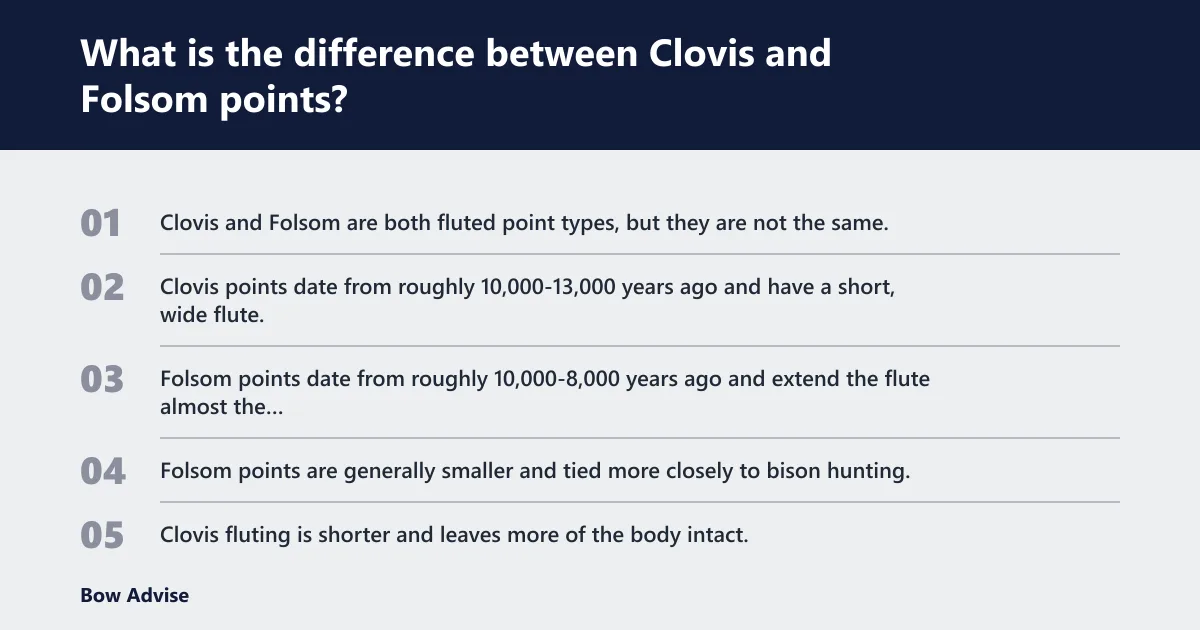
Clovis and Folsom are both fluted point types, but they are not the same. Clovis points date from roughly 10,000-13,000 years ago and have a short, wide flute. Folsom points date from roughly 10,000-8,000 years ago and extend the flute almost the full length. Folsom points are generally smaller and tied more closely to bison hunting.
Flute length and point shape
Clovis fluting is shorter and leaves more of the body intact. Folsom fluting runs farther up the point, making the form slimmer in relation to its length. That difference changes mass, hafting surface, and balance. Archaeologists use these traits to tell the point types apart.
Likely prey and hunting context
Clovis points are often found with mammoth and mastodon bones, which points to big-game hunting or butchery in those contexts. Folsom points are often found with bison bones. That does not mean each point type worked only for one animal, but the archaeological record shows a strong pattern.
Why archaeologists separate them
These point types are separated because shape, age, and context cluster in meaningful ways. That helps archaeologists track technology and subsistence changes over time. It also helps modern readers avoid a common mistake: calling every old stone point “an arrowhead” when some were dart tips or other projectile forms.
How did arrowhead shape affect penetration and flight?
Shape controlled both aerodynamics and impact. A narrow, balanced point usually flew straighter and penetrated better than a broad or overly heavy one. But a point that was too small for the shaft or target could fail in other ways. The best shape matched game size, shaft weight, and launch system.
Flight balance and fishtailing risk
Fishtailing usually appears when the front of the arrow is too heavy or the shaft is poorly matched. Point weight shifts the center of mass forward, which can help or hurt depending on the rest of the setup. Balance matters as much as point length because a stable arrow reaches the target with more energy.
Penetration is not only about sharpness
A sharp edge helps, but a point also has to keep its structure on impact. If the head shatters or the shaft bends badly, deep penetration becomes less likely. One experiment found stone points penetrate about 10% deeper than sharpened sticks, which supports the idea that a real point shape adds value beyond a crude tip.
Common first-timer mistake
A common first-timer mistake is assuming the biggest point is the deadliest. That often backfires. A large, wide point on a light shaft can slow the arrow, wobble in flight, and penetrate less. For many hunts, the better choice is the point that flies cleanly and stays together on impact.
Were stone arrowheads always better than bone or antler points?
No. Stone was often excellent, but it was not automatically better in every situation. Some arrow points were made of bone or antler instead of stone. Those materials could be easier to shape for certain uses, though stone usually held a sharper edge. The best material depended on prey, terrain, and what the maker needed.
Where bone and antler made sense
Bone or antler points could work where stone was scarce or where different impact behavior was useful. They may be less brittle in some forms, but they usually do not hold a cutting edge like fine stone. In hunting, a sharper edge and a reliable break pattern often mattered more than raw toughness alone.
Stone was not the only answer
Not every region had the same stone sources, and not every hunting task needed a stone edge. That is why non-stone points appear in the archaeological record. The choice was practical, not ideological. Materials followed access, tradition, and the demands of the hunt.
Frequently asked questions
What stone arrowheads were best for Native American hunting?
The best stone arrowhead was the one matched to the game and the shaft. For deer, a narrow to moderate point with good balance usually worked well. For larger animals, stronger points with enough mass to survive impact were preferred. Obsidian, flint, chert, and similar stones could all be effective.
Were smaller arrowheads better for deer and bigger ones for larger game?
Usually, smaller or moderate points were better for deer because they fly cleaner and do not overload the shaft. Bigger game may call for sturdier points, but bigger is not automatically better. If a point is too heavy or too wide, it can reduce speed and penetration instead of improving them.
What stones did Native Americans make arrowheads from?
Common materials included obsidian, flint, chert, jasper, quartzite, felsite, rhyolite, and chalcedony. The best choice depended on local geology and what kind of edge the maker wanted. High-quality stone that flakes predictably was often favored because it could be shaped thin and sharp without failing too easily.
How did arrowhead shape affect penetration and flight?
Shape influenced both drag and impact. A narrow, well-balanced point usually flies straighter and penetrates more efficiently. A broad or heavy point can destabilize the shaft and slow it down. In practice, the right shape is the one that works with the arrow’s balance, not against it.
Were stone arrowheads always better than bone or antler points?
No. Stone usually offered better cutting edges, but bone or antler could be useful where stone was scarce or where different durability was needed. The best material depended on the hunting job. Many ancient hunters used whatever material gave the best result for their local setting and technology.
What is the difference between Clovis and Folsom points?
Clovis points are older, date from roughly 10,000-13,000 years ago, and have a short, wide flute. Folsom points date from roughly 10,000-8,000 years ago and extend the flute almost the full length of the point. Clovis is often linked with mammoth and mastodon, while Folsom is often linked with bison.
How were stone arrowheads attached to shafts?
Stone points were hafted with rawhide bindings, plant bindings, or split shaft attachment. The point had to align with the shaft and stay tight under impact. Bow-launched shafts and atlatl shafts could use different point weights, so the attachment had to fit both the material and the launch system.
Could tiny stone points still kill large animals?
Yes. Tiny points under half an inch long could still kill deer or larger animals if the shot was well placed and the shaft carried enough energy. Lethality depends on penetration, balance, and placement, not only on point size. Small does not mean weak in every hunting context.