Compound Bow vs Longbow for Hunters: Which Is the Better Fit?
A compound bow fits most hunters better because it holds steadier at full draw, reaches farther with less gap error, and allows a faster second shot. Choose a longbow only if you hunt close and accept more practice. Pick the wrong bow and you miss more under pressure, or lose the chance to anchor a follow-up before game moves. This guide compares distance, stability, terrain, portability, and follow-up needs so the choice matches how hunting actually happens.
| Decision factor | Compound Bow | Longbow for Hunters | Winner |
|---|---|---|---|
| Hold stability at full draw | Cams and cables create mechanical advantage, and let-off can reduce holding weight to about 15 pounds on a 70-pound bow. | No let-off. The shooter holds the full draw weight at anchor. | Compound Bow |
| Realistic hunting distance | Built for longer hunting shots; many setups suit 40+ yard hunting when tuned and shot well. | Best for closer-range work, often around 20 yards or less. | Compound Bow |
| Portability | Usually shorter and more compact than traditional bows, but heavier and bulkier than a longbow once accessories are added. | Lighter and more compact, with simpler carry in brush and on long walks. | Longbow for Hunters |
| Maintenance burden | Needs inspection of cams, cables, strings, and tuning drift. | Simpler construction with fewer moving parts and easier field repairability. | Longbow for Hunters |
| Learning curve | Sight and release aid aiming, and draw-length fit can be set for the shooter. | Instinctive shooting asks more of form, timing, and consistency. | Compound Bow |
| Close-range stealth | Can be quiet enough, but more parts mean more chances for contact noise if setup is poor. | Quiet, simple, and well suited to close shots in blinds or brush. | Longbow for Hunters |
Compound bow vs longbow: the real hunting trade-off
The basic trade-off is straightforward. A compound bow gives more help at full draw and more margin at distance, while the longbow gives lighter carry and simpler field use. That matters when a deer pauses for three seconds, because stability, shot speed, and how long you can hold matter more than paper specs.
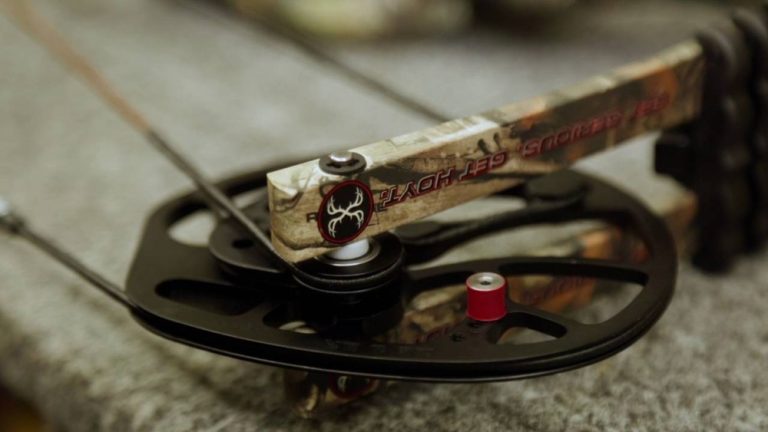
Modern compounds use cams and cables to create mechanical advantage. Traditional longbows use a single string, no let-off, and a full-draw hold that can ask more from the archer under pressure.
What changes in the field, not on paper
A bow that looks good on a spec sheet can still be the wrong hunting tool if it is hard to hold, too loud for your cover, or too large for your travel. A compound is usually shorter and more compact than traditional bows, but it brings more mechanical complexity, more setup parts, and more weight once sights, rests, and a release are added.
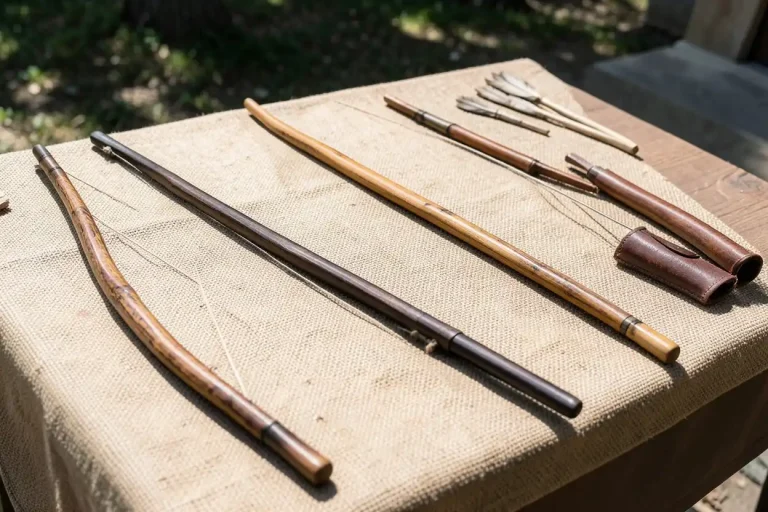
A longbow is the opposite. It is simpler to carry and easier to move through brush, but it demands better shot timing and closer distances because there is no let-off and no sight picture to lean on.
Hunter fit decision table
| Criterion | Compound Bow | Longbow for Hunters | Winner | Why it matters |
|---|---|---|---|---|
| Learning curve | 2 | 4 | Compound Bow | A bow that is easier to aim well can shorten the path to usable hunting accuracy. |
| Hold stability | 5 | 2 | Compound Bow | Steadier holding weight means less wobble while waiting for a clean lane. |
| Effective hunting distance | 5 | 2 | Compound Bow | Extra speed and flatter arrow flight reduce gap error as distance grows. |
| Portability | 3 | 5 | Longbow for Hunters | Long walks, thick cover, and packed gear favor a lighter, simpler bow. |
| Maintenance burden | 2 | 5 | Longbow for Hunters | More moving parts mean more inspections and more chances for tuning drift. |
| Close-range stealth | 3 | 5 | Longbow for Hunters | When the shot is short, a quiet, compact bow is easier to manage in tight cover. |
Learning curve and shooter fit
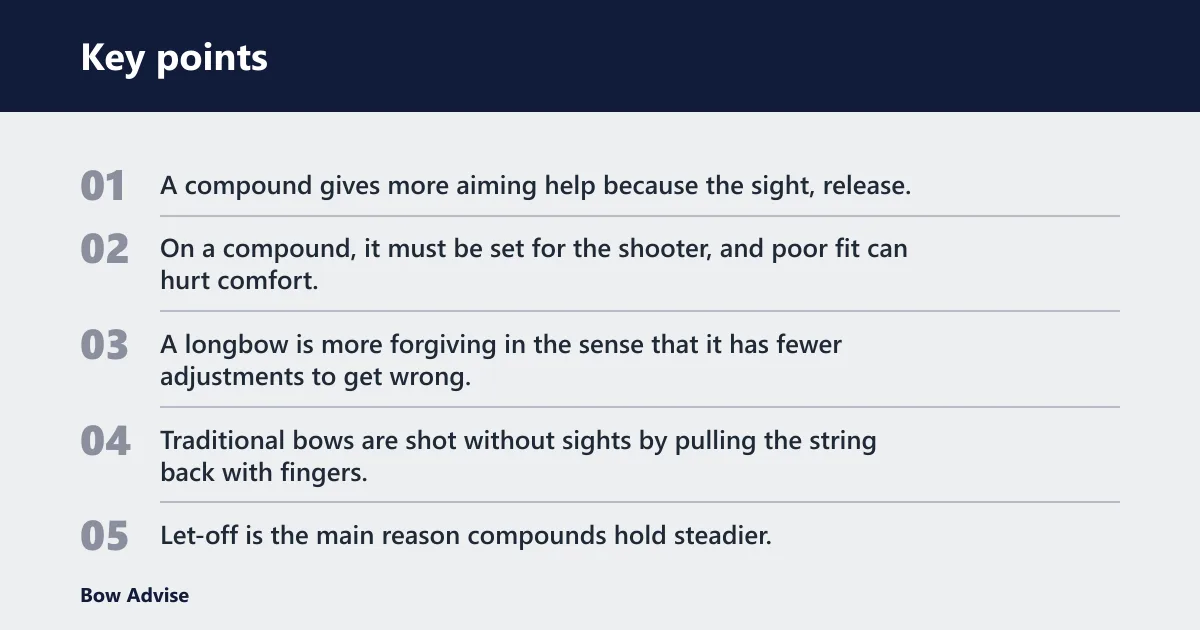
A compound gives more aiming help because the sight, release, and let-off reduce the amount of work at the shot. Draw length matters here. On a compound, it must be set for the shooter, and poor fit can hurt comfort, anchor consistency, and accuracy.
A longbow is more forgiving in the sense that it has fewer adjustments to get wrong, but it asks more of the shooter’s form. Traditional bows are shot without sights by pulling the string back with fingers, so repeatable anchor and release timing matter more.
Hold stability and aiming window
Let-off is the main reason compounds hold steadier. It is the percentage of draw weight the archer does not have to hold at full draw, and that reduction changes how long a hunter can settle the pin or wait for a target to step clear.
HuntWise notes let-off can be around 60-80%. That is why a 70-pound compound may only require about 15 pounds of holding weight at full draw. A longbow has no such relief, so the full draw weight stays in the hand and shoulder until the arrow is away.
Effective distance and shot margin
Range is not only about arrow speed. It is also about how much error the bow forgives when the lane is slightly off or the animal takes one step before release. Compound bows are often reported to offer higher arrow speeds and may suit longer-range hunting, while traditional close-range hunting is commonly kept to about 20 yards or less.
That difference changes the field plan. A compound gives more room for gap error and trajectory drop. A longbow can work well, but only when the hunter accepts a closer window and cleaner shot execution.
Portability, maintenance, and close-range stealth
Longbows are often lighter and more compact than compound bows, and they are generally simpler to carry through brush, up a ridge, or into a small blind. That simplicity also helps with field repairability. Fewer parts mean fewer things that can slip, loosen, or drift out of tune on a trip.
Compounds bring more maintenance. Cables and cams need inspection, strings eventually need replacement, and setup drift can show up after transport or hard use. That is the cost of higher speed and higher hold stability. A common first-timer mistake is assuming a quiet setup stays quiet without checking contact points, cable routing, and limb condition before the hunt.
Which bow is easier to learn for hunting, compound or longbow?
A compound bow is easier to learn for hunting because it gives the shooter more aiming help and more time to settle before release. The sight picture, release aid, and let-off reduce the number of things that must line up at once. That usually makes early hunting accuracy more attainable.
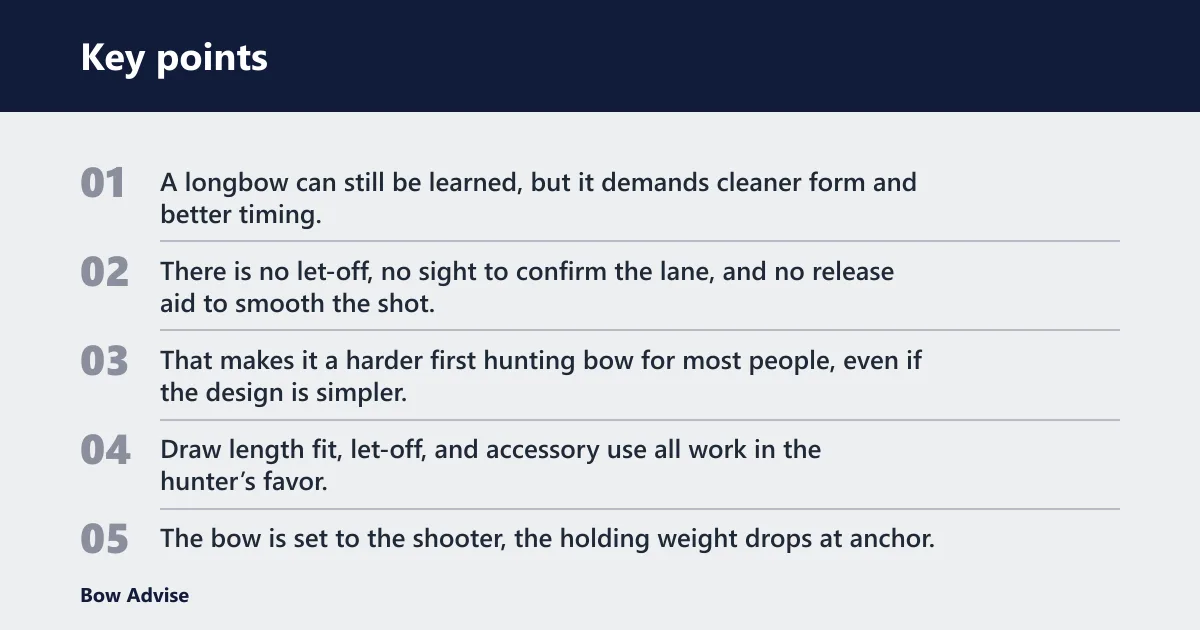
A longbow can still be learned, but it demands cleaner form and better timing. There is no let-off, no sight to confirm the lane, and no release aid to smooth the shot. That makes it a harder first hunting bow for most people, even if the design is simpler.
Why a compound gives more aiming help
Draw length fit, let-off, and accessory use all work in the hunter’s favor. The bow is set to the shooter, the holding weight drops at anchor, and the release helps clean up finger torque. That combination can make steady aiming much easier under field pressure.
Say your first deer steps into a lane at 27 yards and stops for only a moment. A compound gives more time to settle the pin and more room to recover from a small wobble. A longbow asks for faster judgment and cleaner timing on that same shot.
Why a longbow demands cleaner form and timing
A longbow does not hide loose form. Because it is shot with fingers and no sight, the archer has to repeat anchor, hand position, and release path with care. That is why many hunters find it harder at first, even though the bow itself is simpler.
That does not make it poor for learning. It just means the learning target is different. The shooter is learning both archery and close-range judgment at the same time.
Which bow fits your hunting distance?
For most hunters, the distance question decides the bow. A compound bow is better when the shot may stretch beyond close range, while a longbow fits hunts where the animal is expected to come in tight. The more likely your shot is to happen inside a short window, the more a longbow can make sense.
Why longbows are usually a close-range choice
Longbows are best suited to closer-range hunting. Traditional bows are commonly kept around 20 yards or less because the archer has less hold stability, more arrow drop to manage, and no let-off to make the wait easier.
That does not mean they cannot hit farther. It means the hunting margin shrinks quickly. A 3-yard change in range matters more when the setup is slower and the aiming system is more open to shooter error.
Why compounds carry more range in real hunting setups
A compound’s speed and sight system help at longer hunting distances. The arrow gets to the target faster, the trajectory is flatter, and the sight picture gives a repeatable aiming reference. That combination is why compounds are common in tree-stand whitetail hunting and in setups that may need 40+ yard capability.
Suppose a hunter sits above a trail where shots are usually 18 to 35 yards, but the deer sometimes hangs up on the far edge of the lane. A compound is the better fit because it gives more margin if the animal stops farther out. A longbow would push that same situation into a much tighter close-range window.
Which bow is quieter in the field, compound or longbow?
A longbow is usually the quieter and simpler carry choice, especially in brush, blinds, and short walks. It has fewer parts, no cams, and no cables to inspect or manage. That simplicity helps when the priority is getting through cover without extra handling noise.
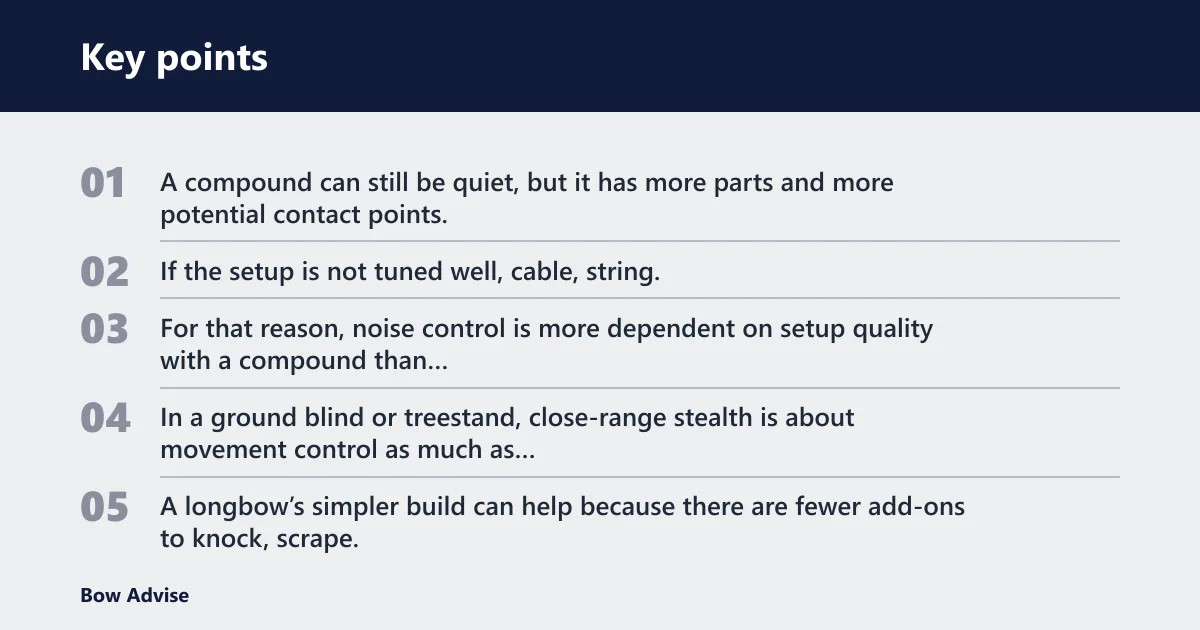
A compound can still be quiet, but it has more parts and more potential contact points. If the setup is not tuned well, cable, string, or accessory noise can show up at the shot or while moving. For that reason, noise control is more dependent on setup quality with a compound than with a longbow.
Noise control in brush, blinds, and treestands
In a ground blind or treestand, close-range stealth is about movement control as much as shot sound. A longbow’s simpler build can help because there are fewer add-ons to knock, scrape, or shift as the hunter draws and settles.
In a tree stand, compounds remain very common because their hold stability offsets the extra equipment. The same source notes compound bows are ideal for tree-stand whitetail hunting. That fits situations where the shot window can be narrow and the hunter needs time to aim.
Weight, length, and packability in the field
Compound bows are usually shorter and more compact than traditional bows, but they are generally heavier and bulkier once the sight, rest, stabilizer, quiver, and release are added. That can matter on long approaches or steep climbs.
Longbows are lighter and easier to carry in hand or on a pack. For backcountry walk-in hunts, that lower carry burden can be the deciding factor if the shot plan stays close and simple.
Choose Compound Bow if… / Choose Longbow for Hunters if…
Choose Compound Bow if you expect shots beyond close range, need more time at full draw, or want the help of a sight and release. It is also the better pick if your hunting plan includes tree stands, open lanes, or follow-up shots where steadiness matters more than simple carry weight.
Choose Longbow for Hunters if you hunt close, value simple gear, or want the lightest and quietest carry in thick cover. It fits hunters who accept more practice, shorter effective distance, and full-draw holding weight without let-off.
- Pick Compound Bow for treestand whitetail, open-field edges, and hunts where 40+ yard capability matters.
- Pick Longbow for Hunters for stump shooting, ground blinds with short windows, and brush-country travel where 20 yards or less is realistic.
- Pick Compound Bow if holding steady under pressure is more important than carrying the lightest bow.
- Pick Longbow for Hunters if field simplicity and close-range stealth matter more than range margin.

Frequently asked questions
Is a compound bow better than a longbow for hunting?
For most hunters, yes. A compound bow is usually the better hunting fit because it holds steadier at full draw, gives more range margin, and makes follow-up shots easier to manage. A longbow is better only when the hunt is close, simple, and within the shooter’s practiced range.
What are the main differences between a compound bow and a longbow?
A compound uses cams and cables, has let-off, and is commonly shot with a sight and release. A longbow is a traditional single-string bow with no let-off and a full-draw hold. The compound is more complex and longer-range; the longbow is simpler, lighter, and better for closer shots.
How far can you realistically hunt with a longbow vs compound bow?
A longbow is often best kept to about 20 yards or less for hunting, because close-range shot execution is more realistic and forgiving. A compound can handle 40+ yard hunting when tuned correctly and shot by a practiced archer, but legal distance limits and animal behavior still matter.
How much maintenance does a compound bow need compared with a longbow?
A compound needs more maintenance because it has cams, cables, strings, and more tuning-sensitive parts. Those components need inspection and periodic replacement. A longbow is simpler and easier to keep serviceable, with fewer failure points and better field repairability.
Is a longbow good for beginner hunters?
It can be, but it is not the easiest first choice for most beginners. A longbow teaches strong fundamentals, yet it gives no let-off and no sighting aid. That means a new hunter must already be comfortable with close-range form, timing, and limited shot distance.
What game and hunting style fit a longbow best?
A longbow fits close-range hunting styles best, especially ground blinds, brush-country travel, and situations where the animal is expected to come inside short range. It can suit deer, hogs, and similar game when the hunter is disciplined about distance, shot angle, and shot selection. Local rules still control what is legal.
Before choosing either bow, check state and species regulations for minimum draw weight, arrow requirements, and legal bowhunting rules. A setup that works on paper can still be wrong for the hunt if it does not meet local legal standards.