New vs Used Archery Bow: Which Is Smarter for Your Budget?
A used bow is usually only the better buy when it is noticeably cheaper than a comparable new setup after you account for a new string, a shop tune, and some extra repair margin; otherwise, buy new. Ignore that threshold, and a “cheap” bow can become the more expensive one, along with lost time and a poor tune. This guide compares real costs, hidden repairs, and the break-even point for beginner and intermediate buyers.
New vs used archery bow: the real budget trade-off


The budget decision is not used versus new on sticker price alone. It is total cost after string replacement, a shop re-tune, missing parts, and the chance that hidden damage forces a replacement anyway. A used recurve bow can save money upfront, but that gap can shrink fast once safety and setup are included.
| Decision factor | New | Used Archery Bow: Which Is Smarter for Your Budget | Winner |
|---|---|---|---|
| Upfront price | Higher sticker price, but known condition | Lower sticker price, often with unknown history | Used |
| Hidden repair risk | Low | Higher because storage history, wear, and heat damage may be hidden | New |
| Setup and tune cost | Usually lower at first | Often needs a shop re-tune and may need string replacement | New |
| Warranty and condition certainty | Full manufacturer warranty and known condition | No factory warranty in most private-sale deals | New |
| Best value for a tight budget | Strong for starter bows under common entry tiers | Best only when the discount is deep enough to cover repairs | Tie |
Upfront price is only part of the bill
Used bows often cost less upfront. That part is true, but it leaves out the rest of the bill. Once a string is worn, a shop re-tune is needed, or missing parts have to be replaced, the lower asking price can vanish.
Say your local listing shows a bow at a very low price, but the string has visible fuzzing and the seller cannot confirm storage history. If the string needs replacement before the bow should be drawn at all, the “deal” has already picked up new costs before the first shot.
Repair risk is where used bows lose ground
Hidden costs matter most on bows with unknown history. A used bow can need a new string, a tune, and small parts that do not appear in photos. The working rule is simple: if repairs and missing accessories push the total close to new, the used bow no longer wins on price.
Warranty changes the value equation
New bows bring known condition and a full manufacturer warranty. That is especially useful for beginners, because a new buyer is less likely to spot a bowed limb, loose fit, or bad string before shooting. A warranty does not replace proper setup, but it does lower the financial risk of an unknown flaw.
📊 The Bear Archery Grizzly Recurve Bow is listed at $499.99. Source: Used vs. New Recurve Bow: What to Check Before You Buy (2026 ….
What should you check before buying a used bow?
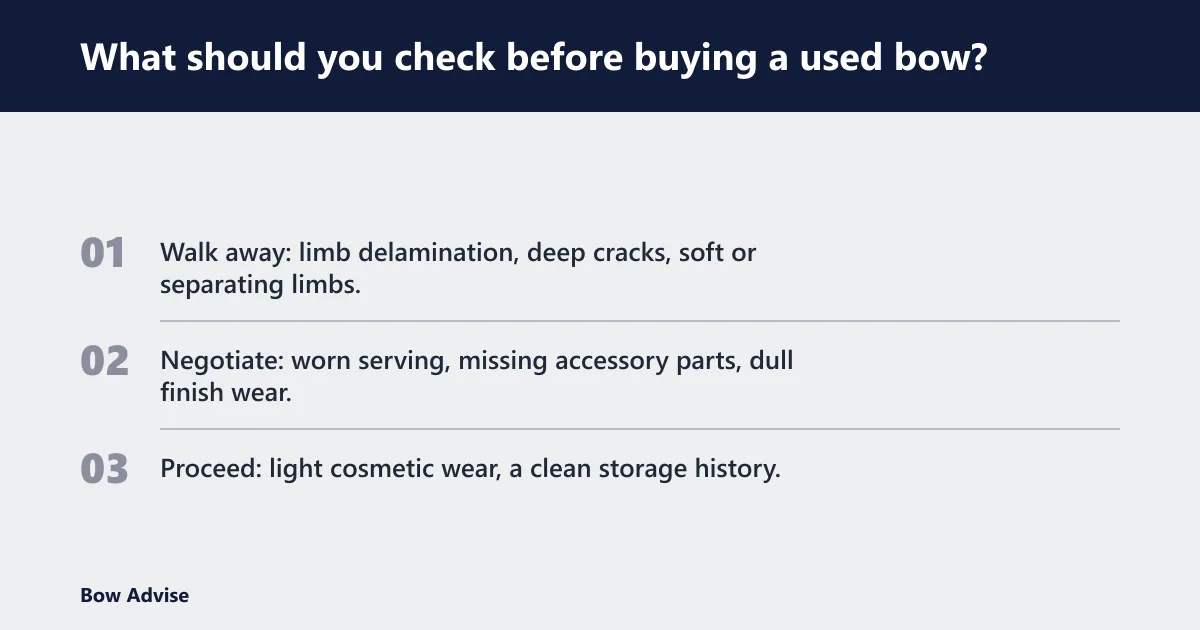
Check the string, limbs, and storage history before money changes hands. Frayed strands, broken strands, cracks, limb separation, and signs of heat exposure are the main reasons a used bow stops being a bargain. If anything points to hidden damage, the safest move is to walk away rather than guess.
Bowstring wear and strand damage
A worn string may need replacement before the bow should be drawn at all. Look for frayed serving, broken strands, flattened sections, or discoloration near nocking points and limb tips. If the seller says the string is “fine” but cannot say when it was last changed, plan to price in a replacement.
Limb condition, cracks, and delamination signs
Limb delamination is one of the most serious hidden failure modes. Heat can damage limb epoxy bonding without visible signs in a photo, so a clean listing image does not prove the bow is safe. Check limb surfaces for bubbles, separation at the edges, soft spots, lifting layers, or any cracking near stress points.
Storage history, heat exposure, and moisture damage
Storage history matters because heat and bad storage can damage limbs. Ask where the bow lived: car trunk, attic, garage wall, closet, or case. A bow that spent time near heat or damp air deserves extra caution, because that history can turn a cheap buy into a repair bill.
What can be fixed and what should end the deal
- Walk away: limb delamination, deep cracks, soft or separating limbs, or a string with broken strands.
- Negotiate: worn serving, missing accessory parts, dull finish wear, or a setup that clearly needs retuning.
- Proceed: light cosmetic wear, a clean storage history, and a bow that only needs normal setup.
A common budgeting mistake is choosing a used bow without checking whether the limbs, cams, and string need costly replacement parts. A small hairline crack near the limb tip may be missed online, then become obvious at pickup when the bow flexes under inspection. At that point, the “deal” is gone and the risk is still yours.
Which bow types are easier to buy used?
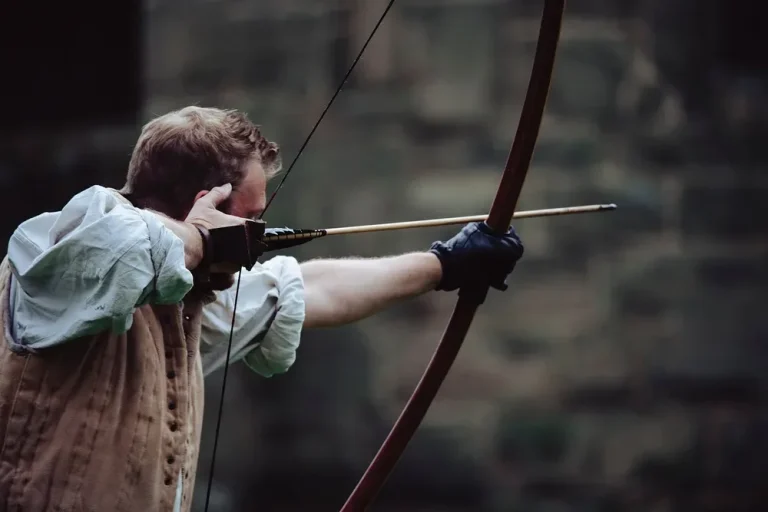
Takedown recurve bows are often easier to inspect than one-piece bows because the limbs can be removed and checked more directly. One-piece longbows are harder to verify because they cannot be unbolted, so storage history carries more weight. Compound bows need a different used-buy checklist because cams, cables, and wheels add their own wear points. (en.wikipedia.org)
Takedown recurve: easier to inspect and service
A takedown recurve gives the buyer a practical advantage. The removable limbs make it easier to check fit, limb surfaces, and hardware before committing. Recurve equipment can also use a sight, dampener, stabilizers, arrow rest, and plunger, so missing parts are easier to spot and price into the deal.
One-piece longbow: harder to verify condition
Longbows typically cannot be taken apart. That makes hidden limb damage and storage abuse harder to inspect with confidence. When the bow cannot be unbolted, the buyer has to rely much more on the seller’s history and on visible surface clues.
Compound bows need a separate checklist
Compound bow checks are different because there are more parts to inspect than just the limbs and string condition. Cams, cables, timing, and accessory fit matter more. That does not make a used compound a bad idea, but it does mean a recurve buying rule should not be copied over without adjustment.
The used-vs-new cost table by price tier
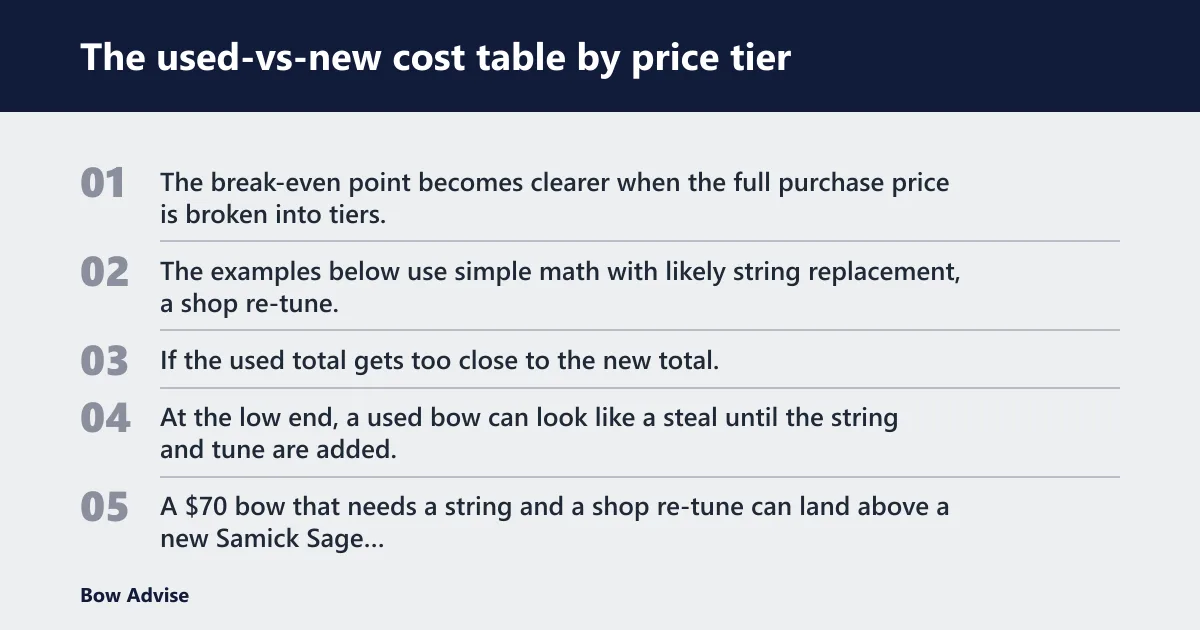
The break-even point becomes clearer when the full purchase price is broken into tiers. The examples below use simple math with likely string replacement, a shop re-tune, and common missing accessories. If the used total gets too close to the new total, the savings are too thin to justify the added risk.
| Tier | Used example | Likely add-ons | Estimated used total | Comparable new option | Estimated new total | Winner |
|---|---|---|---|---|---|---|
| Low-budget | Used bow at $70 | String replacement, shop re-tune, missing nocking point or rest | $120 to $160 | Samick Sage Recurve Bow at $96.99 | $96.99 | New |
| Mid-tier | Used bow at $125 | String replacement, shop re-tune, possible missing accessory | $175 to $225 | Southwest Archery Spyder Recurve Bow at $154.95 | $154.95 | New |
| Premium tier | Used Bear Archery Grizzly Recurve Bow | String replacement, inspection, re-tune, and higher risk if storage is unknown | Often close to or above the new setup cost | Bear Archery Grizzly Recurve Bow at $499.99 | $499.99 | New |
Low-budget tier: cheap used can still lose
At the low end, a used bow can look like a steal until the string and tune are added. A $70 bow that needs a string and a shop re-tune can land above a new Samick Sage Recurve Bow at $96.99. That is why a low sticker price is not the same as a low total price.
Mid-tier: the discount has to be meaningful
The mid-tier is where many buyers get trapped. A used bow at $125 may seem close to new, but one string replacement and one retune can move it above a new Southwest Archery Spyder Recurve Bow at $154.95. If the savings are thin, the warranty and known condition usually win.
Premium tier: the risk rises with the price
The Bear Archery Grizzly Recurve Bow sits at a premium price point at $499.99. Buying it used can still make sense, but only if the condition is clear and the discount is large enough to cover inspection and repair risk. At this tier, a bad used buy gets expensive fast.
What new budget bow can replace a used higher-end bow?
New starter-friendly recurves can replace a risky used purchase when the total used cost creeps too close to retail. The Samick Sage Recurve Bow at $96.99 is a fiberglass-laminated takedown recurve with a full manufacturer warranty, while the Southwest Archery Spyder Recurve Bow at $154.95 gives buyers a new takedown option with a molded two-piece grip. For many beginners, those new bows lower risk without blowing the budget.
Samick Sage Recurve Bow at $96.99
The Samick Sage is the low-buy-in new option in this comparison. Its fiberglass-laminated takedown recurve design makes it appealing for a first bow because the condition is known at purchase and the warranty is intact. For buyers comparing it to a used bow that needs repairs, this is often the cleaner spend.
Southwest Archery Spyder Recurve Bow at $154.95
The Spyder sits one step up in price and still stays in beginner range. Its molded two-piece grip and takedown format make inspection and setup easier than with many older used bows. If the used option needs a new string plus shop work, the Spyder often becomes the better total-cost choice.
Bear Archery Grizzly Recurve Bow at $499.99
The Grizzly is a higher-risk used purchase because the price tier leaves less room for mistakes. At $499.99 new, a used listing only works when condition is very well documented and the discount is large enough to cover service costs. Without that margin, the buyer may pay premium money for uncertain condition.
Choose New if… / Choose Used Archery Bow: Which Is Smarter for Your Budget if…
New wins when the used price is not at least 30% below a comparable new setup after adding string replacement, tuning, and a repair cushion. Used wins only when the bow is clearly discounted, the limbs and string check out, and the seller can explain storage history with confidence. That rule keeps the purchase decision tied to total cost, not wishful thinking.
Choose New if…
Choose new if you want a full manufacturer warranty, known condition, and a lower chance of surprise repairs. Choose new if the used bow needs a string, lacks accessories, or has any sign of heat exposure or limb damage. Choose new if the used listing saves less than about 30% after the likely shop costs are added.
Choose Used Archery Bow: Which Is Smarter for Your Budget if…
Choose used if the bow is a clean takedown recurve, the string is in good shape, and the seller can document storage history. Choose used if the total cost still stays well below a comparable new bow after tuning and any missing parts are priced in. Choose used if you can inspect it in person and walk away from hidden damage.
Frequently asked questions
Is it cheaper to buy a used archery bow or a new one?
Used is cheaper only when the bow’s final cost stays well below a comparable new setup after repairs. A worn string, missing parts, and a shop re-tune can close the gap quickly. If the used bow is only slightly cheaper on the listing, new is often the safer total spend.
What should I check before buying a used bow?
Check the string for frayed strands or broken strands, inspect limbs for cracks or delamination, and ask about storage history. Look for heat exposure, moisture damage, and any sign that the bow sat in a car, attic, or damp garage. If the seller cannot answer clearly, treat that as a warning.
How much do a new string and re-tune add to the cost of a used bow?
The exact amount varies by shop and bow type, but the key point is that the extra cost can erase the savings. A worn string may need replacement before the bow should be drawn at all, and a shop re-tune plus missing accessories can push a low-price used bow above a new starter bow.
When is buying new smarter than buying used?
New is smarter when the used bow has uncertain storage history, questionable limb condition, or a string that looks worn. It is also smarter when the used listing does not beat a comparable new bow by a wide enough margin to cover repairs. If the discount is thin, new is the cleaner buy.
Can a beginner safely buy a secondhand bow?
A beginner can buy used, but the risk is higher because new archers are less equipped to judge condition. A takedown recurve is easier to inspect than a one-piece longbow, so it is the better starting point if buying secondhand. If anything looks unclear, a new bow with warranty protection is safer.
What hidden damage should I look for in a used bow?
Look for limb delamination, cracks, soft spots, and signs of heat damage near the epoxy bonding. Heat can damage limb epoxy bonding without visible signs in a photo, so a clean listing image is not enough. Broken string strands, warped limbs, and odd limb noise are also reasons to stop the deal.