How Much Does a Compound Bow Package Cost? Breakdown
A compound bow package often costs in the $250 to $900 range, but a first-year budget can end up closer to about $450 to $1,400 once arrows, release, sights, rests, cases, and setup are added. Leave those off, and you often end up buying them later anyway. I’ll break down what a beginner, youth buyer, or first-time hunter actually pays out the door.
How much does a compound bow package cost?
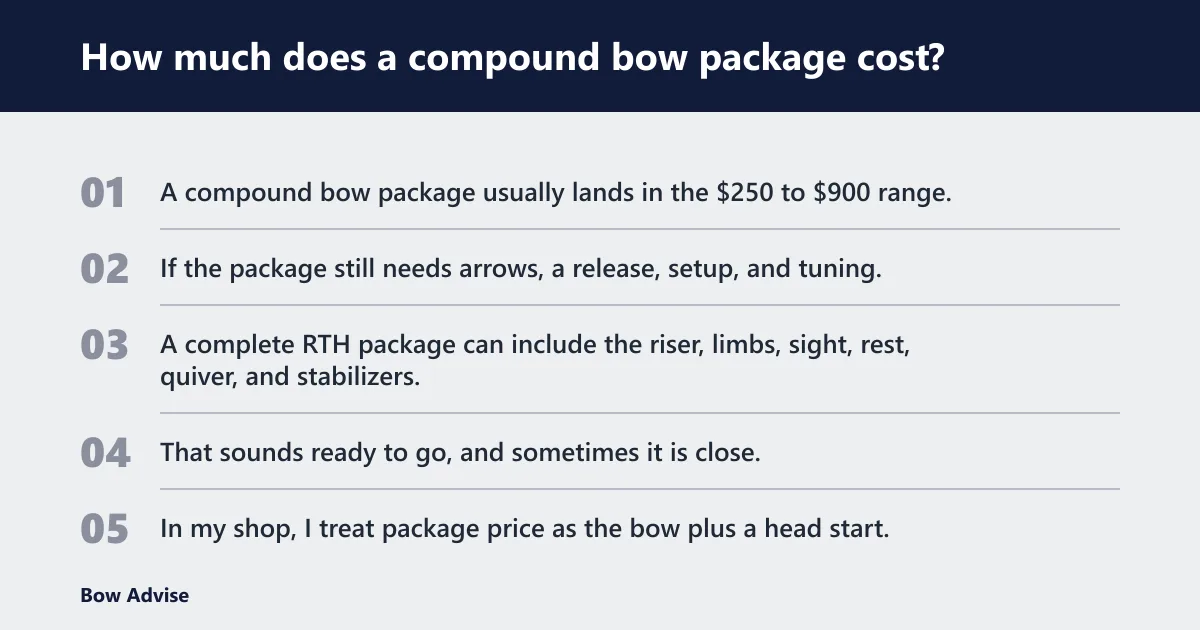


A compound bow package usually lands in the $250 to $900 range, depending on whether you are buying an entry package or a hunting-ready bundle with more complete accessories. That sticker price is only the start. If the package still needs arrows, a release, setup, and tuning, the real first-year cost climbs fast.
A complete RTH package can include the riser, limbs, sight, rest, quiver, and stabilizers. That sounds ready to go, and sometimes it is close. In my shop, I treat package price as the bow plus a head start, not a finished shooting budget.
Why package price is not the full cost
Package contents change by model and retailer, and I have seen that first-hand. One bundle may include a usable sight and rest. Another may include parts I would swap before I ever shoot a group. Cheap packages can still help, but only if the buyer knows where the missing money goes.
Factory strings stretch. Arrows need spine and length that match the bow. A release aid is often separate. Leave those out of the budget, and the package looks cheap right up until the first trip to the range.
📊 Entry-level compound bow packages can start under $120. Source: 12 Best Compound Bow Packages (October 2026) Tested & Reviewed.
My first compound bow was set 10 lb too heavy; I flinched for a month before I backed the limb bolts out.
Bare bow vs compound bow package pricing
A bare bow looks cheaper because it is cheaper. The price only covers the bow itself, not the gear that makes it shootable. For a first buyer, that matters more than the sticker. A package can save money versus piecing everything together, but only if the included parts are worth keeping.
Tiering helps here. Entry-level bare bows are often $300 to $600, mid-range bare bows are $600 to $1,000, and flagship bare bows are $1,000 to $1,800. The guide also says a bare bow plus accessories can run $400 to $700 on top of the bow itself, which is where many shoppers get surprised.
What you still need to buy after a bare bow
- Sight
- Arrow rest
- Quiver, if you want one attached
- Release aid
- Arrows and field tips or broadheads
- Target or safe backstop
- Setup and tune service
That list is why bare-bow shopping only makes sense if you already own accessories or want to choose every part yourself. I have seen beginners spend less at checkout and more over the next two weeks. That is not a bargain. That is delayed spending.
What comes in a compound bow package?
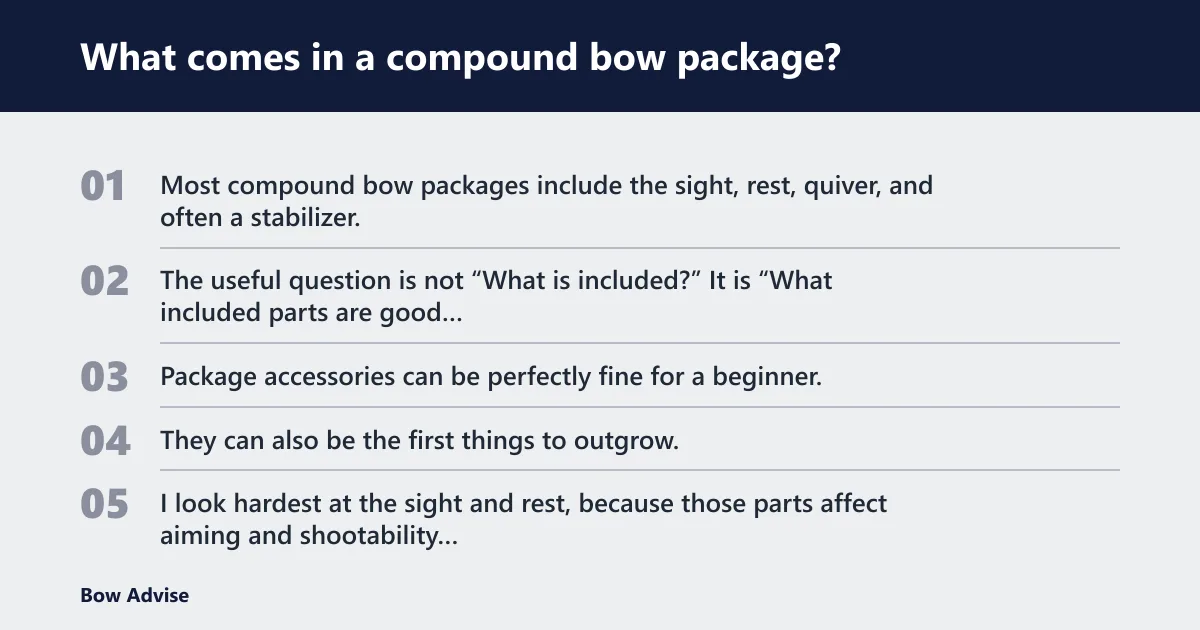
Most compound bow packages include the sight, rest, quiver, and often a stabilizer, with some bundles adding a peep, loop, or other small parts. The useful question is not “What is included?” It is “What included parts are good enough to keep?” That answer changes the real value of the package.
Package accessories can be perfectly fine for a beginner. They can also be the first things to outgrow. I look hardest at the sight and rest, because those parts affect aiming and shootability on day one.
What package accessories are worth keeping
If the sight is solid, the rest drops cleanly, and the quiver holds tight, I keep them. A decent stabilizer is nice, but I do not treat it like a must-have at the start. A beginner needs a bow that shoots cleanly and repeats well before chasing extra hardware.
The Sanlida Dragon X8 is a good example of why package value matters. It has a draw length of 18 to 31 inches and a draw weight of 0 to 70 lbs, which gives new archers a wide adjustment window. It is listed at up to IBO 310 fps, but speed only helps if the bow fits the shooter.
What package parts I would replace first
I replace a weak rest first, then a sight that is hard to read or adjust. After that, I look at arrows and the release aid. Cheap package parts can get a new archer started, but a poor rest or sloppy sight makes learning harder than it needs to be.
I learned that lesson the hard way when I set my first compound bow 10 lb too heavy. I flinched for a month before I backed the limb bolts out. A package cannot fix a bow that is too heavy for the shooter.
How much does it cost to set up a compound bow?
Setup cost often adds roughly $40 to $120, depending on the pro shop and how much work the bow needs. That can include nocking point work, sight leveling, paper tuning, and basic timing checks. It is not an optional luxury if you want the bow to be shootable.
Release aid, arrows, and target costs belong in the setup budget too, because the bow is not ready without them. A beginner often needs the most help here, since the bow must match their draw length, draw weight, and arrow selection.
Pro-shop setup and tuning fees
Some shops charge a flat rate. Others split the work into individual services. Either way, I budget for it every time. If the bow is out of tune or the draw cycle feels wrong, no package price makes up for that.
Release aid, arrows, and target cost
A release aid is often a separate purchase. Arrows must match the setup, and that matters more than most first-time buyers expect. If the arrow spine is wrong, the bow may group badly or feel hard to tune. A target or safe backstop is also part of first-day readiness.
First-string or cable maintenance costs
Strings and cables are a maintenance item, not a one-time thought. Factory strings stretch, and some bows need replacement or an upgrade after the first stretch period. How much does a compound bow string cost? Enough that it should be in the budget if the bow will get real use.
First-year cost worksheet: youth, adult beginner, and budget hunting
Here is the worksheet I use when I help a new archer price a first setup. It separates the bow, included accessories, required add-ons, setup, arrows, release, and first-string maintenance. These totals are closer to real life than package sticker price alone.
| Scenario | Bow / package | Add-ons and setup | First-year total |
|---|---|---|---|
| Youth compound bow | $120 package | $90 arrows + $35 release + $50 setup/tune + $45 target/backstop + $40 first-string maintenance | $380 |
| Beginner adult | $350 package | $100 arrows + $60 release + $75 setup/tune + $60 target/backstop + $60 first-string maintenance | $705 |
| Budget hunting starter | $500 package | $140 arrows + $75 release + $90 setup/tune + $80 broadheads / practice tips / target + $80 first-string maintenance | $965 |
The table is a worksheet, not a promise. Your numbers may move depending on the shop and the package. But the structure holds: the bow is only one line item, and the first year almost always costs more than the box suggests.
How much should a good compound bow package cost?
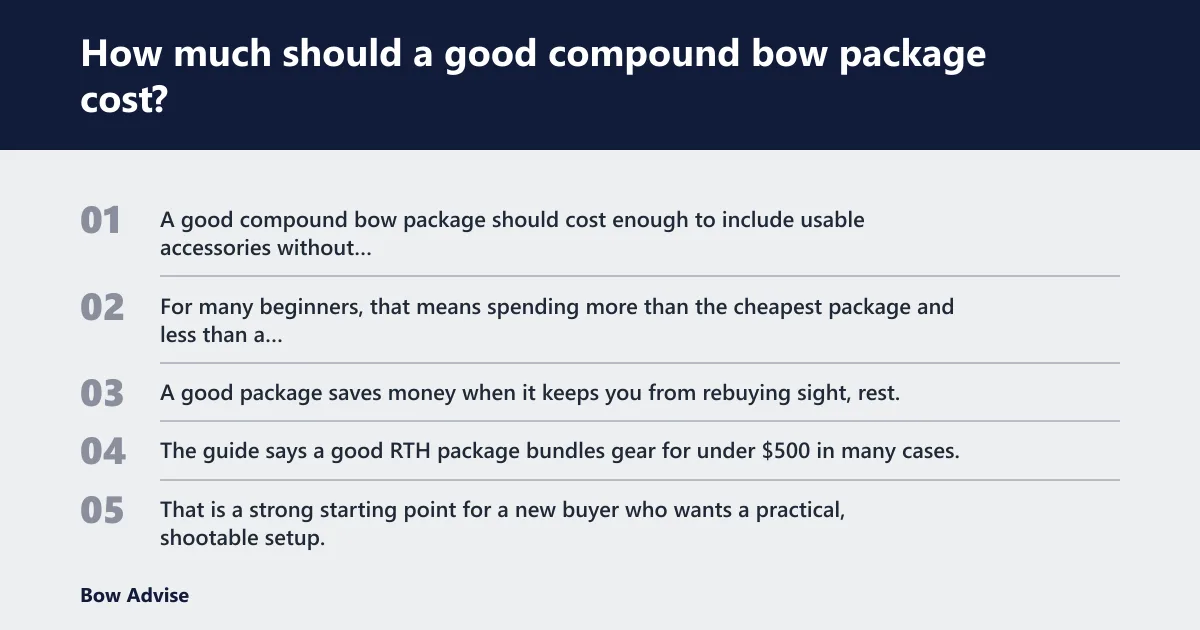
A good compound bow package should cost enough to include usable accessories without forcing a fast upgrade. For many beginners, that means spending more than the cheapest package and less than a flagship bare bow setup. A good package saves money when it keeps you from rebuying sight, rest, and quiver immediately.
The guide says a good RTH package bundles gear for under $500 in many cases. That is a strong starting point for a new buyer who wants a practical, shootable setup. The Florida cost guide also puts Tier 1 real total cost at about $510, which lines up with what I would call a realistic entry budget.
When a cheaper package makes sense
Cheaper makes sense for a youth archer, a casual backyard shooter, or a buyer who wants to test the sport without committing hard cash. Entry-level compound bow packages can start under $120. That is fine only if the fit is right and expectations stay grounded.
When paying more saves money later
Pay more when the package includes better adjustable fit, a better sight, and a rest you will keep. Mid-range hunting setups are in the $250 to $400 range, and those can be smart buys if the accessories are solid enough to stay on the bow for a season or two.
The Florida cost guide estimates Tier 2 real total cost at about $1,220 and Tier 3 real total cost at about $2,360. That spread shows how fast the total rises once the bow moves from starter to serious hunting or flagship-level gear.
When to buy package versus bare bow
Buy a package when you need nearly everything and want fewer decisions. Buy a bare bow when you already own quality accessories or want to build a specific setup piece by piece. If the package parts are weak and you will replace them immediately, the bare-bow route can be better value.
What beginner buyers should check before they buy
Beginner buyers should check fit before price. Adjustable draw length and draw weight matter more than a fancy label. A package that fits the shooter is usually worth more than a more expensive bow that is too heavy, too short, or too long to shoot well.
I switched to a left-hand bow after discovering I am left-eye dominant, and my groups tightened within two weeks. That kind of fit issue changes everything. A bow can be affordable and still be the wrong bow for the shooter.
Adjustable draw length and draw weight
Look for a bow that gives room to grow, especially for youth and first-time adults. Youth compound bow options should fit the shooter now and leave some adjustment room later. If the bow tops out too early, it loses value fast.
Fit, growth room, and intended use
Match the bow to the job. Backyard practice, 3D shooting, and hunting do not always need the same package. A beginner hunter should pay more attention to setup, arrows, and broadhead readiness than to the cheapest sticker price on the shelf.
Signs the package will need upgrades fast
- The sight feels loose or hard to adjust.
- The rest looks basic enough to replace soon.
- The draw weight is near the shooter’s limit.
- The draw length adjustment is narrow.
- The package omits release aid, arrows, or tuning help.
Those warning signs do not mean the bow is bad. They mean the real cost will be higher than the package ad suggests. That is the part I want beginners to see before they hand over cash.
Frequently asked questions
How much does a compound bow cost?
A compound bow can cost from under $120 for entry packages to well over $1,000 for higher-end bare bows, with many practical beginner and hunting setups landing in the middle. The bow itself is only part of the budget, so first-year spend is usually higher than the sticker price.
How much does a beginner compound bow cost?
A beginner compound bow often looks affordable at checkout, but the real number usually includes a release, arrows, setup, and a target. I would budget a few hundred dollars at minimum for a usable first setup, and more if the bow needs tuning or upgrades.
How much should a compound bow cost?
It should cost enough to fit the shooter and include accessories that will actually get used. For most beginners, a sensible package is cheaper than building every piece from scratch, but the final number should still account for setup, arrows, and maintenance.
How much does a compound bow package cost?
A compound bow package usually costs $250 to $900, depending on whether it is an entry-level bundle or a more complete hunting package. I treat that as the bow package price, not the full purchase cost, because arrows, release, and setup are often separate.
How much does it cost to set up a compound bow?
Setup often adds $40 to $120, depending on the shop and the amount of tuning needed. That can cover leveling, nocking point work, timing checks, and paper tuning. If the bow is for a first-time shooter, I would expect setup to be part of the purchase plan.
How much does a compound bow cost for youth?
A youth compound bow can start at a lower package price than adult bows, but the total still needs arrows, a release, and setup. I focus more on fit and adjustability than on the cheapest tag, because a youth bow that does not grow with the shooter loses value quickly.