How to Choose the Right Bow String Length for Setup
Choose the string length listed for your exact bow model. For many recurves and longbows, that usually means a string a few inches shorter than the bow’s overall length, while compounds need to match the bow’s stated axle-to-axle and cam specifications. A wrong length can alter brace height, tune, speed, and can damage limbs or cams. This guide shows how to match bow type, measurements, and string material to the correct replacement.
How bow string length is actually determined
The direct rule is simple: bowstring length must match the bow specification, but the specification source changes by bow type. AMO is commonly used to estimate recurve and longbow string length, while compound bows generally rely on the string and cable lengths listed on the bow’s spec sheet or markings. That difference matters more than generic bow length advice.
Why the bow’s spec matters more than guesswork
AMO is a set of standard lengths and specifications for bows, but it is not a free-pass number for every setup. Recurve and longbow rules of thumb are useful starting points, yet brace height, limb design, and string material can shift the final fit. For compounds, generic bow length rules should not be used at all.
A wrong string can change cam timing on a compound, or leave a recurve sitting too high or too low in brace height. That can show up as poor arrow flight, a noisy shot, or nock fit problems. If the bow was built for a certain string type, that specification should lead the decision.
How AMO fits recurve and longbow sizing
For traditional bows, AMO gives a standard starting point. One common rule says recurve string length can be figured by subtracting 3 inches from AMO length. Another guide says a recurve string is about 4 inches shorter than AMO length, and gives a 68-inch AMO recurve that typically uses a 64-inch string. That difference is why charts and model specs matter.
Longbows are usually about 3 inches shorter than AMO length. A recurve bow string chart may also show minimum and maximum lengths for different recurve bows, which is helpful when the original string is missing. Use the chart as a guide, then confirm against the bow maker’s recommendation or the old string if it is available.
What changes when the bow is a compound
Compound bows do not follow the same offset logic as recurves and longbows. The exact string and cable length should come from the limb sticker or the spec sheet. On this type of bow, even a small mistake can affect cam sync, let-off feel, and tune.
Do not buy a compound string from a general bow-length estimate. If the label or manual is missing, the correct next step is to identify the exact model and axle-to-axle setup, then match the listed string and cable specs before ordering.
What length should a recurve or longbow string be?
For most recurves, a common starting point is a string about 3 to 4 inches shorter than AMO length. For longbows, the usual rule is about 3 inches shorter than AMO length. That is the decision rule, but the actual replacement should still match the bow’s listed spec or a known-good existing string.
Recurve rule of thumb and the AMO offset
Recurve bows often use a string that is 3 inches shorter than AMO length, and some sources use about 4 inches shorter. That is why one guide can say 58 minus 4 equals 54 inches, while another says a 68-inch AMO recurve typically uses a 64-inch string. Both are trying to point you toward the same idea: check the bow’s exact spec and not only the AMO number.
If a recurve chart lists a range, use that range as the first filter. Then match the material and strand count to the bow. A beginner recurve with a Dacron string may tolerate a slightly softer setup, while a performance recurve built for low-stretch material needs the correct modern string type.
Longbow rule of thumb and the AMO offset
Longbow strings are usually about 3 inches shorter than AMO length. That offset is simple, but it still leaves room for variation because limb profile and string material affect brace height. A longbow with older limbs or a traditional build may also need a softer string material than a modern recurve.
Say your longbow is marked 68 inches AMO and the maker recommends Dacron. The right replacement is not just “about 65 inches” in the abstract; it is the length and material the maker expects for that limb design. The spec sheet should always win if it is available.
When to trust a measured old string over a chart
If the original string is present and not badly stretched or damaged, it is often the best reference. Measure the old string end to end from loop to loop under light tension, then compare that number with the bow’s spec and the maker’s material guidance. That helps when charts conflict or when the bow is older.
A common first-timer mistake is to replace a string by AMO number alone when the old string was already serving the bow correctly. If brace height and nock fit were good with the old string, its measured length is a useful confirmation point. If the old string was badly worn, use the bow spec instead.
| Bow type | What to measure | What spec to trust | Length rule to use | Material choice |
|---|---|---|---|---|
| Compound | Exact model, axle-to-axle setup, string and cable labels | Limb sticker or spec sheet | No generic offset rule | Match the maker’s approved material |
| Recurve | Existing loop-to-loop string or bow AMO | Bow chart, manufacturer spec, or known-good string | About 3 to 4 inches shorter than AMO | Dacron/B50 for older or entry-level bows; low-stretch for modern bows built for it |
| Longbow | Existing loop-to-loop string or bow AMO | Manufacturer spec first, then string chart | Usually about 3 inches shorter than AMO | Dacron/B50 for traditional and older bows; low-stretch only if the maker allows it |
How do you measure a bow string correctly?
Measure a bow string from end to end of the loops, under light tension, and compare that length with the bow’s spec. That is the most useful check when replacing a string, especially if the original is missing. If the string is stretched, frayed, or damaged, do not trust it as the only source.
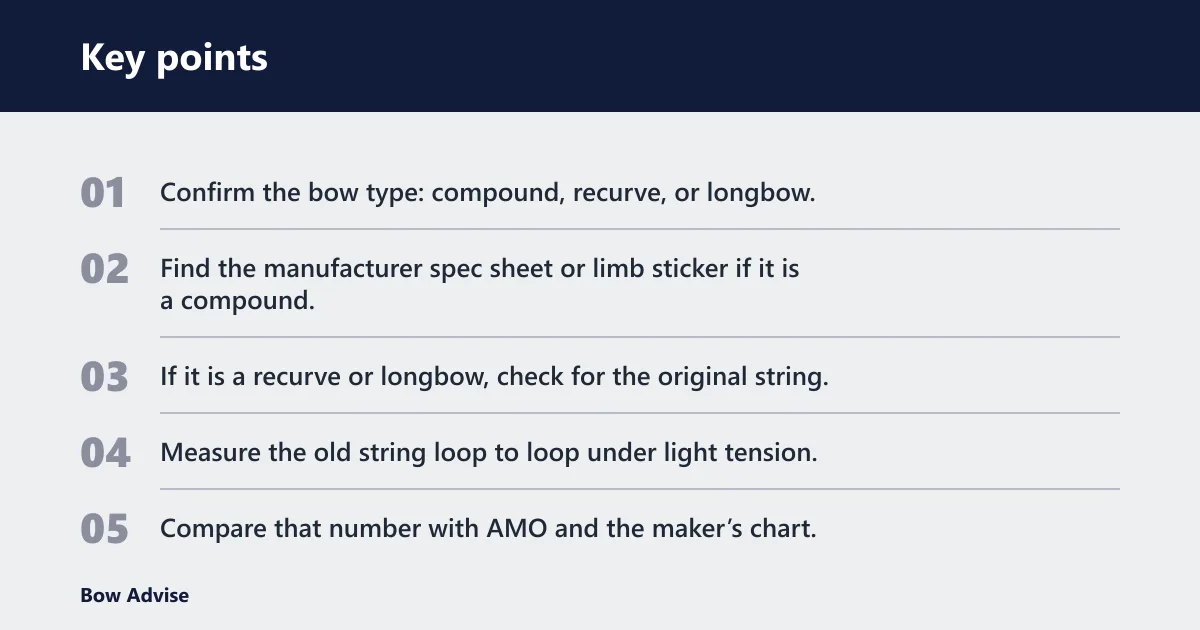
Measuring loop to loop under light tension
The clean method is to lay the string under light tension and measure from the inside of one loop to the inside of the other loop. One guide recommends measuring an existing string under light tension from end to end of the loops. That gives a practical replacement number for recurve and longbow strings.
Do not measure loosely coiled string and call it done. Slack can hide true length. If the replacement is for a compound, skip this method as the primary source and use the limb sticker or spec sheet instead.
- Confirm the bow type: compound, recurve, or longbow.
- Find the manufacturer spec sheet or limb sticker if it is a compound.
- If it is a recurve or longbow, check for the original string.
- Measure the old string loop to loop under light tension.
- Compare that number with AMO and the maker’s chart.
- Choose material based on bow age and limb approval.
- Check strand count against draw weight and nock fit before ordering.
What to do if the old string is stretched or damaged
If the old string shows obvious stretch, broken servings, or fuzzy fibers, treat it as a clue, not a final answer. Use the bow’s listed AMO, the maker’s chart, or the exact model spec to set the replacement length. For recurves, a bow string chart can also show minimum and maximum lengths.
Suppose a 66-inch recurve has a frayed string that measures short because of wear. Ordering the same damaged length can leave the new string too tight, shift brace height, and make the nock fit too stiff. In that case, the bow spec should override the old string measurement.
Why brace height changes the final fit
Brace height is the practical sign that string length is right. If the string is too long, brace height may sit too low and the bow can feel sluggish. If it is too short, brace height can rise too much, which may make the bow harsh and harder to tune.
Wrong brace height is not only a comfort issue. It can change arrow clearance, string angle, and limb stress. That is why a string that “fits the loops” is still not enough; the bow has to sit in its proper brace height range too.
What material should you choose for your bow?
Material choice depends on the age and design of the bow. Dacron/B50 is best for older bows, traditional recurves, longbows, and beginner bows. Modern low-stretch materials such as 8125, 452X, and 8190 fit modern bows built for them. The wrong material can hurt performance or damage older limbs.
Dacron/B50 for older, traditional, and entry-level bows
Dacron/B50 is softer and stretches more than modern low-stretch material. That extra give is useful on older limbs and on beginner bows, and it is also commonly recommended for traditional recurves and longbows. One guide specifically says Dacron/B50 is best for older bows, traditional recurves, longbows, and beginner bows.
This is the safer choice when the bowmaker does not approve faster string material. Low-stretch material on older limbs can be a bad fit and may damage the bow. If there is any doubt, Dacron/B50 is usually the conservative answer.
8125, 452X, and 8190 for modern low-stretch setups
Modern low-stretch materials include 8125, 452X, and 8190. These materials hold tune better and usually give a faster feel, which is why they fit modern bows built for them. They are common on performance recurves and many compounds, but only when the manufacturer allows that material.
The main tradeoff is forgiveness. Less stretch means more speed and better consistency, but it also means the bow must be designed for that load. Older limbs are the place to be careful here.
How material choice affects speed, feel, and tune
Stretch affects how the bow stores and returns energy. More stretch usually feels softer and is kinder to older bows. Less stretch usually gives a crisper shot and more stable tune, but it can make nock fit and brace height more sensitive to small errors in string length.
A material choice should never be made apart from the bow’s age and design. A modern target recurve may benefit from low-stretch material, while a traditional longbow may need Dacron to stay within safe limits and tune cleanly.
How strand count affects fit and performance
Strand count changes speed, durability, and nock fit. It should be selected based on draw weight and the rest of the setup, not guessed. Too few strands can make the string too thin for the nock or too hard on serving life, while too many can slow the bow and create fit issues.
Matching strand count to draw weight
Higher draw weight often calls for a stronger string build, but the right count still depends on material and bow design. A heavier hunting recurve may need a different strand count than a light entry-level bow. The goal is a string that fits the nock cleanly and keeps serving wear under control.
Nock fit checks before you order
Nock fit should be part of the sizing decision. If the center serving is too thick, the arrow nock may pinch or release poorly. If it is too thin, the nock can sit loose and move around. Either problem can make a correct-length string behave like the wrong one.
Wrong nock fit often shows up as inconsistent release or odd arrow flight. If the string length seems right but the bow still tunes badly, the strand count and serving diameter should be checked before blaming the limbs or arrows.
When a thicker string makes sense
A thicker string can make sense when the nock point needs a better grip or the bow sees hard use. It may also help with durability on a beginner bow. The downside is slower arrow speed and the chance of a tighter nock fit, so the choice should be deliberate.
Our picks by need
Best choice for a recurve replacement: KESHES Dacron Bow String Replacement

- Sleek B‑55 Dacron with extra stretch
- Customizable length and strand count
- Pre‑looped design for quick installation
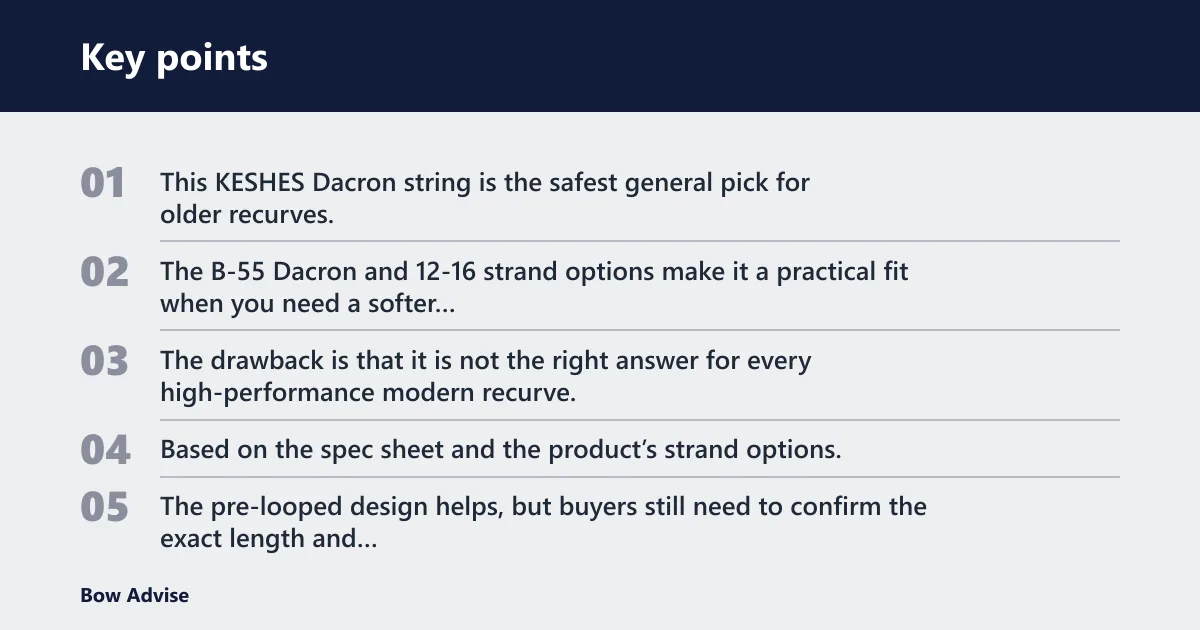
This KESHES Dacron string is the safest general pick for older recurves, traditional bows, and many beginner setups. The B-55 Dacron and 12-16 strand options make it a practical fit when you need a softer string with more forgiveness. The drawback is that it is not the right answer for every high-performance modern recurve.
Based on the spec sheet and the product’s strand options, it is a better fit when the bowmaker favors Dacron and when quick installation matters. The pre-looped design helps, but buyers still need to confirm the exact length and strand count before ordering.
Best choice for a longbow replacement: DEERACE D97 Flemish Fast Flight Bow String

- D97 Flemish material for high performance
- Actual length 4" shorter than AMO for optimal tension
- Endless loop with three‑part construction
This DEERACE string fits traditional longbow and recurve users who want a faster, low-stretch setup and whose bow is approved for that material. The listing notes that the actual length is 4 inches shorter than AMO for optimal tension, which aligns with common recurve guidance. The drawback is that low-stretch string material can be the wrong choice for older limbs.
It is a better match for modern traditional bows that can handle D97-style material and a cleaner, quicker feel. Buyers should confirm the bow’s approval before ordering, because the wrong material can create fit or safety problems.
Best choice for safe string installation: KESHES Archery Recurve Bow Stringer Tool
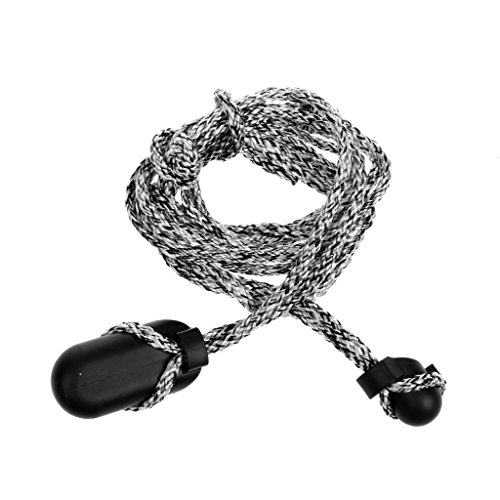
- Simple, quick operation for all bow types
- Tip‑to‑tip pull design reduces effort
- Secure, safe design protects limbs
This stringer tool helps with safe installation on recurves and longbows, which matters when checking a new string’s fit and brace height. The tip-to-tip pull design reduces strain on the limbs, and that is useful for beginners. The drawback is simple: it is a tool, not a replacement string, so it does not solve sizing by itself.
For archers changing strings at home, a stringer makes it easier to avoid limb twist and accidental damage during installation. It pairs well with a correctly sized string, especially on traditional bows that need a little extra care.
One-page decision table for buying the right string
The safest buying process starts with bow type, then moves to spec source, then material. This table separates the three common paths so you can avoid mixing recurve, longbow, and compound rules. Use it as a quick filter before adding any string to the cart.
| Path | What to measure | What spec to trust | Length rule to use | When to choose Dacron/B50 | When to choose low-stretch |
|---|---|---|---|---|---|
| Compound | Exact model, axle-to-axle setup, string and cable labels | Limb sticker or spec sheet | Use the exact listed string and cable lengths | Only if the manufacturer allows it | Usually for modern bows built for it |
| Recurve | Old string loop to loop under light tension, or AMO | Bow chart, maker spec, or known-good string | About 3 to 4 inches shorter than AMO | Older bows, beginner bows, and traditional setups | Modern recurves designed for faster materials |
| Longbow | Old string loop to loop under light tension, or AMO | Manufacturer spec first, then chart | Usually about 3 inches shorter than AMO | Traditional and older longbows | Only when the bow maker approves it |
Mistakes to avoid
The most common error is using one bow-type rule for another. A compound does not use the same offset method as a recurve or longbow, and generic AMO math should never replace the limb sticker or spec sheet. The second mistake is buying the right length in the wrong material.
Another problem is ignoring brace height and nock fit. If the string length seems close but the bow sits oddly, the setup is probably not right. A bow can look fine on paper and still tune poorly if the material, strand count, or length is off.
Be careful with older limbs. Low-stretch string material may be too much for a bow that was built around Dacron. Also avoid trusting a stretched, frayed, or damaged string as the replacement standard. That often leads to the same problem on the new setup.
Frequently asked questions
how to determine bow string length
Start with the bow type. Compounds need the exact length from the limb sticker or spec sheet. Recurves and longbows usually use AMO as the starting point, then a bow-specific offset or chart. If you have the old string, measure it loop to loop under light tension and compare it with the bow maker’s guidance.
how to measure bow string length
Measure from loop end to loop end under light tension. That gives a useful replacement number for recurve and longbow strings. Do not rely on a loose, unstretched string lying on a table. For compounds, the model’s exact string and cable lengths from the spec sheet are the better reference.
how to measure archery bow string length
Use a tape measure or a marked flat surface and pull the string lightly so it stays straight. Read from the inside of one loop to the inside of the other. This method works best for traditional bows. If the string is worn or badly stretched, use the bow’s AMO or maker spec instead.
how to measure recurve bow string length
A recurve string is often estimated from AMO by subtracting 3 inches, though some guides use about 4 inches. The safest method is to compare a measured old string with the recurve chart or manufacturer spec. Some charts also give minimum and maximum lengths for a given bow.
what is AMO bow string length
AMO is a standard set of bow lengths and specifications used to help calculate string length for traditional bows. It is a reference point, not the final answer for every bow. Recurves and longbows often use it with a rule of thumb, while compounds depend on exact model-specific string and cable data.
what material should I choose for an older recurve string
Dacron/B50 is usually the safest choice for an older recurve string. It is softer, has more stretch, and is commonly recommended for older bows, traditional recurves, longbows, and beginner bows. Low-stretch materials such as 8125, 452X, and 8190 should only be used if the bow maker approves them.