How Native American Bows Store Energy: Reflex vs Recurve
Reflex bows often store more energy and can gain more string pull late in the draw. Recurved bows often load more strongly around the middle of the draw. Simple, nearly straight bows often load more evenly and tend to release with less late-stage punch. That design choice shifts draw feel and arrow speed. Stored-energy mismatch can cause slow shots, erratic bareshaft flight, and poor penetration. I’ll link reflex, recurved, and simple shapes to how they load during the draw-cycle and what that means for hunting use.


How does a bow store energy during the draw cycle?
Energy storage is best understood through the force-draw (F/D) curve. I see it every time I tune, because you feel how much force you need at each inch of draw. The area under that curve gives a rough idea of stored energy, and where the bend happens along the limbs affects when the force rises. Pre-load and stacking change the curve shape you live with.
Force-draw curve as the beginner-friendly map
As you draw, your bow limbs bend and store elastic potential energy. The F/D curve is the story of that bending versus draw length. If the curve stays moderate and steady, the bow feeds energy in a spread-out way. If the curve spikes near full draw, the bow demands late-stage effort.
On paper, you can treat stored energy as the area under the curve. In my shop, I watch for the same idea in feel. Does the draw start easy and then get heavy fast near the end, or does it ramp more evenly? The profile that creates the ramp also changes hunting behavior.
What pre-stress and limb bend have to do with where energy shows up
Two bows can hit the same draw weight at full draw, yet still differ a lot in when energy builds. Pre-load is energy stored early in the draw. It shows up when the limb geometry already has bend built into the resting or early-draw position. Reflex and recurves often create that early bend, so you feel power show up sooner.
Stacking is what happens when draw force starts increasing rapidly. That’s the late-knife feel you get when the bow really wants to keep bending right at the end. Many long, aggressive stickbow setups show it. Some reflex layouts also encourage it when you push curvature too far.
According to Plains Indian Weapons, part I: the Bow and Arrows — Native bows in the Plains were often short, about 42–48 inches long. (source)
Self bow vs recurve: what changes when the tips curve away?
A simple self bow gives you a baseline. It has a straight profile that stays effectively the same length as the bow is drawn, so it stores less energy than reflex or recurve designs of similar overall size. A recurve has tips that curve away from the archer when strung. That changes where the limb gets engaged and makes the bow’s energy growth stronger earlier to mid draw.
Self bow as the baseline for storage behavior
A self bow is a single-piece wood construction, low-complexity, traditional design, and it’s a useful baseline for comparing profiles. Straight limbs tend to keep the force rise more even, because the geometry doesn’t grab more working limb length at the same points in the draw. If you want to learn what even feels like, a self bow teaches it fast.
In my own tuning sessions, I’ve found that straight, self-style builds often group well when matched to the arrow. They can still feel less poppy at release compared with recurves. That’s not a flaw in the bow. It’s the energy curve you’re living with.
Recurve profile behavior at brace and through the draw
With a recurve bow, the tips curve away from the archer when strung, and the string contacts the limb section at brace. That geometry matters because the working limb length and mechanical advantage shift as you draw. Recurved limbs can give greater energy and speed to the arrow than equivalent straight-limbed bows.[2]
On the range, that often shows up as draw feel that speeds up and builds force more effectively through the middle portion of your draw, instead of relying on a late-stage shove. It also means you can build a shorter bow for a given arrow energy.
Practical outcome: faster energy growth earlier in the draw
Recurve bows generally trade predictable evenness for stronger loading efficiency. On the range, that shows up as easier management of draw length changes and better arrow launch timing when the bow-to-arrow match is correct. In hunting terms, it supports quick follow-through when you’re in awkward positions.
When I coach beginners, I’ll often have them feel two bows side by side. The recurve usually tells a clear story. The middle of the draw is doing more work, and the end of the draw feels less like it’s paying a big tax for speed.
What does reflex mean for stored energy in Native-style short bows?
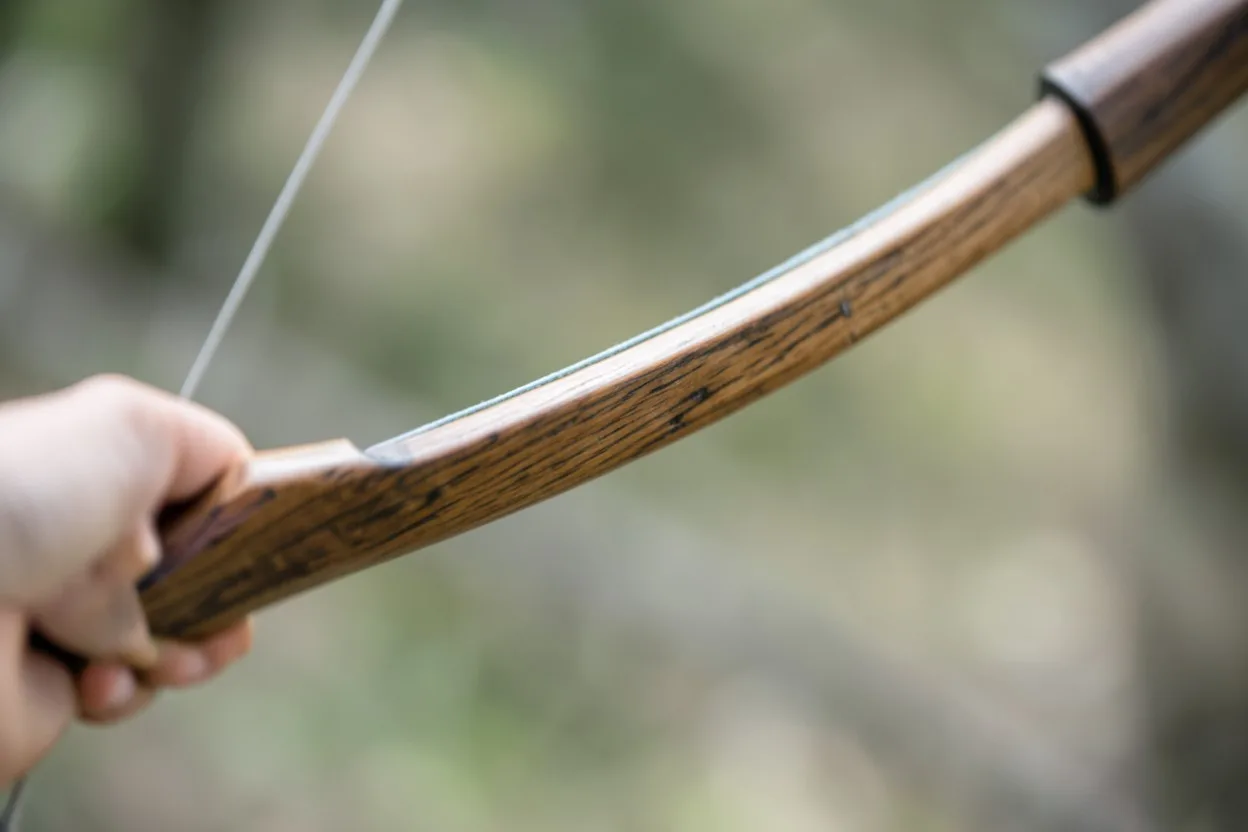
Reflex means the limbs curve away from the archer when unstrung. That leaves the bow with a pre-stressed bend at rest. Because that stored bend exists before you draw, reflex designs can boost stored energy in short bows. The trade is that stringing feel and stability can get more demanding as reflex becomes more aggressive.
Reflex profile behavior unstrung: energy is “pre-loaded” before draw
A reflex bow profile has limbs that are already working in the unloaded state. You’re drawing a bow that resists straightening from the first inches. Pre-load becomes part of the experience right away. Energy is stored early in the draw, which reshapes the F/D curve so the area under it builds sooner.
This matters for short bows. Native bowmakers often favored compact hunting tools. A short bow has less limb length to bend, so it needs geometry that concentrates stored energy without adding length.
Why reflex can boost stored energy when overall length must stay short
Reflex is one way a short bow compensates for less working limb length. By adding curvature that starts the limb in a bent state, the bow can reach useful arrow energy in a compact form factor. In the Plains, Native bows were often short, about 42–48 inches long, and reflexed layouts show up as one way to make that size still hit hard.
In my own builds, I’ve noticed that once reflex becomes too aggressive, the bow can feel like it wants to snap before you get clean form. That’s a stability reality. Your shot depends more on consistent grip and set.
Tradeoffs: stringing feel and stability reality
As reflex increases, stringing can become more awkward because you’re fighting a geometry that wants to keep its unstrung curve. I’ve also seen that aggressive reflex can increase instability risk when the bow doesn’t have enough structural support or when the design relies on a thin margin of strength.
Recurves and reflexes also put greater strain on the materials used to make the bow. With short working limbs, any weakness shows up faster through stress cycles.
Recurved, reflexed, and simple designs: where energy growth differs
When I compare designs through the draw cycle, I compare where the F/D curve rises. Reflex tends to bring energy storage earlier due to pre-stress. Recurves often load strongly toward the middle. Simple self bows keep the load more even. If you push stacking too hard late in draw, it can feel harsh and waste efficiency.
Use the draw-cycle to compare early storage vs late storage
Think of the draw in thirds. Reflex designs often feel heavier sooner, because the limbs are already bent in the relaxed state. Recurves commonly feel like they build power in the middle, because the geometry engages and redirects limb bending through that range. Simple bows usually feel smoother throughout, with less dramatic late punch.
That’s why the same draw weight can translate to different arrow speed and different tuning needs. If your arrow spine and fletching timing are set for a bow that loads evenly, a bow that stacks late can steer the arrow differently at release.
How pre-load shifts the curve, while stacking concentrates difficulty near full draw
Pre-load is energy stored early in the draw. It often shows up as a smoother start that keeps gaining. Stacking is where draw force starts increasing rapidly, and it can create an uncomfortable late draw. In stickbows, stacking appears more often near the end, and it can reduce efficiency when form slips.
I’ve flinched for a month after setting up a compound bow 10 lb too heavy. That end-stage force jump taught me how quickly human form breaks when the last inches demand too much. Even though reflex and recurve are different from compounds, the lesson transfers. Where the force rises matters.
Beginner takeaway: why two bows with similar draw weights can feel very different at the same anchor
If two bows hit the same weight at full draw, but one loads harder mid draw while the other stacks hard late, their release timing demands differ. A beginner can accidentally float the anchor on the stacking bow, which leads to inconsistent arrow departure. Matching profile behavior to shooter control is part of tuning.
Proof asset: stored-energy comparison table
| Design | Brace shape | Draw-cycle feel (where it loads) | Stored-energy tendency | Stringing difficulty | Stability risk | Best Native-use case |
|---|---|---|---|---|---|---|
| Simple self bow | Nearly straight limbs in profile | More even force rise from start toward end | Less energy than equivalent reflex/recurve designs of similar size | Often easiest to string due to simple geometry | Lower risk from profile-driven instability | General use where smooth feel and manageable stress matter |
| Reflex bow profile | Limbs curve away from the archer when unstrung | More load earlier due to pre-stress; higher late pull tendency | Higher stored-energy tendency; energy builds earlier in the draw | Often harder because you must overcome pre-set curvature | Higher risk if reflex is too aggressive for the wood and build | Short bows needing power density for close-range and quick shots |
| Recurve bow profile | Tips curve away from the archer when strung; string touches limb section at brace | Strong loading toward the middle; less end-stage “tax” than heavy stacking | Stores more energy and speed than equivalent straight-limbed bows | Moderate; depends on recurve depth and overall length | Moderate; depends on material strain management | Shorter bow option for given arrow energy and repeatable field control |
Sinew backing: how it changes durability and the energy curve
Sinew backing adds a strong layer to the bow back, which helps it survive the bending stress that reflex and recurved profiles create. Plains bows were often further strengthened by being sinew-backed, and sinew backing was described as making bows faster-shooting and more powerful. The glue line and drying process also affect consistency.
Why adding sinew helps behind the belly and supports faster transfer
When a short bow loads hard, the back face sees significant tension. Sinew backing is animal sinew glued to the bow back, which improves power and sturdiness. That extra strength behind the belly lets the bow keep working through repeated shots instead of failing early.[3]
In my bench practice, I treat the sinew job as part of the energy curve. A clean, bonded, uniformly dried sinew layer doesn’t just prevent failures. It keeps how the bow bends steadier as the bow seasons.
What beginners should watch for: drying, glue line care, and weather effects
Sinew backing requires drying and careful glue application. If the sinew doesn’t dry uniformly or the glue line is messy, you can get localized stiff spots that alter the curve and feel harsh to draw. Over time, moisture exposure and temperature swings can also change how composites behave, so care matters.
This is why I tell beginners to document what they build. How it felt at first, how it felt after a dry week, and how it felt after a humid range day. That’s how you catch a sinew-related change before it shows up as erratic flight.
How composite behavior can change the draw feel compared with a simple self bow
Because sinew-backed bows are built to handle strain, they can support the energy storage that reflex or recurves aim for. In the Plains, sinew-backed bows were often short and designed to do more work per inch. A self bow can be very shootable, but a sinew-backed reflexed or recurved build changes the energy story by keeping the bow together while pushing efficient bending.
Which Native bow shapes fit hunting on horseback, and why?
On horseback, you need a compact bow that still has power in a short, practical draw. Plains gull-wing layouts use a distinctive reflexed shape. It stays usable close to the body and helps add power for size. Short length reduces snag risk and keeps the draw more repeatable in cramped shooting positions.
Gull-wing bow profile: short bow geometry for mounted use
The gull-wing bow profile is a distinctive reflexed shape used on some Plains bows. It’s short-bow optimized for mounted use, and that geometry supports power density when you cannot afford a long draw stroke. If your draw length changes because you’re seated on a horse or twisted around gear, a bow that loads effectively in your usable range becomes the safer choice.
That matches why Plains bows were often short, about 42–48 inches long. I’ve handled bows like this in winter gear and watched how much easier they are to keep aligned without fighting long limb sweep.
Mounted-use needs: compact length and power density
Mounted archery is where field reality beats bench theory. A short bow clears your body and gear. It also helps keep the arrow line consistent when your stance shifts. Reflex and recurve designs can help reach useful arrow energy without requiring as much limb length.
Average draw-weight of these Plains bows was said to be 50–70 pounds. That matters because mounted hunting often demands quick, controlled release with minimal extra draw effort beyond what the shooter can manage.
Stability reality: how profile choice affects forgiveness
Profile geometry influences how tolerant the bow is of minor setup errors. If you’re not perfectly set up on a horse, you need a bow that forgives small grip and anchor variations. Too much aggressive curvature increases sensitivity. The best profile is the one that produces usable energy without punishing inconsistent form.
What wood choices supported these designs (ash and osage orange)?
Wood choice supported the same goals as the profiles: strength where the bow back sees tension, and a shape that bends cleanly under load. Ash is mentioned for Plains Indian contexts and often works well with self-bow and flatter limb geometry. Osage orange is noted as a strong bow wood in North American traditional archery, and it can pair with traditional profiles aiming for durable reflex or recurve behavior.
Ash in Plains contexts
Ash was used in Plains Indian bows, and it’s often suitable for self bows and flatter limb geometry. That fits how stress distributes: a flatter profile keeps bending more gradual. When I build around self-bow baseline behavior, ash can be a natural fit because the wood and shape match.
Osage orange as a traditional strength option
Osage orange is used in Native American bows, noted as a strong bow wood in North American traditional archery.
Still, wood alone doesn’t decide stored-energy behavior. Profile decides where the draw-cycle loads. Wood decides whether the bow survives the curve long enough to keep that behavior consistent.
Frequently asked questions
How do reflex and recurve bows store more energy?
Reflex and recurve bows store more energy by reshaping where the limbs bend during the draw. Recurve tips curve away from the archer when strung, can give greater energy and speed than equivalent straight-limbed bows, and can allow a shorter bow for a given arrow energy. Reflex starts pre-bent, adding pre-load so energy builds early in the draw.
What is the difference between a simple self bow and a recurve bow?
A self bow is single-piece wood with a lowest-complexity, nearly straight profile, and it tends to store less energy than reflex or recurve designs of similar overall size. A recurve bow has tips that curve away from the archer when strung, so the string touches the limb section at brace and the bow can load more effectively through the middle of the draw.
Why were Native American bows often short and reflexed?
Short bows were often practical for hunting, especially where space and movement limited long draw strokes. Plains bows were often short, about 42–48 inches long, and were frequently further strengthened by being sinew-backed. Reflexed layouts added pre-stress that helps short designs still store useful energy, boosting power density for size.
How does sinew backing affect bow performance?
Sinew backing is animal sinew glued to the bow back, which improves power and sturdiness on shorter bows that see heavy stress. Sinew backing was described as making bows faster-shooting and more powerful. Beginners should treat drying and glue application as performance steps, because poor bonding changes how the bow bends and releases.
Which Native American bow designs were best for hunting on horseback?
For horseback, Plains gull-wing bow profiles fit the job because they are short-bow optimized for mounted use. The reflexed shape helps add power for size while keeping the bow compact. When your draw is constrained by riding position, a geometry that still loads efficiently in your usable draw range becomes a practical advantage.
Do recurved bows store more energy than straight bows?
Yes, recurved bows can store more energy than straight bows when you compare equivalent straight-limbed designs. Recurved limbs can give greater energy and speed to the arrow than equivalent straight-limbed bows, and recurves can allow a shorter bow for a given arrow energy. This comes from how the tip geometry changes the force rise across the draw.
What does pre-load mean in bow performance?
Pre-load is energy stored early in the draw. Reflex designs often create that early bend because limbs curve away from the archer when unstrung, so you’re already working against pre-stress at the start. That reshapes the force-draw curve so the bow builds stored energy sooner instead of saving most of it for the end.
Why do some Native bows feel harder to draw?
Some Native-style bows feel harder because profile geometry can concentrate force increases earlier or later in the draw cycle. When energy storage ramps fast near full draw, it can feel like stacking, where draw force starts increasing rapidly. Recurve and reflex designs also put greater strain on materials, which builders manage through design and backing choices.
How strong were Native American bows?
In Plains contexts, the average draw-weight of these Plains bows was said to be 50–70 pounds, and many builds used sinew backing for added power and sturdiness. Strength isn’t only about peak numbers. It’s also about how the bow survives the stress the profile creates and how consistently it delivers energy through the draw.