Common Archery Bow Problems and What They Usually Mean
A bow problem usually falls into one of three buckets: form, setup, or failing parts. Start with the simplest check first, and stop if a limb, string, cam, or riser shows damage. Ignoring the wrong fix can waste arrows, hide dangerous wear, and lock in bad habits. This guide lists common symptoms, what they usually mean, what to check first, and when a pro shop should step in.
Bow problem symptoms at a glance


Symptom-first troubleshooting saves time because the impact pattern often tells you where to look first. A left miss on a compound can point to torque, rest position, or spine. A low miss can sometimes come from follow-through, the nocking point, or a draw-length issue.
Start by sorting form, setup, and parts. If the symptom started after a change, suspect setup first. If it began suddenly with no change, inspect the bow for loose parts, damaged strings, or a rest problem before blaming the shot.
How to sort form, setup, and tuning issues
Form errors usually show up shot to shot and get better when the archer slows down. Setup and tuning issues usually repeat the same miss pattern, especially at the same distance. Parts failures can look random at first, then turn into a steady problem once the damaged piece starts moving more.
Record three things before changing anything: where the arrows hit, what changed recently, and whether the issue appears with field points, broadheads, or both. That short record helps separate a bad release from a rest shift or a spine mismatch.
What to record before changing anything
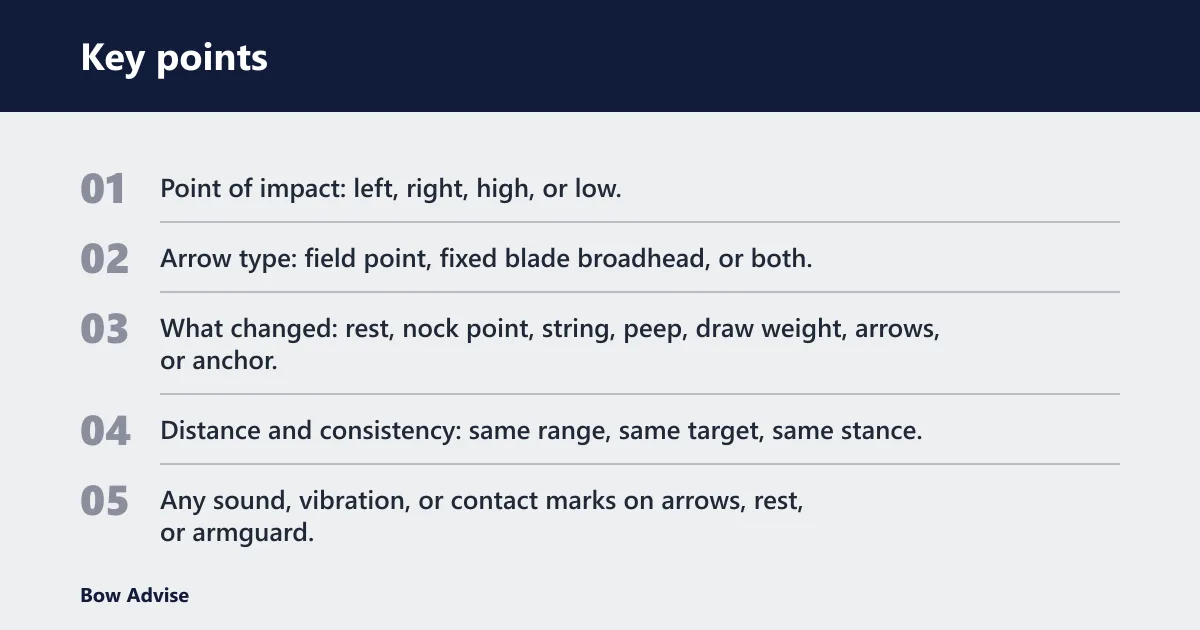
- Point of impact: left, right, high, or low.
- Arrow type: field point, fixed blade broadhead, or both.
- What changed: rest, nock point, string, peep, draw weight, arrows, or anchor.
- Distance and consistency: same range, same target, same stance.
- Any sound, vibration, or contact marks on arrows, rest, or armguard.
Troubleshooting table
The table below gives a fast triage path. Use the quick field check first, then stop if the fix would require a major adjustment, a press, or a part replacement you are not set up to do safely.
| Symptom | Most likely cause | Quick field check | Likely fix | When to stop and visit a pro shop |
|---|---|---|---|---|
| Wrist slap | String contacts the forearm, usually from poor hand position or bow-arm rotation | Look for a welt or abrasion on the forearm after the shot | Rotate the bow arm properly, use an armguard, and keep the bow hand relaxed | If the string path looks wrong even with proper form, or the brace height seems off |
| Bow torque | Twisting the grip, often from squeezing the bow hand | Check whether the bow twists at release or groups drift left and right | Use a relaxed open hand; a common setup for a relaxed bow hand is to turn the hand into a “V”. | If a grip shape or stabilizer setup seems to force rotation |
| Poor arrow flight | Arrow spine mismatch, rest issue, or nocking point error | Watch for tail left, tail right, porpoising, or contact marks on fletching | Match arrow spine to draw length and poundage, then check rest and nocking point | If spine selection is unclear or the bow needs a full tune |
| Left-right misses | Bow torque, bad centershot, or inconsistent anchor | Compare bare shots and fletched shots at the same distance | Check grip pressure first, then rest position and anchor consistency | If the same left-right miss continues after form checks |
| Low misses | Dropping the bow arm or a nocking point that sits too low | Film the shot or watch whether the bow arm drops after release | Keep the bow arm up through follow-through and verify nocking point height | If low hits remain after a clean follow-through check |
| Peep rotation | String or cable movement after a setup change | Check whether the peep still lines up with the anchor | Let the string settle; if rotation is sudden, inspect the setup | If the peep keeps turning after a new string or cable work |
| Noisy bow | Loose accessory, limb pocket issue, string contact, or timing problem | Listen for new clicks, twangs, or vibration after the shot | Check accessory screws, arrow contact, and string condition | If the noise comes from cams, limbs, or a damaged string |
| Broadhead mismatch | Basic tune is off; broadheads expose spine, nock height, centershot, or clearance issues | Compare field point and broadhead impact at the same distance | Fix basic tune first, then make small rest changes | If broadheads still miss after spine, centershot, and clearance checks |
| Sudden group spread | Recent setup change, loose part, tired form, or damaged string | Check whether group size changed right after an adjustment | Back out the last change and recheck form, then verify hardware | If groups opened after a limb, string, cam, or rest problem |
| Target panic | Trigger punching or anticipation | Notice whether the shot breaks before the sight settles | Slow the shot process and stop punching the trigger; punching the trigger can cause flinching and target panic | If release problems continue after a calm shot cycle |
| Over-bowing | Draw weight is too heavy | See whether you can hold at full draw with control | Reduce draw weight; over bowed means the draw weight is too heavy | If the bow cannot be held steadily or form breaks down fast |
| Draw-length mismatch | Too long or too short for the archer’s anchor and posture | Check whether the string sits too far forward or the release feels cramped | Adjust draw length or change setup so anchor stays consistent | If the bow needs module changes, cam work, or a press |
How to use the symptom matrix
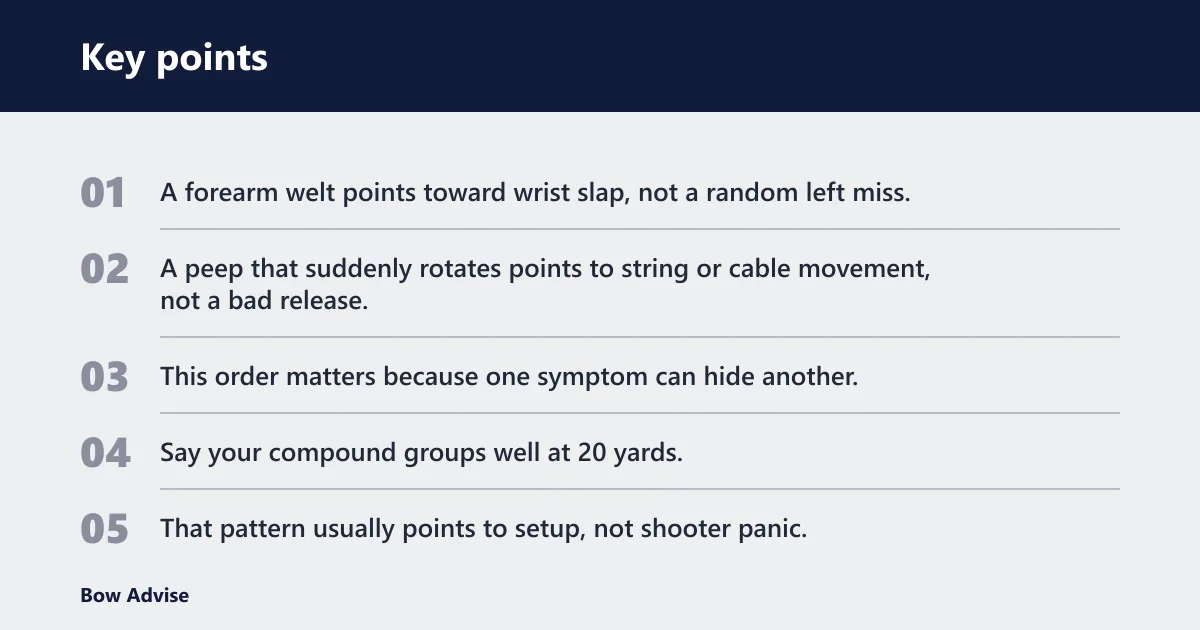
Begin with the most specific clue. A forearm welt points toward wrist slap, not a random left miss. A peep that suddenly rotates points to string or cable movement, not a bad release. This order matters because one symptom can hide another.
Say your compound groups well at 20 yards, then the arrows start drifting left after a rest adjustment. That pattern usually points to setup, not shooter panic. Reverse the last change and confirm the rest position before making larger corrections.
When a quick check is enough
A quick check is enough when the issue is clearly linked to one recent change and no part is damaged. Verify grip, anchor, arm position, or a loose accessory first. Then re-shoot before moving anything else.
For recurve bows, a slightly off nock point or arrow rest can create a clear vertical or horizontal pattern without any limb problem. For compounds, centershot, rest position, and spine deserve attention before broadhead tuning or advanced cam work.
When to stop and take it to a pro shop
Stop if there are cracked limbs, a frayed string, a blade-style rest blade that appears to have snapped at the retaining arm, possible cam timing problems, or a bow that feels unsafe at full draw. Those are not beginner-safe fixes.
Stop as well if you cannot tell whether the issue is spine, rest position, or hand pressure. A pro shop can sort a mixed problem faster than random changes can, especially when several symptoms show up at once.
Why is my bow hitting left or right?
A bow that starts hitting left or right all of a sudden usually points to bow torque, a rest shift, or an anchor change before it points to bad luck. Bow torque causes inconsistent left-right hits on the target. If the miss appears after a setup change, centershot, rest position, and arrow spine move to the top of the list.
Bow torque versus bad arrow flight
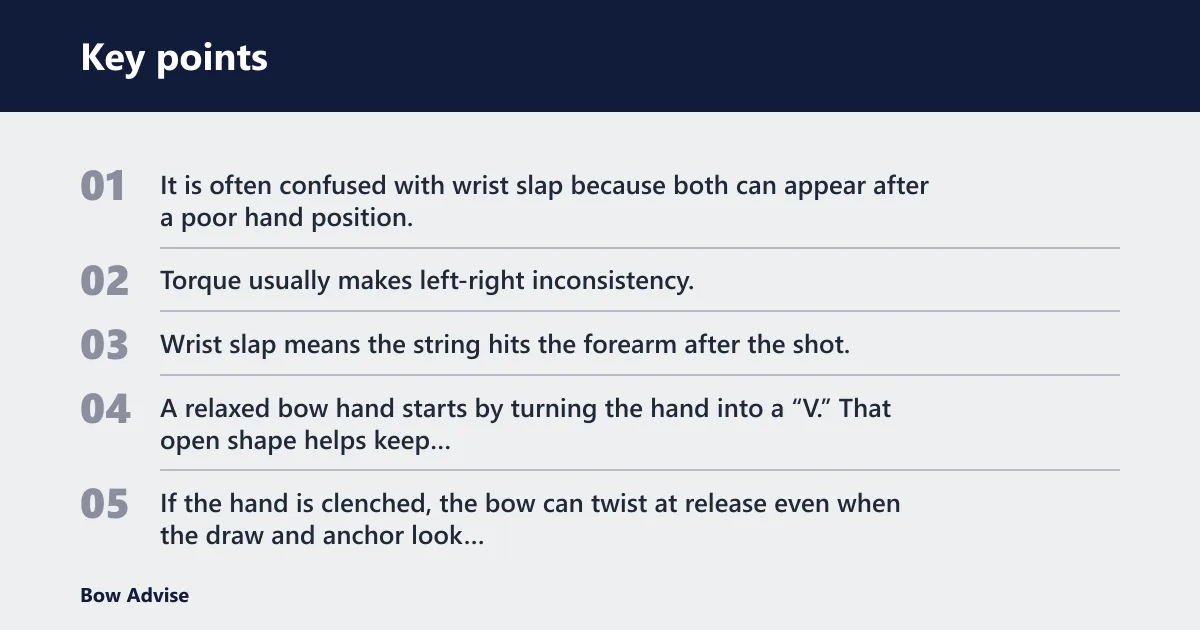
Bow torque comes from twisting the grip. It is often confused with wrist slap because both can appear after a poor hand position, but the impact pattern is different. Torque usually makes left-right inconsistency. Wrist slap means the string hits the forearm after the shot.
A relaxed bow hand starts by turning the hand into a “V.” That open shape helps keep pressure out of the grip. If the hand is clenched, the bow can twist at release even when the draw and anchor look fine.
Centershot, rest position, and spine checks
On a compound, center shot is the alignment baseline that centers the arrow relative to the string. It is often set close to manufacturer guidance, then checked again with French tune. A French tune uses a 50-metre sightmark, and the close-range check is done from two or three metres.
If 50m impacts are left or right, move the arrow rest. To correct left impacts, move the rest to the right. If the arrow still groups poorly after that, arrow spine may be the issue. Arrow spine is the arrow’s stiffness, and higher bow draw weight requires stiffer arrow spine.
Why a sudden side miss can follow a setup change
Even a small rest move, nock set change, or new arrow can alter left-right impact. The problem is often obvious after the change and not before it. That is why the last adjustment matters more than the distance to the target.
Picture a beginner who swaps to heavier points on a recurve without checking spine. The bow may still shoot, but the arrows can leave poorly and land left or right in a repeatable pattern. In that case, the fix is not more aiming practice; it is a better spine match and a fresh tune check.
What does wrist slap on a bow usually mean?
Wrist slap usually means the string is contacting the forearm after the shot. That is most often a hand-position or bow-arm rotation problem, not a random defect. It can leave an abrasion or a welt, and it often goes away when arm position and clearance improve.
Hand position and bow-arm rotation
Proper bow-arm rotation changes the forearm angle so the string clears cleanly. The issue often starts with a grip that lets the wrist roll inward or the elbow stay too low. A relaxed hand and correct arm rotation usually solve the cause faster than changing equipment.
If the slap happens only when the bow arm is bent or the grip is tight, that points to form. If it happens even with a clean arm position and an armguard, check brace height, string path, or an unusual setup issue.
Armguard use and string clearance
An armguard does not fix the cause. It protects the forearm while the archer corrects the shot. If the string still brushes the armguard, the bow arm may need more rotation or the grip may need to be opened up further.
How wrist slap differs from bow torque
Wrist slap is about string-to-forearm contact. Bow torque is about twisting the grip and sending shots left or right. They can happen together, but they are not the same fault and they do not always create the same miss pattern.
Why are my arrows flying badly after I change something on my bow?
Bad arrow flight after a change usually means the bow and arrow no longer match the way they did before. The most common causes are spine mismatch, rest movement, or a nocking point that no longer fits the setup. Start with the last change, not the most visible symptom.
Arrow spine and draw-weight changes
Arrow spine is the arrow’s stiffness. Too weak or too stiff changes flight. Manufacturer spine charts are the correct first stop because spine must match draw length and poundage. Higher bow draw weight requires stiffer arrow spine.
If draw weight went up, the old arrows may now behave too weak. If draw length changed, the arrow can act differently even when the bow weight stays the same. That is why an arrow that flew well before can start showing porpoising or side wag after a setup change.
Nocking point and rest adjustment checks
The nocking point affects up-down flight. It is part of arrow-flight tuning and should be adjusted when vertical impact is off. A paper tune or walk-back style check helps confirm whether the issue is vertical, horizontal, or both.
The arrow rest affects left-right flight and may need micro-adjustment. Small changes matter. Blade rests can fail or snap, so inspect the blade and retaining arm before chasing tune with more shots.
Paper tune, walk-back, and basic clearance cues
Paper tears and walk-back results can show whether the arrow is leaving cleanly or kicking on the way out. Broadheads are less forgiving than field points, so use field points first. Do not begin broadhead tuning until the basic tune, spine, centershot, and clearance are sound.
Suppose a bow groups field points tightly at 18 metres, but a fresh set of arrows begins tail-left tear after a rest change. That points to the rest or spine, not a random bad shot. A small rest correction may fix it; a full rebuild is usually not needed.
What peep rotation and noise mean
Peep rotation and new noise both point to setup movement or contact. A peep sight should align with the anchor. If it rotates after a string or cable change, it may simply need settling. A sudden rotation can also point to a setup change that needs checking.
String and cable movement after setup changes
After new string or cable work, some peep movement is normal while the system settles. If the peep keeps turning or ends up far off anchor, something in the setup likely changed. That could be string twist, cable length, or a serving issue.
Do not keep twisting at random. Confirm that the anchor is stable first, then check whether the peep aligns the same way on every shot. Inconsistent alignment usually means the setup is still moving.
Noisy bow checks for contact, timing, and loose parts
A noisy bow can come from loose accessories, string contact, timing trouble, or a part that is starting to fail. Start with the simple checks: rest screws, sight screws, stabilizer hardware, quiver mounts, and any cable or vane contact marks.
If the noise is sharp, sudden, or paired with a vibration you did not have before, stop and inspect the bow carefully. Limb or cam issues are not beginner fixes. A blade-style rest can also fail at the retaining arm, which is a clear shop-level problem.
When sound or rotation points to a shop visit
If the peep rotates after every shot and the string has already been settled, or if the bow makes a new noise that appears during the draw cycle, a shop visit is the safer move. That is especially true after a string change, cam work, or a tune that no longer holds.
Why are my broadheads not grouping with field points?
Broadheads not grouping with field points usually means the basic tune is not finished yet. Broadhead tuning checks spine, nock height, centershot, and vane clearance, and it requires a sound basic tune first. Broadheads are less forgiving than field points, so they expose problems faster.
Why broadheads reveal tune issues
Field points often forgive small setup errors. Broadheads do not. If the broadhead group drifts away from field points, the likely causes are still mechanical: spine mismatch, rest position, nocking point, or clearance.
Small rest changes are common during broadhead tuning. That is normal when the base tune is already close. If the bow is far off, broadhead changes will only hide the real problem for a few shots.
How to tell if the bow is over-bowed
Over bowed means the draw weight is too heavy. Archers who are over bowed can still pull the bow back, which makes the issue easy to miss. The real clue is that full-draw holding gets shaky, anchor collapses, and groups open as the shot process breaks down.
Could your draw weight be too heavy for you? If you cannot hold at full draw with control, the answer is likely yes. Beginners often benefit from a lower setting that lets them settle into anchor and follow-through without fighting the bow.
Draw-length mismatch clues and fixes
A draw-length mismatch can make the bow feel cramped or stretched. It can also shift the anchor point and change the string angle enough to affect arrow flight. If the release feels forced or the peep no longer sits where it should, check draw length before chasing the rest.
Fixes depend on the bow type. Some compounds need a module or cam change. Recurve shooters may need to revisit stance, anchor, or the overall setup fit before changing arrows. In either case, a mismatch is a setup problem, not a reason to simply shoot more.
Frequently asked questions
Why is my bow hitting left or right all of a sudden?
A sudden left or right miss usually points to bow torque, rest movement, or a change in anchor rather than pure chance. Check grip pressure first, then confirm centershot and arrow spine. If the miss began right after a setup change, reverse that change before making bigger adjustments.
Why do my arrows fly badly after I change something on my bow?
A new setup can upset arrow spine, rest position, or nocking point height. Start with the last change you made and check for contact marks or unusual tears. Match arrow spine to draw length and poundage, then confirm centershot, rest height, and clearance before broadhead tuning.
What does a peep sight that rotates mean?
A rotating peep often means the string or cable system moved after a change. Some settling is normal after a new string, but sudden or repeated rotation can point to a setup problem. Confirm that the peep still lines up with your anchor and have the system checked if it does not settle.
Could my draw weight be too heavy for me?
Yes. Over bowed means the draw weight is too heavy, even if you can still draw the bow. If you cannot hold at full draw with control, your form will usually suffer and your groups will spread. Beginners often shoot better after reducing draw weight.
When should I take my bow to a pro shop instead of fixing it myself?
Go to a pro shop if you see cracked limbs, a damaged string, a broken blade rest, cam timing issues, or a problem that persists after the basic checks. Stop as well when the cause is unclear. A shop is the right place for repairs that require a press or precise tuning.