What Size Bow Do I Need for My Height?
Your height gives a rough draw-length starting point. A common rule of thumb is that most beginners fall within about 1–2 inches of a target range: under 5’3″ often starts around 24–26″, 5’3″–5’7″ around 26–27″, 5’8″–6’0″ around 27–29″, and over 6’0″ around 29″+. A bad guess can leave you with poor anchor, weak accuracy, and a bow that feels unsafe or unstable. This guide turns height into a rough draw-length estimate, then matches it to a recurve, longbow, or compound bow size. Start with height, then check arm span. If your wingspan is more than your height by a couple of inches, move up one draw-length step; if it is shorter, move down one step. Height alone is only a starting point.
Start with draw length
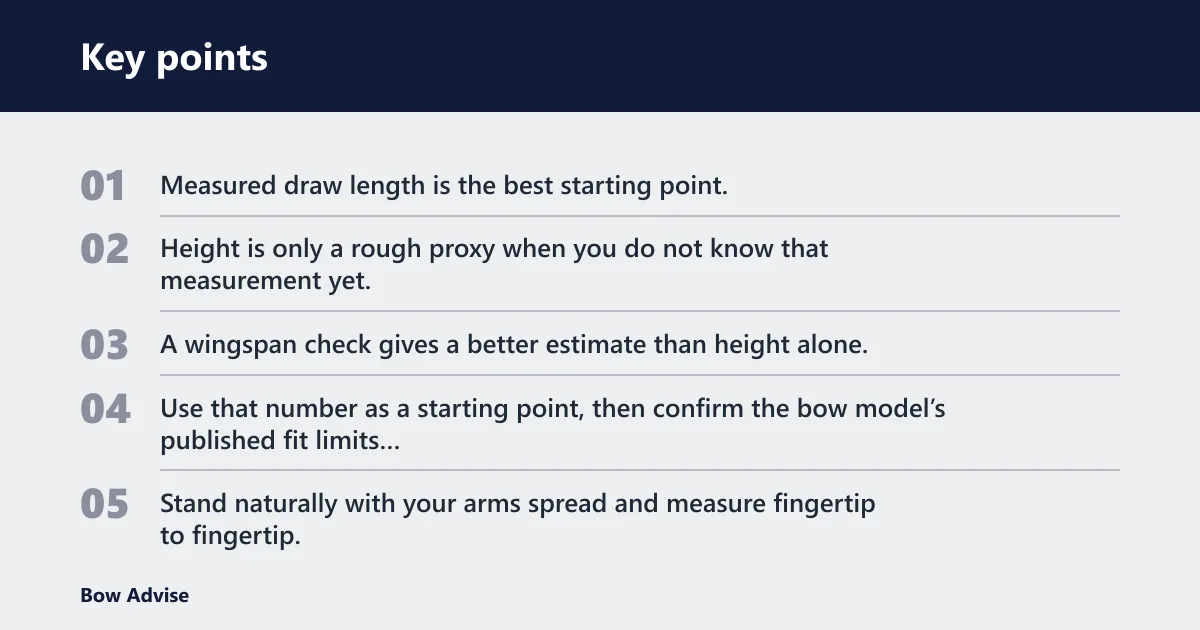

Measured draw length is the best starting point. Height is only a rough proxy when you do not know that measurement yet. A wingspan check gives a better estimate than height alone, and the common fallback formula is wingspan ÷ 2.5. Use that number as a starting point, then confirm the bow model’s published fit limits before buying.
How to use wingspan when draw length is unknown
Stand naturally with your arms spread and measure fingertip to fingertip. Divide that wingspan by 2.5 to get a rough draw-length estimate. This is only a guide, not a final fit check. If the number lands between size bands, use the model’s published draw-length range to settle the choice.
Common red flags that mean the estimate is unreliable
If the bow feels cramped at anchor, the estimate may be too short. If the string jumps hard near the end of the draw, the setup may be too long or the cam fit may be off. A beginner setup that is too heavy can also hide a bad size choice, because form breaks before fit becomes obvious.
Bow sizing table
Use this table as a buying shortcut. Height starts the process, wingspan sharpens it, and estimated draw length points you toward a recurve AMO length or a compound ATA shopping range. The red-flag column tells you when not to trust the estimate.
| Height | Wingspan check | Estimated draw length | Recommended recurve AMO length range | Compound ATA shopping range | Red flags before buying |
|---|---|---|---|---|---|
| Under 5’3″ | Usually shorter than height | About 24–26″ | 62″–64″ for many beginner setups | 28″–32″ ATA if hunting compactness matters; 32″–36″ ATA if stability matters more | Finger pinch at anchor, cramped string angle, or a draw weight that forces poor posture |
| 5’3″–5’7″ | Near height or slightly under | About 26–27″ | 64″–66″ for many beginner setups | 28″–32″ ATA or 32″–36″ ATA depending on use | Short brace-height feel on a compound, or a recurve that feels jumpy at anchor |
| 5’8″–6’0″ | Near height or slightly over | About 27–29″ | 66″–70″ for many beginner setups | 32″–36″ ATA for a balanced feel; 36″+ ATA for target-focused setups | Stacking near full draw, or a bow that feels too lively through the click or anchor |
| Over 6’0″ | Often over height by a few inches | About 29″+ | 68″–72″ or maker-specific guidance | 32″–36″ ATA or 36″+ ATA for steadier holding | Short-bow finger pinch, stacking, or a model chart that caps out below your draw |
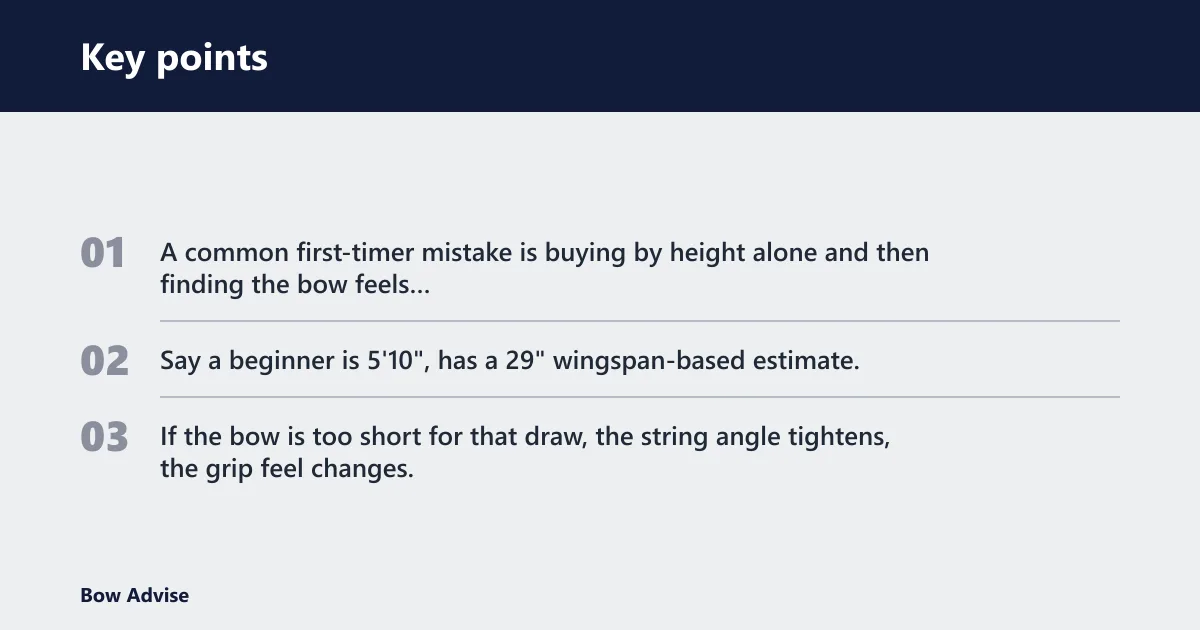
A common first-timer mistake is buying by height alone and then finding the bow feels wrong at anchor. Say a beginner is 5’10”, has a 29″ wingspan-based estimate, and chooses a very short recurve. If the bow is too short for that draw, the string angle tightens, the grip feel changes, and the shot can become harsh fast.
What size recurve bow do I need?
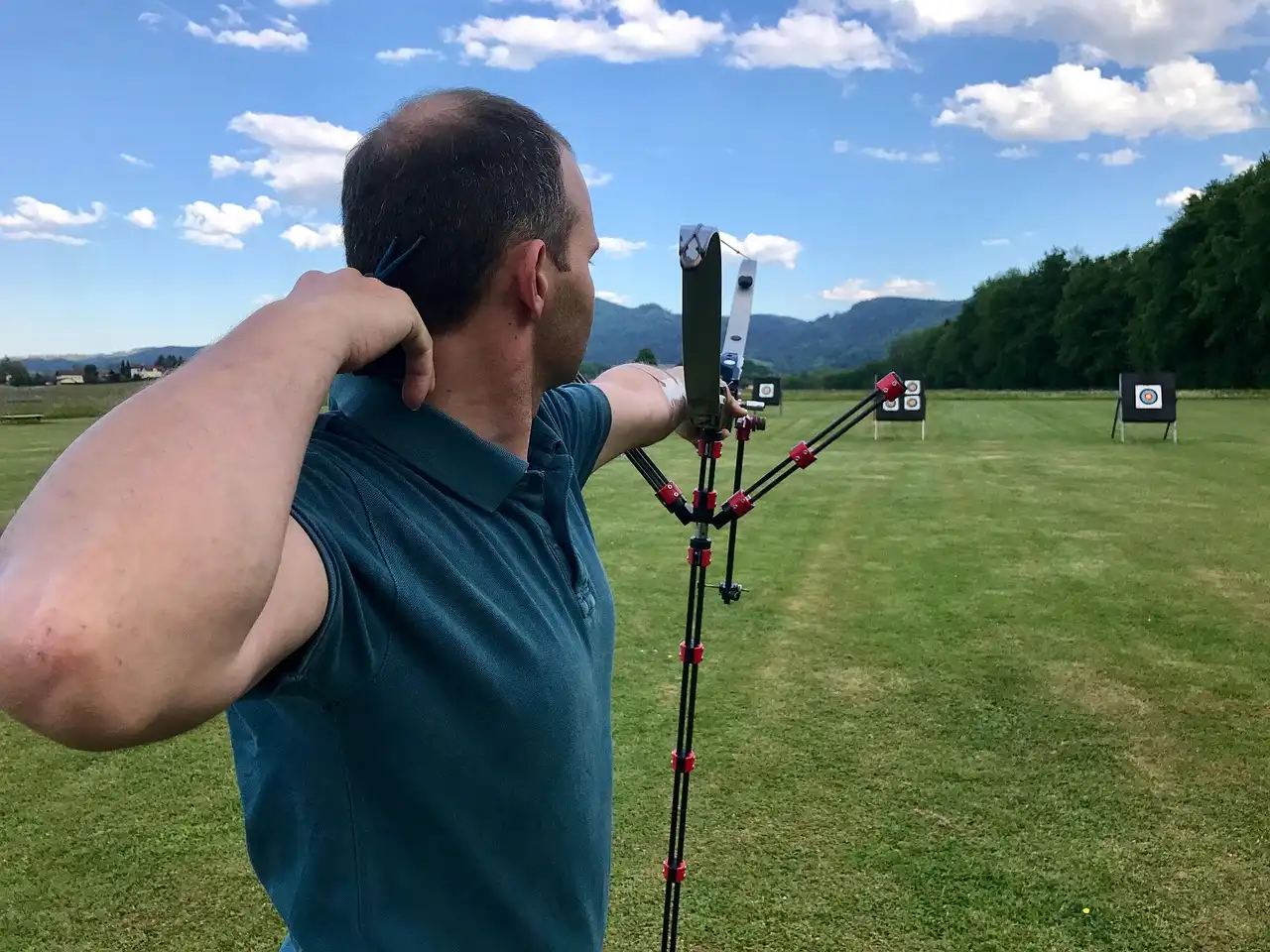
For recurves, draw length is the main fit measurement, and bow length is usually matched to it. A 28-inch draw is shown with a 68-inch recurve recommendation, and the starting range for a 28-inch draw is 68-70 inches. Shorter bows can feel harsher at longer draw lengths, while longer bows usually feel smoother.
How draw length maps to recurve AMO length
Lancaster Archery’s basic chart places 26″-28″ draw in the 66″-68″ recurve range. It places 28″-30″ draw in the 68″-70″ recurve range, and 31″+ draw length at 70″-72″ recurve. That chart matches the common rule that recurve length follows draw length.
Why short bows can feel harsh
A shorter recurve changes string angle faster as the draw grows. That can bring finger pinch, a tighter anchor feel, and more strain near the end of the draw. Longer bows usually spread that geometry out, so the shot tends to feel smoother for longer-draw archers.
Where ILF takedown recurves need a maker table
An ILF takedown recurve is a riser plus limb combination, so the final AMO length depends on the limb set. Do not guess from riser length alone. Check the manufacturer’s limb table, because the same riser can end up at different finished lengths depending on the limbs attached.
Say your draw estimate is 28″ and you are choosing between a 66″ and a 70″ recurve. The 66″ option may feel quicker and tighter, but the 70″ option is more likely to stay comfortable if your anchor is long or your fingers crowd the string.
What size compound bow do I need?
For compounds, cam or module fit comes first. Axle-to-axle length comes second. A bow can have a good ATA number and still be the wrong fit if the cam modules do not cover your draw length. Brace height also matters, so check the model specs before you order.
How ATA length affects handling
Compound axle-to-axle length is mainly a stability-versus-maneuverability choice. Compact compound bows are described as about 28″-32″ ATA, all-around compound bows are about 32″-36″ ATA, and target-focused compound bows are 36″+ ATA. Hunting setups often favor compactness. Target setups often favor steadier hold.
Where brace height fits into model specs
Brace height affects feel and geometry, especially on compounds. It does not replace draw-length fit, but it changes how the bow behaves through the shot cycle. Two bows with similar ATA can still feel different because brace height, cam design, and valley shape all change the shot.
What to check before ordering a compound
First, confirm the published draw-length range for the exact model. Second, confirm the module or cam setting needed for your draw. Third, check the ATA and brace-height specs together, because those numbers help predict whether the bow will feel compact, steady, or somewhere in between.
What size longbow should I buy?
Longbow sizing is more model-specific than recurve sizing, and there is no universal formula that fits every design. Use the maker’s draw-limit guidance for the exact bow. A longbow can feel right at one draw length and harsh at another, depending on limb shape, reflex, and string angle.
Why one formula does not fit every design
Longbows vary more from model to model than many beginners expect. Some are built for shorter draws and lighter string angles. Others are made to handle more draw. That is why a universal height chart is not enough here, and why the maker’s published guidance matters before ordering.
What to verify before ordering
Check the maker’s recommended draw length, the stated bow length, and any draw-limit notes for the exact model. If the listing does not spell those out clearly, treat that as a warning sign. For longbows, the safest choice is the one that matches the manufacturer’s own table.
What can make the estimate wrong?
Finger pinch, stacking, and an over-heavy beginner setup can all make a bow seem wrong even when the size chart looked close. Youth sizing should be based on current fit, not age. If the archer’s form is changing fast, the safest check is the current draw length, not the birthday.
Finger pinch
Finger pinch shows up most often on bows that are too short for the archer’s draw. The string angle gets tighter at anchor, especially with recurves and longbows. If the fingers feel squeezed at full draw, the estimate is probably too aggressive or the bow geometry is too short.
Stacking
Stacking is the hard, sudden feeling at the end of a draw cycle. It often means the bow is being drawn past the point where it stays smooth. That is a strong sign to move to a longer bow or a model built for a longer draw window.
Draw weight that is too high
Draw weight is not the same thing as bow length. A beginner can have the right AMO or ATA size and still struggle if the limbs or cams are too heavy. A bow that is too hard to hold cleanly will hide fit problems and make learning worse.
Youth sizing by age instead of fit
Youth archers should be sized by current draw length, not age. A 12-year-old and a 12-year-old can differ a lot in reach and control. Pick the bow that fits the present draw and strength, then revisit sizing as the archer grows.
Bow fit checklist
Use this checklist before checkout. It keeps the size decision tied to the actual bow, not just the height estimate. If any line fails, keep shopping.
- Confirm the published draw-length range for the exact model.
- Check whether the bow is a recurve, compound, or longbow, because each size method is different.
- Match recurve length to draw length using the maker’s AMO chart.
- For compounds, confirm the module or cam setting first, then compare ATA.
- Verify brace height and any other model specs listed by the manufacturer.
- Choose a draw weight you can hold and anchor cleanly without strain.
- For ILF recurves, confirm the limb table for the final AMO length.
- For longbows, follow the maker’s draw-limit guidance instead of a universal formula.
Frequently asked questions
What size bow do I need?
Start with draw length, not height. If you only know height, use wingspan as a proxy and divide by 2.5 for a rough estimate. Then choose the bow type and model range that matches that draw length. The right answer depends on whether you want a recurve, compound, or longbow.
What size compound bow do I need: for a compound, the cam?
For a compound, the cam or module draw-length range comes first. Once that fit is confirmed, choose ATA based on handling. Compact bows are about 28″-32″ ATA, all-around bows are about 32″-36″ ATA, and target-focused bows are 36″+ ATA. Check brace height in the model specs too.
What size recurve bow for height
Height is only a rough starting point for a recurve. Use wingspan, then estimate draw length, then match that to recurve AMO length. A 28-inch draw is shown with a 68-inch recurve recommendation, and the broader starting range for 28-inch draw is 68-70 inches.
How tall should a bow
There is no single height for every bow. Recurves are commonly matched to draw length, compounds are fit by cam range first, and longbows need maker-specific guidance. Think in terms of finished bow length, not the archer’s height alone.
How to measure bow length
Bow length is usually listed by the manufacturer, and the label depends on the bow type. Recurve length is often given as AMO length in inches. Compound bows are commonly listed by axle-to-axle length. For an accurate buy, use the published spec rather than eyeballing the riser.