How to Measure Bow Grip Size for Comfort
A bow grip fits when the fingers wrap naturally, the wrist stays neutral, and pressure feels balanced in the hand. If you must squeeze, the grip is too small. If the bow sits deep in the palm, it is too large. A poor fit can torque the riser, create hand fatigue, and move arrow impact. This guide shows a simple at-home check using hand measurements, finger wrap, wrist angle, and pressure points to size the grip.
What bow grip size means
Grip size is not only about width. Thickness, palm swell, and the angle that sets the hand in place matter too. Those details change where pressure lands, which changes how steady the bow feels at full draw and how much the hand wants to twist the riser.
A grip should feel repeatable every shot. The hand should land in the same spot without hunting for the shelf or clamping down on the riser. The fingers should rest, not grip hard, and the wrist should stay close to straight rather than bent forward or back.
How grip size changes hand pressure
A thinner grip often makes the fingers close too far around the handle. That can increase squeeze pressure and push the bow into the heel pad in a sharp point. A thicker grip can do the opposite by forcing the hand to open up and bend the wrist away from neutral.
For many archers, pressure is most useful when it feels spread across the hand rather than concentrated in one spot. If the pressure point sits in one narrow place, the grip shape is doing too much of the steering.
Why grip shape affects torque and repeatability
Grip shape controls where the bow sits in the hand. If the palm swell is too aggressive or the angle is off, the hand rotates slightly from shot to shot. That small change can show up as torque, and torque can shift arrow flight before the archer notices the hand position changed.
Repeatability matters more than a fancy profile. A simple grip that places the hand the same way every time is usually better for a beginner than one that feels dramatic in the store but changes the wrist angle or finger wrap under load.
How do you measure your hand?
Measure from the wrist crease to the tip of the middle finger on the hand that actually grips the bow. For a right-handed archer, that is usually the left hand on the grip; for a left-handed archer, it is usually the right hand. Record the result in inches and millimeters so you can compare it with a grip chart or sleeve size.
This hand length check is a starting point, not a final call. It helps sort a grip into a size band before the fit check confirms whether the fingers wrap cleanly and the wrist stays neutral on the bow.
Use the wrist crease to middle-finger tip method
- Open the hand flat and relax the fingers.
- Place a tape measure or ruler at the main wrist crease on the grip hand.
- Measure to the tip of the middle finger.
- Write down the number in inches and millimeters.
- Repeat once to confirm the reading.
A tape measure is the easiest tool at home. A ruler works too, though the wrist crease can be harder to line up cleanly. Screen ruler apps can help in a pinch, but they depend on calibration, and small calibration errors matter when a grip change may be only a few millimeters.
Measure the upper grip hand
Use the hand that sits on the bow grip, not the drawing hand. Handedness matters because a bow grip fit is about the hand that contacts the riser, palm swell, and heel pad. That is true for recurve and compound bows alike.
Say a right-handed archer has a left hand measuring 7.1 inches from wrist crease to middle-finger tip. That reading is only a starting point; the final answer still depends on finger wrap and wrist angle on the actual bow.
Record inches and millimeters
Write both units. Many grip charts list inches, while some aftermarket sleeves and foam wraps are easier to compare in millimeters. A simple conversion is useful because 1 inch equals 25.4 millimeters.
Bow grip fit checklist
Use this checklist on the bow, with the string and accessories in place. Grip fit should be judged on the assembled setup, because sights, stabilizers, and the bow’s balance can change how the hand settles. The goal is not a single perfect number; it is a grip that passes three checks at once.
| Check | How to measure | Too small | Correct | Too large |
|---|---|---|---|---|
| Hand width at the knuckles | Measure across the knuckle line of the grip hand, from first knuckle to first knuckle | Hand sits cramped; fingers crowd the grip | Hand wraps with room for relaxed fingers | Hand spreads too open; grip feels buried in the palm |
| Middle-finger contact depth on the grip | Note how far the middle finger wraps under the grip at anchor | Finger wraps far underneath and squeezes | Finger pads touch lightly without pulling under | Finger does not reach the same contact point |
| Wrist angle at anchor | Check wrist position from side view at full anchor | Wrist bends sharply to hold the bow | Wrist stays near neutral with mild flex only | Wrist opens too much and the bow sits deep in the palm |
Bow grip size decision table
If two of the three checks land in the correct column, the grip is often close enough to keep. If only one passes, the grip likely needs a change in thickness, tape, or shape before more shooting. If all three fail, the grip is likely in the wrong size band.
| Result | Recurve interpretation | Compound interpretation |
|---|---|---|
| Too small | Fingers wrap too far, heel pad gets pinched, torque rises | Hand squeezes harder to steady the riser, wrist may feel cramped |
| Correct | Palm heel contacts steadily, fingers stay relaxed, wrist is near neutral | Grip settles consistently, pressure is spread, front end feels steady |
| Too large | Grip sits too deep, fingers lose contact control, wrist bends | Hand floats on the handle, placement changes shot to shot |
A common first-timer mistake is to judge fit only by hand size. A hand can be large and still need a slimmer grip if the palm swell is too aggressive, while a smaller hand may prefer a thicker grip if the wrist stays straighter that way.
What are the signs of the wrong grip?
The wrong grip shows up in the hand before it shows up on the target. Too small grips usually create squeeze, finger wrap under the handle, and pressure at the heel pad. Too large grips usually push the bow deeper into the palm and bend the wrist out of a stable position.
The goal is a grip that lets the bow rest, not one that forces the hand to fight it. When the grip is close, the bow feels planted without needing extra tension in the fingers or forearm.
Too small: fingers wrap too far and squeeze harder
With a grip that is too small, the fingers curl farther underneath than they should. The hand often squeezes to stop the bow from rolling, and that squeeze can create hand fatigue and torque. The heel pad may feel compressed instead of supported.
Suppose a beginner tries a narrow recurve grip and notices the middle finger pressing hard under the handle after a few shots. That is a classic sign that the grip is too small or too thin for that hand shape.
Too large: fingers miss the heel pad and wrist bends
A grip that is too large can push the contact point away from the heel pad and into the center of the palm. The wrist may bend more than it should. That often feels soft at first, then unstable as the shot cycle continues.
Too large is not always more comfortable. It can feel easier during the first draw, then create control problems because the hand cannot settle into a repeatable spot.
Correct: pressure spreads without hot spots
A correct grip spreads pressure without a sharp hot spot. The fingers stay relaxed, the wrist stays near neutral, and the same hand placement returns shot after shot. That is the best sign that the grip size is working.
Grip shape and bow type
Grip shape matters as much as grip size. Palm swell, thickness, and grip angle change how the hand settles on a riser, and the best shape for a recurve is not always the best shape for a compound. Beginners should favor control and repeatable placement over a stylish profile.
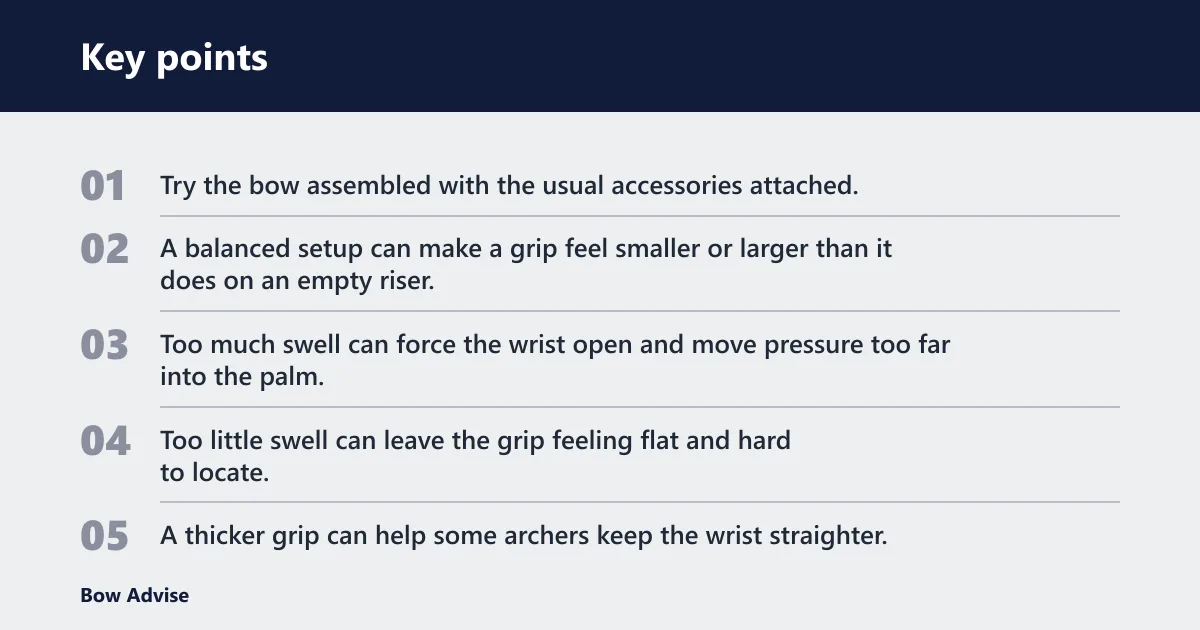
Try the bow assembled with the usual accessories attached. A balanced setup can make a grip feel smaller or larger than it does on an empty riser, because the bow may rotate differently once the stabilizer or sight is in place.
Palm swell and grip thickness
Palm swell fills the hand. Too much swell can force the wrist open and move pressure too far into the palm. Too little swell can leave the grip feeling flat and hard to locate, which often leads to a tighter squeeze.
Grip thickness changes the hand wrap. A thicker grip can help some archers keep the wrist straighter, while a thinner grip can help others keep the fingers from overwrapping. The right answer is the one that produces the most repeatable hand contact.
Grip angle and repeatable hand placement
Grip angle sets where the hand wants to rest. A steeper angle can place the wrist differently than a flatter one, and that changes both comfort and torque. The most useful angle is the one that lets the hand land in the same place without searching.
Picture a compound archer with a very upright wrist but a grip that forces the hand deeper into the palm. The wrist may feel locked, and the bow may drift as the hand tries to find a more natural angle.
Recurve grip comfort versus compound grip comfort
Recurve grip comfort often centers on a clean heel-pad contact and a relaxed finger wrap. Compound grip comfort often centers on steadiness and wrist neutrality, because the geometry of the bow and the grip shape can change hand position quickly. The same size label does not guarantee the same feel across both bow types.
For recurve bows, a grip that is slightly smaller than expected can sometimes work if it improves heel-pad contact without forcing squeeze. For compound bows, a grip that is too deep in the palm often causes more inconsistency than a flatter, more repeatable hold.
Bow grip wrap and tape
Tape, a grip sleeve, or an aftermarket cover can fine-tune fit without replacing the grip. That is useful when the handle is close but not quite right. A temporary change is especially helpful if the archer is between sizes or wants to test the feel before buying a new grip.
Grip wrap can change the fit quickly, so start small. The goal is a better hand position, not a thick layer that turns the grip into a different shape entirely.
When a thin wrap helps
A thin wrap can fill a shallow palm swell, reduce pressure points, or make a narrow grip easier to hold without clamping. It can also protect the thumb area from wear on some products.
When 2 to 4 wraps change the fit too much
Two to four wraps can be enough to move a grip from too thin to correct. Beyond that, the change may be too much for a child or smaller-handed archer because the hand no longer finds the same grip angle or finger wrap. The bow can start to feel like a different handle, not a tuned one.
Use short test sessions after each wrap change. If the wrist angle improves but the fingers start missing the heel pad, stop adding material. One small correction is better than building a bulky grip that hides the real fit problem.
Using sleeves or aftermarket covers for small changes
Grip sleeves are best for small, reversible changes. They help confirm whether the issue is thickness, shape, or angle. If the change works, the archer can keep the sleeve or move to a grip that matches the new feel more cleanly.
Try the cover on the exact bow setup that will be shot most often. A shop or coach can help confirm whether the change improved the hand position or just masked a fit problem.
Frequently asked questions
How do I measure bow grip size for comfort?
Measure your grip hand from the wrist crease to the middle-finger tip, then check the bow in hand for finger wrap, wrist angle, and pressure on the hand. If the fingers clamp, the grip is too small. If the bow sits too deep, it is too large.
What hand measurement should I use to choose a bow grip?
Use the wrist crease to middle-finger tip measurement on the hand that holds the bow, not the drawing hand. That gives a quick size band, but the final choice should still be confirmed by how the hand wraps and whether the wrist stays neutral.
How do I know if my bow grip is too small or too large?
If the fingers wrap too far underneath and the hand squeezes, the grip is too small. If the fingers do not land on the same contact point and the wrist bends too much, the grip is too large. The correct grip spreads pressure without hot spots.
What is the most comfortable bow grip size for a beginner?
The most comfortable grip for a beginner is the one that allows relaxed fingers, a neutral wrist, and repeatable hand placement. That is usually a grip that fits the hand without forcing a clamp, but the right size depends on bow type, hand shape, and grip angle.
Can I change bow grip size with tape or grip sleeves?
Yes. Tape, grip sleeves, and aftermarket covers can fine-tune fit without replacing the grip. Use them for small changes first. If 2 to 4 wraps already change the hand position too much, the base grip size may be wrong for that archer.
Does hand size affect how a bow grip feels?
Yes, but hand size is only part of the fit. A larger hand can still dislike a thick palm swell, and a smaller hand can still prefer more thickness if it keeps the wrist straighter. The grip must fit the hand and the bow’s balance together.
How do I tell if my bow grip is causing tension or torque?
If the fingers squeeze harder as the bow settles, or if the wrist twists to hold the riser straight, the grip may be causing tension or torque. Look for uneven pressure, hand fatigue, and repeatable contact changes from shot to shot.
Should I size up if I have arthritis or joint pain?
Not automatically. A slightly thicker or better-shaped grip may reduce joint strain, but sizing up too far can force wrist bend and create new problems. The better move is to test for neutral wrist position and even pressure first, then adjust with a sleeve if needed.