How to Measure Recurve Bow Length Correctly
Measure a recurve bow by its AMO length, read from the manufacturer’s stated bow length or limb size, and match it to your draw length; do not use string length or brace height for bow size. A wrong measurement can leave you with a bow that stacks early, draws badly, or feels unstable at full draw. This guide shows how to measure the bow in hand, confirm the correct AMO length, and check fit against your draw length.
Check manufacturer labels and sizing marks
Start with the marking on the bow or the maker’s manual. That marked size is the bow length you should verify first, and it is usually an AMO-based size designation, not a raw physical guess from limb tip to limb tip.
Read the maker’s size first
If the bow is marked 66 inches, 68 inches, or another number, treat that as the starting point for identification. If the bow is unmarked, use the manufacturer’s documentation, the limb labels on a take-down bow, or a shop check before assuming the size.
AMO bow length is a commonly used reference for recurve and longbow matching. That is why a recurve bow marked as 68 inches does not use a 68-inch string in the same way. Bow size, string size, and brace height are related, but they are not the same measurement.
Why the label matters more than guessing
A recurve bow’s size is selected with draw length in mind, not height or age alone. A bow that is too short can feel harsh near full draw. A bow that is too long may feel calmer and more forgiving, but it is still only a good choice if it fits the archer’s draw and purpose.
Suppose a beginner picks a bow because it looks “about right” on a rack, then later finds the string feels too short and the brace height looks odd. That usually points to the wrong measurement at the start, not a defective bow.
Bow length, string length, and brace height
These three numbers answer different questions. Bow length tells you the size category of the bow. String length tells you the correct string for that bow. Brace height tells you the gap from string to grip after the bow is strung. Mixing them leads to the wrong setup.
Bow length is not string length
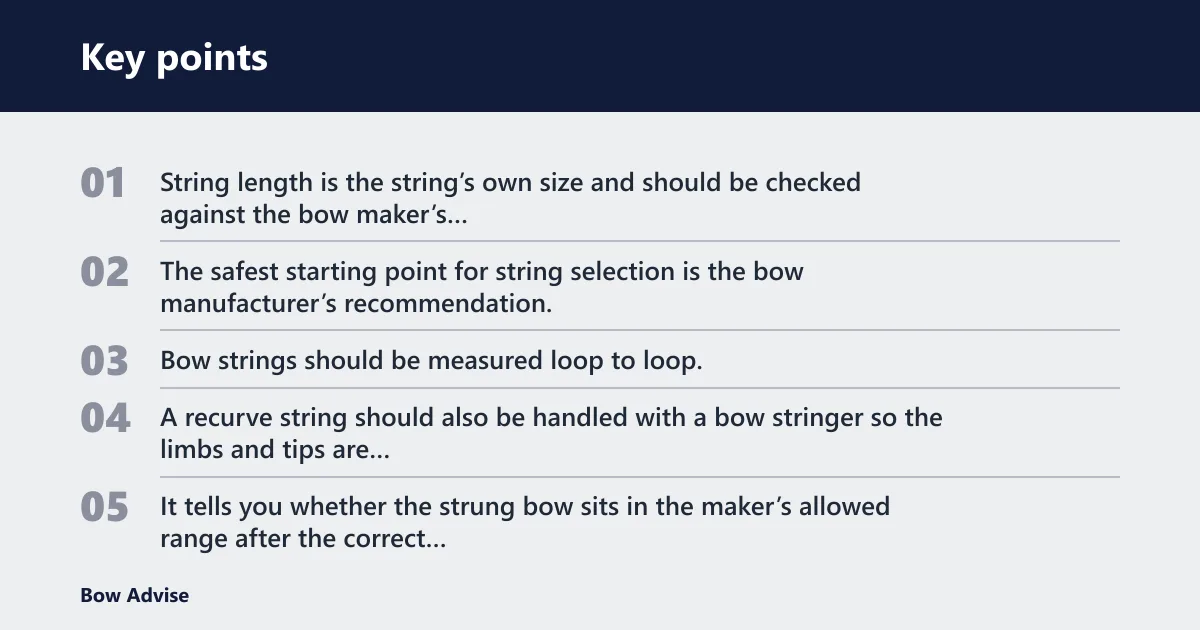
Bow length is the AMO size marking. String length is the string’s own size and should be checked against the bow maker’s recommendation. The safest starting point for string selection is the bow manufacturer’s recommendation, especially on a take-down recurve where limb swaps can change the needed string size.
Bow strings should be measured loop to loop, and they should be measured without aggressively stretching it. That keeps the number useful for comparison. A recurve string should also be handled with a bow stringer so the limbs and tips are protected during stringing and unstringing.
Brace height is a setup check, not a bow-size check
Brace height is the gap from string to grip. It does not tell you the AMO bow length. It tells you whether the strung bow sits in the maker’s allowed range after the correct string is installed.
If the brace height is too low or too high, the bow may behave badly even if the bow length is correct. That is why the string choice matters first, then the brace height check comes next.
How to measure brace height recurve bow
Measure from the string to the deepest point of the grip, then compare the result to the manufacturer’s range. If the maker lists a brace-height window, stay inside it. If the bow is unmarked, ask a shop to confirm the correct string and brace height together rather than guessing each one separately.
Picture a 68-inch recurve strung with the wrong string size. The bow can still look “close” at a glance, but the brace height may sit outside the maker’s range. That is a setup problem, not proof that the bow length was wrong.
How do you measure draw length for recurve fit?
Use wingspan divided by 2.5 as a starting point, then confirm it with a shop draw check if possible. Draw length helps determine which bow length is likely to feel comfortable, because recurve fit is tied to how far the archer must open the bow at full draw.
Use the wingspan method as the first pass
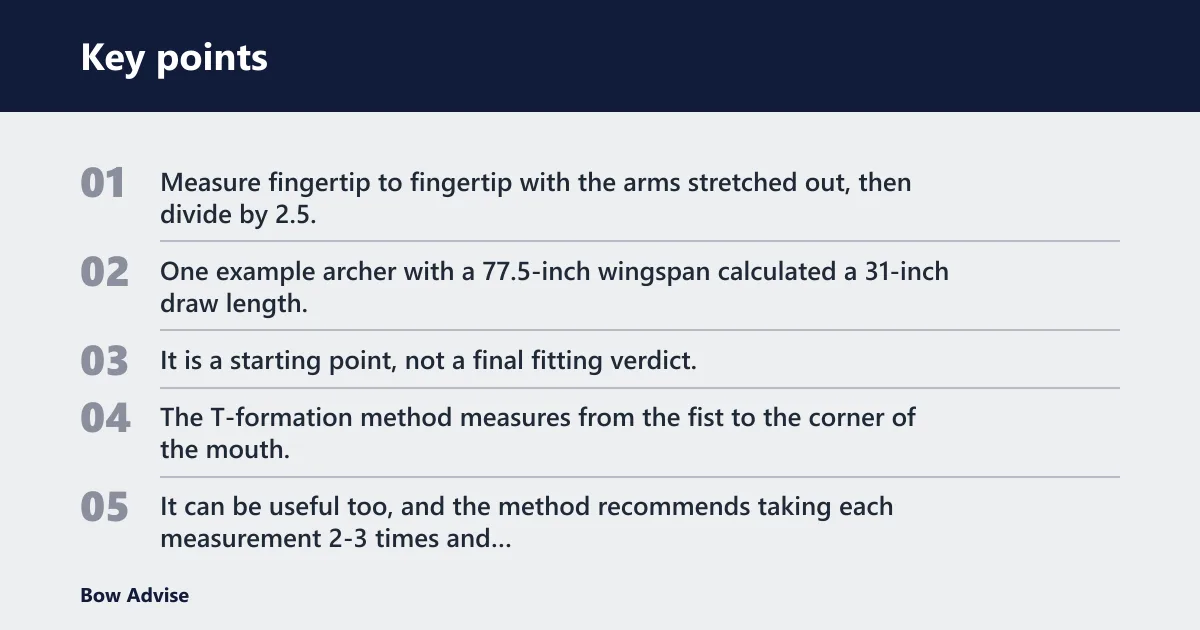
Measure fingertip to fingertip with the arms stretched out, then divide by 2.5. That is the wingspan method. One example archer with a 77.5-inch wingspan calculated a 31-inch draw length. It is a starting point, not a final fitting verdict.
The T-formation method measures from the fist to the corner of the mouth. It can be useful too, and the method recommends taking each measurement 2-3 times and averaging it. For beginners, an archery shop fitting is still the better confirmation because it can catch stance and anchor differences that a tape measure misses.
How draw length affects bow length choice
A recurve bow should be at least twice your draw length. For 25-28 inches of draw length, a common guide recommends a 66-68 inch bow. For a 28-inch draw length, the article suggests a 56-inch to 60-inch recurve bow, but that shorter range suits a different fit than the 66-68 inch beginner sweet spot often used by many archers.
The practical point is simple: draw length narrows the bow-length choice. It does not replace a real fitting. If the archer draws past the bow’s comfortable window, the bow can feel harsh or stack early. If the bow is too long for the task, it may feel less lively than needed.
What recurve bow length should you buy?
For many beginners, 66 inches and 68 inches are common starting points, not universal rules. Most archers’ sweet spot is between 66 and 68 inches, but the final choice should still follow draw length, draw weight, and whether the bow will be used mainly on the target line or in the field.
Longer bows for stability
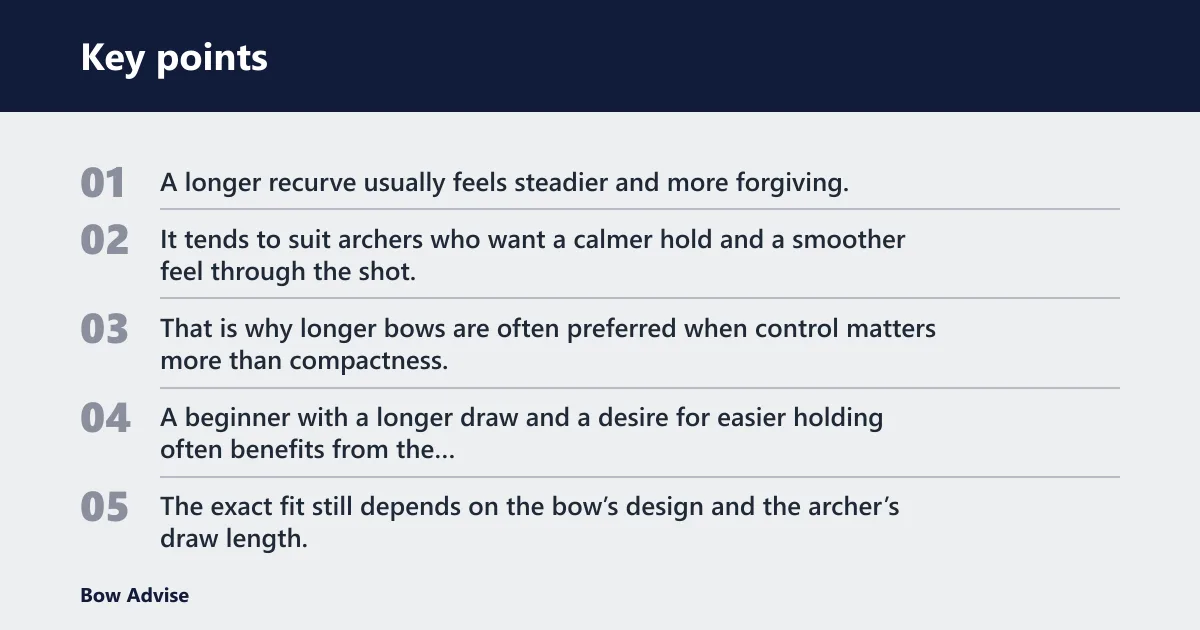
A longer recurve usually feels steadier and more forgiving. It tends to suit archers who want a calmer hold and a smoother feel through the shot. That is why longer bows are often preferred when control matters more than compactness.
A beginner with a longer draw and a desire for easier holding often benefits from the steadier feel of a 66-inch or 68-inch bow. The exact fit still depends on the bow’s design and the archer’s draw length, not on one number alone.
Shorter bows for handling
A shorter recurve is easier to handle in tight spaces and can be more convenient for hunting setups. It turns more easily and is less bulky in the hand. That convenience can matter in brush, blinds, or other cramped conditions.
Shorter does not automatically mean better. If the bow is too short for the archer’s draw, the shot can feel abrupt. For a beginner, comfort and control usually matter more than compactness, especially at 20-30 pounds of draw weight, which is a common starting range for new archers.
How draw weight fits
Draw weight is measured in pounds. Beginners often start with 18-24 lbs or 20-30 lbs because lighter poundage makes it easier to hold form, control the string, and learn a clean release. Higher draw weight can hide bad form and make a bow feel harder to manage.
Say your draw length points to a 66-inch recurve, but the bow also comes in a heavier limb set than you can hold steady. The bow may still be the right length and still be the wrong setup. Length and draw weight must both fit.
Recurve sizing checklist
Use this checklist to verify the bow in hand. It separates the size category, the string, the brace height, and the draw-fit check so nothing gets mixed together.
| What to measure | How to measure it | What a correct result looks like | Common mistake |
|---|---|---|---|
| Bow length | Check the maker’s marking, manual, or limb labels for the AMO size in inches. | The stated size matches the bow’s intended AMO length, such as 66 inches or 68 inches. | Measuring the bow like a string and assuming tip-to-tip equals AMO size. |
| String length | Measure loop to loop without aggressively stretching it, then compare with the maker’s string spec. | The measured string matches the manufacturer’s recommendation for that bow. | Using the bow length number as if it were the string length. |
| Brace height | Measure the gap from string to grip and compare it with the maker’s allowed range. | The brace height falls inside the manufacturer’s range for the strung bow. | Trying to “fix” bow size with brace height instead of correcting the string or bow length. |
| Draw-length fit | Use wingspan divided by 2.5 as a starting point, then confirm at a shop if possible. | The bow length suits the draw length and the draw feels controlled at full anchor. | Choosing only by height, age, or one chart number. |
Common mistakes when measuring a recurve
Most sizing errors come from mixing one measurement with another. The most common problem is treating bow length like string length, then trying to correct the result with brace height. That can send a beginner in the wrong direction twice.
- Using height or age alone instead of draw length.
- Assuming a marked bow size is the same as string length.
- Ignoring limb swaps on a take-down recurve.
- Checking brace height before confirming the correct string.
- Skipping a shop check when the bow is unmarked or mixed-standard.
A common first-timer mistake is buying a take-down bow with one limb set, then later swapping limbs and keeping the old string. The bow can still assemble, but the string and brace height may no longer match the new setup.
Another common mistake is buying by age or height alone. Two archers of the same height can have different draw lengths, and that changes what bow length feels right. That is why the bow should be verified against the body’s draw, not just the body’s size.
Frequently asked questions
What length recurve bow should I buy?
Buy the bow length that matches your draw length and the maker’s AMO size guidance, not your height or age. For many beginners, 66 inches or 68 inches is a common starting area, but draw length still decides whether that bow will feel smooth, stacked, or awkward at full draw.
How to measure brace height recurve bow: measure the gap
Measure the gap from the string to the grip, then compare it with the bow maker’s allowed range. Brace height is a setup check, not a size label. If the number is outside the recommended range, the string may be wrong even when the bow length is correct.
How do I know what recurve bow length I need?
Start with wingspan divided by 2.5 to estimate draw length, then compare that number with the bow maker’s length guidance. If the bow is unmarked, confirm it at a shop. A bow that fits draw length well should feel controlled at full anchor, not cramped or overextended.