How to Tell When You’ve Outgrown Your Beginner Bow
If your groups shrink only after a bow fits your draw length, draw weight, and anchor without strain, you have likely outgrown the setup. If those basics are off, retune first before buying a new bow. Ignoring fit can hide form problems, create inconsistent arrow flight, and make practice feel harder than it should. This guide gives a simple checklist for telling when to retune, increase draw weight, or replace a beginner bow.
Outgrown beginner bow checklist
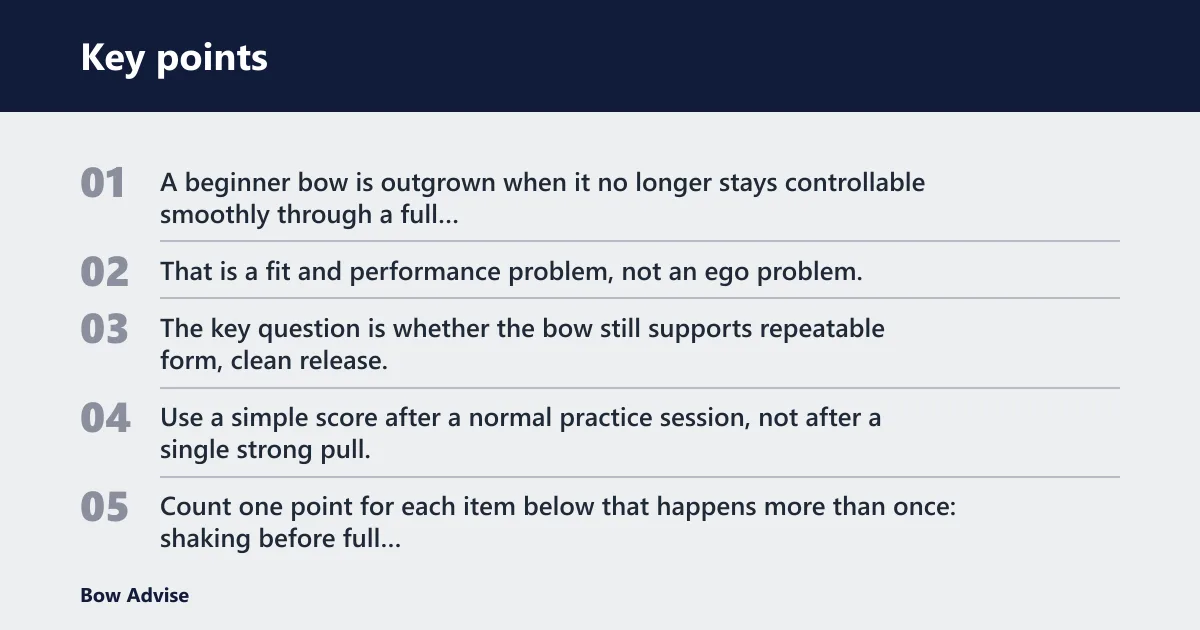


A beginner bow is outgrown when it no longer stays controllable smoothly through a full practice session, even if it can still be drawn once. That is a fit and performance problem, not an ego problem. The key question is whether the bow still supports repeatable form, clean release, and safe arrow flight.
Scoring rule for fit and strain
Use a simple score after a normal practice session, not after a single strong pull. Count one point for each item below that happens more than once: shaking before full draw, pain or strain, inconsistent anchor, sky drawing, and groups that open up as the session goes on. A score of 0-1 suggests the bow probably still fits. A score of 2-3 usually means tuning first. A score of 4 or more may mean the setup is holding the archer back, and a different bow or a lower draw weight may be the better call.
Quick decision table by symptom
| Symptom | Likely cause | Quick fix | Upgrade trigger |
|---|---|---|---|
| Shaking before full draw | Draw weight is too heavy for steady control | Drop weight if possible, shorten practice blocks, and focus on clean form | Shaking continues at a lower, manageable weight |
| Inconsistent anchor point | Overbowing, poor setup, or rushed expansion | Check anchor reference points and verify actual draw weight | Anchor still moves after tuning and practice volume is modest |
| Poor arrow flight | Arrow spine mismatch, rest issue, or string setup problem | Check spine against measured draw weight and inspect the rest and string | Arrows remain inconsistent after setup correction |
| Pain or strain | Bow is too heavy for now or the draw length is increasing effort | Reduce draw weight and verify draw length | Comfort does not improve with a lighter setup |
| Can draw once, but not through a full session | Training load exceeds current control | Lower volume, shorter ends, and cleaner form work | Form breaks down in every session, even after adjustment |
| Groups tighten only after equipment changes | Starter bow still usable, but setup needed adjustment | Retune before replacing | Setup changes no longer solve the problem |
What does outgrowing a bow mean?
Outgrowing a bow means the setup no longer matches the archer’s draw length, strength, and repeatable anchor well enough for clean shooting. It does not mean the bow is old. It means the bow is no longer the right tool for the archer’s current form and goals.
Fit versus ego
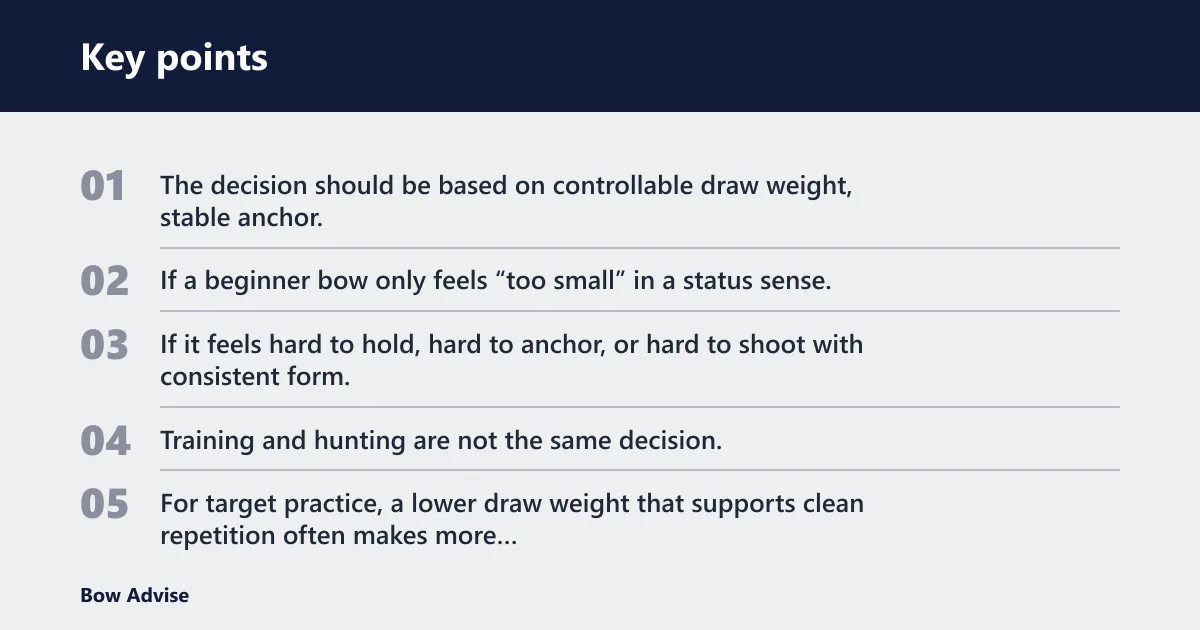
The decision should be based on controllable draw weight, stable anchor, and safe arrow flight. If a beginner bow only feels “too small” in a status sense, that is not a reason to replace it. If it feels hard to hold, hard to anchor, or hard to shoot with consistent form, that is a fit issue.
Training use versus hunting use
Training and hunting are not the same decision. For target practice, a lower draw weight that supports clean repetition often makes more sense than pushing weight upward. For hunting, local regulations and ethical shot placement matter, so the required setup may be different and should be checked before choosing the bow.
Why a starter bow can still stay useful
A starter bow can still be useful after skill improves. It may remain the better choice for warm-up, form drills, and high-volume practice. If the bow is easy to control and the arrows tune well, there is no need to retire it just because the archer has advanced.
How much draw weight is too much?
Draw weight is measured in pounds (lb), and beginners should start with a weight they can control smoothly, not the heaviest they can pull once. A bow is too heavy if it causes shaking, sky drawing, pain, strain, or poor form. For many adult beginners using recurve or traditional bows, 20-30 lb is a common starting range. Adult beginner compound bows are often about 25-40 lb.
Beginner recurve and traditional starting ranges
Recurve bows and traditional bows are often rated at a standard draw length, and they can feel heavier as draw length increases. That matters because a longer draw can increase effective weight on many recurves and traditional bows. Measure before buying, and do not trust the label alone.
Youth bow starting ranges
Young children often need about 10-15 lb draw weight. Older children and smaller youth often need about 15-20 lb. Teens and smaller beginners often start around 18-25 lb. A youth bow should be easy to hold steady and repeat safely, and adjustable models can grow with the archer.
Warning signs of overbowing
Shaking before full draw is a sign the draw weight is too heavy. Sky drawing is another. Pain, strain, and poor form mean the bow is too heavy for now. If the archer can get through the first few shots but form falls apart later, the problem is still too much load for the session.
Does draw length change the answer?
Yes. Draw length changes the answer on many recurves and traditional bows because a longer draw can increase effective weight. That means a bow marked at one weight can feel different once the archer reaches a full anchor. Measuring draw length correctly before buying or resizing matters because it changes how the bow actually behaves.
Why recurves feel heavier at longer draw length
Recurve bows are commonly rated at a standard draw length. If the archer draws farther than that standard, the bow often feels heavier and may stack sooner. That can turn an otherwise reasonable bow into one that is hard to hold steadily.
Why measuring before buying matters
Buying by label alone can lead to a mismatch. A bow that looks fine on paper may be too much once the archer reaches full draw. A bow scale helps verify actual pulling weight and compare it with the marked limb weight, which is more useful than guessing.
How draw length affects upgrade decisions
Suppose a teenager moves from a short draw to a longer one and the same recurve now shakes at full draw. The bow may not be “worn out” at all. It may simply be the wrong weight for the new draw length, which makes retuning or a lower-weight set the smarter move.
Keep, tune, or upgrade?
The best choice is often not a replacement. If the bow is within a controllable draw weight, the anchor is repeatable, and the arrows tune correctly, keep it. If symptoms trace back to setup or arrow mismatch, tune first. If the archer still cannot complete a full practice session with good form after those checks, upgrade or step down in weight.
When arrow spine is the real problem
Arrow spine depends on the actual measured draw weight and the bow setup. If the arrows are too stiff or too weak for the bow, flight can look erratic even when the bow itself is fine. That is why a new bow should not be the first fix when the real issue may be arrow selection.
When anchor inconsistency points to fit issues
Anchor point inconsistency is a warning sign. If the hand lands in different places from shot to shot, the bow may be too heavy or the setup may be forcing a rushed release. Clean anchor quality should stay repeatable. If it does not, the archer should check draw weight, then setup, then stance and execution.
When a small adjustment is enough
Sometimes a small change solves the problem: a slightly lighter limb set, a different arrow spine, a rest adjustment, or a different nocking point. Those fixes are cheaper than replacing the whole bow and should be checked before assuming the starter bow has been outgrown.
A common first-timer mistake is buying a stiffer arrow set to “fix” bad groups when the real issue is an over-heavy bow and a collapsing anchor. The result is more strain and less consistent flight, which makes the archer feel weaker than the setup really is.
Recurve and compound setup differences
Recurve and compound bows do not feel the same at full draw. A recurve is rated at a standard draw length and often feels heavier as draw length increases. A compound bow has peak weight and let-off, so the held weight is not the same as the peak number. Manufacturer guidance matters for compound adjustments.
Recurve draw weight at standard draw length
On a recurve, the marked weight is tied to a standard draw length, so a longer draw can increase effective weight. That is why two archers can have very different experiences with the same bow. Draw length must be part of the decision.
Compound peak weight versus holding weight
Compound bows use cams, which create peak weight early in the draw cycle and a much lower holding weight at full draw because of let-off. That means the number on the limb does not describe the full holding feel. A compound that seems manageable on the rack can still be wrong if the peak weight is too high or the holding weight is awkward for the archer’s control.
What manufacturer guidance changes
Compound adjustments should follow manufacturer guidance. Changing draw weight, let-off, or draw length without that guidance can move the bow outside its intended range. If a compound is hard to hold but the archer is unsure whether the issue is weight or setup, checking the manual and actual scale readings is the right next step.
When is a new bow worth it?
A new bow is worth it when the archer has outgrown the starter bow for more than one reason: the bow is too heavy for a full session, the anchor keeps drifting, tuning no longer fixes the flight, and practice volume has reached a point where the current setup limits progress. That is a training decision, not a status move.
Practice volume and consistency thresholds
If an archer can only shoot a few arrows well and then loses form, the bow is probably too demanding. If the archer can complete a normal practice session with steady anchor and controlled release, the bow may still be fine. The key threshold is repeated control, not a single good shot.
Cost of retuning versus replacing
Retuning a starter bow is usually cheaper than replacing it. Arrow changes, rest changes, and a string or nocking point correction often cost less than a new bow. If those smaller fixes solve the issue, replacement is unnecessary. If they do not, the money spent on retuning still gives useful information for the next setup.
When hunting goals justify an upgrade
Hunting goals can justify a different bow sooner than target practice does, but only after checking the rules that apply where the bow will be used. Local hunting regulations may set minimum draw weight or equipment limits. If the current bow cannot meet those requirements while staying controllable, then a new setup makes more sense.
Frequently asked questions
How do I know when I’ve outgrown my beginner bow?
You have likely outgrown it when you can still draw it once, but you cannot keep good form through a full practice session. Look for shaking, pain, inconsistent anchor, and groups that fall apart as you tire. If tuning and arrow checks do not help, the bow may no longer fit your current draw length and strength.
What signs show my bow is too light or too heavy for me?
Too heavy shows up as shaking, sky drawing, strain, and poor form. Too light can show up as a lack of control pressure at anchor, though that is less common for beginners than overbowing. A bow should feel steady and controllable, not hard to manage or vague at full draw.
Should I increase draw weight or buy a new bow?
Increase draw weight only in small steps after the current bow feels easy to control through a full session. If the current setup causes pain, shaking, or poor anchor, a new bow or lighter limbs may be the better move. Start with fit, then decide whether a change in weight is actually needed.
How much draw weight should a beginner use?
Adult beginners using recurve or traditional bows often start around 20-30 lb. Adult beginner compounds are often about 25-40 lb. Young children often need about 10-15 lb, older children and smaller youth about 15-20 lb, and teens and smaller beginners often start around 18-25 lb. Control matters more than the number.
Does draw length affect whether I need a different bow?
Yes. On many recurves and traditional bows, a longer draw can increase the effective weight, so a bow that seemed fine at one draw length may become too heavy later. Measure draw length before buying or resizing. On compounds, draw length still matters because it affects fit, comfort, and how the bow holds at full draw.
What is the difference between recurve and compound draw weight?
A recurve is usually rated at a standard draw length, and the feel gets heavier as draw length increases. A compound has peak weight and let-off, so the weight you hold at full draw is lower than the peak number. That is why the same labeled weight does not feel the same across the two bow types.
Can a beginner bow still be useful after I improve?
Yes. A starter bow can remain useful for warm-ups, drills, and higher-volume practice. If it still fits your draw length and lets you keep a repeatable anchor, there is no need to replace it immediately. Many archers keep a starter setup for form work even after moving to a more advanced bow.
When should I upgrade from a starter bow to a more advanced one?
Upgrade when the bow no longer supports clean, repeatable shooting through a full session and setup changes do not fix it. If the arrows, rest, or string are the problem, correct those first. If the bow is still too heavy after that, or your hunting goals require a different setup, then moving up makes sense.