How to Fix Arrow Direction Drift Caused by a Crooked Nock
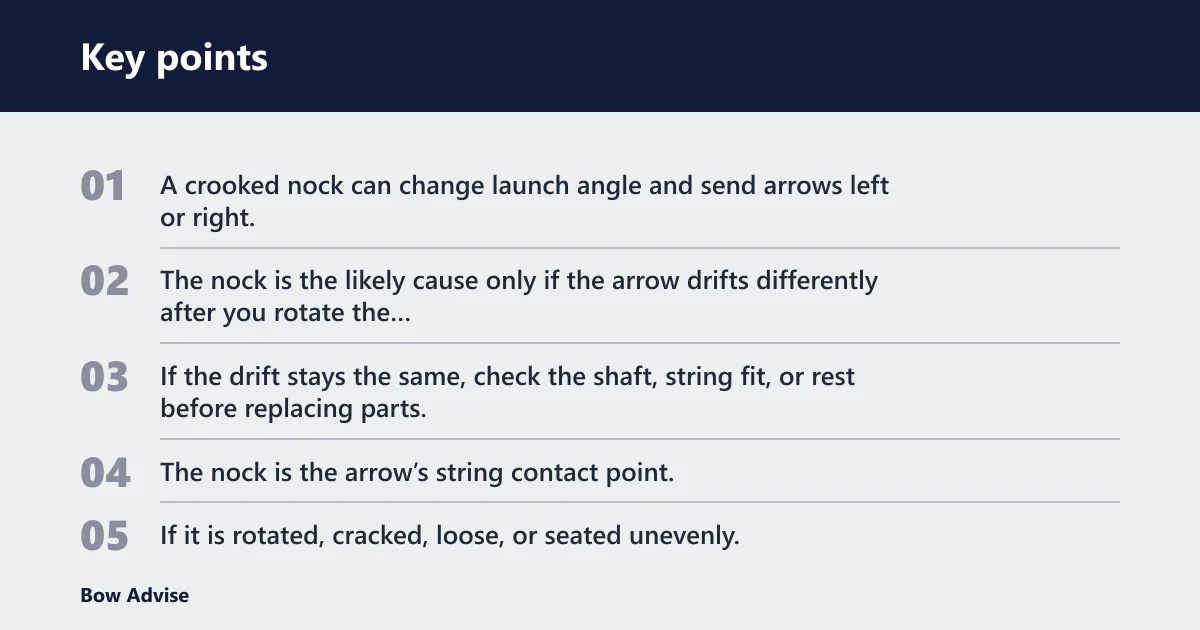
Yes. A crooked nock can change launch angle and send arrows left or right. The nock is the likely cause only if the arrow drifts differently after you rotate the shaft or the nock. If the drift stays the same, check the shaft, string fit, or rest before replacing parts.
This guide is part of our Arrow direction guide for archers series.
Identifying nock-related arrow drift


How a bad nock changes launch angle
The nock is the arrow’s string contact point. If it is rotated, cracked, loose, or seated unevenly, the string can push the arrow off center at release. That small launch error can show up as a consistent left or right miss, especially at short range where the bow’s other setup errors are easier to hide.
Nock drift can appear on both recurve and compound bows. On a recurve, a poor nock fit or bad index can show up as a sideways kick right away. On a compound, the same fault can also look like a paper tear, a broadhead tune issue, or a rest timing problem if the nock does not leave the string cleanly.
What left and right drift can look like
A nock problem usually shows a repeatable pattern. If the same arrow tends to land left with one nock orientation and right after the shaft is rotated about 180 degrees, the nock or its alignment is a strong suspect. Random misses, by contrast, are more often linked to torque, spine mismatch, or a rest that is out of line.
Why the same fault can show up differently on recurve and compound bows
Recurve setups rely more on a clean, centered launch from the fingers and string serving. Compound setups add the rest, D-loop, and release aid, so a crooked nock can interact with those parts and create a false diagnosis. The drift may look like torque on one bow and rest error on another.
Crooked nock troubleshooting matrix
Use this matrix to separate visible nock damage from string fit, group pattern, and bare-shaft result. The key is rotation: if the drift changes when the arrow is rotated on the string, the nock or its indexing is more likely than the rest or spine. If the drift stays fixed, shift attention to the shaft or tune.
| Visible nock damage | Nock fit on string | Group pattern | Bare-shaft result | Most likely fix |
|---|---|---|---|---|
| Crack, chip, or looseness | Too loose or inconsistent | Left or right drift that changes after rotation | Bare shaft follows the same side bias | Replace the nock, then confirm serving fit |
| Rotated index, no crack | Normal grip, but indexing is off | Groups open up after one arrow is remounted | Deviation shifts when nock orientation changes | Realign or replace the nock if it cannot hold index |
| No obvious damage | Too tight | Erratic release, poor consistency across shots | Bare shaft shows inconsistent left/right change | Check serving diameter or use a different nock size |
| No obvious damage | Too loose | Arrow twists on release, inconsistent launch angle | Bare shaft may kick unpredictably | Resize the nock or correct serving wear |
| Crack near nock end of shaft | Fit appears normal | Drift stays even after nock change | Bare shaft remains off to the same side | Replace the shaft, not just the nock |
| Nock looks fine | Fit is correct | Left/right error only on fletched arrows | Bare shaft and fletched shaft disagree sharply | Check rest alignment, spine, and shooter input |
For snap-on nocks, the fit must be secure without forcing. For glued nocks, the bond line has to hold the nock square to the shaft. For insert/nock systems, inspect the insert or end cap too, because a damaged insert can mimic a crooked nock even when the nock itself looks sound.
Replace versus reuse decision checklist:
- Replace the nock if you see a crack, chip, split throat, or bent seating surface.
- Replace the nock if it rotates under string pressure or will not stay indexed.
- Replace the nock if the fit on the serving is clearly too loose or too tight and the correct size is available.
- Replace the whole shaft if there is a crack, ovaling, or splintering near the nock end.
- Reuse only a nock that is intact, seats squarely, and holds the same index after several mount-and-remove cycles.
How do I tell if my nock is crooked or damaged?
A crooked or damaged nock usually shows one of four signs: visible cracking, a rotated index, a loose fit on the string, or a seating surface that no longer sits square. If the arrow’s drift changes when you rotate the nock or the shaft, the nock is a stronger suspect than the rest or the bow’s spine.
Check for cracks, chips, and rotation
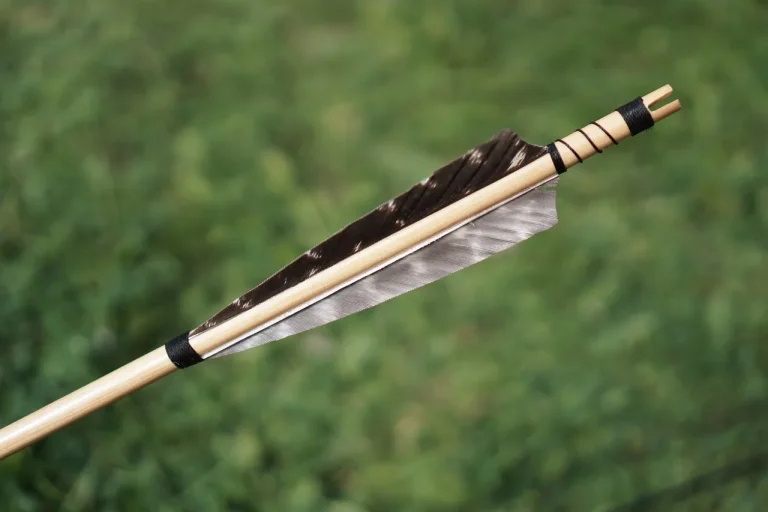
Look closely at the throat, ears, and base of the nock. Fine cracks often start near the string groove or the press-fit collar. A rotated nock may still look intact, but the fletching will no longer line up in the same direction from arrow to arrow. That inconsistency matters more than appearance alone.
A bent seating surface can be harder to spot. Lay the arrow on a flat surface and spin it slowly while watching the nock end. If the nock wobbles or the shaft end appears uneven, the part may not be square enough for reliable launch, even if it is not visibly split.
Verify indexing against the fletching
Use the fletching as the reference. On most arrows, the nock index should keep the same relation to the vane or feather pattern from one arrow to the next. Offset and helical fletching still need a consistent index, but the angle reference is the same: the nock must be aligned, not casually turned to any position.
Suppose a 500-spine carbon shaft lands left with one nock orientation and center with another. That tells you the problem is tied to how the nock leaves the string. If the nock orientation does not change the impact point, move on to shaft straightness or rest alignment.
Look for signs the nock is not seated square
A nock that sits off-center can point slightly left or right relative to the shaft axis. On glued nocks, the glue line may look uneven. On press-fit styles, the nock can appear slightly cocked even when it still clicks onto the string. That small error is enough to matter when launch is already marginal.
Is the nock fit on the string wrong?
Yes, and this is one of the most common causes of false nock diagnosis. The bowstring serving controls how tightly the nock grips and releases. If the fit is too tight, the arrow can twist on release. If it is too loose, the nock can slip, wobble, or release inconsistently.
Bowstring serving diameter and nock fit
Serving diameter changes how the nock engages the string. Most arrow makers size nocks for a specific serving range, but that range varies by brand and shaft diameter. A nock that fits one serving may be too snug or too slack on another, so the correct nock type matters as much as the string itself.
Check the fit by clipping the arrow to the string and letting it hang. It should hold without falling off, but it should not need force to install or remove. If the nock must be pried off, or it falls free with a light bump, the fit is likely wrong.
Signs the nock is too tight
A too-tight nock can twist the arrow when the string leaves. That twist may show up as a launch kick, a hard release feel on a compound, or inconsistent left/right groups on a recurve. The arrow may also squeal, bind, or leave with a slight roll that changes where the tail starts.
Signs the nock is too loose
A loose nock can move before release, which breaks repeatability. The arrow may twist on the string, shift orientation between shots, or leave with a lazy launch that looks like poor tune. If several arrows with the same shaft diameter all feel loose, the serving may be worn or too thin for that nock size.
Check the shaft and rest
A nock is only one part of the launch system. A cracked shaft, a rest that is out of line, or a serving that grips unevenly can copy the same left/right drift you would blame on the nock. The fix is to isolate one variable at a time, starting with the arrow itself.
When shaft cracks mimic nock drift
Carbon, aluminum, and hybrid shafts can all fail near the nock end. A crack there may let the nock seat crooked or change how the shaft flexes at release. If the arrow still drifts the same after nock replacement, inspect the last few inches of shaft closely and reject it if there is any split or soft spot.
Picture a carbon arrow that groups right with one nock and left with another, but only after the same shaft is rotated. That shaft may be damaged near the nock end. In that case, a new nock will not solve the problem because the shaft itself is no longer straight or stable.
How rest misalignment can look like a nock problem
An arrow rest that is too high, too far left or right, or poorly centered can create the same kind of side drift a crooked nock would. That is why bare-shaft tuning matters. If the bare shaft and fletched shaft both show the same side bias, the rest or tune is more likely than the nock.
What fletching orientation tells you
Fletching gives you a reference for repeatable nock indexing. Vane or feather orientation should stay consistent, especially on a set of arrows built the same way. If one arrow’s nock is turned differently than the others, or the fletching pattern no longer matches the rest of the set, the arrow can leave the bow with a different launch attitude.
How do I check nock fit so the string doesn’t twist the arrow?
Check that the nock holds the bowstring serving with firm, even pressure. It should click on and stay put without forcing the shaft to twist during loading or release. If the fit is too tight or too loose, the arrow can rotate as the string starts moving, which changes launch and makes diagnosis harder.
- Install the arrow on the string and note how much pressure it takes to clip on.
- Twist the shaft lightly by hand. The arrow should not spin freely, but it should not bind hard.
- Unclip and reclip the arrow several times. Each attachment should feel the same.
- Compare it with another arrow of the same shaft diameter and nock type.
- If one arrow fits differently, inspect the nock and the serving before changing the tune.
Fix the nock and retest
Replace a damaged nock instead of forcing it back into shape. If the nock is cracked, deformed, or unable to hold index, it should come off the arrow. After the swap, verify that the shaft is still sound, the serving grips correctly, and the rest has not shifted enough to create a false fix.
When to replace the nock
Replace the nock when the damage is local to the nock itself: cracked plastic, loose press fit, poor rotation control, or a crooked glue joint. That is the fastest and most correct repair when the shaft is otherwise straight and the nock end shows no structural damage.
When to replace the whole arrow
Replace the whole shaft if cracks extend beyond the nock area, if the end is crushed, or if the shaft no longer holds the nock squarely. A new nock cannot restore a compromised carbon, aluminum, or hybrid shaft. If the arrow keeps drifting after the nock change, the shaft deserves the next inspection.
Short post-repair verification sequence
Use a short test sequence, not a vague “few shots” check. Use a short test sequence: one repaired arrow, about two known-good arrows, same distance, point weight, and bow setup. Then rotate the repaired arrow about 180 degrees and shoot again. If the side bias changes with rotation, the nock fix is doing real work.
Next, shoot one bare shaft if your setup allows it. If the bare shaft now tracks closer to the fletched arrows, the nock issue was likely part of the problem. If the bare shaft still shows the same left or right deviation, return to rest position, spine match, and serving fit before calling the repair complete.
Frequently asked questions
Can a crooked nock cause arrows to drift left or right?
Yes. A crooked nock can change how the arrow leaves the string, which can push impact left or right. The strongest clue is repeatability: if the side drift changes when you rotate the shaft or nock, the nock is more likely than the rest, spine, or shooter input.
How much nock misalignment is enough to change arrow flight?
There is no universal degree number because nock fit, shaft diameter, and bow type all matter. In practice, any visible rotation, wobble, or off-square seating that changes the arrow’s impact should be treated as enough to fix. If it cannot hold a consistent index, replace it.
Should I replace the nock or the whole arrow shaft?
Replace the nock when the damage is limited to the nock itself and the shaft is straight. Replace the whole shaft when there are cracks, crushed fibers, or a damaged nock end that will not hold a square fit. A new nock cannot correct structural shaft damage.
Can nock alignment issues affect both recurve and compound bows?
Yes. Recurve bows can show the problem as a clear side kick or poor grouping, while compound bows may show it as a release issue, paper tear, or false tune symptom. The mechanism is the same: the arrow leaves the bow with a bad launch angle or unwanted twist.
Do I need to retune my bow after replacing a nock?
Often a full retune is not needed, but a quick verification is smart. If the shaft was fine and only the nock changed, retest group shape and bare-shaft behavior. If the repair changes nothing, move on to serving fit, rest position, and spine rather than assuming the nock was the only fault.