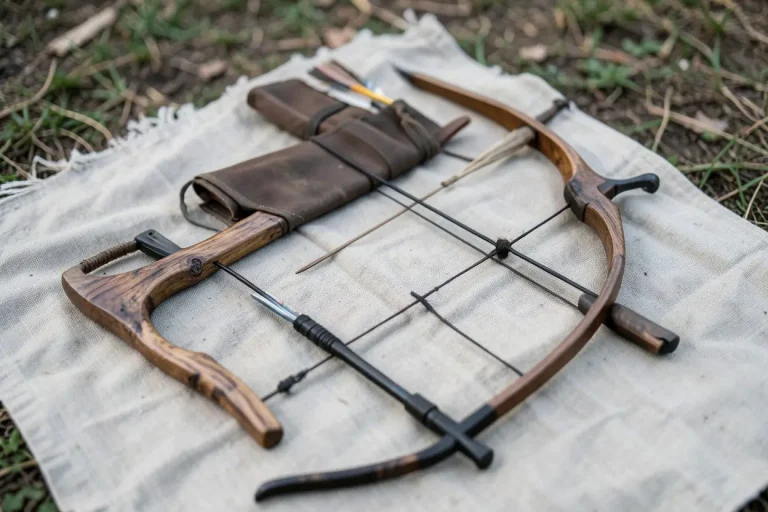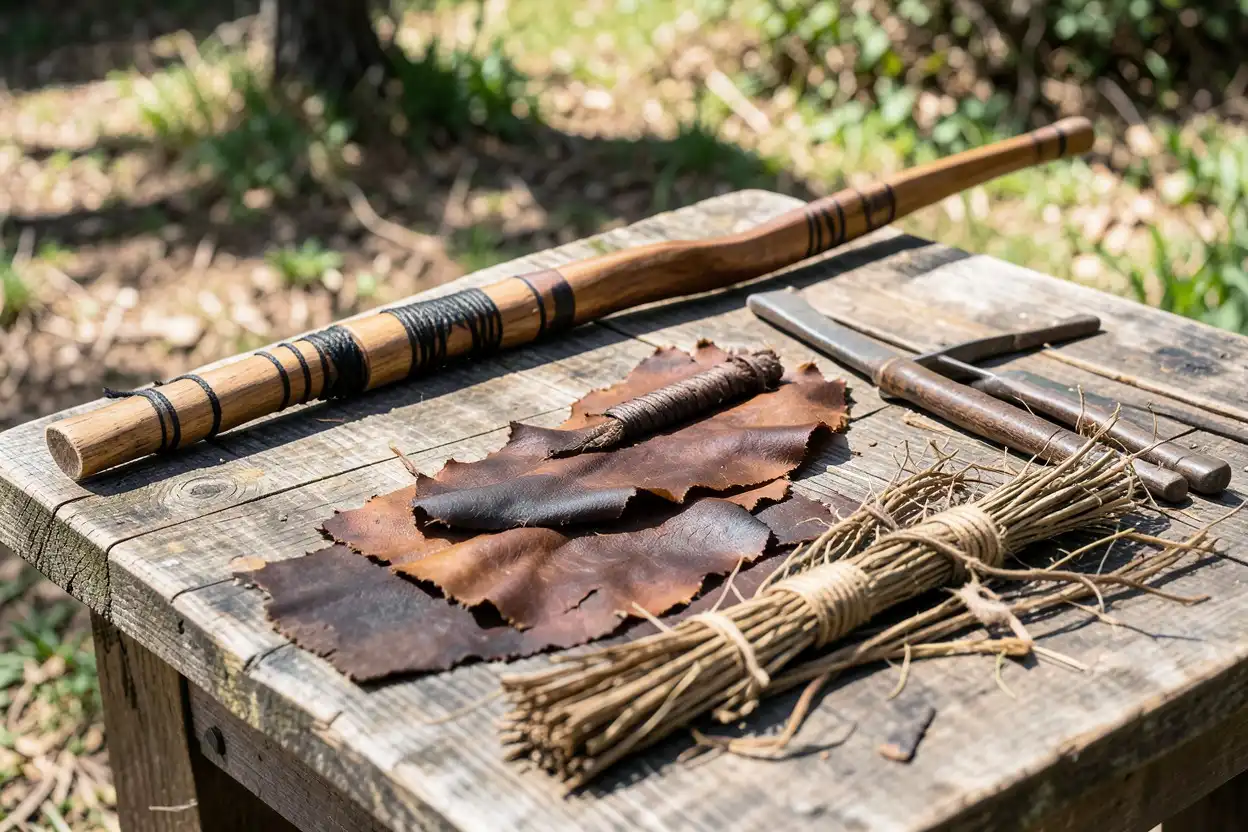
Native American bow materials: wood, sinew, hide, fibers
Native American-style replica bows work as a laminate: wood sets the limbs, sinew provides most of the spring, hide or rawhide resists abrasion and stabilizes, and plant fibers bind and seal. I aim for a flex-tillering that matches each material’s thickness. Wrong thickness, poor binding, or let-drying to low humidity can cause delamination, set creep, or sudden belly cracks during brace-to-draw. I’ll break down what each material does, where it fails in real use, and how combinations change draw weight, speed, and maintenance.


What job does each material perform in a Native archery bow?
Think of a Native archery bow as a load path made from different jobs. Wood carries bending and sets the limb shape. Sinew works in tension to add recoil. Hide or rawhide and string materials store and release energy. Glue and bow oil manage how the interfaces survive moisture. Failures usually start at weak adhesion, poor grain orientation, or stretch and shrink transitions.
Load path at full draw (where stretch, shrink, and failure start)
At full draw, the belly (front) of the bow compresses while the back (rear) stretches. Wood carries most of the bending stiffness, but the back decides whether the limb stays alive through repeated cycles. Sinew-backed bows add a second tension layer, and that layer changes how the back “accepts” load as you approach full draw.
On the cordage side, the string or cordage takes tension, then relaxes to drive the arrow. If your string stretches too much, tuning never settles. If it swells in humidity or goes slack after letting it dry out, you’ll chase point-of-impact shifts every week.
The “glue and interface” zone is where a lot of beginners lose bows. If hide glue is too weak, improperly mixed, or applied to a surface that can’t lock in, sinew can separate under flex. If you then keep shooting, you turn a small air gap into a bigger one.
Bow stave, backing, string, and interface materials (clean taxonomy)
Wood bow stave is the main working member that bends. Sinew backing is a tension layer on the back. Hide or rawhide appears as string or binding material, and it can also show up as part of cordage and reinforcement. Hide glue bonds sinew to wood back and is also used where fletching needs a firm hold. Bow oil or animal grease protects the stave by managing moisture loss.
According to A Note on Indian Bow Making or the Secrets of Sinew … — A Scientific American crossbow article stated sinew has a tensile strength of 28,000 psi. (source)
Wood bow stave: which hardwoods were used, and why back grain matters?
Wood sets the limb geometry and carries the bending load. Common choices include ash, willow, juniper, cedar, walnut, hickory, oak, and birch, with selection driven by availability and stiffness. Preserving back grain matters because disturbed or reversed grain creates stress risers that can crack during the first sessions.[2]
Common woods used for self bows and what you should look for
For a self bow build, the typical “start list” of hardwoods includes ash, willow, juniper, cedar, walnut, hickory, oak, and birch. In a shop setting, the stave should be treated like a bending beam. What matters most is grain continuity along the back, plus a profile that lets the wood flex without forming sharp strain zones.
Back grain preservation is why I’m picky about how I split or saw blanks. The back side is the tension side during draw, so any loose back fibers, planer tear-out, or uneven thickness that forces localized flex becomes a crack starter.
Seasoning and drying approach to reduce warps and set
Shaping is only step one. After shaping, you want slow, controlled drying so the stave doesn’t twist itself into an unusable geometry. I’ve had better results by storing shaped staves in stable conditions and checking for movement over days rather than “letting it happen” overnight. When the back is still moving while you’re already bracing, you can lose the consistency you need to tune.
What goes wrong when you violate back grain (common failure modes)
When back grain is damaged or reversed, belly failures get blamed because people watch the front. In practice, the back can micro-crack, then the crack grows after repeated flex. Once a crack starts, it’s hard to predict whether the bow will fail suddenly or slowly, and repairs are rarely clean.
Thickness mistakes also act like grain damage. If one limb section ends up too thin, the bow can look fine at brace and then “let go” as you increase draw and the strain concentrates.
Why use sinew backing, and how does it change bow shape?
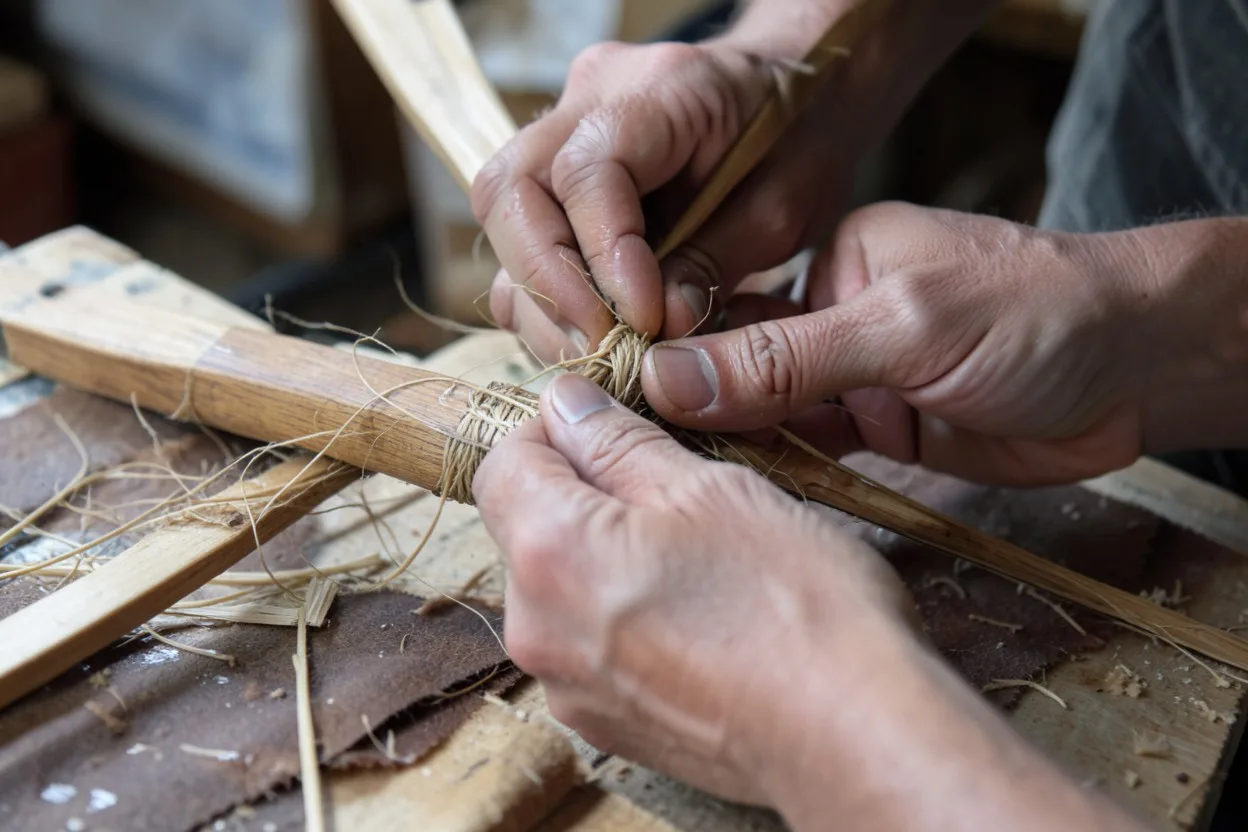
Sinew backing adds a highly tension-capable layer and changes how the bow recovers from draw. It shrinks as it dries, and that shrinkage can pull limbs into a more recurved shape. I’ve seen this firsthand on builds where the same wood behaved differently once sinew backed it and dried into place.[3]
Sinew as tendon fiber: shrinkage that changes geometry
Sinew backing is made from animal tendon fibers. It shrinks as it dries, and that shrink can pull the limbs toward a more recurved set. This isn’t just cosmetic. It affects limb loading because the bow’s geometry determines how tension rises as you draw.
Historical accounts back the role of sinew in function: Sinew has been used for cordage, binding points on arrow shafts, and as backing material for bows. The Eskimos applied sinew as twisted cordage tied on the back of the bow. Saxton Pope reported that sinew backing protected weak grain and prevented breakage at full draw. Reginald Laubin said sinew backing dried into a deeper recurved position and made the bow more powerful.
Where sinew tends to excel (and where it fails)
In good adhesion and proper thickness, sinew helps distribute back tension and can protect weaker grain areas by acting as a tension “overlay.” It also tends to stabilize behavior after it dries into its final recurved position.
The failure cases are predictable: moisture exposure that loosens adhesion, air gaps between sinew and wood back, and poor preparation that prevents the sinew from conforming tightly. If the sinew doesn’t bond over the full area, you can get localized over-stress and then a rapid failure zone as you reach full draw.
On the strength side, a Scientific American crossbow article stated sinew has a tensile strength of 28,000 psi. For stiffness behavior, replicated examples vary by design, but I treat shrink and thickness as the practical “power dial” on replicas.
Rawhide and hide glue: what they were for, and where repairs get hard?
Rawhide mainly shows up as strings and bindings: you soak it and twist it into cordage. Hide glue bonds sinew to the bow back and holds fletching on, so its condition drives backed-bow consistency. Repairing is harder when sinew has separated or when the original surface prep prevents a tight re-bond.
Rawhide roles: strings and bindings, plus cordage prep
Rawhide is commonly used for strings and bindings. A typical workflow is soaking and twisting it into cordage. Deer rawhide is often described as stronger than elk rawhide, and that difference matters when you’re trying to reduce string creep and breakage on a replica.
In load terms, rawhide cordage sits between “string stretch” and “interface stability.” Too much stretch changes tuning, and weak spots at splices create sudden failure when tension peaks.
Hide glue roles: sinew bonding and fletching attachment
Hide glue is used to bond sinew to the bow back, and it may also be used for fletching attachment. In a backed bow, glue quality is one of the biggest tuning variables because it controls how tightly sinew follows the wood during flex. If glue doesn’t grip and close gaps, the bow can feel “alive” at brace and then behave unpredictably as draw increases.[4]
Common repair friction points (what I’ve had to redo)
When a string breaks, re-binding rawhide or cordage is usually straightforward with the right material and tensioning tools. Loose sinew or localized separation is harder. You often need to remove damaged sinew, clean back surfaces, and re-bond with good contact area.”
Plant fiber cordage: when yucca or nettles makes sense (and when it doesn’t)
Plant fibers were used as lighter bowstrings and cordage options, especially on lighter bows and builds where you want lower mass. Examples include yucca, nettles, milkweed, and inner bark fibers. These can have less stretch than sinew in some accounts, but they’re labor-intensive to produce and can still behave differently with humidity.
Plant fibers as string materials (and why labor changes your build)
Plant fiber cordage can be used for bowstrings, and sources describe nettles, milkweed, and inner bark fibers as high quality string material. One account also describes that these plant fibers did not stretch over time. That’s a big deal for tuning stability.
There’s a tradeoff: the effort. I don’t treat plant fiber cordage as a “weekend string.” In practice, you’re spending build time prepping fibers, drying them consistently, and then making cordage with tight, repeatable twist. If your fibers aren’t uniform, the finished string can have uneven stretch and strange tiller behavior.
Stretch and moisture behavior tradeoffs vs sinew-backed setups
Sinew-backed bows add shrink-driven geometry change. Plant fibers add string-specific stretch behavior. If your plant fiber cordage doesn’t move much after curing, you get stable tuning. If it takes on moisture differently, string length changes and affects point of impact.
Where it often doesn’t make sense is if you expect heavy rain, frequent fog, or constant swings between hot and cold without letting gear stabilize. Plant cordage can work, but the maintenance rhythm becomes part of the build system.
Side-by-side material matrix: strength, stretch, moisture behavior, and repairability
The table below frames Native American bow materials as a system: wood sets the bending shape, sinew backs tension behavior, hide or rawhide handles string and bindings, and plant fibers provide lighter cordage. The “best-use scenario” assumes builders want predictable tuning and survivable repairs during a real hunting season.
| Material | Strength under load | Stretch type | Moisture behavior | Repairability | Best-use scenario | Failure to plan for |
|---|---|---|---|---|---|---|
| Wood bow stave | High bending stiffness when grain is sound and thickness is right. | Mostly elastic bending; local strain spikes reveal weak areas fast. | Moves with drying; poor seasoning leads to warps and set changes. | Limited mid-limb repairs; cracks often require major rebuild steps. | Primary structure for any build; pair with backing that matches climate. | Back grain damage or wrong thickness creating belly cracks during early draws. |
| Sinew backing | Tension overlay; described tensile strength for sinew is 28,000 psi. | Minimal if bonded tightly; shrink during drying changes geometry. | Shrinks as it dries; moisture exposure can loosen adhesion and disturb contact. | Repair possible, but re-bond quality is the limiter. | Back tension control, especially when wood back grain is weaker. | Air gaps, poor adhesion, or let-drying conditions that create delamination. |
| Hide / rawhide (strings and bindings) | Rawhide cordage can be strong; deer rawhide is often described as stronger than elk. | Some stretch until cured; splice and twist quality decide creep. | Absorption and drying cycles can change cordage dimensions. | String re-make is usually easier than full backing repair. | Backcountry durability when you can soak, twist, and re-tension. | Weak splices or uneven cordage twist breaking under peak tension. |
| Plant fibers (yucca, nettles, milkweed, inner bark) | Good tensile performance when spun/twisted uniformly. | Described as not stretching over time in some accounts; varies with prep. | Can respond strongly to humidity swings; needs consistent curing. | Repair by re-making sections is possible, but consistency is labor-heavy. | Stable tuning on lighter bows in drier conditions. | Labor shortcuts leading to inconsistent twist and point-of-impact drift. |
Replica-builder decision column: choose materials by climate and tolerance
If you’re trying to choose historically plausible materials for a modern replica, your climate and maintenance tolerance decide what “works.” I frame it as a decision. Pick wood for stiffness, then pick backing and string based on how your environment moves moisture, and how often you’ll re-tension or re-make cordage.
| Your situation | Wood choice (stave) | Back or backing choice | String/cordage choice | Glue and protection notes | What you’ll likely tune first |
|---|---|---|---|---|---|
| Cold mornings, dry afternoons | Choose a wood that seasons consistently; keep back grain clean. | Sinew backing can add stable recoil once bonded and dried. | Rawhide or plant fibers depending on your humidity stability and patience. | Use reliable hide glue for tight sinew contact; protect stave with grease/oil. | Draw weight feel and point-of-impact during humidity recovery. |
| Wet spells or frequent fog | Prioritize wood with predictable drying behavior and avoid weak back fiber. | Sinew backing may handle cold better, but adhesion protection matters. | Rawhide often survives abrasion if your cordage prep is clean. | Grease/oil helps reduce cracking from moisture loss; keep interfaces sealed. | String length changes after drying and re-wetting. |
| Dry climate, limited maintenance time | Hardwood stave with correct tiller to avoid localized stress. | Sinew backing if you can control curing and bonding quality. | Plant fibers can support stable tuning if cordage doesn’t keep moving. | Hide glue must form full contact; oil helps stabilize the stave. | Final tiller and stabilization after first brace-to-draw sessions. |
| You want faster rebuild after damage | Stave that can be repaired without gambling on complex rework. | Choose backing you can re-do with your tools and time. | Rawhide strings are often easier to replace than backing sections. | Make hide glue mixes reproducible; keep surfaces clean for re-bonding. | String height and arrow point-of-impact stability. |
How do arrow shafts, fletching, and nocks interact with these bow materials?
Bow materials change how the string behaves and how the bow recovers, so your arrow components decide whether you see that change as tuning or as “flight problems.” I straighten and dry shafts, bundle them to cure, then build consistent fletching and nocks because small timing errors amplify once your bow tunes cleanly.
Arrow shaft materials: wood or woody reeds, straightening, bundling
Arrow shafts were made from wood or woody reeds. The practical workflow is straightening and drying before use, then bundling shafts to cure. Rushing the drying stage leads to inconsistent spine behavior, making arrow groups appear as if the bow is at fault.
I’ve also learned that arrow consistency matters because changes in string or cordage material shift arrow point of impact. If your shafts aren’t stable, you won’t know whether the shift is bow behavior or shaft movement.
Fletching and nock assembly: feathers, glue, nock placement
Fletching and nock assembly affects flight stability and timing. Feathers are typically glued and tied, and the nock is cut into the shaft. Nock placement and fit change how the arrow starts leaving the string, and that can show up as group spread even when your bow tiller looks correct.
Because hide glue is used for fletching attachment, glue condition can influence consistency. If fletching comes loose or shifts after a few shots, your arrow flight changes faster than your bow tune ever will.
Tuning expectations: how string and cordage materials shift point of impact
If you move between plant fiber cordage and rawhide or sinew-based cordage, you’ll often see point-of-impact changes during the period where strings settle. If sinew shrink changed bow geometry while drying, your brace and draw behavior will also shift. That’s why I treat “tuning” as a sequence: brace-to-draw settlement, then arrow behavior confirmation.
Frequently asked questions
What materials were Native American bows made from?
Native American-style replicas commonly use wood bow staves, sinew backing, and string materials such as rawhide or plant fibers. Hide glue bonds sinew to the back and helps secure fletching. Builders also used animal grease or bow oil to protect the stave by reducing cracking from moisture loss, and arrow shafts were typically wood or woody reeds.
Why was sinew used on Native American bows?
Sinew was used because it provides strong tension behavior as a backing layer. Sinew can shrink as it dries, pulling limbs into a more recurved position and altering bow power and feel. Historical reports also describe it protecting weak grain and preventing breakage at full draw when bonded correctly.
What wood was best for Native American bows?
There isn’t one universal “best” wood, but many sources list hardwoods such as ash, willow, juniper, cedar, walnut, hickory, oak, and birch. In practice, I care more about back grain quality and predictable seasoning than the species name. Preserving back grain helps prevent belly-front surprises later.
What plant fibers were used for Native American bowstrings?
Plant fibers described as string materials include yucca, nettles, milkweed, and inner bark fibers. Some accounts describe nettles, milkweed, and inner bark fibers as high quality because they did not stretch over time. They can work well for tuning stability, but prep and consistency take more labor than sinew-based approaches.
What is the difference between a self bow and a sinew-backed bow?
A self bow relies on the wood stave itself for all bending and back tension behavior. A sinew-backed bow adds sinew on the back, bonded with hide glue, which changes how tension distributes under draw. The sinew can also dry into a deeper recurved position, so the bow geometry and power feel can shift during curing.
How were rawhide and hide used in Native American bows?
Rawhide was used for strings and bindings, typically requiring soaking and twisting into cordage. Deer rawhide is often described as stronger than elk rawhide. Hide glue is the bonding glue in backed bows, used to attach sinew to the bow back and to secure fletching, so glue condition affects consistency and repair outcomes.
Which Native American bow materials worked best in wet or cold climates?
In wet or cold conditions, moisture behavior and adhesion protection matter more than the material label. Sinew-backed bows can be powerful once bonded and dried, but moisture exposure can threaten interfaces if contact is incomplete. Rawhide strings and bindings can tolerate abrasion, while plant fibers demand consistent humidity-stable curing and careful maintenance.
How did Native American bow materials affect power and durability?
Wood sets the limb stiffness, sinew backing adds tension capacity and can increase power as it dries into recurved shape, and string material decides how much the bow releases energy cleanly. Durability usually fails at the back, at string splices, or at moisture-driven shrink and stretch transitions. Picking matching thickness and curing conditions is where power and survival come from.