Arrow Direction and Broadhead Flight: What Changes First
Start with the arrow’s impact pattern. If broadheads hit left or right with clean vertical grouping, adjust the rest first. If they hit high or low, check nock height first. If tears still show after that, verify spine, then cam timing. Wrong order burns arrows and masks the real fault. This guide gives a fast diagnosis for fixed broadheads versus field points, with a clear correction sequence for common impact patterns.
This guide is part of our Arrow direction guide for archers series.
Arrow direction basics
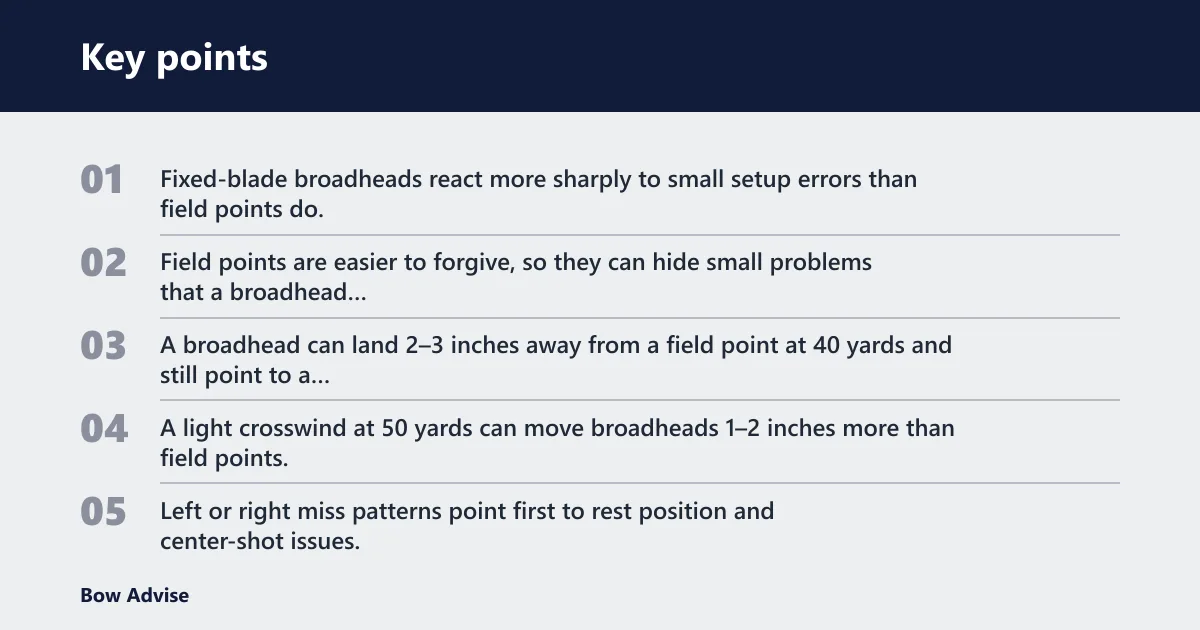


Fixed-blade broadheads react more sharply to small setup errors than field points do. That makes them a useful tuning check. Field points are easier to forgive, so they can hide small problems that a broadhead will expose.
A broadhead can land 2–3 inches away from a field point at 40 yards and still point to a bow setup issue rather than a bad shot. A light crosswind at 50 yards can move broadheads 1–2 inches more than field points, so wind matters more as distance grows.
What a left/right or high/low miss usually means
Left or right miss patterns point first to rest position and center-shot issues. High or low impact points more often point to nock height or clearance. Scattered groups that do not settle after those checks usually move the diagnosis toward spine, cam timing, or cam lean.
Paper tune at 5 to 6 feet before broadhead tuning. That gives a baseline so the broadhead result has context. Broadheads should be threaded clockwise into the insert and tightened until moderately snug; overtightening can strip threads.
When a miss is small enough to keep tuning
If field points and broadheads are only slightly apart and the pattern stays steady, keep tuning instead of rebuilding the whole setup. Broadheads do not need to overlap field points exactly every time. The goal is a clean, repeatable pattern that makes sense at the distance you hunt.
What you’ll need
- Field points matched to your hunting arrow weight
- Your fixed-blade broadheads
- A target at short distance
- A bow square or marking tool for reference points
- A wrench or bow tool for small rest moves
- Spare arrows or clearly marked arrows for repeat shots
- A paper-tuning setup at 5 to 6 feet
First change when broadheads drift
Use the impact pattern to pick the first correction. Left or right drift goes to rest position first. High or low drift goes to nock height first. If the pattern stays wrong after a few careful changes, move to spine and then cam timing or cam lean.
- Compare field-point and broadhead impact at the same distance.
- If the group is left or right, move the rest about 1/32 inch.
- If the group is high or low, adjust nock height, then shoot again.
- If the pattern does not change after two or three retests, stop and move to the next component.
Say your broadheads are 3 inches left of field points at 40 yards while the field-point group stays tight. That pattern points first to rest position, not spine. Change one thing, reshoot, and keep notes so the next correction does not wipe out the first one.
Step 1: Check rest position
For a right-handed shooter, broadheads landing left of field points often mean the rest needs to move right. That is the first left/right correction point because broadheads magnify center-shot errors. Make only tiny moves, then retest before changing anything else.
- Verify your current center-shot reference.
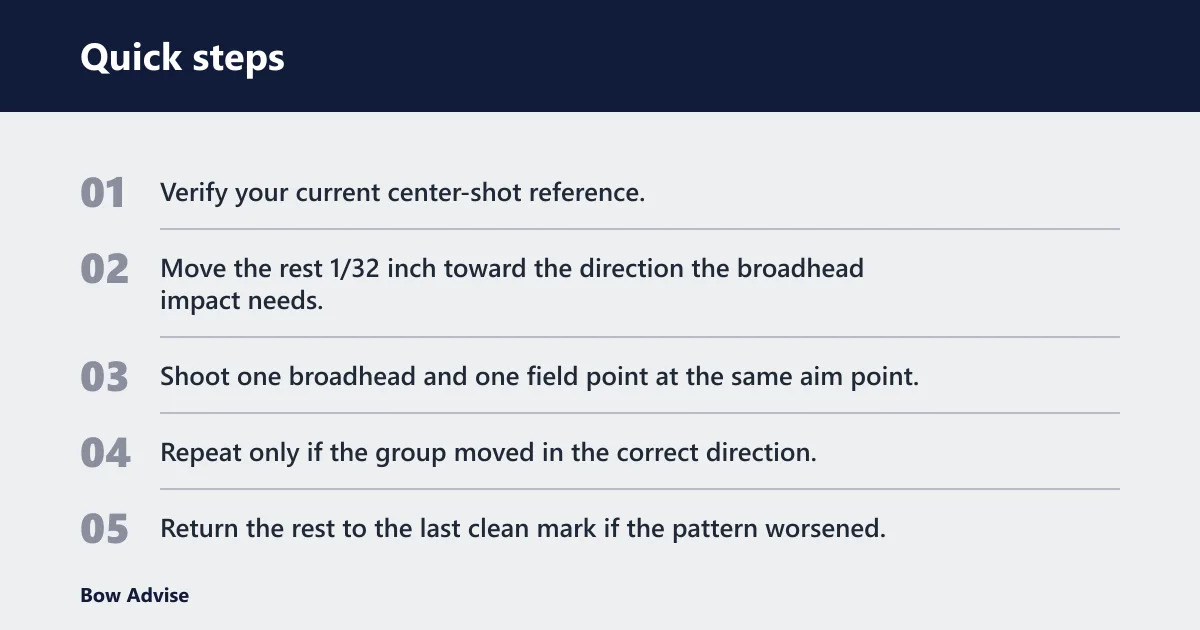
- Move the rest 1/32 inch toward the direction the broadhead impact needs.
- Shoot one broadhead and one field point at the same aim point.
- Repeat only if the group moved in the correct direction.
Stop here if the rest has already moved more than 3/16 inch and the groups still will not come together. That usually means the issue is no longer simple center-shot correction. On compounds, cam lean may be involved. On recurve-style setups, check arrow stiffness, tiller, and nocking point before chasing more rest movement.
If that didn’t work, try this next
When rest movement stops helping, inspect the arrow’s path and the bow’s timing. On a compound, cam timing or cam lean can hold a broadhead left or right even when the rest looks close. On a recurve, a left/right problem that survives center-shot changes often traces back to spine, nocking point, or release consistency.
- Return the rest to the last clean mark if the pattern worsened.
- Shoot a field point and a broadhead again at the same distance.
- Note whether the error is steady or changing shot to shot.
Step 2: Check nock height
Nock-high and nock-low impacts are vertical clues. If broadheads hit high, the nock point may be too low. If they hit low, the nock point may be too high. Vertical errors should be handled before cam work because a wrong nock point can mimic a more serious tuning fault.
- Confirm the arrow sits level at rest or at your normal setup reference.
- Adjust the nocking point in a small increment, then reshoot.
- Keep the change small enough to read the direction of travel.
- Check for clearance contact if the vertical pattern changes suddenly.
Common first-timer mistake: a field point looks fine, so the nock height gets ignored. Then the broadhead shows a low hit at 20 yards and a worse one at 40 yards. That pattern can look like wind or weak spine, but the first check should still be the vertical launch angle.
What a nock-high or nock-low impact means for broadhead tuning
A nock-high impact means the rear of the shaft is leaving the bow in a way that drives the broadhead down. A nock-low impact does the opposite. If the broadhead changes more than the field point in the vertical plane, start with nock height before touching cam timing.
Step 3: Check spine and cam timing
Arrow spine must match draw weight and arrow length. A weak shaft can create erratic groups and false left/right broadhead movement. It can also make a good rest setting look wrong, especially when the shaft flexes too much during launch.
- Confirm the spine rating matches the bow’s draw weight and arrow length.
- Check whether group shape changes with broadheads versus field points.
- On a compound, verify cam timing and cam lean if rest movement no longer helps.
- On a recurve, inspect arrow stiffness and tune around the shaft’s behavior rather than cam timing.
Picture a compound that keeps throwing broadheads left even after the rest has moved several times and the nock height is close. If the rest has moved more than 3/16 inch with no real gain, cam lean moves up the list. On a recurve, the same stubborn pattern is more likely to be a spine or nocking-point issue than a timing problem.
First change when broadheads drift
Miss pattern to likely cause, first adjustment, and when to stop can be mapped in a simple order. Use this table when you want the fastest likely correction instead of random changes.
| Miss pattern | Likely cause | First adjustment | When to stop and check next |
|---|---|---|---|
| Broadheads left of field points | Center-shot or rest position | Move rest right about 1/32 inch | Stop after 2–3 retests if impact does not move toward center |
| Broadheads right of field points | Center-shot or rest position | Move rest left about 1/32 inch | Stop after 2–3 retests if the pattern stays unchanged |
| Broadheads high | Nock height too low | Raise or lower the nocking point in a small step | Stop if the vertical gap does not shrink after a few shots |
| Broadheads low | Nock height too high | Lower or raise the nocking point in a small step | Stop if the vertical gap does not shrink after a few shots |
| Erratic group shape | Weak spine, wobble, or alignment issue | Check arrow spine and spin test the shaft and broadhead | Stop and inspect cam timing or cam lean if the pattern remains wild |
Common mistakes
Do not chase broadheads without a paper-tune baseline. A paper tune at 5 to 6 feet gives a reference, and without it the broadhead may point to a problem that was already there.
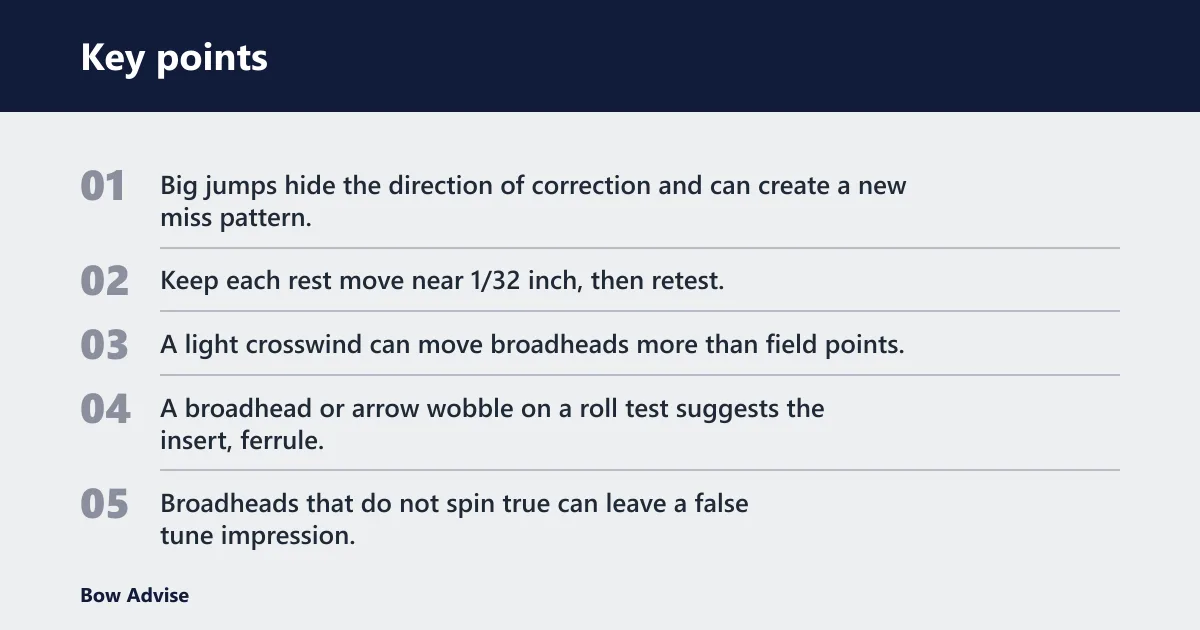
Do not make large rest moves. Big jumps hide the direction of correction and can create a new miss pattern. Keep each rest move near 1/32 inch, then retest.
Do not blame wind too early. A light crosswind can move broadheads more than field points, but a clean left/right pattern at short range still points first to setup.
Do not ignore insert alignment. A broadhead or arrow wobble on a roll test suggests the insert, ferrule, or shaft is out of line. Broadheads that do not spin true can leave a false tune impression.
How do I tell if an arrow is wobbling or not spinning true?
Roll the assembled arrow on a flat surface or spin it at the shaft and watch the point. Any visible wobble means the ferrule, insert, or shaft may be out of line. If the broadhead tip traces a circle instead of staying centered, fix alignment before changing the bow again.
How far off can broadheads be from field points before I worry?
A few inches at hunting distance can still be part of a broadhead-tuning problem, not a disaster. Broadheads can land 2–3 inches differently than field points at 40 yards. Worry more when the gap keeps growing, changes direction between shots, or comes with poor group shape.
Can a light crosswind change broadhead flight more than field points?
Yes. In a light crosswind at 50 yards, broadheads may drift 1–2 inches more than field points because of added drag and planing sensitivity. That matters more as distance grows. At short range, setup faults usually explain the bigger miss before wind does.
Frequently asked questions
Why do my broadheads hit somewhere different than my field points?
Fixed-blade broadheads create more drag than field points, so they expose small setup errors sooner. Start by comparing the direction of the miss, not just the size of it. Left or right points to rest or center-shot first; high or low points to nock height first.
What changes first when broadhead flight starts drifting?
The first change should match the impact pattern. Move the rest first for left/right drift, and check nock height first for vertical drift. If the pattern does not improve after a few small adjustments, move on to spine and then cam timing or cam lean.
Should I move my rest or check my arrows first?
Check the arrow only after the pattern tells you where to start. If broadheads land left or right, move the rest first. If the arrow wobbles during a roll test or does not spin true, inspect the insert, ferrule, or shaft before making larger bow changes.
When should I suspect cam timing or cam lean instead of rest position?
Suspect cam timing or cam lean when rest changes stop helping. If the rest has moved more than 3/16 inch and the groups still will not come together, the fault is probably beyond simple center-shot correction. On compounds, check timing before making more rest movement.
What does a fixed-blade broadhead reveal that a field point hides?
A fixed blade reveals drag, slight misalignment, and weak spine faster than a field point. Field points have low drag and can hide small tune issues. That is why broadheads work well as a tuning test, even when the field-point group looks acceptable.
How small should rest adjustments be during broadhead tuning?
Use about 1/32 inch at a time, then reshoot. Larger moves make it hard to see which direction improved the flight. If the broadhead still misses the same way after a few tiny changes, stop and check the next likely component instead of forcing the rest farther.