Wet Feathers, Soaked Vanes, and Arrow Direction in Rain
Wet feathers and soaked vanes slow rear stabilization, so arrows correct later and often strike lower; the heavier the moisture load, the larger and less predictable the drift. Ignore it and you get unexplained misses, bad sight calls, and broadhead groups that open in rain. This guide breaks down why moisture changes arrow direction, plus recurve, compound, and broadhead fixes for wet weather.
Wet fletching decision table


| Bow type | Fletching type | Release style | Distance band | Field point or broadhead | Expected directional change | Risk level | First diagnostic check |
|---|---|---|---|---|---|---|---|
| Recurve | Feather | Finger release | 0 to 20 yards | Field point | Small vertical drop, possible late left/right drift | Moderate | Check feather shape and nock travel for clumping or limp vanes |
| Recurve | Feather | Finger release | 20 to 40 yards | Field point | More visible drift and slower correction | High | Compare one dry arrow to one wet arrow at the same sight setting |
| Recurve | Feather | Finger release | Any hunting range | Broadhead | Drift can open groups and show fishtailing | High | Inspect broadhead tune before blaming sight marks |
| Compound | Vane | Release aid | 0 to 40 yards | Field point | Usually small change, often mostly vertical | Low | Check for rest contact and vane clearance |
| Compound | Vane | Release aid | 30 to 60 yards | Broadhead | Small setup errors become easier to see | Moderate | Confirm broadhead tune and arrow spine before chasing wind drift |
| Compound | Feather | Release aid | Hunting distance | Broadhead | Possible added drift and slower recovery | Moderate | Check whether the feathers are flattening or sticking together |
| Traditional bow | Feather | Finger release | 0 to 30 yards | Field point | Most change shows as delayed correction, not a fixed left or right move | Moderate | Inspect nock fit and bare shaft comparison |
| Traditional bow | Feather | Finger release | 30 to 50 yards | Broadhead | Greater drift and broadhead group spread | High | Test one dry fletched arrow against one wet fletched arrow at the same mark |
| Compound | Vane | Release aid | Any range | Bare shaft comparison | Less change from moisture, so tune issues stand out | Low | Use the bare shaft to separate moisture drift from tune drift |
What moisture changes on the arrow
Wet feathers and soaked vanes slow rear stabilization, so arrows settle later and often land lower; the more water they hold, the less predictable the drift becomes. Leave it alone and you get misses that make no sense, bad sight calls, and broadhead groups that open in rain. This guide explains why moisture changes arrow direction, plus recurve, compound, and broadhead fixes for wet weather.
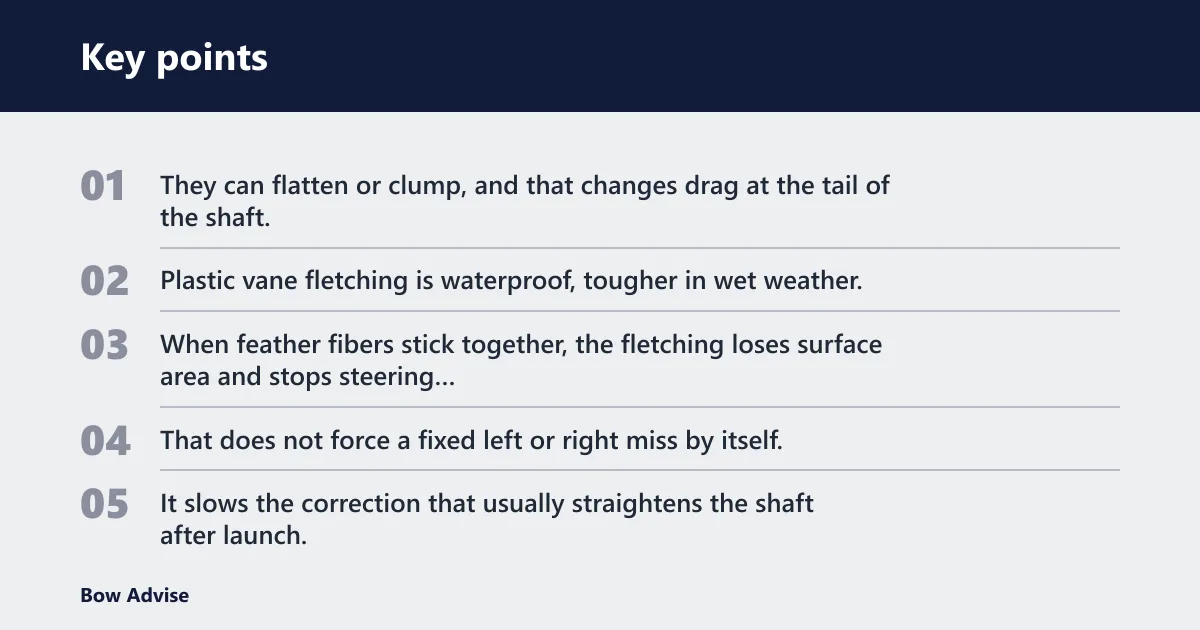
Natural turkey feathers can absorb water. They can flatten or clump, and that changes drag at the tail of the shaft. Plastic vane fletching is waterproof, tougher in wet weather, and common on compound and hunting setups; it is also heavier and stiffer than feathers, so it holds shape better when rain starts to soak everything.
Flattened or clumped feathers
When feather fibers stick together, the fletching loses surface area and stops steering the arrow as early. That does not force a fixed left or right miss by itself. It slows the correction that usually straightens the shaft after launch, so the arrow can leave with more yaw and keep it longer.
Heavier saturation can also change the rear balance feel of the arrow. The added moisture at the tail can make the shaft recover later, which is why the same arrow may look fine at one distance and wobble at another. Archery360 notes that feathers may go limp in rain and affect arrow flight.
Rear drag and correction timing
Fletching works by creating drag behind the arrow’s center of mass. Wet feathers cut that drag and delay it. The arrow then takes longer to point where it should, and the timing of the correction changes. That matters most when the shot still has time to show the problem before impact.
Longer range gives that process more room to appear. Forum users report wet feathers matter more at longer ranges, while another note says they may still be fine at hunting distances with a compound. That fits the mechanics: the farther the arrow travels, the more small instability can show itself.
Why stabilization slows
Fletching does two jobs here. It steadies the rear and it manages recovery from launch disturbance. If the feathers flatten, the arrow may act as if it has less fletching area for the first part of flight. That makes the arrow less forgiving of poor tune, release errors, and broadhead steering.
A useful comparison point is the bare shaft. A bare shaft is less forgiving than a fletched arrow and is often used to evaluate tune. If wet feathers and a bare shaft start acting closer to each other than usual, the problem is often lost steering at the tail, not a sight issue.
Do wet feathers actually change arrow flight?
Yes, they can. The change is usually small at very short range, but it becomes more visible as distance grows or as the feather load gets wetter and flatter. The main effect is delayed stabilization, which can turn a clean-looking shot into a wider group or a late drift on impact.
The size of the change depends on setup. Feather fletching is lighter than vanes and more forgiving on rest contact, which helps traditional and finger-release setups. But once feathers soak up enough water, they can clump and lose shape. Archery Gear Junkie notes that feathers are preferred for traditional and barebow shooting, yet rain cuts their usual advantage.
When the effect is small
At short range, many archers will see little more than a slight change in point of impact or a small shift in group shape. If the shaft is still recovering before the arrow reaches the target, the change may be hard to spot. That is why rain sometimes looks worse on paper than in a hunting lane.
Suppose a recurve shooter is grouping well at 15 yards and then moves to 35 yards in steady rain. The same wet feather setup can begin to show more drift because the arrow has longer to reveal delayed correction. The arrow does not need to fly badly for the groups to open.
When the effect becomes noticeable
The effect becomes easier to see when feathers are soaked enough to lay down, when the release adds extra side movement, or when broadheads are mounted. Fixed blades are more sensitive to setup changes, and wet feathers can matter more with broadheads because broadhead tuning depends on arrow stabilization. That is where rain can show up fast.
A common first-timer mistake is assuming the bow sight is off when a rain-soaked fletching is actually nudging the arrow off line. If wet arrows start grouping low or drifting after rain starts, the first check should be the fletching shape, then the rest clearance, then the broadhead or field point comparison. Changing the sight setting before that can hide the real problem.
Will wet feathers make arrows hit left or right?
Sometimes, but not in one fixed direction. Wet feathers usually change timing first, then direction. The actual left or right move depends on bow setup, rest contact, release style, and how much the rear of the arrow is recovering when it leaves the bow. The direction is a symptom, not the rule.
On a finger release setup, extra side movement can make feather performance more important, so any loss of stabilization may show as more visible left/right error. On a release-aid compound, the same wet arrow may show more of a vertical change or a smaller horizontal drift, especially with good rest clearance.
Reading the miss pattern
If the group moves low with no clear side bias, the problem is often slower recovery and lower effective speed from the tail. If the group spreads left and right, look for release inconsistency, rest contact, or a feather shape that changes shot to shot. Wet feathers can make all of those easier to see.
Fishtailing is another clue. A forum user reports wet feathers can cause fishtailing, and that fits the idea of delayed steering. If the arrow tail wobbles more before it settles, the direction at impact becomes less reliable, especially as distance increases.
Are vanes better in rainy conditions?
For many compound and hunting setups, yes. Plastic vane fletching is waterproof, durable in wet weather, and works well with drop-away rests. It keeps its shape better in rain, so the rear of the arrow usually corrects sooner and with less change from shot to shot. That makes the flight easier to predict.
That said, vanes are not the best answer for every archer. Feathers are often preferred for traditional or barebow shooting because they can be more forgiving on rest contact and finger release noise. The tradeoff is clear: feathers often steer well in dry weather, but they are more vulnerable to water.
Drop-away rest compatibility
Drop-away rests pair well with vanes because the arrow has clean clearance and the vane material keeps its shape. That helps prevent contact issues that can add random drift. On a compound with a release aid, this is usually the more steady rain setup, especially when broadheads are in play.
Advanced Hunter identifies straight, offset, and helical fletching as the common orientations. Helical fletching creates maximum arrow stability, but it trades some speed for control. In rain, that extra control can help offset some wet-weather uncertainty, though it does not cancel bad tuning or soaked feathers.
Why some traditional setups still favor feathers
Traditional bows and finger release shooting still benefit from feather fletching because feathers are lighter and more forgiving of shelf contact. A feather can brush a rest or shelf more cleanly than a stiff vane. That is useful when the arrow leaves the bow with more side motion than a release aid would allow.
Archery Gear Junkie says feathers are preferred for traditional and barebow shooting, while vanes are a fit for compound and hunting setups. That split holds up in rain too. A water-resistant vane may be better for a compound hunter, but a traditional shooter may accept wet-weather risk to keep clearance and launch feel.
Broadheads, field points, and bare shafts
Broadheads usually react first. Fixed blades are more sensitive to setup changes, so a wet tail can make their steering more obvious than it would be with field points. Field points often show fewer wet-fletching issues because they do not add the same steering load. Bare shafts are the strictest comparison, because they remove fletching help entirely.
Why broadheads react first
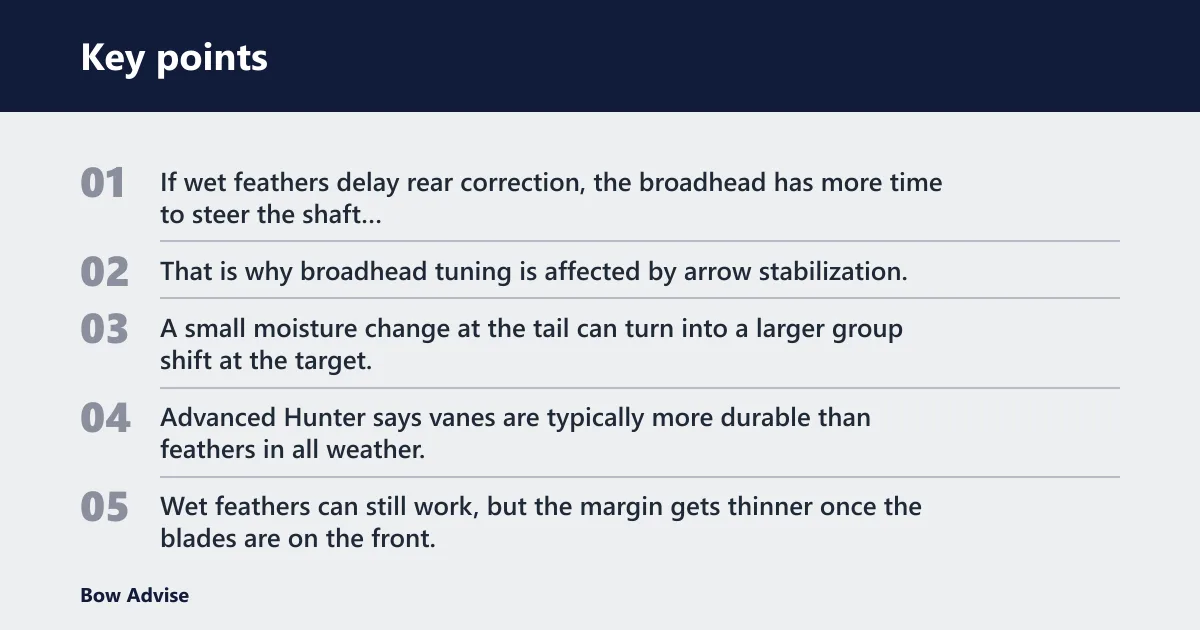
Broadheads need stable arrow flight sooner. If wet feathers delay rear correction, the broadhead has more time to steer the shaft before the arrow settles. That is why broadhead tuning is affected by arrow stabilization. A small moisture change at the tail can turn into a larger group shift at the target.
Advanced Hunter says vanes are typically more durable than feathers in all weather, which helps explain why broadhead setups often use them. Wet feathers can still work, but the margin gets thinner once the blades are on the front. The flight is less forgiving of poor tune and poor weather at the same time.
Why field points often stay steadier
Field points are used for tuning and target shooting, and they often show fewer wet-fletching issues than broadheads. The point does not plane like a fixed blade, so small changes in rear stabilization are easier to miss. That does not mean the arrow is fine; it means the front end is not magnifying the problem as much.
If a field-point group looks normal while a broadhead group opens in rain, the fletching may be part of the answer but not the whole answer. Check the broadhead tune, center shot, and arrow spine before assuming the fletching alone caused the miss.
How bare shafts expose tune changes
Bare shafts strip away the fletching’s help, so they show the raw tune of the bow and arrow. In wet weather, that makes them useful as a comparison point. If the fletched arrow drifts more than usual but the bare shaft does not change relative to the same tune baseline, the moisture effect is likely in the rear steering, not the launch setup.
That comparison is best used carefully. A bare shaft is less forgiving than a fletched arrow, so it should not be treated like a hunting substitute. It is a diagnostic tool. In rain, it helps separate moisture drift from a deeper tuning issue.
Why setup type changes the impact
Setup changes how much the arrow depends on fletching to recover from launch. Recurve and finger release setups usually lean more on feather forgiveness, while compound setups often work better with waterproof vanes and a drop-away rest. The same rain can look minor on one bow and obvious on another.
Recurve and finger release
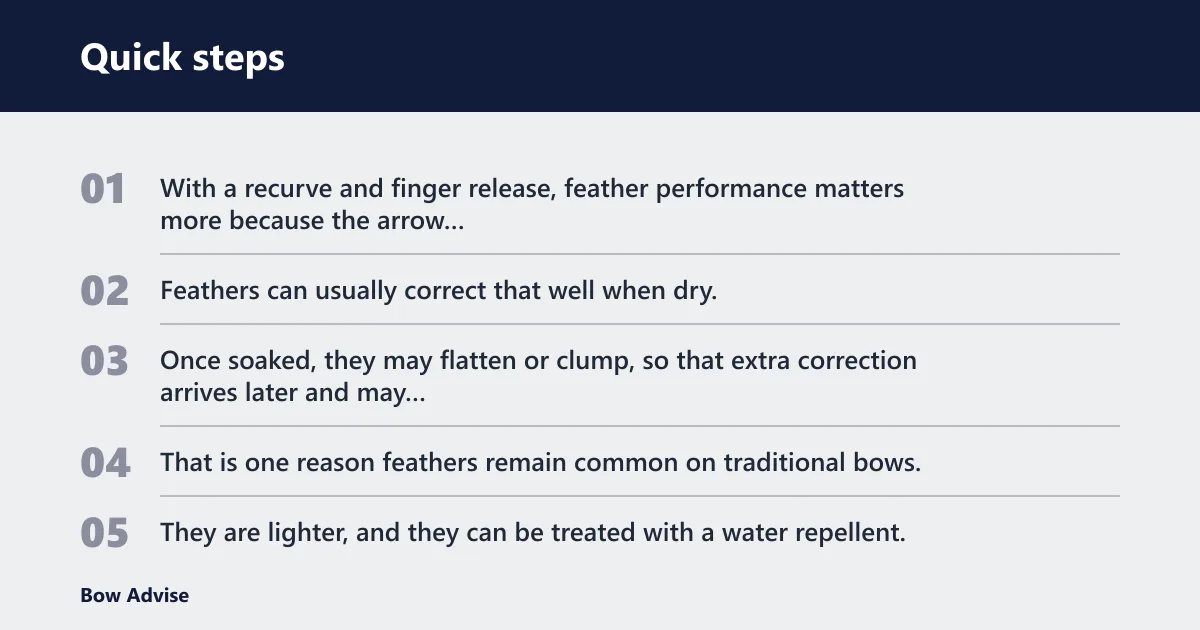
With a recurve and finger release, feather performance matters more because the arrow often leaves with more side movement than a release aid would create. Feathers can usually correct that well when dry. Once soaked, they may flatten or clump, so that extra correction arrives later and may not fully catch up before impact.
That is one reason feathers remain common on traditional bows. They are lighter, and they can be treated with a water repellent. A water repellent helps, but it does not make wet feathers behave like dry ones. It only slows the rate at which they lose shape.
Compound and release aid
Compound bows with a release aid usually depend less on feather forgiveness and more on clean rest clearance and repeatable tune. Vanes fit that setup well because they are waterproof and durable. The same source says vanes are waterproof and good for compound and hunting setups, and that is the practical reason they dominate rain-ready compounds.
Drop-away rests reduce clearance issues, which keeps vane contact from becoming a separate problem. If a compound still shows rain drift, look first at tune, peep alignment, and broadhead planing. Wet fletching may be involved, but it is often not the only variable.
Heavier or stiffer fletching choices
Heavier and stiffer fletching holds shape better in rain, but that does not automatically make every shot better. More control usually means a small speed tradeoff. Helical fletching is the clearest example: it can add maximum arrow stability, yet it gives up some speed for that control. In wet weather, that trade often makes sense.
For a hunting arrow, control matters more than a slight speed loss. For a target arrow, the choice depends on distance and bow type. If rain is regular, a stiffer fletching choice may be the safer option, but only if the rest and tune are already clean.
How to dry or protect wet arrow fletching
Drying and protecting wet fletching matters, but it is not a cure-all. The goal is to restore shape and reduce future water loading. The same source recommends covering feather fletchings between shots in wet weather, and it also suggests steam can reshape arrow fletching after rain. Both steps help, but neither replaces a proper rain setup.
Field-ready steps
- Wipe the shaft and fletching with a dry cloth as soon as practical.
- Separate clumped feather fibers gently with fingers.
- Let the arrow air dry before the next end.
- Cover feather fletchings between shots in steady rain.
- Check for rest contact, vane damage, or feather flattening before changing sight marks.
- Apply a water repellent to feathers if the setup is used often in wet weather.
Do not assume a quick wipe fixes everything. A feather can look dry on the surface and still have lost enough shape to affect steering. If the arrow still groups oddly after drying, use the field point, broadhead, and bare shaft checks to sort out what changed.
Two common rain scenarios
Say your 40-yard broadhead group opens only after the feathers get soaked. The first check should be the feather shape, not the sight tape. If the same arrow returns to normal after drying, the issue was likely delayed rear correction rather than a bad tune change.
Suppose your recurve arrows still land close at 15 yards but start drifting at 35 yards in rain. That pattern points to slower stabilization, not a sudden bow problem. The fix is usually better feather protection, cleaner launch, or a fletching choice that handles moisture better.
Frequently asked questions
Are vanes better than feathers in rainy conditions?
For most compound and hunting setups, yes. Vanes are waterproof, durable, and work well with drop-away rests. Feathers still make sense on traditional and finger-release bows because they are lighter and more forgiving on contact, but rain makes them less steady than dry feathers or vanes.
How much does wet fletching affect broadhead tuning?
More than field points in many cases. Fixed blades are sensitive to setup changes, and wet feathers can delay stabilization enough to show it. If broadheads group worse in rain while field points stay steadier, the first checks should be fletching shape, tune, and clearance, in that order.
Can I still shoot accurately with soggy feathers?
Yes, sometimes, especially at short range. Accuracy usually drops more as distance increases because delayed correction has more time to show up. If you must keep shooting, cover the feathers between shots, dry them as soon as possible, and use field points or a calmer distance to limit spread.
What should I do to dry or protect wet arrow fletching?
Wipe the arrows, separate clumped feathers, and let them air dry before the next end. The same source recommends covering feather fletchings between shots in wet weather, and steam can reshape fletching after rain. A water repellent can help feathers, but it should be treated as risk reduction, not a fix.