How Did Native American Archers Make Arrow Nocks?
Most Native American archers made arrow nocks by cutting a short slit or V at the shaft end, then reinforcing it with sinew, rawhide, or a small insert of bone, antler, or hardwood when needed. A poor nock can split the shaft on release, or let the string slip free. This guide covers the main nock forms, the materials used, and how they differ from modern plastic nocks.
How arrow nocks worked
An arrow nock is the rear slot or groove that holds the bowstring. To nock an arrow means to place the arrow on the string. The fit had to hold the string in place, yet still let it leave cleanly.
On a modern setup, the nocking point is on the bowstring itself. A properly set nocking point is typically about 1/4 to 3/8 inch above square. The arrow shaft should sit on the arrow rest before the nock clips to the string. That order matters for consistency, but historical arrows did not use the same plastic clip system.
The main job was direct. Keep the rear of the shaft lined up. Keep the string seat repeatable. Stop the end grain from opening under stress.
What made fit matter
A bowstring that is too thick for the nock can bind at release. A nock that is too loose can fall off before the shot or shift under draw tension. Nocks come in different sizes to fit bowstring diameters, and the same idea applied historically: the rear slot had to match the string closely enough to hold, while still releasing cleanly.
For traditional arrows, the rear of the shaft was often the weak point. End grain, grain direction, and wall thickness all affected whether the nock stayed intact.
What you’ll need
- Wood shaft or shaft section
- Bone, antler, horn, or hardwood insert
- Sinew, hide glue, or plant-fiber wrap
- Knife, scraper, or fine saw
- Awl or narrow tool for opening a slot
- Binding material for finishing and reinforcement
How were arrow nocks made?
Many traditional nocks were made by shaping the rear of the shaft, then either cutting a slot into the wood or adding a harder material to help protect it. The exact method varied by region, available materials, and the kind of arrow being built. Light hunting shafts, heavier war arrows, and replica arrows could all use different rear-end construction.
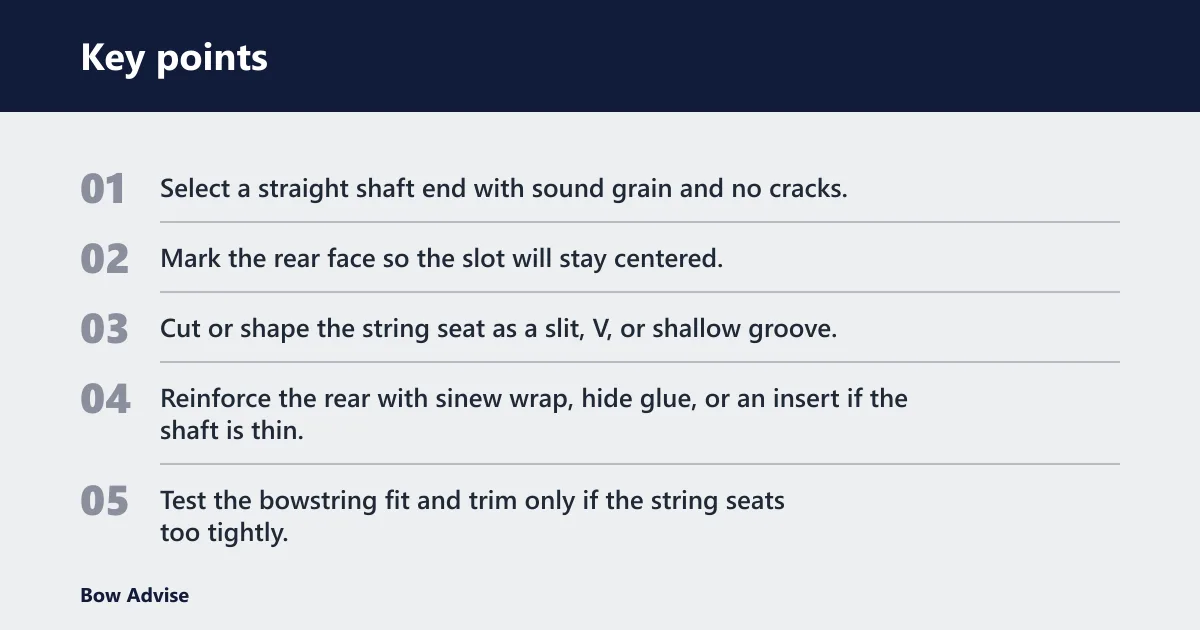
- Select a straight shaft end with sound grain and no cracks.
- Mark the rear face so the slot will stay centered.
- Cut or shape the string seat as a slit, V, or shallow groove.
- Reinforce the rear with sinew wrap, hide glue, or an insert if the shaft is thin.
- Test the bowstring fit and trim only if the string seats too tightly.
- Check the rear end for splitting after repeated flexing.
Step 1: Choose the shaft end
Select the straightest end of the shaft and avoid areas with runout, checks, or soft spots. The rear end takes repeated stress each time the string is drawn and released. A weak grain line there can open into a split.
Step 2: Cut or shape the string seat
Many historic arrows used a short slit or V-shaped notch. Some used a rounded groove. The shape had to guide the string to the same spot every time, because repeatable seating affects release consistency. The nock itself is the seat; nocking the arrow is the act of placing it on the string.
Step 3: Reinforce the rear of the shaft
If the shaft material was likely to split, builders could wrap the rear with sinew, secure it with hide glue, or add a harder tip section made from horn, bone, antler, or hardwood. Traditional nock reinforcement was a matter of materials and function, not decoration.
Sinew wrap helps hold a thin wood wall together. A hard insert can resist crushing and spreading. Plant fibers also appear in some binding systems, usually as part of a broader composite repair or reinforcement.
Step 4: Fit the nock to the bowstring
The string should seat firmly without forcing the slot open. A modern nock uses a small plastic groove that clips onto the bowstring, but historical arrows depended on a shaped natural-material seat. The same rule still applies: the fit must hold the string in place and release the same way each shot.
Say your bowstring is thicker than the rear slot on a replica arrow. The first sign is a hard snap onto the string or a slight twist in the shaft end. That usually means the nock is too narrow, not that the bow is necessarily at fault.
Step 5: Finish and check for splitting
Inspect the rear end after fitting. If the slot runs too deep into thin wood, or if the grain lifts at the edges, the shaft is at risk. A repaired or finished nock should show a clean seat, tight reinforcement, and no fresh cracking near the rear face.
Did tribes use the same nock?
No single nock design covered all Native American arrow construction. Regional practice varied with local wood, animal materials, and the target use of the arrow. Some communities favored separate inserts. Others used a slot cut directly into the shaft and reinforced it with sinew or binding.
Regional material differences
Where horn, bone, or antler were available and practical, they could be used as inserts or end reinforcements. In wood-rich regions, a hardwood rear section was often easier to obtain. In areas with strong fiber traditions, sinew and plant fibers could strengthen the shaft end without a separate hard insert.
Separate insert versus cut-in slot
A cut-in slot is made directly in the shaft. A separate insert adds a harder piece at the rear end. Both approaches aim to stop splitting and give the string a repeatable seat. Archaeological fragments can show one or the other, but preservation is often incomplete, so certainty is limited.
Light hunting arrows versus heavier shafts
Lighter arrows generally needed a nock that held the string securely without adding too much rear mass. Heavier war shafts could tolerate larger rear-end reinforcement, but they also faced more stress on release. In both cases, the rear had to stay aligned with the shaft axis.
Arrow nock comparison table
| Material | How the nock was formed | Expected durability | Likely failure mode | Best use case |
|---|---|---|---|---|
| Horn insert | A short horn tip was fitted to the rear and slotted for the string | High if the bond stayed intact | Bond failure or crack at the joint | Heavy war arrow |
| Bone insert | Bone was shaped as a capped rear end with a string groove | Moderate to high | Chipping at the groove | Replica or hunting arrow |
| Antler insert | Antler was trimmed and fitted as a rear reinforcement | High | Split at the fit line | Heavy arrow |
| Hardwood end | A tougher wood section was used at the rear, often as a splice or cap | Moderate | Crush or split along grain | Light hunting arrow |
| Sinew-wrapped shaft end | The rear was slotted, then wrapped and glued for reinforcement | Moderate | Wrap loosening or slot spread | Practice arrow |
| Saw-cut shaft slot | A narrow slit was cut directly into the shaft and left open or lightly bound | Low to moderate | Rear splitting | Replica |
What evidence can and cannot show
Fragments can reveal slot shape, reinforcement traces, and tool marks. They cannot always prove the full building sequence. A browned fiber residue may be sinew, rawhide, or another binding. A bone fragment at the rear may be a nock insert or part of another repair. Context matters.
Can a nock be repaired?
Yes, sometimes. A split rear end can be stabilized if the crack is short, the grain is sound, and the shaft still seats the string without wobble. If the split reaches deep into the shaft or the seat is badly crushed, replacement is usually the better fix.
When a split can be stabilized
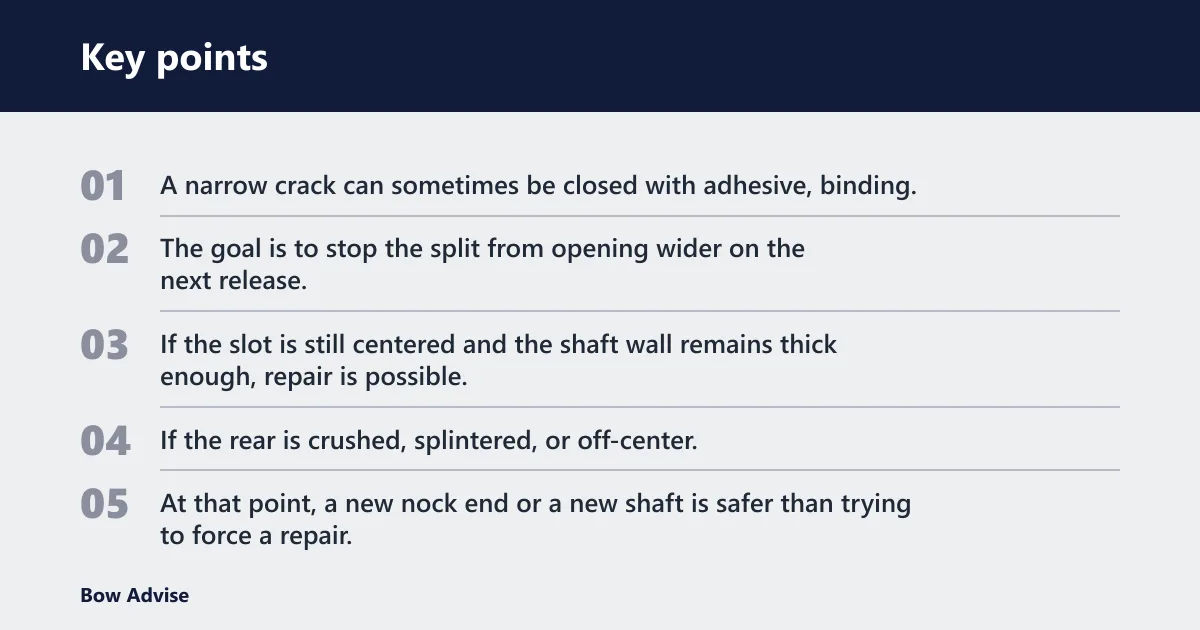
A narrow crack can sometimes be closed with adhesive, binding, and a fresh reinforcement over the rear end. The goal is to stop the split from opening wider on the next release. If the slot is still centered and the shaft wall remains thick enough, repair is possible.
When replacement is the better fix
If the rear is crushed, splintered, or off-center, the arrow will not seat the string consistently. At that point, a new nock end or a new shaft is safer than trying to force a repair. The rear end fails first because it is cut, flexed, and struck by release stress repeatedly.
Picture a 3/8-inch shaft with a shallow rear split after repeated shooting. If the crack stops near the binding, a reinforced repair may hold. If the split runs past the slot and the string rocks side to side, replacement is the more reliable choice.
Prevention
Keep the rear slot shallow enough for the shaft thickness, and reinforce thin-walled shafts before repeated use. That reduces splitting and keeps the string seat repeatable.
Common mistakes
Most failures come from the rear end being cut too deeply, left too thin, or matched poorly to the bowstring. The fix is usually better fit, better reinforcement, or both. A modern plastic nock can hide these issues on a contemporary arrow, but a traditional shaft shows them fast.
Cutting the slot too deep
A deep slot weakens the shaft wall and invites a split at release. Keep the cut short and centered. If the rear wall becomes knife-thin, the nock may look neat but fail under load.
Leaving the fit too loose
A loose nock can slide, twist, or fall off the string. It also makes the arrow sit inconsistently from shot to shot. If the fit is loose, the string seat needs to be narrowed or rebuilt.
Ignoring grain direction and rear-end cracks
Any visible check or runout near the rear is a warning sign. That area is already under stress. A crack that begins beside the slot can spread quickly with repeated shots.
Confusing modern plastic nocks with historical methods
Modern nocks are small plastic pieces at the back of the arrow. They have a groove that clips onto the bowstring. Historical arrows usually used wood, bone, antler, horn, sinew, and plant fibers instead, often in combinations tied to local building traditions.
Frequently asked questions
How did Native American archers make arrow nocks?
They usually cut a short slit or groove into the rear of the shaft, then reinforced that area with sinew, rawhide, horn, bone, antler, or hardwood when needed. The goal was a secure string seat that would not split when the arrow left the bow.
What materials were used to reinforce arrow nocks in traditional Native American arrows?
Sinew, hide glue, rawhide, hardwood inserts, horn, bone, antler, and sometimes plant fibers were used to strengthen the rear end. The exact choice depended on local resources and the shaft’s thickness. Thin shafts generally needed more reinforcement than thicker ones.
Were Native American arrow nocks cut into the shaft or added separately?
Both methods were used. Some arrows had a slot cut directly into the shaft. Others used a separate insert or cap at the rear end. The separate piece helped resist splitting and gave the string a harder, more durable seat.
Did different tribes use different nock materials or designs?
Yes. Arrow construction varied by region, available materials, and intended use. One community might favor horn or antler inserts, while another used wood and sinew reinforcement. Archaeological finds can show local practice, but they do not prove a single universal design.
How strong did a wooden arrow nock need to be?
Strong enough to hold the bowstring securely through draw and release, but not so stiff that it crushed or jammed the string. In practice, the rear end had to resist splitting while still allowing a clean, repeatable release. Fit mattered as much as hardness.
How do modern nocks differ from historical nocks?
Modern nocks are separate plastic pieces that clip onto the bowstring and come in sizes for different string diameters. Historical nocks were usually part of the shaft end or a natural-material insert. The function is the same, but the construction is very different.
What is the difference between nocking an arrow and the nock itself?
The nock is the rear seat or slot on the arrow. Nocking an arrow is the action of placing that arrow on the string. One is a part of the arrow; the other is the process of loading it for a shot.
Can a damaged arrow shaft be repaired at the nock end?
Sometimes. A short split can be stabilized with reinforcement if the shaft remains sound and the string seat stays aligned. If the rear end is crushed, badly split, or off-center, replacement is usually the better option because the arrow will not seat consistently.