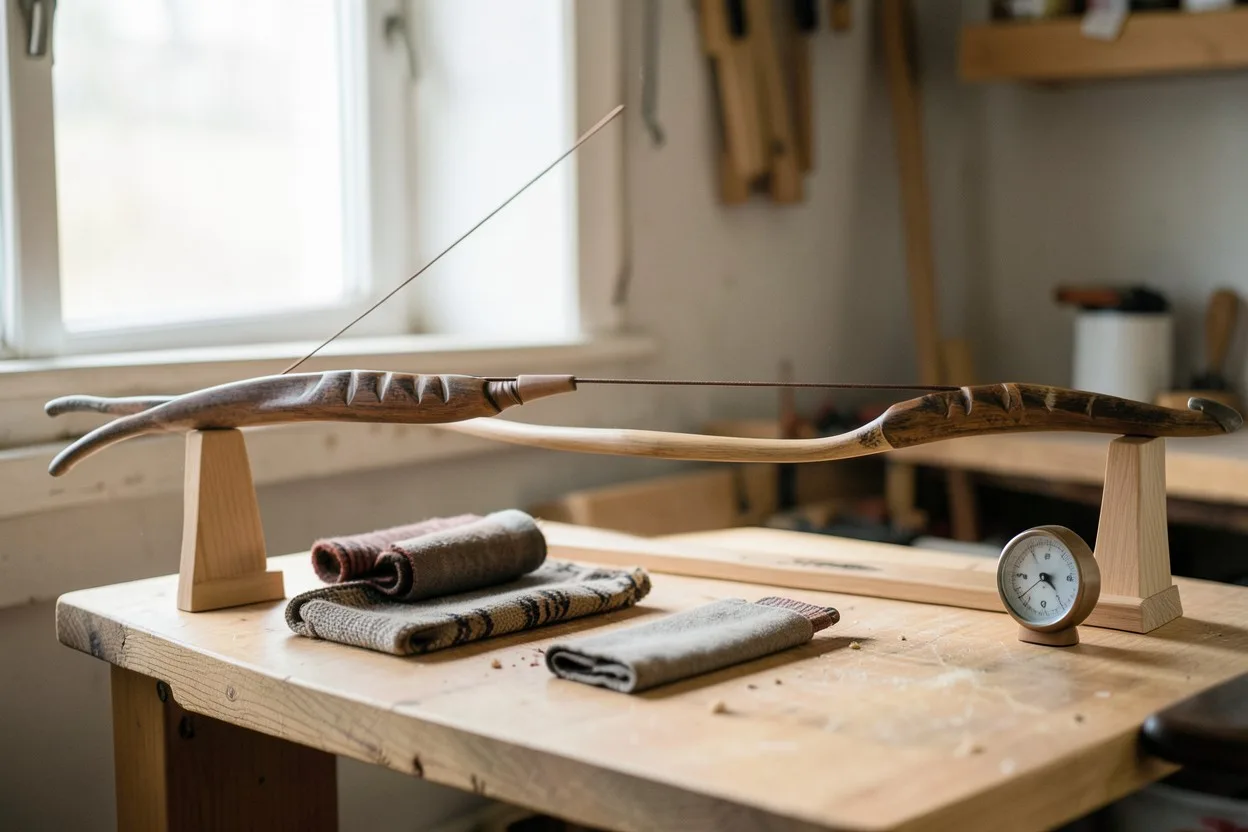
How to Care for a Native American Style Bow and Stay Straight
Care for a Native American style bow by keeping it straight through controlled moisture. I store it unstrung in a cool, dry room, aim for moderate humidity, and avoid large temperature swings. Bad care creates permanent set, twist, and limb creep, and that ruins cast and accuracy. This guide covers stringing, storage, climate control, cleaning, and twist/set fixes that work on self bows and replicas.


Why straightness fails in self bows (and how care prevents it)
Straightness fails when stress and temperature team up to push the wood into a new shape. In a self bow, limb fibers can creep under load, and uneven moisture can make one side move earlier than the other. My goal is straightness preservation, and I get there with storage position, stringing timing, brace height discipline, and tight climate control.
Set vs twist in wood: what they really look like
Set is a lasting bend that shows up after the bow sits under load, even if you relax it later. Twist happens when the bow stops tracking in the same plane, so the tips fight each other. When you see either one, you’re watching time, heat, and load rewrite the bow’s memory.
What “straightness preservation” means in practice
I treat care like risk management. I manage when the bow is loaded, where it rests, and what environment surrounds it. I also control the exact geometry I ask for each session, especially brace height, so the bow isn’t forced into a longer bend than the maker intended.
According to Bowmaking Basics — Significant twist over 20 degrees from tip to tip is not beginner-friendly. (source)
How do you store a Native American style bow so it stays straight?
Store a Native American style bow unstrung when it’s not in use. I keep it in a cool, dry room and I avoid point pressure on the tips. For me, rest position matters more than casual storage, because self bows are more sensitive to storage stress, and they follow the shape they repeat.
Self bow storage rule: best unstrung, best timing
A self bow is best unstrung when not in use. I follow the simple rule: string only before hunting, and unstring afterward. If you leave a self bow strung for long idle periods, you keep the limbs under constant tension while the wood sits through daily humidity swings.
Recurve vs longbow hanging differences
Recurves can often stay strung briefly, but I unstring them if the bow will sit unused for a while. Longbows are more forgiving over storage duration, yet I still avoid careless hanging because bottom-limb pressure changes how the limb carries load. Traditional bows should be hung horizontally to avoid bottom-limb pressure, and I avoid long-term vertical storage.
A daily/weekly check that catches twist early
Each time I pull the bow from storage, I do a quick same-day compare. I look down the limbs for mirror alignment, then I sight the tips at rest. If it looks different than last week, I stop before I shoot and adjust storage rather than forcing a tune.
Should you unstring a Native American style bow after shooting?
Yes for long-term care: I unstring a Native American style bow after I’m done shooting, and I only string it before the hunt. That timing matters because a self bow is more sensitive to storage stress. After practice, I also let it return to stable room conditions before it goes back into storage.
Switching between practice and storage
If I’m training for consecutive days, I treat the bow like it’s in use, but I still avoid long idle stretches strung. If it’s going to sit, I unstring. Recurve and training bows behave differently than self bows, so I don’t apply one rule to all traditional builds.
After-session cooling and re-check
After any long session, I give the bow time to come back to the same room temperature before I store it. Then I check brace height consistency and visible twist cues. My shop habit is simple: if the bow feels off, I inspect it. If it’s visibly off, I stop there.
Can you leave a traditional bow strung in a hot car?
No. Heat accelerates the risks that create set and locked-in twist, and leaving bows in hot cars and trucks ruins many bows. My practical rule is to unstring before any hot vehicle storage. If the day turns into a long wait, I bring the bow inside once it’s safe.
The hot-car rule and what to do instead
If I’m traveling, I unload and unstring before the vehicle gets fully heat-soaked. Once the bow is unstrung, I keep it out of sun and away from that near-engine warmth zone. For rest stops, I cool it down to stable indoor conditions before I store it for hours.
Cold mornings and indoor warm-ups
Cold can make wood feel stiff and strings less cooperative. I avoid storing a bow in extreme cold and then shooting immediately. In my routine, I let the bow reach stable temperatures in the same space I’ll shoot, so the first load doesn’t surprise the limb.
How do you string a Native American style bow without warping it?
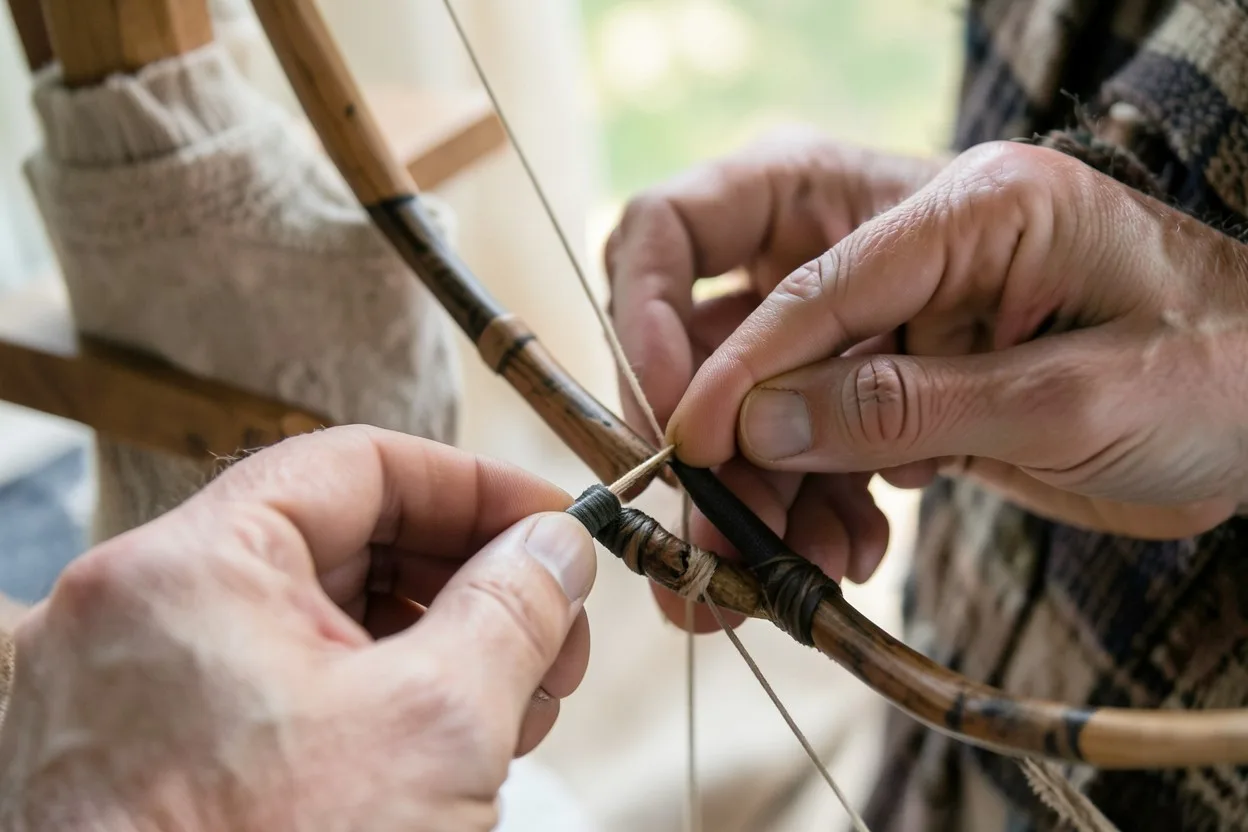
String with a bow stringer. A bow stringer is the correct and safest method for stringing because it protects the bow and the user, and it reduces shock-loading that can trigger uneven limb stress. I also keep brace height discipline by setting it to the maker’s recommendation and tracking it.
Use a bow stringer to reduce limb stress
When you string a self bow by brute force or by careless bending, you create sharp stress spikes at the tips and limbs. I use a bow stringer every time I’m responsible for the bow’s alignment. Safe stringing helps prevent warp and helps the bow repeat its geometry session after session.
Brace height discipline: within the maker’s range
Brace height should usually sit within half an inch of the maker’s recommendation.Too-long brace height can cause problems, especially when paired with light arrows or a string that has stretched more than you realized.
String inspection at string-up
Before I put load on a traditional bow, I look at nocks, loops, and wear points. If the string is frayed or unevenly seated, I don’t send it and hope. A bad seating point can create uneven limb behavior and mimic twist that’s coming from string mismatch.
What bowstring material should you use, and how often should you inspect it?
I match string behavior to the bow’s age and limb-tip tolerance. Older recurves and longbows were often built for B-50 Dacron strings, and in many cases older bows respond better to higher-give strings. Newer low-stretch materials can stress older limb tips, so I start by using a material that won’t force a mismatch in how the bow loads.
Waxing and inspection cadence
I wax and inspect on a predictable rhythm. For my own self bows and replicas, I check for fuzzing, flat spots, and loop wear before every session. Then I do a deeper look weekly, especially after damp weather. Regular wax also keeps the string consistent, not just for looks.
When the string is “good enough” vs when it’s time
Strings fail quietly. If I see uneven wear at the nocking points, fraying strands, or a noticeable change in how brace height settles over time, I replace rather than gamble. For straightness preservation, I treat string aging as a mechanical input. Once it changes, the bow’s load pattern changes too.
Before/after straightness checklist
This checklist is how I run a before/after inspection log so straightness problems don’t turn into mystery failures. I track limb alignment, stringing frequency, storage position, climate exposure, brace height consistency, and visible signs of set or twist. If the bow changes after rest, I adjust storage and string timing right away.
Straightness-preservation checklist with inspection log
| Check item | How to record (before/after) | Pass/Fail note | What it tells me |
|---|---|---|---|
| Limb alignment | Look down the limbs for tip-to-tip mirror alignment, note any shift | Mark Pass or Fail | Early twist cue or storage stress |
| Brace height consistency | Measure and record brace height each session after stringing | Mark Pass or Fail | If it drifts, string or fit may be forcing geometry |
| Visible twist markers | Use a reference point on each tip and note rotation at rest | Mark Pass or Fail | Uneven stress or string mismatch |
| Storage position | Note: unstrung/resting position or hanging method | Mark Pass or Fail | Bad resting can train set over time |
| Stringing frequency | Record when it was strung and unstrung | Mark Pass or Fail | Time under load drives creep in self bows |
| Climate exposure | Note heat/cold/damp exposure windows and duration | Mark Pass or Fail | Moisture gradients create uneven movement |
| Signs of set or twist | Document any lasting bend change after unstringing or rest | Mark Pass or Fail | Active problem, not a minor cosmetic issue |
| Arrow weight pairing | Record arrow grains per pound draw weight target | Mark Pass or Fail | Underweight arrows can stress limbs like a dry fire |
Simple pass/fail decision guide for self bows
- Fail condition: Visible twist or lasting set after unstringing and room-temperature rest.
- Fail condition: Brace height is drifting beyond the maker’s expectation (commonly more than about half an inch).
- Pass condition: Alignment is stable across two storage cycles and brace height returns to the same range after stringing.
- If you fail: Stop shooting, unstring if needed, and improve storage position and climate exposure before attempting any tune changes.
First-aid: what I do when straightness starts slipping
I treat this like a workflow. First I confirm whether the problem appears after rest, meaning storage-related, or only during shooting, meaning tune or load-related. Next I check string condition and brace height. Then I confirm I followed proper rules for the bow type: self bows unstrung when not in use, recurves unstrung if idle about a week, and longbows hung horizontally to reduce bottom-limb pressure.
How do arrow weight and draw stress affect keeping the bow straight?
Arrow weight affects straightness because limb stress affects wood memory. A good arrow weight rule is 10 grains per pound of draw weight, and lighter arrows can stress limbs like a dry fire. In my builds, correct arrow weight reduces uneven limb strain, so you’re less likely to treat storage failure as mysterious set.
Dry-fire and underweight risk
If you chronically underweight arrows, the bow runs a harsher stress profile. I’ve seen bows feel fine and still show geometry drift later, so I don’t chase straightness problems without checking arrow weight first. For straightness preservation, it’s part of the load equation.
Brace-height tie-in to stress distribution
Even when arrow weight is right, brace height that’s too long can force the limbs deeper than the maker intended. I keep brace height close to the recommendation and monitor consistency. If the bow’s brace height changes quickly, I look at string stretch and fit before blaming the wood.
Frequently asked questions
What is the safest way to hang a traditional bow at home?
Longbows should be hung horizontally to avoid bottom-limb pressure. For my shop, horizontal hanging is the rule whenever I’m storing a traditional bow that I don’t plan to unstring immediately. I avoid vertical standing that loads one limb direction for long periods. For self bows, I still prefer unstrung storage.
How often should a traditional bowstring be replaced?
I replace based on condition and straightness risk, not a calendar date. If waxing no longer smooths surface wear, if I see fraying, or if loops sit unevenly, I change it. I also remember that older recurves and longbows were often built for B-50 Dacron strings, and mismatched string behavior can stress limb tips over time.
What arrow weight is safe for a traditional bow?
I follow a simple rule of thumb: aim for at least 10 grains per pound of draw weight. Underweight arrows can stress limbs like a dry fire, and that kind of repeated harsh load can show up as long-term set or mystery straightness drift. I pair arrow weight with correct brace height and string condition.
How do you know if wood twist will cause a bow to take a set?
In my inspections, the tell is how the bow behaves after relaxing the load. If twist appears or increases after storage, and if it remains after the bow has had time to sit at room conditions, you’re likely dealing with set or creep rather than a temporary alignment issue. I also watch for early twist markers at the tips.
Why do modern bows have handles when Native American… Amateur bowyer/archer question: why yall put handles on when Indians didn’t?
I can’t speak for every maker or every historical build, but handles on modern recurve-style traditional bows often solve comfort, grip repeatability, and stability during aiming. On self bows, how you hold it and where pressure lands matters for consistency, so designs tend to match the construction and shooting method. In my shop, the safer priority is consistent grip pressure and correct brace height.