How Did Native American Archers Shoot From Horseback?
Native American archers, especially on the Plains, usually shot from horseback with short, light bows at close range. They often used a side draw or a brief anchor so horse and rider could stay balanced and keep the target in view. Bad timing or a long, awkward bow slows the shot and makes it unstable, which cuts accuracy and can spook the horse. This guide covers horse-bow design, riding position, release, and the practical ranges that made mounted archery work.
Why mounted archery mattered
Horseback changed speed, reach, and access on the Plains. It let hunters and war parties close distance fast, move with herds, and shoot while keeping pace with a moving target. That is why Plains mounted archery developed as a field system, not as a target-shooting style.
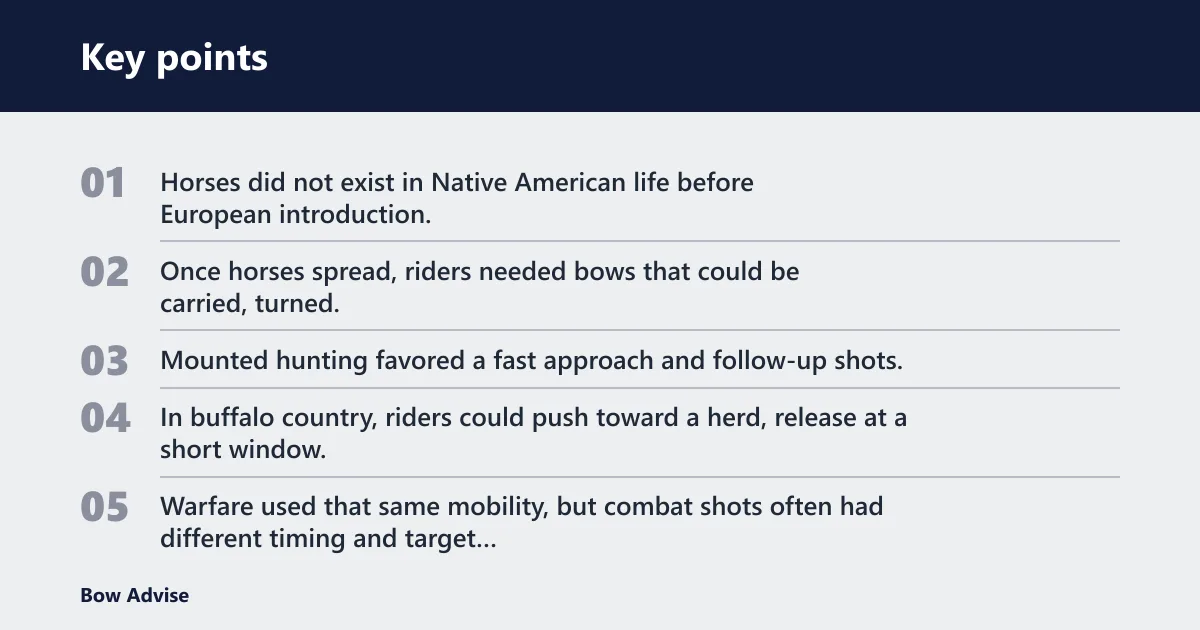
Horses did not exist in Native American life before European introduction, so mounted archery came later than foot archery. Once horses spread, riders needed bows that could be carried, turned, and fired in the saddle without snagging on the neck, mane, or horse gear.
Why mounted shooting fit hunting and warfare
Mounted hunting favored a fast approach and follow-up shots. In buffalo country, riders could push toward a herd, release at a short window, then take another shot if the horse still had room and the animal had not broken away. Warfare used that same mobility, but combat shots often had different timing and target windows than hunting shots.
The point was practical hits from a moving platform, not formal form.
Plains horse bow basics
The Plains Indian horse bow was usually short for maneuverability, often around 42–48 inches. Many examples were reflexed, and some had a gull-wing profile. That shape kept the bow compact in the saddle while still storing enough energy for a useful shot.
Mounted hunting and combat required shorter bows than bows used on foot. A long stave is harder to manage when the rider needs to turn, rise slightly in the stirrups, or shoot across the horse’s neck without clipping the animal.
Reflex, recurved, and gull-wing forms
Reflex and recurved shapes let a short bow behave more strongly than its size suggests. The limbs bend forward when unstrung, then store energy when drawn. On horseback, that mattered because a short bow had to do the work of a larger one without becoming clumsy.
The gull-wing profile also helped keep the bow lively in hand. Mounted use punishes slow gear.
Why sinew backing suited a short stave
Sinew backing used buffalo or elk sinew glued in layers to the back of the bow. That backing added speed, power, and resistance to breakage, which is especially useful when a short bow is asked to perform hard at a high draw weight. Some bows were also protected with rattlesnake skin.
Historical overviews describe mounted Plains bows as stronger and faster-shooting with sinew layers. A shorter stave can be pushed harder when the back is reinforced well.
How riders drew and aimed
Mounted archers usually drew farther toward the chest than a strict target archer would, and the anchor could be brief or adapted to the angle of the shot. One historical forum discussion notes that many Native archers anchored to the chest. That makes sense on horseback, where the rider must keep balance, sightline, and horse control together.
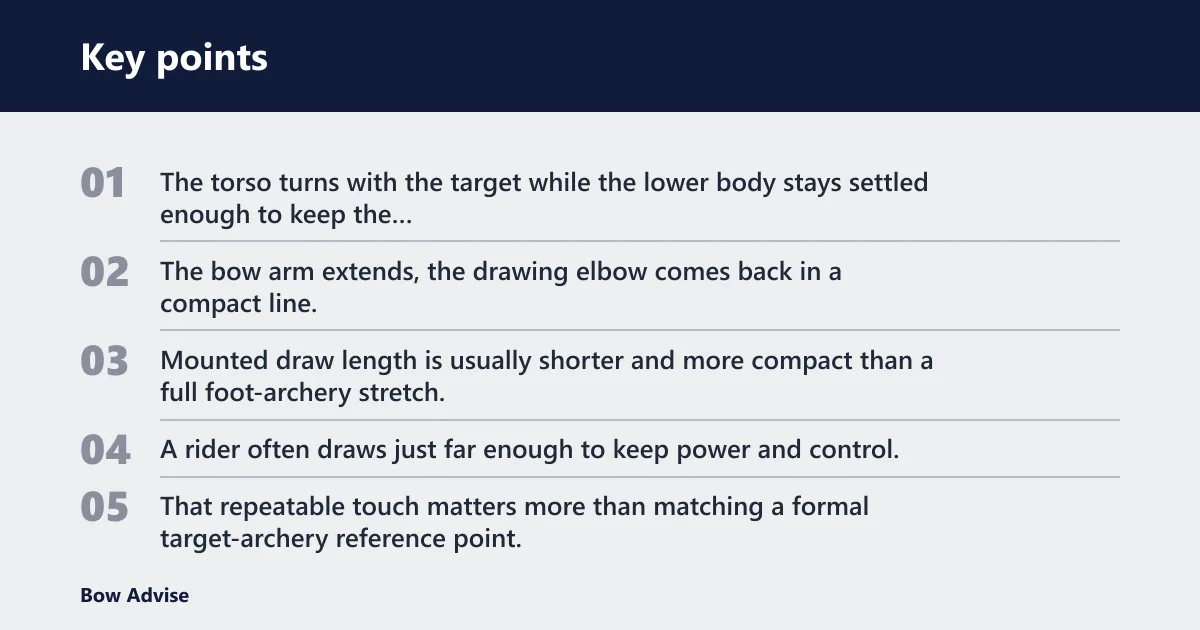
The key biomechanical change is rotation. The torso turns with the target while the lower body stays settled enough to keep the horse from being disturbed by the shot. The bow arm extends, the drawing elbow comes back in a compact line, and the release happens quickly before the angle changes again.
Compact draw length and chest-side anchor habits
Mounted draw length is usually shorter and more compact than a full foot-archery stretch. A rider often draws just far enough to keep power and control, then touches or approaches a chest-side anchor that can be repeated quickly. That repeatable touch matters more than matching a formal target-archery reference point.
Practical accuracy from horseback depends on reading distance and angle in real time. The shot window can vanish in a few strides.
Balance, timing, and release from a moving horse
The rider cannot freeze the body the way a standing archer can. A moving horse changes the platform, so the archer times the release between bumps or steps that would otherwise pull the sight picture off line. The shot has to leave the string cleanly before the horse’s motion breaks the aim.
Say your horse is moving at a steady lope and the target is broadside for only a moment. A long hold will usually spoil the shot; a compact draw and quick release are more likely to keep the arrow on line.
How did native american decision table
This table gives a field-use view of how bow setup affects horseback performance. It does not describe every Native tradition. It shows why Plains mounted use favored short, reinforced bows and why certain setups failed in motion.
| Bow length | Draw weight | Backing type | Likely horseback performance | Best fit |
|---|---|---|---|---|
| 42–48 inches | 50–70 lbs | Sinew-backed | Compact in the saddle, quick to turn, strong enough for hunting and war when the shot is close | Plains mounted hunting and combat |
| 42–48 inches | Below 50 lbs | Wood only or light backing | Easy to handle, but may lack punch on larger game or in combat with heavier arrows | Light mounted practice or smaller targets |
| 42–48 inches | Above 70 lbs | Sinew-backed or composite | Strong, but harder to draw cleanly at speed and more tiring on horseback | Specialized use for strong archers |
| Longer than 48 inches | 50–70 lbs | Any backing | More awkward around the horse, slower to turn, greater risk of striking tack or neck | Poor choice for mounted use |
| Too stiff for the arrow | Any practical weight | Any backing | Arrow flight suffers, especially at short range where a bad release shows fast | Failure case |
Failure cases on horseback
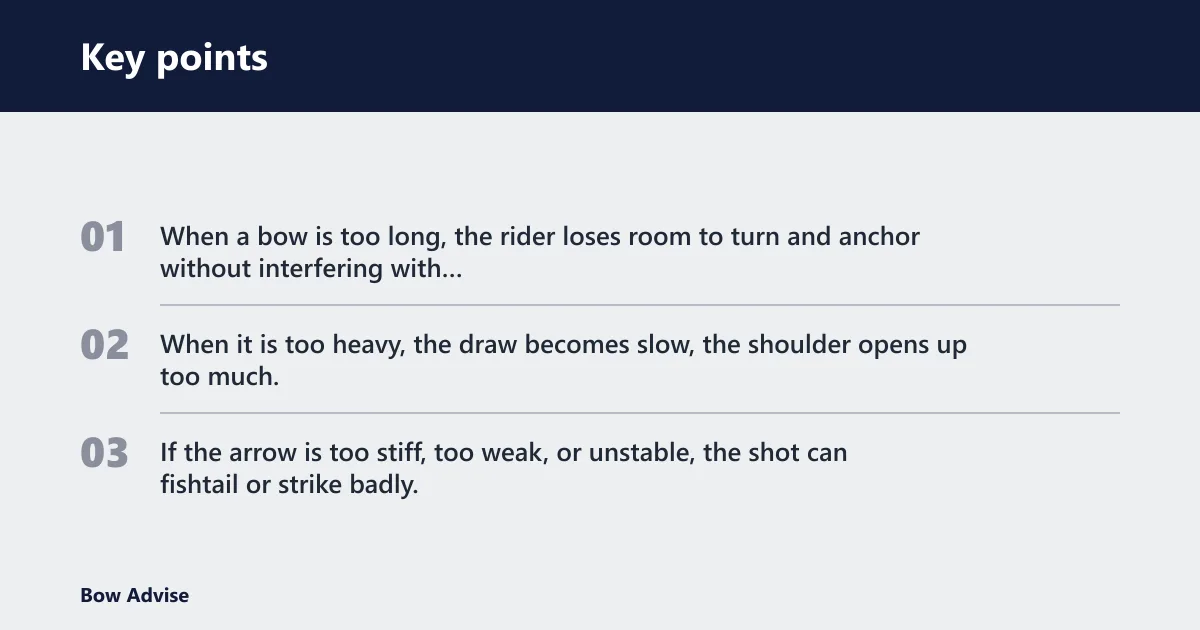
When a bow is too long, the rider loses room to turn and anchor without interfering with the horse. When it is too heavy, the draw becomes slow, the shoulder opens up too much, and the archer starts fighting the horse’s motion instead of shooting through it.
A poorly tuned bow is its own problem. If the arrow is too stiff, too weak, or unstable, the shot can fishtail or strike badly, which wastes the short window that mounted shooting depends on.
Arrows, shafts, and flight
Mounted archery depended on arrows that flew cleanly. Wooden shafts and reed shafts both are reported in historic use. Reed arrows sometimes had foreshafts, which could make the front end easier to strengthen or repair. Points could be made from stone, bone, wood, metal, or glass in later periods.
Straight shafting is essential. A bent or uneven shaft will not leave the bow well, and mounted shooting gives less time to correct a bad arrow in flight.
Fletching and spin
Proper fletching helps prevent tumbling. Feathers can also create spin, which stabilizes the arrow in the air. That matters even more on horseback, because the shot often comes fast and at a changing angle, with little time for a slow correction after release.
If the arrow is not tuned to the bow, the rider pays for it immediately in flight.
Mounted hunting range and targets
Close range was often used in buffalo hunting. Historical overview material notes that bows were used to hunt animals as large as bison and elk, and that hunters approached prey on foot or on horseback. Mounted hunters relied on speed to get into range and on quick follow-up shots if the first arrow did not end the chase.
Vulnerable areas were the aim. On large game, a mounted shot had to count, because the target could move, wheel, or disappear into the herd before a second careful shot was possible.
What riders aimed
Hunters did not shoot at random parts of the animal. They aimed for openings that gave the best chance of a fast, effective hit from a moving horse. That is one reason mounted archery was a field skill: the archer had to read anatomy, movement, and distance in the same moment.
Horseback and foot archery compared
Mounted archery and foot archery are related, but they are not the same system. On foot, the body can settle more fully, the anchor can be more formal, and the aim can be held longer. On horseback, the rider gives up stability to gain mobility, so the shot must be shorter, faster, and more forgiving of motion.
That is why field accuracy is a better yardstick than formal target form. Historical accounts and forum discussions both point to practical accuracy in conflict and food gathering, not to a static target range standard.
Stance, anchor, and timing differences
Foot archery allows a stronger brace through the legs and hips. Horseback shooting asks the rider to work with a moving base, keep the chest open enough to draw, and release before the horse changes the line. The anchor often becomes a quick chest-side touch instead of a fixed competition-style reference.
Suppose a mounted archer on a steady horse can draw smoothly but waits too long to release. The horse’s step shifts the line, and the arrow lands off the mark. On foot, the same archer might have held the aim longer and corrected the line more easily.
Frequently asked questions
How did Native American archers shoot from horseback?
They used short bows, compact draws, and quick releases while keeping the horse moving in a controlled line. The draw often came toward the chest, the anchor could be brief, and the archer rotated the torso enough to keep the target in view without upsetting balance. Accuracy came from timing, not stillness.
Did Native American horse archers use short bows?
Yes. Plains mounted bows were typically about 42–48 inches, which made them easier to handle on horseback. Short length helped the rider turn, draw, and release without striking the horse or tangling with tack. The shorter stave also paired well with sinew backing for added strength.
How accurate were Native American archers on horseback?
Accurate enough for field use when the range was close and the archer was skilled. Mounted shooting was not the same as standing target shooting, so the standard was practical hit probability under motion. Historical accounts describe effective use in hunting and conflict, but never as a calm, fixed-platform shot.
What kind of bow did Plains Native American horsemen use?
They commonly used short Plains horse bows that were often reflexed or gull-wing shaped and frequently sinew-backed. Buffalo or elk sinew was glued in layers to the back of the bow. That construction helped a short stave stay powerful, fast, and resistant to breakage in mounted use.
Did Native Americans use an anchor point when shooting from horseback?
Yes, but it was usually more practical than formal. Many archers anchored to the chest or used a short, repeatable touch that fit the motion of the horse. The goal was consistency under movement, not a rigid target-archery style that would be hard to keep in the saddle.
Were Native American bows strong enough for buffalo hunting?
Yes, especially on the Plains where mounted bows were often described at 50–70 pounds. That power level, paired with sinew-backed or composite construction, was suitable for hunting bison and elk at close range. The bow had to be strong, but the shot still depended on the right angle and distance.