Native American Archers Aimed Without Sights: Guide Now
Many traditional archers anchored the bow in a consistent way, drew to a repeatable length, then held the arrow tip at a learned “range spot” using distance judgment, with around 20 yards as the coaching yardstick. Bad anchors or sloppy range judgment turn that spot into an unknown, so groups spread and game shots miss or wound. I’ll cover how to build that range map today using consistent form, anchor habits, and hold-over practice.


What did “aiming without sights” actually mean?
“No sights” is mechanical reality, not a lack of aiming. The aiming behavior still happens: you repeat the same draw length, lock the same anchor, and let the arrow’s direction come from body geometry plus a learned hold over the target. Distance judgment replaces sight marks, and the best shot sequence stays identical.
When people picture sightless shooting as staring at the target and hoping, they miss the system. In my shop and on the line with beginners, the difference between “wild” and “repeatable” is almost always the same three parts: repeatable face reference, stable release timing, and a consistent way to interpret distance. Native American bows were hand-made from natural materials, and those hunters practiced for hunting and war where time, posture, and distance vary.
According to Instinctive Archery: 7 Steps to Aim Without Sights (2026) — Many beginners can group tightly at 15 yards within a few months of daily blank-bale practice. (source)
How accurate were Native American bows without modern sights?
Accuracy without sights came from repetition and learned distance judgment, not from perfect measurement. Instinctive archery is built through thousands of repeated identical shots, so the body learns the motor pattern and the arrow lands where the shooter expects.
Two practical realities shape what “accurate” means in the field. First, distance judgment was part of the job, especially for traditional bowhunting where shot execution is fast and distances are unknown or variable. Second, every arrow launch is distance-dependent because arrow trajectory changes with draw length and release consistency.
That’s why tuning matters even without sights. If your draw length drifts, your release timing changes, or your bow oscillation is inconsistent, your “range spot” won’t stay put. I’ve watched the whole process fall apart after a shooter starts creeping the anchor to “make it look better.” You can’t out-aim a moving anchor with good intentions.
Did Native American archers use instinctive aiming or gap shooting?
Both were practical options, and the choice depended on shooter comfort, distance, and the target situation. Instinctive aiming leans on subconsciously learned timing and single-spot focus, while gap shooting adds a visual reference from the arrow tip as distance changes. In the field, hunters used the method that stayed repeatable under speed and wind.
If you need more conscious control because the distance sits outside what you’ve trained, gap shooting gives you a stable reference point. Split vision aiming can bridge the two when you need form checks without giving up target focus.
Instinctive aiming as a target-focused release
Instinctive archery uses no sights, marks, or conscious aiming reference. The archer focuses on the target and releases, while subconscious motor patterns repeat the launch. The method works best when the shooter runs the same broadhead-sized spot focus and keeps a stable shot rhythm.
One detail that helps beginners right away: many people “search the target” with their eyes. Instinctive aiming does the opposite. Focus on a single broadhead-sized spot, not the whole target face. F1 and F2 aren’t trivia to me; they’re training directions. I see group tightening when the shooter builds a stable routine and stops altering the form halfway through.
Common breakdown: changing the sequence
Instinctive aiming breaks down when you change the anchor, change draw pressure, or drift the release rhythm. Even a small face-reference shift acts like changing your rear sight between shots. Firing faster, adding extra torque, or “checking” where the arrow went after the draw interrupts subconscious learning, and the next shot becomes a guess.
My body finally repeated the same alignment with less squirming, and that steadiness kept the instinctive shot sequence intact.
What is the anchor point in traditional archery?
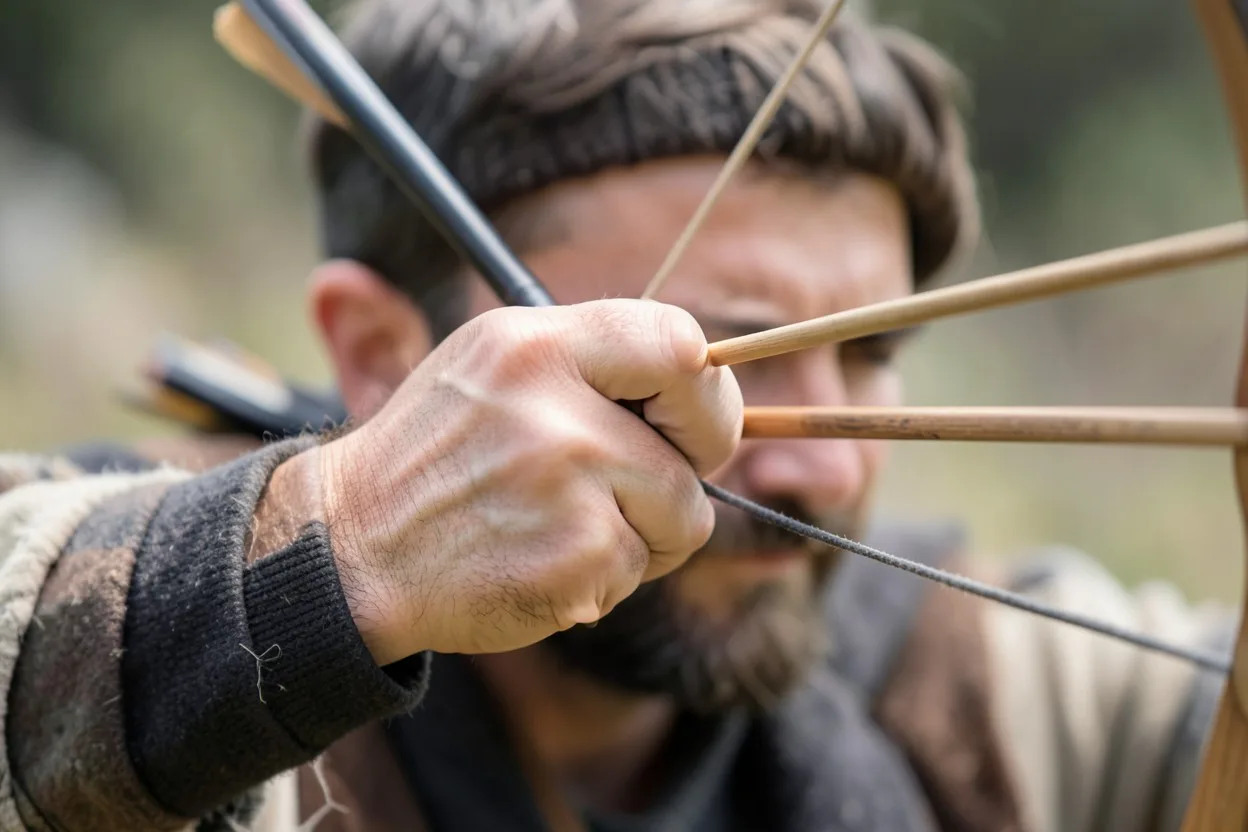
Anchor point is a repeatable face reference that functions like a rear sight in sightless shooting. Common references can include the corner of the mouth or a tooth reference, and the key is that it does not drift between shots. When anchor point stays consistent, release alignment and timing become repeatable, which stabilizes arrow flight.
F5 is why anchor talk matters: a repeatable anchor point is described as the archer’s rear sight. When you anchor the same way every time, your body geometry stops “re-solving” the shot. That’s how you keep the arrow’s direction consistent enough for a learned hold-over.
Anchor consistency ties to arrow flight
Arrow trajectory is distance-dependent flight path, affected by consistent draw length and release. If your anchor changes, your release alignment changes. If your release timing changes, the bowstring leaves at a different point in the system, and your “range spot” no longer matches your actual launch.
In my own tuning sessions, I treat anchor drift like a tuning problem in disguise. I’ve seen it after a shooter changes stand posture or turns their head to “look down the fletching.” Under speed, it shows up fast. Under stress, it shows up as missed range and poor impact placement.
How do you practice shooting without sights?
Practice uses blank bale training to remove visual aiming references and force form and release consistency. F3 also matters: many beginners can group tightly at 15 yards within a few months of daily blank-bale practice.[3]
Start close, keep the same anchor, and focus on the same broadhead-sized spot behavior. Then move farther and add speed only after groups stop drifting. When you move to targets, keep your sightless process: learn a hold-over that matches your setup and tuning.
Blank bale drill progression
F4 is a practical cue here: focus on a single broadhead-sized spot, not the whole target face. On a blank bale, you’re training the release and the anchor to produce repeatable arrow flight, not chasing impact with your eyes.
Once the shot sequence is stable, you can add field-relevant speed. Traditional bowhunting isn’t a slow, perfect draw. It’s a calm process performed while your body wants to rush.
What is split vision aiming in traditional archery?
Split vision aiming is a middle ground between instinctive and dedicated aiming. F7 describes it as a hybrid approach, and the key is how attention moves: you alternate between target focus and local sight-picture checks. Instead of aiming with a pin, you check the bow hand, riser area, or arrow tip position while keeping the shot rhythm.[2]
For beginners, this matters because form errors hide when you only look at the target. Split vision gives you permission to check cues without turning your whole focus into a “sight archer” routine. I use it when someone’s groups look good but the consistency breaks, or when they shoot fine at slow pace and fall apart during faster shots.
When split vision helps most
Split vision aiming works best when you’re learning form consistency, then reducing conscious control at speed. If you can’t repeat your anchor, your “middle ground” becomes a distraction. Once anchor and draw length are stable, checking local cues can prevent bad releases while you keep the target as the main reference.
What is the difference between instinctive aiming and gap shooting?
Instinctive aiming uses a single spot focus and a subconscious release, with no sights or conscious aiming reference. Gap shooting is more deliberate: it uses the arrow tip or fletching as a reference, and the visual gap changes with distance. F8 and F6 frame the intent. Gap shooting depends on arrow trajectory, and it helps when you need trajectory control beyond your instinctive comfort zone.
Instinctive aiming is fast and forgiving of unknown distances when your shot sequence stays repeatable. Gap shooting is for repeatable anchor and consistent release where you can manage the distance-dependent hold. In stress, I’ve seen most shooters do best when they choose the method they practiced, not the method they think sounds smarter.
Why does anchor consistency matter when shooting without sights?
Anchor consistency matters because it acts like a rear reference for your body. F5 says it plainly, and you feel it the first time your anchor drifts. A moving anchor changes release alignment and timing, which changes arrow trajectory. Then your learned hold-over becomes wrong, and groups spread even if your bow tune is solid.
F2 makes the training consequence clear: instinctive archery is built through thousands of repeated identical shots. If “identical” changes because your face reference changes, your muscle memory learns the wrong pattern.
Why Most Archers Aim the Wrong Way — A very common mistake is staring at the sight pin and trying to hold it perfectly still on the target.
That mistake exists because aiming with sights encourages pixel-level control. In sightless shooting, you can’t hold a pin steady because you don’t have a pin. If you stare too hard, you’ll tension up and your anchor will drift. I tell beginners to pick their spot behavior, run the same sequence, and stop micro-correcting during the draw.
In compound or modern setups, staring at a sight pin becomes a crutch. In traditional bowhunting, that habit costs time and consistency. Under stress, trying to “freeze” the picture turns your release into a variable. Sightless aiming rewards calm repetition instead.
Sightless aiming method matrix
| Method | Distance range fit | Target type | Typical errors | Best practice drill |
|---|---|---|---|---|
| Instinctive aiming | Field-ready distances you’ve trained | Broadhead-sized scoring zone; hunting-style targets | Changing anchor mid-shot, searching the whole target face, rushing the release rhythm | Blank bale practice: blank target, single broadhead spot focus, identical draw-to-release sequence |
| Gap shooting | Beyond your instinctive comfort using trained holds | Marked targets or repeatable spot/zone | Inconsistent draw length, referencing the wrong arrow point, forgetting that visual gap shifts with distance | Measured step gaps: anchor the same, then record a repeatable arrow-tip-to-target gap at each distance |
| Split vision aiming | Learning-to-run ranges when form needs checking | Paper targets transitioning into hunting-style zones | Over-checking cues and slowing the shot, inconsistent attention shifts, anchor drift during the “check” | Form-check alternation: keep target focus, then briefly check arrow tip/bow hand after the draw before releasing |
They replace a sight with an imaginary one, then lock tension into their face and shoulders. The fix is boring on purpose: anchor the same way, focus on the correct spot behavior, and use blank bale to build the correct motor pattern.
How distance judgment fits into each method
Distance judgment isn’t the same thing as measurement. For instinctive aiming, your distance mapping comes from practice sequences that train where the arrow lands. For gap shooting, F8 matters: gap shooting depends on knowing arrow trajectory and the arrow-tip-to-target relationship, so your visual gap becomes a learned stand-in for distance. Split vision helps because it reduces form mistakes while you maintain target focus.
How do you practice shooting a bow without sights?
Use blank bale training at close range to stabilize form and release without any aiming reference. F3 says many beginners can group tightly at 15 yards within a few months of daily blank-bale practice, and I’ve seen that happen when they stop “fixing” shots and commit to a repeated sequence. Then progress distance and speed.
When you start adding distance, you have two safe paths: keep instinctive aiming and expand your trained range spot, or add gap shooting for deliberate trajectory holds. Arrow trajectory changes with draw length and release, so your practice must keep draw length consistent. Under speed, your anchor and timing are the first things to drift, so practice those transitions.
Frequently asked questions
How did Native American archers aim without sights?
They relied on practice-built motor habits, repeatable anchor, and distance judgment rather than sight marks. F1 notes that instinctive archery uses no sights, marks, or conscious aiming reference, and F2 says it’s built through thousands of repeated identical shots. In hunting, the shooter’s form and learned hold-over replaced external aiming tools.