Arrow Direction After Release: What a Good Flight Path Looks Like
A good arrow flight path has a clear pattern: clean launch, short oscillation, then straightening before impact. Fishtailing, porpoising, or sideways kick that keeps repeating points to tuning or form trouble. Leave it alone, and you waste time, lose accuracy, and may chase the wrong fix. This guide shows the arrow’s motion after release, from the first inch off the string to a stable line downrange, so you can separate normal behavior from setup errors.
Arrow motion in the first few yards

Good flight begins with a clean release, followed by a brief shaft movement, then a steady run toward the target. The arrow does not move like a rigid dart; it travels on a parabolic arc. By about 10 yards and beyond, the arrow must rise above the shooter’s line of sight before it drops again.
For a beginner, “good” usually means the arrow leaves the string without a visible kick, shows only a short wiggle, and settles fast. The exact look changes with arrow speed, bow setup, and distance. That is why bowhunters should map their own setup on the range instead of copying a generic picture of flight.
What normal motion looks like in the first yards
The first few yards often tell you the most. A released arrow can oscillate as it leaves the string, and the shaft can vibrate while the bowstring pushes it. That movement is expected. It should be brief, and it should shrink as the arrow moves away from the bow.
A clean shot usually shows the point moving downrange without a hard sideways snap, then the shaft settling before it reaches the target. Fletching then provides most of the arrow’s orientation correction, helping the shaft calm down and hold a stable nose attitude.
What clean flight should look like by the target
By the time the arrow crosses the lane, it should look settled, with the point and tail tracking in the same general direction. A stable arrow should not show much lift, but yaw or pitch can create it. If the tail keeps wandering late in flight, the setup or release needs attention.
Why arrows follow a curved path
An arrow’s actual path is curved because gravity acts on it the moment it leaves the bow. The line of sight from your eye through the pin is only an aiming reference. The arrow’s path and your line of sight are different things, and the gap between them grows with distance.
Drop increases as range increases. That is normal, not a fault. A faster arrow needs less correction for the same distance, while a slower setup needs more. Sight pins and longer pin setups exist to account for that drop, with the first pin distance depending on speed and arrow setup.
Line of sight versus actual arrow path
The pin may sit on the target, but the arrow still follows its own arc. At shorter range, the gap between line of sight and flight path is small. At longer range, the arrow drops farther below the aiming line and the pin gap grows.
This is why a 20-yard pin and a 30-yard pin are often used for different jobs. Many hunters also set a longer pin or farther reference for extended shots. The pin is an aiming tool. The arrow path is physics.
What archer’s paradox means in flight
Archer’s paradox is the reason the shaft can seem to bend around the bow during release. The arrow is not rigid in the instant it leaves the string. Lateral string movement pushes the shaft aside, and the arrow flexes, then recovers into flight.
That bend is expected. It comes from how the string releases and how the arrow reacts to the bow’s force. A clean paradox movement is short and controlled. A bad tune or poor release can turn that expected flex into repeated fishtailing.
Expected bend versus a fault
Expected bend happens right at launch and fades quickly. Fault movement stays visible longer, wanders harder left and right, or comes with obvious nock kick. If the tail keeps slapping side to side several yards downrange, the shot is no longer behaving like normal paradox.
On a recurve, this can show up as spine mismatch, plunger setting issues, or a grip that torques the riser. On a compound, rest contact, nock height, cam timing, or a bad release can show up first in the flight.
How can you spot bad flight cues?
Bad flight usually appears as a pattern, not one loose wiggle. Fishtailing means the arrow moves back and forth around its travel line. Porpoising is vertical wobble, often nose-up then nose-down. Either one suggests the arrow is not leaving cleanly or not matching the bow well.
Do not confuse a short, normal oscillation with a true flight fault. The key difference is duration and severity. Healthy motion fades. Problem motion repeats, grows, or stays obvious after the arrow has left the bow and started its downrange run.
Fishtailing versus steady tracking
A fishtailing arrow shows side-to-side tail movement soon after release. A steady arrow shows only a brief flex, then the shaft tracks straight relative to its own path. If the tail keeps yawing while the point hunts left and right, look first at nock fit, release quality, or spine.
Porpoising and vertical wobble
Vertical wobble points more often to nock height, rest height, timing, or a release that drives the string downward or upward. On a compound, rest timing and center-shot alignment matter. On a recurve, arrow spine and nocking point height often show up quickly in this pattern.
Signs that point to spine, rest, or nock issues
If the arrow leaves cleanly but lands with a repeating left or right miss, the spine may be mismatched. If the tail slaps or contact marks appear on the rest or fletching, look for interference. If the arrow starts straight but then kicks, the nock or string release may be the first place to check.
Say your compound sends arrows cleanly at 20 yards but the tail still kicks left at 40 yards. That can point to a setup that looks acceptable close in but shows weak spine response or minor rest issues as distance magnifies the problem. The shot did not “turn bad” later. The setup made the flaw easier to see.
What the first 5 flight cues show
The first few visible cues after release tell you where to look. These cues do not need high-speed gear. A phone video, a side view from the range, or even careful eye tracking can reveal whether the shot is clean, unstable, or affected by the environment.
Use the sequence below in order. The earlier cues often point to release quality and bow setup. The later cues often show how well the arrow has recovered and whether it is settling into stable flight.
- Watch the string launch.
- Watch the nock leave the string.
- Watch the shaft’s first oscillation.
- Watch vane or fletching correction.
- Watch the arrow stabilize downrange.
Arrow flight checklist
This checklist separates normal arrow behavior from warning signs. Use it on the range while watching the first about 1 to 10 yards after release. A good flight path is short, repeatable, and predictable for your exact bow and arrow combination.
| First visible cue | What normal looks like | What abnormal looks like | Most likely cause |
|---|---|---|---|
| String launch | String moves cleanly, with no obvious slap or jump | Hard jump, noisy kick, or visible hand torque | Grip torque, poor release, or bow setup inconsistency |
| Nock travel | Nock leaves straight with only brief flex | Nock kicks high, low, left, or right | Nocking point, rest contact, or release problem |
| Shaft oscillation | Short side-to-side or up-down vibration that fades quickly | Repeated fishtailing or porpoising past the first few yards | Spine mismatch, tuning error, or poor release |
| Fletching correction | Vanes begin to steer the shaft into a steadier track | Vanes appear to fight visible wobble or contact | Rest contact, arrow clearance issue, or broadhead sensitivity |
| Downrange stability | Arrow settles and holds a consistent path to impact | Tail continues wandering or the point drifts erratically | Bow tuning, wind drift, or spine issue that shows at distance |
How setup, wind, and distance change flight
Bow setup changes the first moments of flight. String release quality, sight pin zero distance, and tuning consistency all shape how the arrow leaves the bow. The same arrow can fly differently from a recurve than from a compound, and it can also change with a different rest, nock fit, or shaft weight.
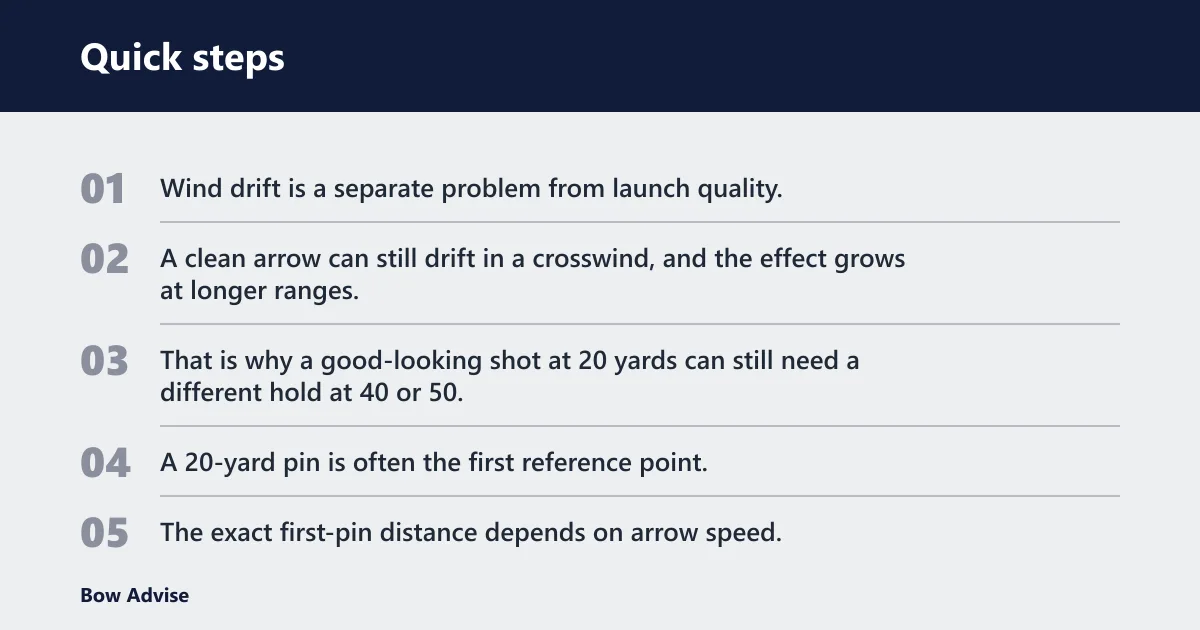
Wind drift is a separate problem from launch quality. A clean arrow can still drift in a crosswind, and the effect grows at longer ranges. That is why a good-looking shot at 20 yards can still need a different hold at 40 or 50.
Sight pins, drop compensation, and target gap
Sight pins exist to account for drop. A 20-yard pin is often the first reference point, with a 30-yard pin or longer setup used for farther shots. The exact first-pin distance depends on arrow speed, so the setup must be matched to the bow and arrow, not copied from another archer.
The target gap, or shooting window, is the useful distance band around the pin zero where your hold is practical for a given shot. That band changes with speed and setup. For hunting shots, that matters because small differences in range can change the hold more than a beginner expects.
Wind drift and longer ranges
Wind changes the arrow flight path without changing the basic quality of launch. The arrow can leave cleanly and still drift. The farther it travels, the more time the wind has to move it. That is why wind correction often matters more at 40 yards than at 20 yards.
Picture a 30-yard shot on a breezy afternoon. The arrow leaves with no fishtail, but the impact is still a little off center. That is a wind problem, not a launch problem. If the same arrow also shows a hard tail kick, then wind is not the only issue.
Recurve and compound differences
Recurve arrows often show more visible paradox because the shaft must react around the riser during release. Compound arrows usually show less visible bend, but they are more sensitive to rest timing, nock fit, and release execution. The same visual cue does not always mean the same fault on both bow types.
For a recurve, weak spine or poor nocking point height often shows early. For a compound, rest contact and timing can create a late kick or tear pattern. The bow type changes what you should suspect first.
When should you use bare shaft testing?
Bare shaft testing is most useful when the arrow’s flight cues point to spine, rest, or nock problems and you need a clearer read than fletched arrows provide. It is especially helpful when the arrow appears to leave cleanly but the groups still show a repeatable left-right or up-down bias.
Use it to compare a fletched shaft with an unfletched shaft at the same distance. That can separate tuning problems from fletching correction. It also helps when visual checks are unclear and the bow keeps giving mixed signals.
When visual checks are not enough
Visual checks can miss small contact issues, especially if the arrow looks stable by the time it reaches the target. Bare shafts remove the correction help from fletching, so tuning errors show up more clearly. That matters when you are sorting out spine, rest height, or nock position.
If the bare shaft hits well away from the fletched group, the setup likely needs tuning before more guessing. If both behave the same, the problem may lie more in release or sighting than in the shaft itself.
Frequently asked questions
What does a good arrow flight path look like after release?
A good arrow flight path starts with a clean launch, shows brief oscillation, and then settles into a stable downrange path. The arrow still follows a parabolic arc, so it is not straight. What matters is that the motion fades quickly instead of turning into repeated fishtailing or porpoising.
How can I tell if my arrow is fishtailing or flying cleanly?
Fishtailing looks like the tail moves side to side after release and keeps doing it longer than a short normal wiggle. Clean flight shows only a brief flex, then the arrow steadies. A phone video from the side can help, but even by eye you should see the wobble fade fast.
What is the difference between arrow oscillation and true arrow direction?
Oscillation is the shaft’s short vibration after the string pushes it. True direction is the actual downrange path of the arrow as it travels toward the target. The two are related, but they are not the same. A brief wobble can be normal even when the arrow is still headed correctly.
How much arrow drop should I expect at longer ranges?
Some drop is expected at every distance, and it increases as range increases. Arrows must rise above the shooter’s line of sight past about 10 yards, then fall through the target window as distance grows. Faster setups usually need less holdover, but the exact amount depends on your bow and arrow combination.
How do wind and distance change arrow flight path?
Wind drift pushes the arrow off its line even when launch is clean. The longer the arrow is in the air, the more time wind has to move it, so the effect is larger at longer range. Distance also magnifies the visual gap between your pin and the actual arrow path.
What does arrow path tell me about spine, rest, or nock problems?
Left-right tail kick often points to spine mismatch, rest contact, or a release problem. Up-down wobble often points to nock height, rest height, or timing. If the arrow looks fine at first but drifts or kicks later, the setup may be close but not consistent enough for the bow and shaft combination.
Why does an arrow move differently in the first few yards after release?
The first few yards are where the bow’s force, the string release, and the shaft’s flex all happen at once. The arrow can oscillate during its release and vibrate as it leaves the string. That motion is normal if it is short and fades quickly. It becomes a problem when it stays visible.
When should I use bare shaft testing to diagnose arrow flight?
Use bare shaft testing when the visual pattern suggests a tuning issue but the cause is not obvious. It is useful for checking spine, rest contact, and nock height. If the bare shaft groups very differently from the fletched arrow, you likely have a setup issue that needs correction.