Why Arrows Corkscrew in Flight
Arrow corkscrew flight often comes from a spinning shaft, a broadhead, or lighting, not from true instability. If the point group is tight and bareshafts track with fletched arrows, the arrow is usually flying well. A real instability can hurt broadhead accuracy, open groups, and hide clearance or tune problems. This guide separates optical illusion from true flight error, then follows the cause through arrow type, lighting, clearance, and bow tune.
This guide is part of our Arrow direction guide for archers series.
Corkscrew flight: what it usually means
“Corkscrew” can mean three different things: the arrow is actually yawing, the shaft is rotating normally and only looks wobbly, or the view is distorted by light and background. The first matters for impact. The other two can waste time if they are treated as a tuning fault too early.
True instability versus visible rotation
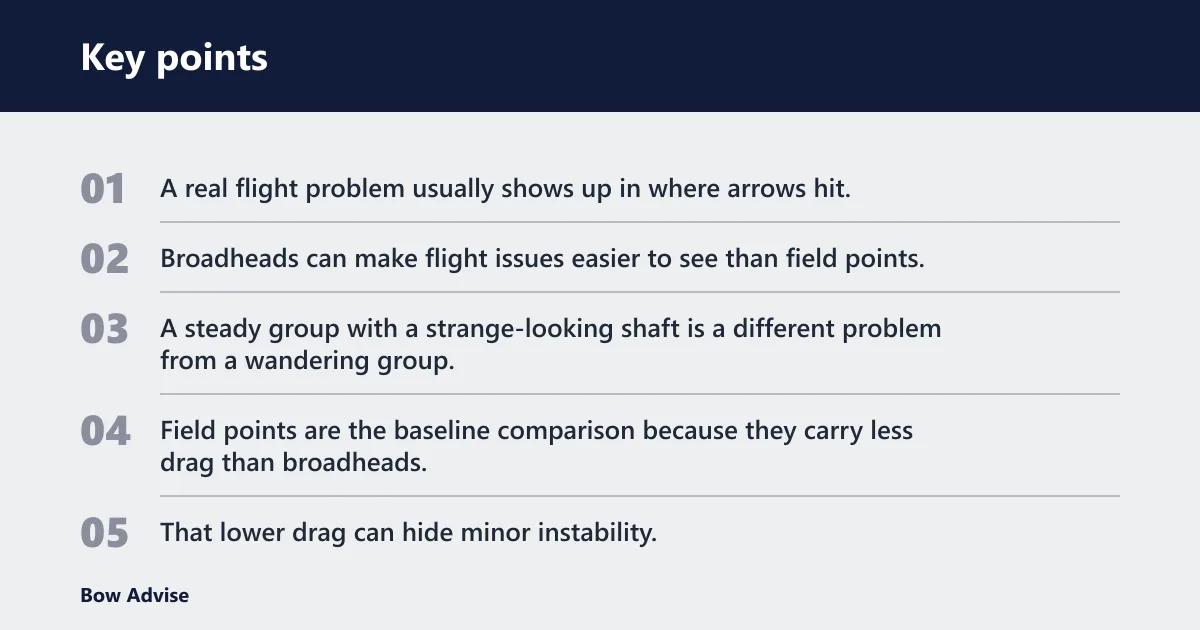
A real flight problem usually shows up in where arrows hit, not only how they look in the air. Broadheads can make flight issues easier to see than field points, and they can expose small alignment problems that field points hide. A steady group with a strange-looking shaft is a different problem from a wandering group.
Field points are the baseline comparison because they carry less drag than broadheads. That lower drag can hide minor instability, so a field-point group that looks perfect does not always clear the bow, spine, or tune. Broadheads are often the first place a small problem becomes visible.
When a steady group matters more than the spin
If field points and broadheads group closely, and bare shafts track with fletched arrows, the visible “corkscrew” may be normal arrow rotation or a lighting artifact. The impact pattern matters more than the air picture. That is especially true when the bow is a compound with a near-clean tune or a recurve with consistent loose form.
Say your 30-yard field points stack in a tight cluster, but the arrow looks like it is weaving as it passes through a bright gap in the woods. If broadheads land with the same center and bare shafts are close, the visual effect is more likely rotation plus light contrast than a true flight fault.
Why arrows look different in shade and sun
Shade-to-sun transitions can sometimes create a false corkscrew effect. The shaft may be rotating normally, but moving from dark shade into bright sunlight changes edge contrast so the eye reads motion that is not there. Vane color contrast can do the same thing, especially against a busy or high-contrast background.
Shadow edges and motion blur
When an arrow crosses a sharp shadow edge, the eye gets a stuttered image. That can make a straight, spinning shaft look unstable. A member in one discussion described the apparent wiggle as an optical illusion from shooting through shadows, which is a useful reminder to check the viewing condition before changing the setup.
Vane color contrast against the background
Bright vane colors can look especially odd in mixed light. A reply noted that vane color contrast can make the arrow look wonky when the background changes. That does not mean the arrow is wandering off line. It may only mean the eye is losing a clean reference point.
When the wobble is only a visual artifact
Look for a clear pattern: the arrow seems to wobble only in sun-to-shade transitions, only against certain targets, or only when the vanes flash at a bright angle. If the target face and grouping stay the same while the visual effect comes and goes, stop treating it as a flight fault until other checks disagree.
Why arrows corkscrew troubleshooting matrix
This matrix separates four common cases. Use it after one change at a time, not after a pile of adjustments. The short checkpoint at the end of each row matters. Do not change anything else until that test is read.
| Symptom | Likely cause | Quick check | Next adjustment |
|---|---|---|---|
| Field points group poorly, broadheads also open up | Bow tune, spine, or clearance issue affecting all arrows | Compare bare shafts and paper tears at 6, 8, and 10 feet | Check rest center-shot, nock fit, and spine before changing broadheads |
| Field points group well, broadheads hit off line | Broadhead drag is exposing a small tune or spine mismatch | Shoot the same shaft with a field point, then the broadhead | Inspect rest alignment, then make minor bow adjustments |
| All arrows look like they corkscrew in flight | True instability, fletching contact, or under-spined setup | Watch for vane contact marks and compare bare shafts | Check rest clearance, vane spacing, and arrow spine first |
| Only in shade-to-sun transitions, or with bright vanes | Optical illusion from contrast and angle | Repeat the shot in even light with the same target face | Do not change anything yet; confirm with another light condition |
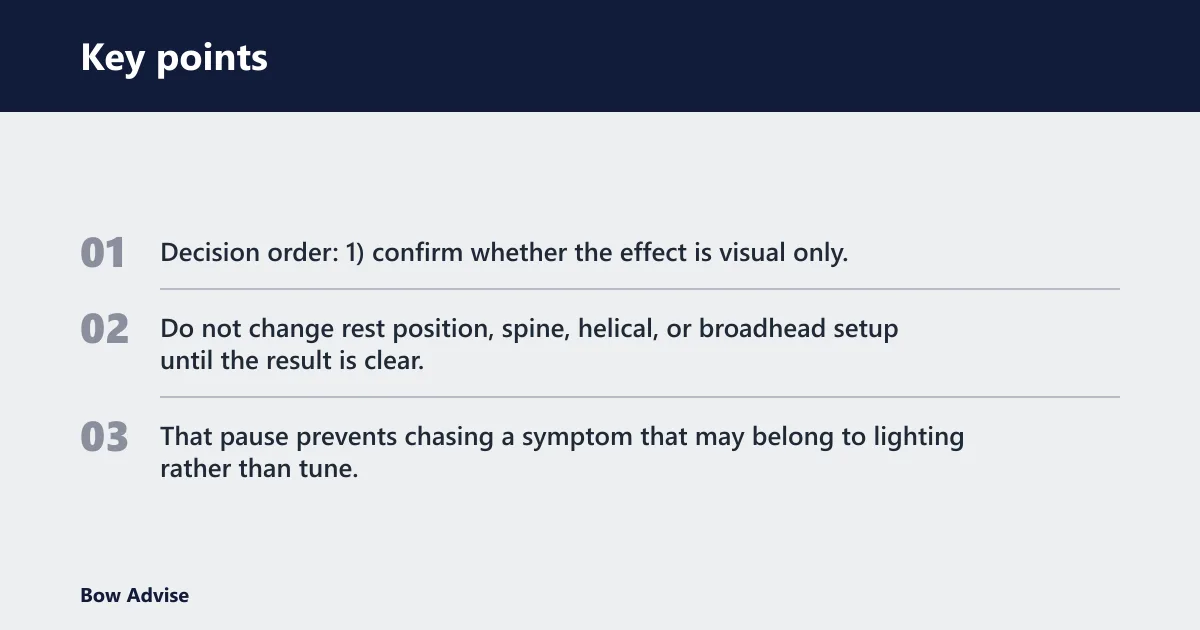
Decision order: 1) confirm whether the effect is visual only; 2) compare field points and broadheads; 3) check bare shafts; 4) inspect fletching and rest clearance; 5) use paper tuning at more than one distance; 6) only then consider more setup changes.
After each test, stop. Do not change rest position, spine, helical, or broadhead setup until the result is clear. That pause prevents chasing a symptom that may belong to lighting rather than tune.
Do broadheads make wobble easier to see?
Yes. Broadheads create more drag than field points, so they can magnify small errors in spine, rest alignment, or bow tune. That is why broadhead tuning is a common trigger for diagnosis. A broadhead may reveal a problem that a field point hides, even when the bow is close to tuned.
What field points can hide
Field points are less demanding in flight. They can keep a minor tune issue from showing clearly until distance grows or lighting changes. A shooter in one discussion reported broadheads hitting inline with field points or slightly right, which is a reminder that the comparison has to be read in context, not guessed from the sight picture alone.
As an example, a 300 spine arrow with a typical insert and broadhead setup may print with field points at short range but open up as distance grows. That does not automatically mean the arrow is bad. It suggests the broadhead is exposing a weak spot in tune, spine, or clearance.
What a broadhead group can reveal about alignment
When broadheads and field points separate, look at alignment before replacing parts. One reply recommended checking whether the insert is installed straight on a spin tester. That is a small detail, but a crooked insert can send a broadhead off line even when the shaft looks fine in the hand.
Bare shaft, spine, and paper tuning checks
Bare shafts help separate spine and tune problems from fletching effects. A bare shaft that lands far from the fletched group often points to spine mismatch, rest position, or launch inconsistency. That makes it useful in both compound and recurve troubleshooting, especially when broadheads and field points disagree.
What bare shafts reveal about direction and spine
Bare shafts strip away vane correction. If they land differently from fletched arrows, the bow or arrow build is telling you something that the vanes were hiding. Under-spined setups are a common cause worth checking when draw weight, arrow length, and point weight do not match well.
That is why bare shafts are so useful after a broadhead complaint. They can point toward spine mismatch before a shooter starts moving the rest a long way or changing broadheads again.
How to read paper tears at 6, 8, and 10 feet
Paper tuning gives a snapshot of arrow flight, but it should be checked at multiple distances. A common reference point is to check at about 6, 8, and 10 feet. A tear that looks “perfect” at one close distance can still miss the full story, and a small tear at very short range can be misleading if it gets treated as final proof.
A reply in one thread suggested checking whether the issue was a paper tune at 3 to 15 feet. That range can help, but the result should be read across more than one distance. If the tear changes shape or direction as distance changes, the bow may be showing a real tuning difference rather than a fixed flaw in the arrow.
Why a close tear should not trigger a big change
Close paper tears can exaggerate what is only a small launch mismatch. If paper looks slightly off at 6 feet but the field points, broadheads, and bare shafts all agree better than expected, hold the adjustment and gather another data point. Paper is useful, but it can be over-read.
Could rest contact or fletching setup be the cause?
Yes. Rest contact can make arrows veer or fishtail, and fletching errors can show up more clearly with broadheads. Clean clearance matters. So does even vane spacing. If the arrow is touching the rest or the vanes are not indexed well, the “corkscrew” may start before the shaft clears the bow.
Arrow rest clearance and contact signs
Look for shiny marks on vanes, witness marks on the rest, or inconsistent tear shapes that do not match the rest’s position. Drop-away rest behavior matters here because a rest that does not drop cleanly can create inconsistent contact. Minor rest movement may be needed, but only after confirming that the rest is the source.
Even 3-vane spacing and vane alignment
Unequal vane spacing was cited as a possible cause of corkscrew flight. If one vane is out of position, the arrow can rotate unevenly and the broadhead may react more than the field point. Check that 3-vane spacing is even and that each vane sits straight and consistent from shaft to shaft.
Can fletching spacing or helical cause corkscrewing? Yes, if the setup is inconsistent. Helical or offset changes rotation, and that is normal. The issue is not the helical itself. The issue is when the helical, vane placement, or vane height varies enough to create uneven steering and visible wobble.
What helical or offset changes
Helical or offset fletching helps the arrow rotate sooner, which can stabilize broadheads and fixed blades. But the benefit depends on consistency. If the arrow build is uneven, the added rotation can make the problem more obvious instead of less.
Frequently asked questions
Why do my arrows look like they corkscrew in flight?
That look can come from real yaw, normal shaft rotation, or a lighting artifact. Start with the group, not the impression. If field points and broadheads agree closely and bare shafts track with fletched arrows, the visual corkscrew is often not a true flight fault.
Can broadheads make arrow wobble more obvious than field points?
Yes. Broadheads can exaggerate small tune problems because they create more drag than field points. That extra drag often reveals alignment issues, spine mismatch, or rest problems that a field point may hide. If the broadhead group opens while field points stay tight, inspect tune before changing broadheads again.
Is arrow corkscrew in flight always a tuning problem?
No. It can be a tuning issue, but it can also be a visual effect caused by rotation, shade, sun angle, or vane color contrast. If the point impact is steady and the effect appears only in certain light, treat it as a possible illusion until the other checks point the same way.
How do I know if the arrow is actually wobbling or it’s an optical illusion?
Repeat the shot in even light and compare the result with broadheads, field points, and bare shafts. If the “wobble” appears only through shadows or at a contrasty background, it may be visual. If the group changes and bare shafts drift, treat it as a real flight problem.
How far should I paper tune an arrow to judge flight correctly?
Use more than one close distance. A common reference is 6, 8, and 10 feet. A perfect hole at one distance can still miss the full story. If the tear changes across those distances, keep reading the result before making a major adjustment.
Could rest contact cause arrows to veer or fishtail?
Yes. Rest contact can steer the shaft, disturb clearance, and create flight issues that look like corkscrewing or fishtailing. Check for vane marks, rest marks, and incomplete drop-away behavior if relevant. Make the rest check before changing spine or broadheads unless the rest is already known to be clean.