How to Choose a Youth Bow That Can Grow with the Archer
Choose a youth bow that matches the child’s current draw length and weight, with wide adjustment and a riser that can take longer limbs or higher draw weight later; upgrade once the archer is near the bow’s max setting or form starts breaking down. Pick badly and the bow becomes hard to draw, unsafe to use, or too small within a season. This guide explains fit, adjustability, limb options, and the point where buying the next bow makes more sense.
What draw length and draw weight should you start with?
Start with draw length first, then set draw weight low enough for clean repeat shots. A youth bow should usually begin in about the 7 to 14 pound range for beginners, with enough room to grow. If the draw length is wrong, the bow may feel awkward even before the weight is a problem.
Outdoor Life lists 7 pounds as the lightest draw weight in its youth-bow group and 15 inches as the shortest draw length. That gives a practical floor for very small archers. For many kids, the better question is not “what is the strongest bow?” but “what setting lets them shoot 20 to 30 careful arrows without form breaking down?”
Draw length comes first
Draw length should match the archer’s arm span and anchor position. Youth-compatible ranges are commonly reported at about 15 to 31 inches, and fit matters more than brand. A bow that is too long in draw length forces shoulder reach and poor anchor; a bow that is too short can feel cramped and unstable.
For a growing beginner, choose a bow that can be set correctly now and still has a few inches of room left. That gives time for growth without pushing the cams or limbs to their limit.
Draw weight comes second
Beginner draw weight should be low enough for repeated practice without form breakdown. Many youth picks start at 7 to 14 pounds, while some youth compounds adjust far higher later. The right starting weight is the one the archer can draw smoothly, hold briefly, and release without leaning back or collapsing the bow arm.
Higher draw weight can look impressive on paper. It does not help if the child can only shoot a handful of poor arrows before fatigue takes over.
What “grow with the archer” really means
Growth room means two separate things: the bow still fits today, and the bow has a clear path for the next 12 to 24 months. A bow may be adjustable, yet still be the wrong shape or weight class for a smaller child. Buying once only works when the bow’s adjustment range matches the child’s likely growth band.
What draw length range should I look for in a youth bow?
Look for a draw length range that covers the child now and leaves some room to move up later. For small kids, the low end matters most; for teens, the upper limit matters more. A youth bow with a broad range is useful only if the archer can still anchor correctly at both ends.
Bear Legend XR spans 18 to 31 inches, which is wide enough for many growing archers. Elite Terrain runs from 25.5 to 31.5 inches, which suits larger teens and smaller adults better than very young kids. A bow that starts too high in draw length is not a growth buy; it is a bad fit.
Use these size bands as a buying check
Small children usually need the lowest settings in the range. Older kids and teens need a longer usable top end. If the bow’s minimum draw length is already above the child’s current anchor, move on.
Suppose a child’s current draw length is around 18 inches and the bow begins at 20 inches. Even if the bow has room to grow later, it is the wrong bow today. The first purchase should solve current fit before it tries to solve next year’s size.
What makes a youth compound bow fit for growth?
A youth compound fits for growth when its adjustment range is wide enough, its holding weight stays manageable, and its physical size still feels stable in small hands. Speed numbers matter less than fit. A youth or entry compound often lists 260 to 320 fps, but that number should never outrank draw length, draw weight, and comfort.
Let-off and holding comfort
Let-off is the percent of peak weight removed at full draw. Common compound let-off runs around 65 to 85 percent, and higher let-off reduces holding strain. That matters for youth archers who need time to aim without shaking. The archer should be able to settle into anchor without fighting the bow.
Axle-to-axle length and stability
Axle-to-axle length affects how steady the bow feels and how easy it is to manage at full draw. Common youth and entry compound lengths are often around 27.75 to 32.5 inches. Smaller archers often handle shorter bows more comfortably, but very short bows can feel twitchy if the archer is still building consistent anchor control.
Brace height and forgiveness
Brace height influences forgiveness and ease of shooting. Common beginner compound brace heights are often around 6.25 to 7 inches. A slightly taller brace height usually gives a calmer feel and a bit more room for form errors, which helps new archers who are still learning release and anchor consistency.
Bow weight and carry comfort
Total bow weight changes how steady the bow feels in the hand. Light bows around 2.5 to 5.2 pounds are often easier for youth handling. Bear Legend XR weighs 5.2 pounds with sight and arrow rest, which is not light for every child, but may still be manageable for a stronger teen who needs a wide adjustment window.
Right-hand and left-hand versions
Hand orientation must be checked before purchase. Right-hand and left-hand versions are not interchangeable in most compounds. Some models are ambidextrous or offered in both orientations, but that should be confirmed in the listing before anything else. A good fit in the wrong hand is still the wrong bow.
Is a takedown recurve a better long-term buy?
A takedown recurve can be the smarter long-term buy when the child is small, still growing fast, or likely to change draw weight in steps. Interchangeable limbs let the archer move up later without replacing the whole bow. For some families, that is easier than chasing compound adjustment ranges.
When limb swaps make sense
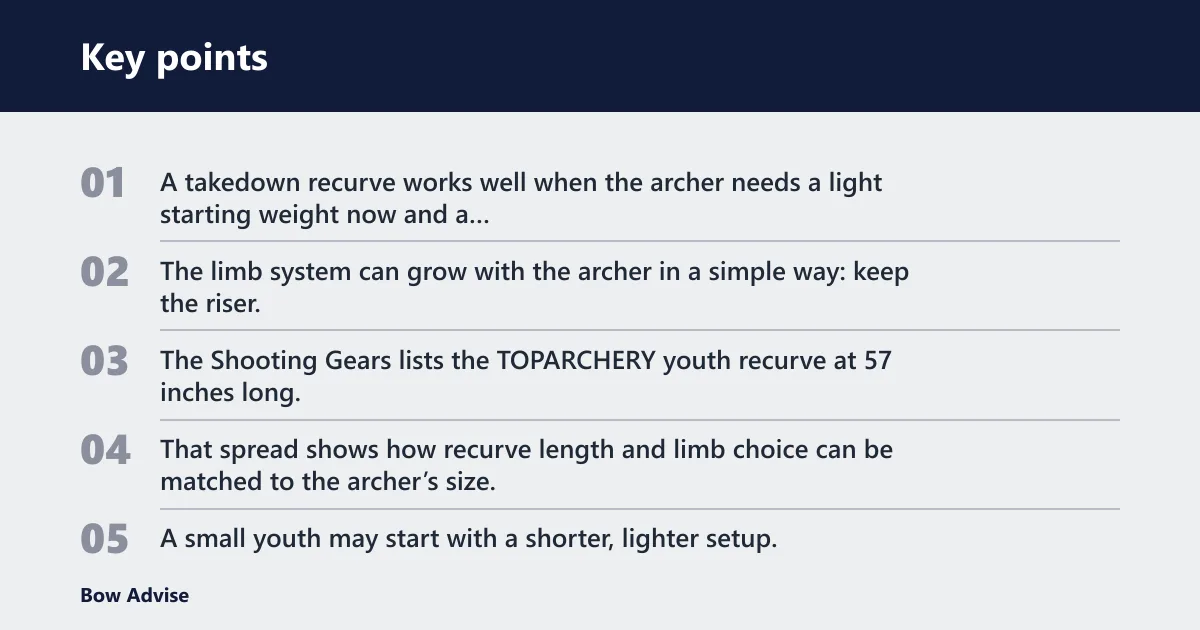
A takedown recurve works well when the archer needs a light starting weight now and a planned progression later. The limb system can grow with the archer in a simple way: keep the riser, change the limbs. The Shooting Gears lists the TOPARCHERY youth recurve at 57 inches long, the Sanlida Noble Recurve Kit from 48 inches to 70 inches, and the Southwest Archery Spyder in a 64-inch XL option.
That spread shows how recurve length and limb choice can be matched to the archer’s size. A small youth may start with a shorter, lighter setup. A bigger teen may need a longer bow for comfort and cleaner form.
When a compound is the better choice
A compound is the better choice when the child wants broader adjustment in one bow, more holding relief at full draw, or a ready-to-shoot package with sight and rest already included. PANDARUS lists about 19 to 28 inches of draw length and 15 to 29 pounds of draw weight, which may suit a beginner who needs a low starting point and a simple kit.
Bear Royale RTH Package at $359.99 and Bear Cruzer G4 RTH Bow Package at $459.99 are examples of complete package pricing in the market. Bear Legit MAXX RTH Bow Package is listed with 10 to 70 pounds, which is the kind of range that can carry a growing archer for longer, though not every child will benefit from that much top-end capacity.
Who should start with a recurve?
Start with a recurve when simplicity, lighter handling, and step-by-step limb changes matter more than accessory density. A young beginner who struggles with bow weight may do better with a takedown system than with a heavier compound frame. The trade-off is less let-off and usually less built-in adjustability than a compound.
Youth bow decision table
This table turns “adjustable” into a buying rule. Fit now comes first. Growth room comes second. Replace the bow when the child has outgrown both the current setting and the useful range of the model.
| Archer size band | Starting draw weight | Starting draw length | Acceptable growth range | Replace versus adjust |
|---|---|---|---|---|
| Small child, first bow | 7 to 10 lbs | 15 to 20 inches | About 2 to 4 inches of draw length and 3 to 6 lbs of weight | Adjust if the bow still anchors cleanly; replace if the minimum setting is still too long |
| Older child, steady beginner | 10 to 14 lbs | 20 to 24 inches | About 3 to 5 inches of draw length and 5 to 10 lbs of weight | Adjust until the archer nears the top end; replace if holding form breaks down at the max safe setting |
| Teen, growing fast | 14 to 20 lbs | 24 to 28 inches | About 3 to 6 inches of draw length and 10 to 20 lbs of weight | Adjust if the bow still feels stable; replace when the draw length ceiling is reached or the bow feels short |
| Teen or smaller adult | 18 to 25 lbs | 26 to 31 inches | About 2 to 4 inches of draw length and 15 to 30 lbs of weight | Replace if the bow cannot reach the needed length, hold steady, or accept the desired hunting or target setup |
Common failure signs and fixes
| Failure sign | What it usually means | Fix |
|---|---|---|
| Overbowed | Draw weight is too high for repeat form | Lower the weight setting or move to a lighter bow |
| Outgrown draw length | The archer is reaching or collapsing at anchor | Increase draw length if room remains; otherwise replace the bow |
| Unstable hold | The bow is too heavy, too short, or both | Check total bow weight and axle-to-axle length; choose a steadier platform |
| Poor anchor | String contact changes shot to shot | Reset draw length and check face reference points before increasing weight |
What should come in a youth bow package?
A useful youth package should cut setup friction and give the archer the parts needed for a basic first session. The best starter kits usually include a sight, arrow rest, quiver, arrows, arm guard, and a wrench or manual. That does not replace coaching, but it does reduce the number of separate purchases.
Minimum useful accessories
Look for a package that includes the bow, sight, arrow rest, quiver, arrows, arm guard, and wrench or manual. PANDARUS lists 12 arrows plus sight, rest, and quiver, which is a practical start for a beginner who needs to shoot quickly without piecing together every item.
Complete kits are helpful because the first setup is where many new archers lose time. If a package omits key parts, the final cost and setup effort can rise fast.
What still may need to be bought separately
Even a good kit may still need proper arrows matched to draw length, a target, and basic coaching help. Right-hand or left-hand fit should also be confirmed separately. A package is only useful if the bow matches the archer and the accessories match the bow’s settings.
Mistakes to avoid
The biggest mistakes are simple: choosing speed before fit, starting with too much draw weight, ignoring hand orientation, and buying a bow that cannot grow far enough. Safety and coaching matter at every step. A bow that is technically adjustable still fails if the child cannot hold it, anchor it, or shoot it cleanly.
- Do not chase speed first. A 260 fps or 320 fps claim means little if the archer cannot maintain form.
- Do not start heavy. Lower draw weight keeps practice volume up and form changes down.
- Do not skip hand orientation. Right-hand and left-hand versions must match the shooter.
- Do not buy past the growth band. If the bow starts near its max for the child, the upgrade is too late.
Say your child is 8 years old, needs about 18 inches of draw length, and can only manage 8 pounds for 10 clean shots. A bow that begins at 22 inches and 15 pounds is the wrong purchase, even if the package looks complete. The child will struggle long before the bow “grows.”
Suppose a 13-year-old begins at 24 inches and 12 pounds, then moves to 27 inches and 16 pounds over the next year. A bow with room to 28 or 29 inches and a higher weight ceiling can stay useful. Once the archer is at the top end and the anchor starts slipping, replacement becomes the better choice.
Our picks by need
Best adjustable starter package: PANDARUS youth compound

This is the clearest fit for a low-cost starter who needs broad adjustment in one package. The listed 19 to 28 inch draw length and 15 to 29 pound draw weight give a workable youth range, and the kit includes 12 arrows, a sight, rest, and quiver. The 260 fps claim should be treated as secondary to fit.
The main drawback is the limited top-end ceiling compared with larger compounds. It is a good first bow for a small-to-medium beginner, but teens with longer draw lengths may outgrow it sooner than a wider-range compound or a takedown recurve setup.
Frequently asked questions
What draw weight should a youth bow start at for a beginner?
A beginner should usually start in the 7 to 14 pound range, with the exact setting based on whether they can draw, anchor, and hold without leaning or shaking. The same source lists 7 pounds as the lightest youth-bow draw weight, which is a useful floor for the smallest archers.
How do I know if a youth compound bow will fit as my child grows?
Check the current draw length first, then compare the bow’s usable range with the child’s likely growth over the next 12 to 24 months. If the bow still fits at the low end now and has room before the top end, it has growth value. If it starts near the ceiling, plan to replace sooner.
Is a compound bow or recurve bow better for a growing beginner?
A compound is usually better if you want broad adjustability, lower holding strain, and a kit with accessories already included. A takedown recurve is better if you want a simpler setup and a clear limb progression path. The better choice depends on whether the child needs adjustment range or lighter handling first.
What features make a youth bow easier to tune and upgrade later?
Wide draw-length adjustment, a realistic draw-weight range, and a riser that accepts future changes are the main features. Higher let-off helps holding comfort, and a stable axle-to-axle length helps control. A complete package with sight and rest also lowers first-setup friction.
What accessories should come with a youth bow package?
A useful package should include a sight, arrow rest, quiver, arrows, arm guard, and a wrench or manual. Some kits also include a bow already set up for the first shooting session. If those parts are missing, expect extra buying and setup time before the bow is ready.
When should a young archer move from a starter bow to a stronger bow?
Move up when the archer is near the bow’s top draw-length setting, the draw weight is still too light for the next stage, or the shot breaks down under a longer hold. That is the point where trying to stretch the same bow further usually costs more than replacing it.
Which youth compound bows are adjustable enough for teens and smaller adults?
Look for bows with longer draw-length ceilings and higher draw-weight ceilings. Bear Legend XR reaches 31 inches and 70 pounds, and Elite Terrain reaches 31.5 inches with 45 to 60 or 55 to 70 pounds. Those numbers matter more for older teens and smaller adults than a short child’s first purchase.