How Often Did Native American Hunters Replace Arrow Points?
Native American hunters did not replace arrow points on a fixed schedule. They replaced or reshaped them when impact damage, dullness, cracks, or haft failure made the point unreliable. Ignoring that shortens range, lowers penetration, and can waste a hard-won shot. Here is how replacement and repair typically worked, what signs mattered, and what that means for traditional archers today.
Arrow points and materials
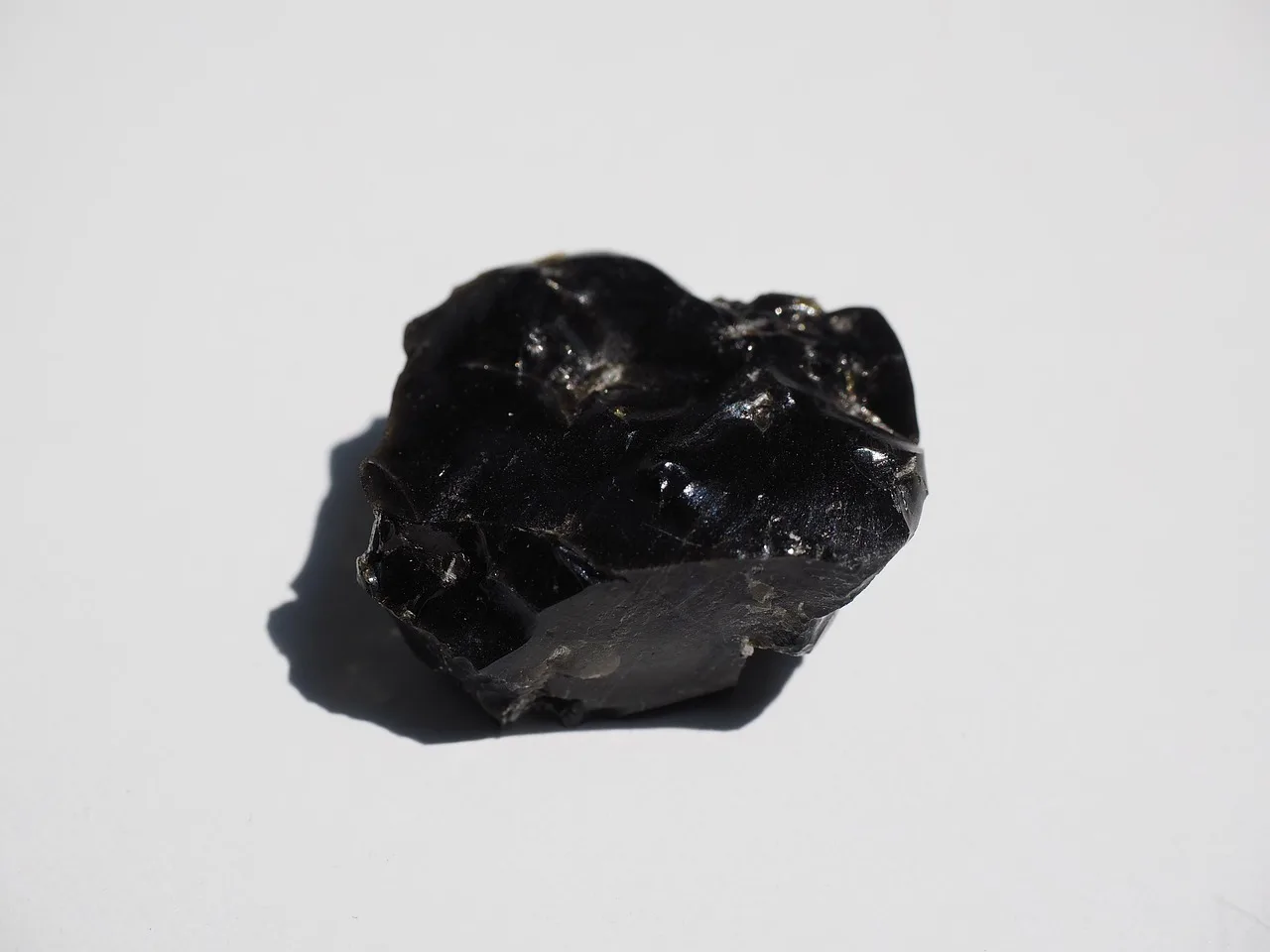
Arrow points were made from stone, bone, antler, shell, and later metal. Material changed wear, repair, and breakage. A stone point could often be sharpened again after edge loss. Bone, antler, shell, and metal tended to fail in different ways, especially at the tip, base, or cutting edge.
Why material affected life span
Stone points usually failed in a brittle way. They could keep cutting well until a chip, crack, or snap changed the shape enough to matter. Bone and antler often allowed some shaping, but they could splinter, split, or wear smooth at the edge. Shell could be sharp yet fragile, while metal resisted dulling better but bent or deformed instead of flaking.
For hunting, the point had to match the game and the shaft. Small-game points did not need the same mass or penetration pattern as broad hunting points for larger animals. When resources were scarce, a hunter might keep repairing a usable point longer. When material was abundant, replacement could happen sooner.
How hunters judged wear
Hunters did not usually ask whether a point was “old.” They checked whether it still cut, held fast, and flew straight. The main signs were edge sharpness, tip integrity, base cracks, loosened hafts, shaft straightness, and fletching condition. A dull edge alone did not necessarily mean failure. A crack through the base often did.
Edge dulling versus true damage
Dulling reduced cutting efficiency, but it did not always end use. A stone point with a blunted edge could sometimes be resharpened by pressure flaking. A bone or antler point with wear at the edge might still work if the point remained straight and the haft held. True damage meant the structure had changed enough to threaten impact performance.
What was inspected after each shot?
- Check the point edge for chips or a rounded cutting line.
- Inspect the tip for a break, crush, or bend.
- Look at the base for cracks near the haft.
- Test the lashings for looseness or slipping.
- Roll the shaft to see whether it still stayed straight.
- Glance at fletching for tears, missing feathers, or wet binding.
That order matters because point damage was only one part of arrow maintenance. A point could stay sharp while the shaft warped in wet weather, or the adhesive softened and let the point wobble. In that case, the arrow was no longer dependable even though the cutting edge still looked good.
Point damage decision table
| Common field damage | Likely action | Why that action made sense |
|---|---|---|
| Edge dulling | Resharpen | The point still has usable shape and can cut again. |
| Small tip chip | Repair if stone; reuse if still centered | A minor loss may not affect flight or penetration much. |
| Large tip break | Replace | The strike point is altered enough to reduce effectiveness. |
| Base fracture | Replace | The hafting zone is weakened and may fail on impact. |
| Loosened haft | Reset and rebind | The point may still be sound if the joint is restored quickly. |
| Split shaft | Retire arrow or cut down for practice use | The shaft can throw the point off line and may keep splitting. |
| Sinew failure | Rebind | The point may be fine, but the joint is no longer secure. |
| Resin softening | Re-seat and cool, or wait for better conditions | Heat or moisture can weaken the bond without breaking the point. |
| Complete snap through body | Replace | The point no longer has enough structure to trust on game. |
| Repeated flake loss on stone point | Retire when too small or thin | After enough flaking, the point can become weak or too short to haft safely. |
Could points be repaired in the field?
Yes, some repairs could be done in the field, but only when the damage was minor and the material allowed it. Stone points could sometimes be reworked by pressure flaking. A loose point could be reseated and rebound. A broken tip or a split base often ended that point’s service.
Pressure flaking and edge rejuvenation
Pressure flaking removed small flakes to restore a cutting edge on stone. That worked best when the point still had enough thickness and edge support. If the point had become too thin, a fresh flake could run too far and split the piece. In other words, resharpening had a limit.
Say your stone hunting point loses its edge after hitting dry hide and a rib edge on a medium deer. If the blade is still thick and the tip remains centered, a few controlled flakes can restore the edge. If the same point already has a basal crack, that is replacement territory, not touch-up work.
Reseating a loose point
A point could sometimes be reset if the shaft remained sound and the adhesive had only softened or the sinew had relaxed. Hunters could clean the joint, add resin-based glue, and bind it again with sinew. That was a practical fix when the point itself was still intact.
Picture a small-game arrow carried through damp brush. The point stays sharp, but the sinew loosens after repeated moisture and drying cycles. If the shaft is straight and the base is unbroken, the joint can be restored. If the shaft has split at the nock end, the point is not the main problem anymore.
Limits of field fixes
Field repair depended on time, weather, and materials. Resin-based adhesive softens with heat and can be affected by moisture before it fully sets. Sinew shrinks as it dries, which helps hold a joint, but wet sinew loses strength. A hunter traveling far from camp could do only the quickest fixes and save full repair for later.
Did hunting context change replacement rates?
Replacement rates often changed with game size, arrow use, travel distance, weather, and access to materials. Small game often meant lighter impact, so points might last longer. Large game could create heavier shock, deeper cracks, or a broken haft. Practice arrows usually wore down more slowly than hunting arrows, and ceremonial arrows were often preserved rather than used hard.
Small game versus large game
Small-game arrows often met softer targets and less violent impact, so the point might need simple edge upkeep more than full replacement. Large-game hunting raised the chance of tip damage, base cracks, or shaft stress. Even a successful shot could end with a point that looked intact but no longer deserved another hard strike.
Travel, weather, and supply
Long travel could change maintenance choices. A hunter carrying a limited supply of points might keep repairing a marginal point because replacement material was not nearby. Wet weather could weaken sinew and soften pitch. Cold could make some adhesives less forgiving. A long season in the field meant more chances for all of that to happen.
How did hafting affect point life?
Hafting often determined whether a point failed early. Points were commonly set with pine pitch or other resin-based glue and secured with sinew binding. That joint could be strong, but it was sensitive to heat, moisture, and poor surface fit. Many “point failures” started as haft failures, not blade failures.
Pine pitch, resin, and heat
Resin adhesives could hold well when properly prepared, but heat could soften them. That mattered during transport, long sun exposure, or repeated handling. If the bond loosened, the point could shift even if the blade itself remained sound. A shifted point changed flight and made the arrow less trustworthy.
Sinew lashing and moisture
Sinew lashing tightened as it dried, which helped lock the point in place. Moisture reversed that advantage. Wet sinew could swell, slacken, or lose grip until it dried again. Because of that, hunters often inspected bindings after rain, stream crossings, or heavy dew. The joint might need tightening before the next shot.
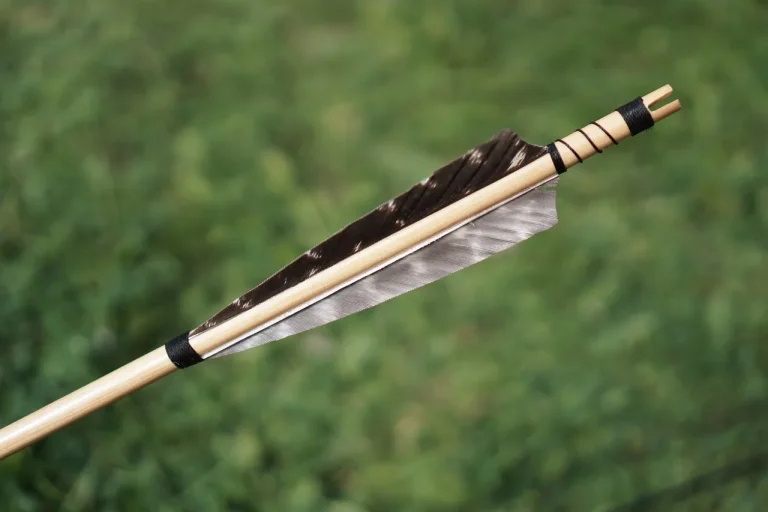
The shaft also mattered. A straight wooden shaft with healthy fletching could keep a point usable longer. A warped shaft, split wood, or damaged feathers could make a good point behave badly. In maintenance terms, the point was only one part of the arrow’s service life.
How did hunters carry extra arrow points on the trail?
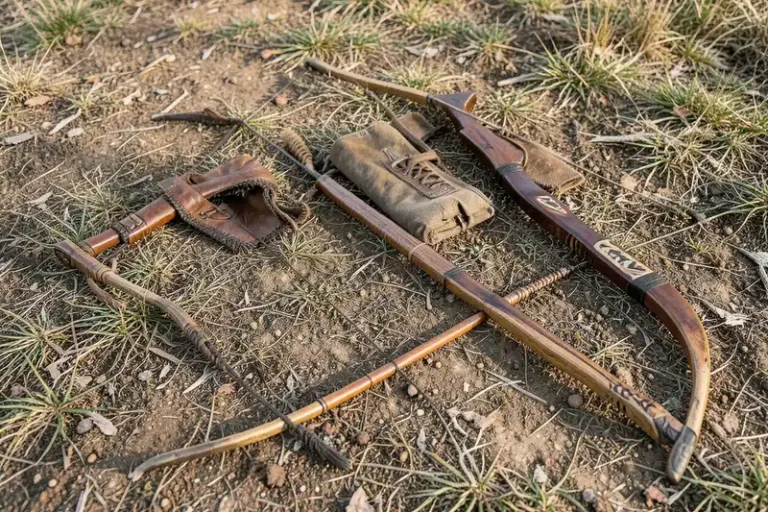
Hunters could carry spare points in a pouch, bundle, or wrapped kit with adhesive and binding material. That made sense because a point could chip, loosen, or snap away from camp. Spare points mattered most on longer trips, where local material was not guaranteed and a failed point could end the day’s hunting.
Extra points were usually carried with the tools needed to fix them: resin, sinew, and sometimes a scraper or stone flaking piece. That let a hunter replace one point, repair another, or re-haft a fresh point onto a sound shaft. Carrying spares was practical, not excessive.
What changed after repeated shots
Repeated shots increased wear in small steps. One arrow might only dull. Another might chip. After enough use, the point, shaft, or binding could fail together. That is why maintenance was not a single event. It was a series of quick decisions made after each shot, each impact, and each stretch of travel.
Did different tribes replace points at different rates?
Yes, but the better answer is that replacement rates varied by tribe, region, season, game, and available materials. No single timetable fits all Indigenous hunting practices. A group with abundant stone or shell could repair and replace differently from one working with scarcer raw material, different prey, or different seasonal travel patterns.
Why broad averages mislead
Different hunting cultures used different shafts, point styles, binding methods, and field routines. Some groups might favor reworking stone points many times. Others might use bone, antler, shell, or metal in settings where replacement was more practical than reshaping. The right question is not “how often” in the abstract, but “under what conditions did a point stop being worth keeping?”
Frequently asked questions
How often did Native American hunters replace arrow points?
There was no fixed schedule. Hunters replaced points when dull edges, cracks, tip loss, loosened hafts, or shaft damage made the arrow unreliable. Hunting arrows usually wore out faster than practice arrows because they took real impact. Exact timing varied with material, game, weather, and how often the arrow was used.
Did Native American hunters reuse broken arrow points?
Sometimes, yes. A stone point with a small chip or edge loss could be reworked and used again if enough material remained. A point with a fractured base, a deep crack, or a snapped body was far less likely to be reused. Bone, antler, shell, and metal followed their own limits.
What made an arrow point too damaged to keep using?
A point was usually retired when the damage was likely to affect flight or penetration. A cracked base, major tip loss, repeated flake loss on stone, or a loose haft could make the arrow unsafe or inaccurate. If the point could not stay secure or no longer had a usable striking edge, replacement made more sense than repair.
Were stone points replaced more often than bone or antler points?
Not in a single universal way, but stone points were often repaired by resharpening until they became too small or too weak. Bone and antler did not flake like stone, yet they could split, splinter, or wear differently. Replacement depended more on damage pattern and use than on material alone.
Could Native American arrow points be repaired in the field?
Yes, minor problems could often be handled in the field. A stone edge could be touched up, a loose point could be reset, and a binding could be replaced if the shaft was still sound. Severe cracks, snapped tips, split bases, or badly warped shafts usually called for replacement rather than repair.