How to Reduce Bow Noise and Vibration for a Smoother Shot
To reduce bow noise and vibration, fix string and cable wear first, then tune brace height, nocking point, and centering shot before adding dampers. Change one variable at a time. Skipping that order usually leaves the real source untouched, so the bow still feels harsh and the added accessories only hide the problem. This guide walks through a step-by-step check for noise, vibration, and balance so you can find the cause and quiet the shot.
Noise, hand shock, and vibration


These are related, but they are not the same fault. Noise is what you hear. Vibration is what moves through the riser. Hand shock is the bump your grip feels at release. A bow can be loud with little hand shock, or it can feel harsh while sounding fairly normal.
Common causes to check before changing parts
Start with the things that make sound before the shot leaves the bow. Loose accessories, a string or cable that needs replacement, a rest that touches the arrow, and a poor brace height can all create a sharp report or a buzz that no stabilizer will fully hide.
On a compound bow, cam system behavior matters too. Single-cam and dual-cam setups can react differently to timing, limb load, and balance. A bow with high let-off can also feel less stable in the hand, which makes balance changes more noticeable.
What a clean shot should feel like
A clean shot usually gives a short, controlled impulse, then settles quickly. The bow should not slap, rattle, or ring after the arrow leaves. If the riser keeps buzzing or the sight picture jumps hard after release, the cause is usually still in the setup.
Bow stabilizer basics
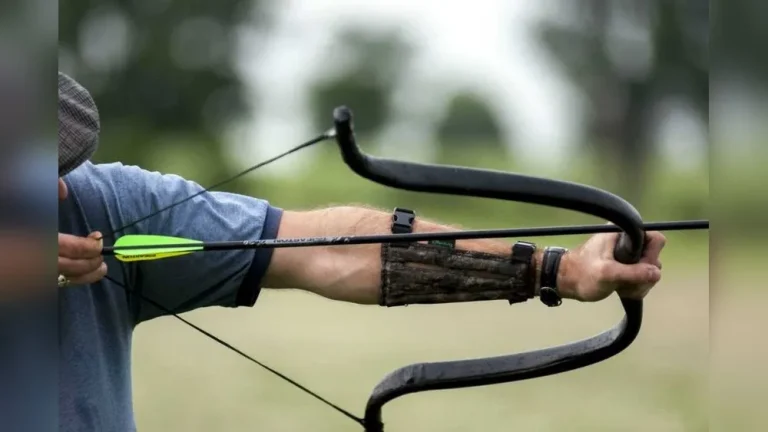
A bow stabilizer is a weighted rod attached to the end of your bow. Its job is to add inertia, reduce hand shock, and steady the bow at full draw and through the shot. That is why stabilizers can help both vibration control and balance control, but those are separate jobs.
Front placement versus rear placement
Front stabilizers sit out in front of the riser and shift mass forward. That can calm the sight pin and reduce the jump you feel at release. A rear bar, often called a back bar, moves weight behind or below the grip to counter front weight and help level the bubble.
Front and rear bars do different work. A bow can feel steadier with a front rod alone, yet still tip forward in the hand. Adding rear weight may solve that, or it may make the setup awkward for hunting. The right answer depends on how the bow is carried and shot.
Shock dampening materials and carbon construction
Modern stabilizers may use rubber parts, internal dampeners, and carbon construction to cut residual vibration and noise after the release. That can help with the lingering buzz, but it will not fix arrow rest contact, bad brace height, or loose hardware. Those must be corrected first.
How do stabilizer length and weight change shot feel?
Length and weight change the feel of the shot more than the marketing copy suggests. A short bar is easier to carry and maneuver. A longer bar spreads weight farther from the grip, which can improve steadiness, but it can also make a setup feel slower, heavier, or awkward in tight cover.
Choosing a hunting length versus a target length
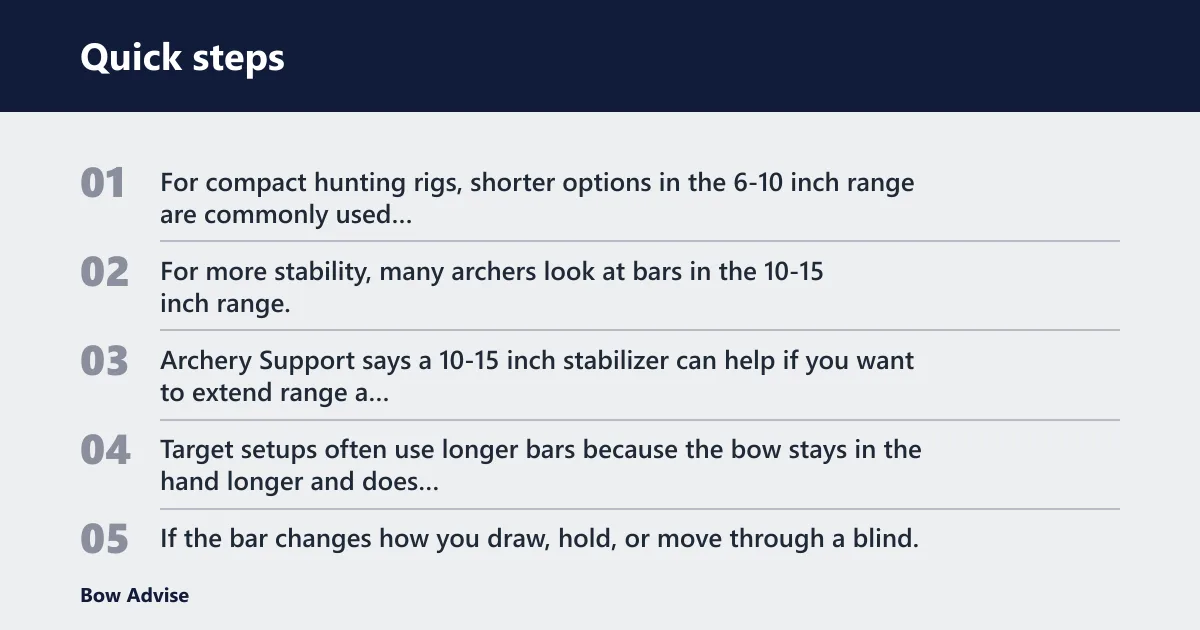
For compact hunting rigs, shorter options in the 6-10 inch range are commonly used because they are easier to pack and less likely to catch brush. For more stability, many archers look at bars in the 10-15 inch range. Archery Support says a 10-15 inch stabilizer can help if you want to extend range a little, but that does not mean longer is better for every bow or every shot.
Target setups often use longer bars because the bow stays in the hand longer and does not need to move through brush. Hunting bows often need the opposite. If the bar changes how you draw, hold, or move through a blind, it may help the bow but hurt the shot process.
When adjustable weights help
Stabilizer weight should match bow style and shooter preference. Removable or adjustable weights let you tune steadiness without committing to one setup. More weight can improve steadiness, but only if you can still hold the bow cleanly and keep proper posture through the shot.
Say your 12-inch front bar feels calm on the range but becomes tiring after a few holds in a treestand. That is a clue to reduce weight before changing length. If the bow still jumps hard after the shot, the issue may be tuning or contact, not mass.
When a setup feels steadier but worse to carry
A heavier front end can make the bubble calmer and the pin float slower, yet it may also make the bow feel nose-heavy in the woods. That tradeoff matters. If a setup only feels good when the bow is at full draw on a calm line of fire, it may not be the best hunting choice.
Do you need a back bar stabilizer too?
A back bar stabilizer helps when front weight pulls the bow forward or rolls the sight picture to one side. It counterbalances the front bar and can make the bubble easier to level. That said, a rear bar is useful only when the front setup actually needs counterweight.
What counterbalancing does
Counterbalancing shifts the center of mass so the bow sits more neutrally in the hand. That can reduce the feeling that the bow wants to tip forward after the shot. On hunting compounds, a rear bar is often paired with a front stabilizer when the front weight is high enough to affect hold.
When extra rear weight is not worth it
If the bow already balances well and the sight settles cleanly, a rear bar may add bulk without solving the real issue. It can also complicate carry and movement. For a lightweight hunting setup, the simplest answer is often a modest front bar and correct tuning, not more hardware.
Tuning checks that can quiet the bow
Before changing stabilizers, check the bow itself. Brace height, tiller, nocking point, cam timing, and rest contact can create the exact symptoms that people blame on vibration dampeners. A bow square is the right tool for several of these checks because it gives a consistent reference point.
Brace height and why it matters
Brace height is part of basic bow tuning checks. On many recurve bows it can be adjusted within the manufacturer’s range, while on many compound bows it is a fixed design spec rather than a user-adjustable setting. If the bow is not within the maker’s specification, the shot can feel harsher or louder.
Using a bow square for brace height, tiller, and nocking point
A common order is to check brace height first, then confirm tiller and nocking point. On a recurve, those measurements can change the way the limbs load and recover. On a compound, the same checks help confirm that the arrow is leaving cleanly instead of bouncing off the rest or loading the cams unevenly. A bow square can help mark brace height and nocking point positions, while peep height is usually set by draw alignment rather than a direct bow-square measurement.
Cam timing, rest position, and loose hardware
Cam timing issues, a rest that sits out of line, or a loose sight, quiver, limb dampener, or bolt can create buzz and rattle. Arrow rest noise should be treated as its own symptom. A stick-on rest or a super rest can be the source of the sound if the arrow or launcher arm makes contact at the wrong point in the shot cycle.
A common first-timer mistake is to add a heavier stabilizer to a bow that already has rest contact. The bow may feel different, but the click or slap is still there because the actual contact point never changed.
Bow noise and vibration troubleshooting matrix
Use this matrix to rank the symptom before changing parts. Start with the row that matches the loudest or most repeatable issue, then test one change at a time. After each adjustment, score the result for shot feel, noise, and vibration on a 0 to 3 scale, with 0 meaning none, 1 mild, 2 moderate, and 3 strong. Compare the total before and after each change.
| Symptom | Likely cause | Fastest test | Fix |
|---|---|---|---|
| Loud string slap | String wear, brace height off, or brace too low for the bow | Inspect serving and string condition; confirm brace height with a bow square | Replace worn string parts, then reset brace height to the maker’s spec |
| Hand shock | Grip torque, poor balance, or too little mass out front | Relax the bow hand and shoot a blank bale with the same grip pressure | Correct grip first; then adjust front stabilizer length or weight |
| Buzzy riser | Loose accessory, limb pocket noise, or residual vibration | Check each accessory by hand and listen after a shot | Tighten or isolate the loose part; add damping only after the source is found |
| Pin float | Front of bow too light, poor balance, or rear of bow underweighted | Hold at full draw and note whether the sight wants to dip forward | Add front weight first; if needed, counter with a back bar |
| Rest noise | Arrow contact with a stick-on rest or super rest | Watch the rest for marks and listen for a click at release | Center the rest, check nocking point, or replace worn parts |
| Sharp pop from the front end | Cable guard contact, timing issue, or accessory resonance | Shoot with the quiver removed, then listen again | Check timing and all mount points before adding weight |
| Side-to-side twist | Grip torque or poor balance line | Pay attention to the sight bubble as the shot breaks | Reduce grip pressure and rebalance with front or rear weight |
| Harsh aftershock | Weak damping, loose hardware, or excess string wear | Tap the riser lightly and listen for ringing | Replace worn parts and consider a stabilizer with dampening materials |
| Arrow launch feels abrupt | Nocking point or tiller off, or rest clearance issue | Check both with a bow square and inspect arrow flight | Reset tiller and nocking point; then retest bare shafts if needed |
| Bow feels calmer but harder to carry | Front bar too long or too heavy for the task | Walk with the bow at ready position and note fatigue | Reduce stabilizer length or weight; keep the setup practical for the hunt |
| Shot feels uneven on a recurve | Brace height, tiller, or grip pressure not matched to the limbs | Check setup values and repeat with a relaxed bow hand | Reset the tuning marks and refine the grip before changing accessories |
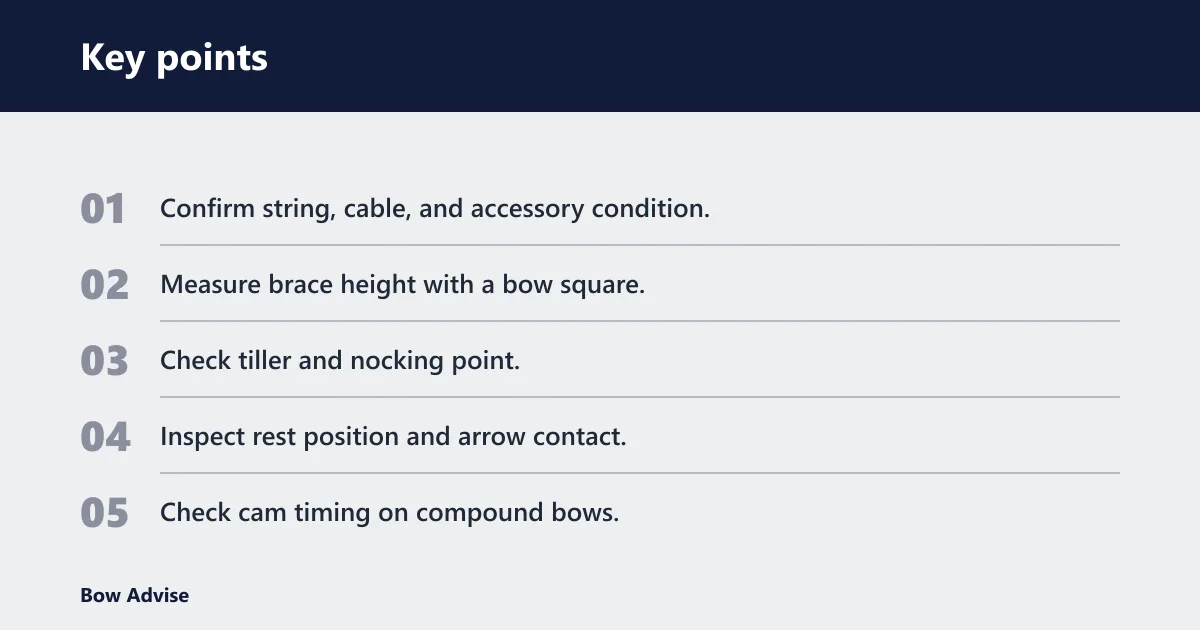
- Confirm string, cable, and accessory condition.
- Measure brace height with a bow square.
- Check tiller and nocking point.
- Inspect rest position and arrow contact.
- Check cam timing on compound bows.
- Test the bare bow before adding weight.
- Add or change stabilizer weight only after the bow tunes cleanly.
Can a recurve bow be tuned to vibrate less?
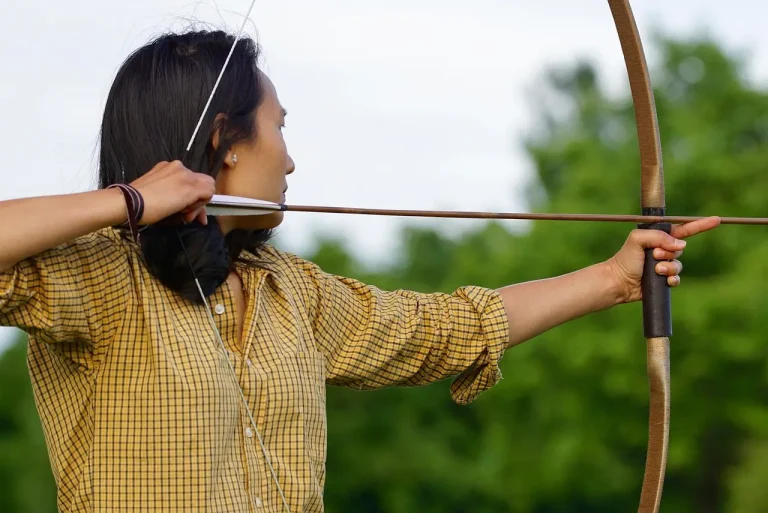
Yes. A recurve bow can usually be made calmer by fixing brace height, tiller, and nocking point first, then matching stabilizer setup and arrow choice to the limbs. Recurve vibration often comes from tune and grip interaction, not from one missing accessory. If the tune is off, a stabilizer only hides the reaction.
Recurve-specific vibration sources
Recurve bows can be more sensitive to brace height and tiller than many shooters expect. Hoyt’s Super Rest Recurve is a basic plastic arrow rest for beginning archers, and it is available for left- and right-handed bows. A simple rest can be fine, but it must still match the bow and arrow path.
Stabilizer and limb-tuning considerations
For recurve or compact setups, shorter bars in the 6-10 inch range are common. They are easier to manage and less likely to get in the way. That does not mean heavier is always better. The bow should still come to full draw cleanly, settle without excess effort, and recover without a harsh kick.
Grip pressure and arrow setup
Grip pressure can make a recurve feel far louder than the hardware suggests. A tense bow hand sends torque into the riser and can create more apparent vibration. Arrow setup matters too. If spine and nocking point are wrong, the bow can feel lively in the wrong way, even with damping hardware installed.
How do I reduce bow noise and vibration on my compound bow?
On a compound bow, start with the source of the sound, not the stabilizer. Check string and cable condition, verify cam timing, inspect the rest, and confirm brace height before adding mass. Single-cam and dual-cam bows can need different tuning attention, especially if the bow has high let-off and a light hold weight.
That sequence matters because compound bows can hide the problem until release. A front rod can help settle the sight and reduce hand shock at the grip, but it will not cure a rest slap or a timing issue. If the bow still snaps or buzzes after those checks, then stabilizer weight and length become the next variable.
Hoyt Bow Square is used to check brace height, tiller, nocking point, and peep height, so it belongs in the first round of checks, not after the accessory swap. Hoyt Arrow Rest Hunter is a solid stick-on arrow rest, and its position should be checked before any stabilizer change.
Frequently asked questions
Will a bow stabilizer make my bow quieter?
A stabilizer can reduce the noise you hear after the shot if the sound comes from residual vibration, but it will not fix every source of noise. String wear, brace height, cam timing, and rest contact can still create sharp sound. Fix those first, then judge whether the stabilizer made a real difference.
What size stabilizer reduces vibration best for hunting?
For hunting, many archers stay in the 6-10 inch range because it is easier to carry and less likely to snag. A 10-15 inch stabilizer can feel steadier, but the best choice depends on your bow, your hold, and how much length you can carry in the field without interference.
How much weight should I put on my stabilizer?
There is no universal number that fits every bow. Start with a light base setup and add weight in small steps, such as 1 to 2 ounces at a time, until the bow holds cleanly and carries well. If you are unsure where to begin, a modest front weight that feels stable without making the bow nose-heavy is a practical starting point. More weight improves steadiness only when the setup still suits the bow style and the shooter.
What accessories help make a bow smoother to shoot?
Start with the pieces that control vibration at the source: string and cable condition, a correctly set bow square measurement, a quiet rest, and then a stabilizer with appropriate length and weight. Rubber parts, internal dampeners, and carbon construction can help with residual vibration, but only after the bow is tuned.
Why is my bow vibrating so much after the shot?
That usually means one of two things: the bow is out of tune, or something is touching when it should not. Brace height, tiller, nocking point, rest contact, and loose accessories are the first places to look. If those check out, then add damping and balance in small steps.