Best Arrow Length Gauge for Beginner Archers: Buy Guide
For beginner archers, the best arrow length gauge is the one that gives a repeatable draw-length reading close to the same mark each time and fits your setup habits. Price matters less than getting the same result twice. I have seen too many new archers buy arrows that were too short, too long, or wrong for the spine because they trusted a sloppy measurement. I’ll cover the best gauge types, what accuracy to look for, and which one I’d buy first.
This guide is part of our Bow measurements guide series.
Best arrow length gauge for beginner archers
The trade-off is plain: cheap tools are easy to own, but the best choice is the one you can use the same way every time. For a beginner, that usually means a draw-length indicator arrow or a pro-shop check, depending on how steady your anchor point is and whether you need arrows right away.
What a beginner actually needs from a measuring tool
You do not need a fancy system for a first setup. You need a reading you can trust enough to pick archery arrows that fit your bow setup and shooting form. If your draw length changes because your stance changes, any gauge can lead you astray.
According to Draw Length Indicator Arrow – Easton Archery — Easton sells the Draw Length Indicator Arrow for $9.99.
Draw-length indicator arrow vs tape measure vs pro shop setup
A draw-length indicator arrow gives the best mix of simple use and buying confidence for most beginners. A measuring tape is cheaper and useful for rough checks, but it can be easier to misuse. A pro-shop setup costs more, yet it is the safest choice when your form is still changing or your first bow needs full setup help.
| Method | Cost | Ease | Likely accuracy for beginners | Best use case |
|---|---|---|---|---|
| Draw length indicator arrow | $9.99 | Easy | Good enough for first-arrow decisions if your form is steady | Home setup, first-bow buyers, quick draw-length checks |
| Measuring tape | Very low | Moderate | Fair for a rough estimate, weaker for final buying decisions | Quick reference, second check, budget-conscious beginners |
| Pro-shop setup | Higher | Very easy for the archer | Best when the tech sets the bow and checks form details | New bow owners, youth archers, changing anchor or release style |
Draw-length indicator arrow: cost, ease, likely accuracy, best use case
Easton sells the Draw Length Indicator Arrow for $9.99, and Easton places it under Tools. Easton describes it as a simple, easy-to-use tool that helps determine ideal draw length, with quick adjustments and compatibility with most bow setups. That makes it a strong first buy when you want a fast answer before ordering arrows.
Measuring tape: cost, ease, likely accuracy, best use case
A tape measure is the cheapest option, and it works well for rough checks when you want a quick comparison. It can point you in the right direction, but it does not account for the details that matter most, like anchor point, grip pressure, or whether you repeat the same draw every time.
Pro-shop setup: cost, ease, likely accuracy, best use case
A pro-shop setup is the best option when you want someone to watch your stance and confirm your bow setup before you buy arrows. For beginners, that matters because a measurement only helps if it matches real shooting form. I have seen archers chase the wrong arrow length for weeks because they measured before their anchor was stable.
Which method fits recurve and compound shooters best
Recurve archers often benefit from a simple tool first, then a shop check if their anchor point is still changing. Compound shooters often benefit from a pro-shop setup sooner, especially if their draw board, release style, or let-off setup is still being sorted out. The same gauge can work on both, but the best use case is not the same.
Why correct draw length matters
Draw length has to match your shooting form, or the arrow length decision can be wrong. It affects accuracy, comfort, and how steady the bow feels at anchor. If your draw is off, you may choose arrows that do not fit your setup, and that creates problems before you ever shoot a round.
How draw length affects accuracy
When draw length is right, the string path, anchor, and eye alignment tend to repeat more cleanly. When it is off, your aim point can wander because your body is not landing in the same place shot after shot. That is why the number matters before you buy archery arrows.
How draw length affects comfort
If the draw is too long, you may overreach and tense your shoulders. If it is too short, you may feel cramped and collapse into the shot.
What happens when draw length is off
The wrong draw length can lead you to buy the wrong arrow length, then the wrong spine, then the wrong point weight. One mistake feeds the next. On a beginner setup, that gets expensive fast, and it can make a bow feel bad when the real issue is fit.
Why shooting form changes the number you should trust
Anchor point, stance, and release style all change what the gauge should tell you. The bow did not change my eye dominance. My setup did. Beginners need to respect that.
How do you use a draw-length indicator arrow?
Use a draw-length indicator arrow by setting it on the bow, drawing to your normal anchor, and reading the marked length after you repeat the shot the same way a few times. The tool is simple, but the result only helps if your stance, anchor point, and release are already steady enough to trust.
Basic setup on a recurve bow
On a recurve bow, I want the archer to stand square, grip the bow lightly, draw to anchor, and stop at the same facial reference every time. Then I check the reading more than once. Recurve form can vary more than new archers expect, so I care about repeatability before I write down a number.
Basic setup on a compound bow
On a compound bow, the reading depends on the exact draw cycle, release aid, and anchor. A compound archer may feel “at full draw” long before the number is truly settled. That is why I like to confirm the draw with a consistent anchor and, when possible, a shop check after the first pass.
Quick assessment and necessary adjustments
The point is not to find a perfect number on the first pull. The point is to get close, then make necessary adjustments before buying arrows. If the reading changes when the archer changes stance or anchor, I treat that as a sign to slow down and fix the setup before ordering anything.
Common setup mistakes that throw off the reading
Common errors include standing differently on each draw, pulling to a floating anchor, changing release tension, and measuring before the bow is set to the right side and eye dominance. Those mistakes do not mean the tool is bad. They mean the measurement is reflecting bad setup, which is exactly what a beginner needs to catch early.
Beginner decision matrix for recurve and compound archers
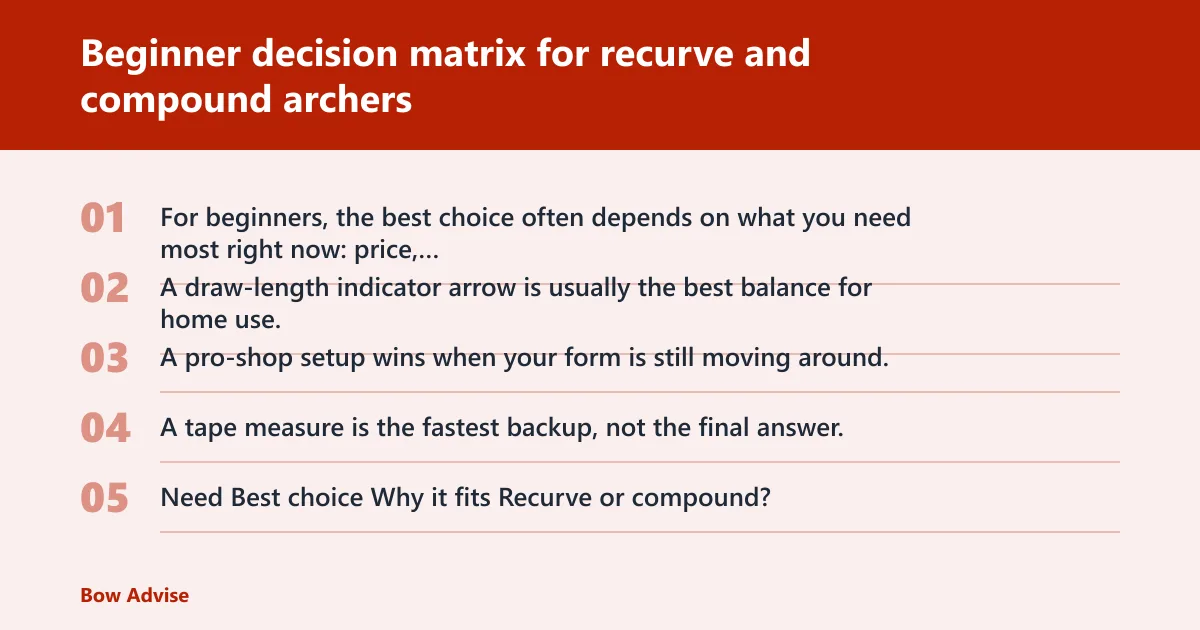
For beginners, the best choice often depends on what you need most right now: price, simplicity, or confidence before buying arrows. A draw-length indicator arrow is usually the best balance for home use. A pro-shop setup wins when your form is still moving around. A tape measure is the fastest backup, not the final answer.
| Need | Best choice | Why it fits | Recurve or compound? |
|---|---|---|---|
| Cheapest option | Measuring tape | Low cost and easy to keep in a gear bag | Both, as a rough check |
| Easiest option | Pro-shop setup | Someone else verifies the setup and watches form | Best for both, especially compounds |
| Closest setup before buying arrows | Draw length indicator arrow | Simple, repeatable, and good for quick adjustments | Both, if the anchor is steady |
| Youth archers and first-bow buyers | Pro-shop setup first, then indicator arrow later | Growing bodies and changing form need a second check | Both |
Best choice if you want the cheapest option
If you only need a rough check, a tape measure works. I would not use it alone to place a full arrow order unless the rest of the setup is already confirmed. For a beginner on a tight budget, it is better than guessing, but it is not my first pick for buying arrows.
Best choice if you want the easiest option
If you want the least hassle, a pro shop is the easiest path. The tech can look at your stance, watch your anchor, and tell you whether the number makes sense. That matters when you are not yet sure if your draw is changing from shot to shot.
Best choice if you want the closest setup before buying arrows
If you are ordering arrows soon, the draw length indicator arrow is the best middle ground. Easton says the Draw Length Indicator Arrow helps determine ideal draw length, and it is sold as a single tool for $9.99. That makes it a practical first purchase when you need a quick, repeatable read.
Best choice for youth archers and first-bow buyers
Youth archers and first-bow buyers should lean toward a pro-shop setup first, then confirm at home with a simple tool. Growing shooters can change size, strength, and posture relatively quickly. A number taken once can go stale quickly, and that is how a beginner ends up with arrows that stop fitting after a few months.
Do I need an arrow-length gauge or a draw-length indicator arrow?
For most beginners, a draw-length indicator arrow is enough if your goal is to buy the right arrows and you can repeat your anchor. Use a pro-shop setup when your form is still changing, and use a tape measure only as a rough check. The right choice depends on how close to final your setup really is.
When a draw-length indicator arrow is enough
It is enough when your stance is steady, your anchor point is consistent, and you are ready to buy arrows soon. That is the sweet spot for a first-bow owner who wants a simple measuring tool without paying for a full setup every time.
When a pro-shop setup is the better call
Choose the shop when your release style is new, your draw feels different on each shot, or you are unsure whether your bow hand and eye dominance match. I have seen more than one beginner chase the wrong length because they trusted a number before the rest of the form settled.
When a tape measure can work in a pinch
A tape measure can work if you need a quick check before a class, a range session, or a second opinion. I would treat it like a field note, not a final buying decision. It is useful when you already have a rough idea and want to confirm that the setup is in the right zone.
What to buy before ordering archery arrows
Buy the simplest tool you can measure with consistently. For many beginners, that is a draw-length indicator arrow. Then verify the number against your actual anchor and stance before you order arrows, because arrow length selection depends on the draw-length related fit, not just a single reading.
Choose draw-length indicator arrow if… / choose pro shop setup if…
Choose the draw-length indicator arrow if you are setting up a first bow at home and want a quick, repeatable reading before buying arrows. Choose the pro shop setup if your anchor point or release style still changes, or if you want someone to verify the bow setup before you spend money on the wrong shaft length.
Choose draw-length indicator arrow if you are setting up a first bow at home
This is the better call when you already shoot with reasonable consistency and want a simple tool that helps determine ideal draw length. Easton says it is compatible with most bow setups and suitable for both beginners and experienced archers, so it fits a home check well.
Choose pro shop setup if your anchor point or release style still changes
If your form is moving around, a shop setup is safer. A tech can spot why the number is drifting and help you make quick adjustments to optimize shooting form. That is especially useful for a compound shooter or a youth archer whose posture is still changing.
Choose tape measure if you need a quick check, not a final buy decision
A tape measure is fine when you want a rough reference and nothing more. I would not trust it alone for a final arrow order unless I had already confirmed the bow setup another way. It is a backup tool, not the tool I would bet my arrow budget on.
Frequently asked questions
How do I use a draw-length indicator arrow on my bow?
Set it on the bow, draw to your normal anchor, and repeat the draw the same way several times. Then check whether the reading stays close. If it changes a lot, your stance, anchor point, or release style is still moving and needs attention before you buy arrows.
Will this tool work with a recurve bow and a compound bow?
Yes, Easton says the Draw Length Indicator Arrow is compatible with most bow setups, which includes common recurve and compound use. The tool works on both, but the way you interpret the reading is different. Compounds often need tighter setup control, while recurves depend heavily on anchor consistency.
How accurate are simple draw-length tools for new archers?
They are accurate enough to get you close, but not magic. For new archers, the limit is usually not the tool. It is the shooter. If stance, anchor point, or release style changes, the reading changes too. That is why I trust repeatability more than a single number.
What should I buy if I want to set draw length before buying arrows?
I would buy a draw-length indicator arrow first if I am setting up a bow at home and want a quick check before ordering arrows. If my form is still changing, I would spend the money on a pro-shop setup instead. The right arrow length depends on the setup being settled.